Coping with Catastrophe is a practical handbook for people who provide psychosocial aftercare for victims of disasters. This completely revised and updated second edition includes the latest findings on the nature and effects of trauma, the psychological debriefing process and the effects of emergency work, and the latest treatment models for post-traumatic stress and abnormal grief.
Eminently practical and easy to read, Coping with Catastrophe provides readers with information and skills to respond effectively and confidently to the needs of disaster survivors. It will be of immense value to a wide variety of helping professionals and carers, including social workers, psychologists, doctors, voluntary counsellors, and all those whose work brings them into contact with disaster victims.
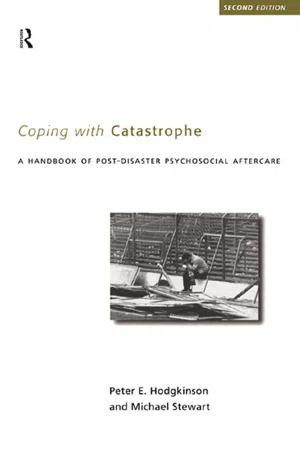
eBook - ePub
Coping With Catastrophe
A Handbook of Post-disaster Psychosocial Aftercare
- 271 pages
- English
- ePUB (mobile friendly)
- Available on iOS & Android
eBook - ePub
Coping With Catastrophe
A Handbook of Post-disaster Psychosocial Aftercare
About this book
Information
1
SURVIVAL AND BEREAVEMENT
Disasters strike with sudden violence, tearing bodies, lives and families apart. Yet, sitting at home in the UK, witnessing natural cataclysms such as earthquakes through the eye of the television camera, there may be little sense of reality – such things simply do not happen to us. A tragedy nearer to home, such as an air crash, happens so rarely that potential disaster can still be dismissed as a threat with little substance.
Catastrophes such as the crash of the Pan Am jet onto the Scottish town of Lockerbie in 1988 concentrate the minds of those who think, ‘It won’t happen to us, it always happens to someone else’. Who could have been less vulnerable to being literally wiped off the face of the earth than someone lying in bed, or watching television in the comfort of their sitting room? Technological disasters, experienced with increasing frequency, seem to have a particular ferocity of suddenness and violence, and kindle powerful emotions of anger and blame. After one catastrophe a newspaper cartoon depicted a tombstone inscribed with the legend, ‘This will never happen again’, reminding us that technological disasters will always occur, because we are human and we make mistakes.
Disaster survivors are ordinary people – the only thing that distinguishes them from the reader of this book is that they happened to be in the wrong place at the wrong time. Their very ordinariness presents helpers with new challenges in terms of the organisation of services, and with an old problem, perhaps the central problem of existence – loss.
Psychological reactions to disaster, complex as they are, can be understood essentially as the reactions of normal human beings to sudden, unexpected and terrifying events in their lives. In disasters, people lose loved ones, relatives and property. Above all, in psychological terms, they lose faith – not religious faith, but faith in the fact that life has a certain consistency and meaning. The fabric of everyday existence is torn away to reveal danger and risk. For the survivor, the encounter inevitably involves a corruption of innocence. Once something of this nature has happened to a person, it is very difficult for them to believe that life can ever be the same again; that they can let their children walk across the street; or that they can safely go to bed at night. It is also difficult for them to avoid thinking not only that something else terrible may happen, but that in some way they have been singled out, or even that ‘if such a terrible thing can have happened to me then I must have done something to deserve it’.
What is survival? Survival is not just the difference between living and dying – survival is to do with quality of life. Survival involves progressing from the event and its aftermath, and transforming the experience. The difficulty of ‘moving on’ is described best by the words of survivors themselves. One young woman who survived the 1987 Zeebrugge disaster wrote the following some ten months after the tragedy:
I have had what can only be described as a weird year. Firstly, I became engaged, then John and I were survivors of the ‘Herald’. Soon afterwards, John’s job took him away and I was left to recover from my injuries and to come to terms with what I had been convinced was my death as I happened to be under water and would still be there if John had not come back for me. I tried to get back to work, but it was impossible, and I failed. Soon after the wedding John was away again, but I was so busy I had no time to even take breath – at Christmas we never seemed to be in. Now it’s all over there are no plans to be made, only time to reflect. I am not complaining – we have been so very lucky and are very happy. But now it’s beginning to hit home. I seem to be spending more time thinking about what happened and crying about it a lot more than I have done. I am not unhappy or depressed, just still trying to sort out what happened and why we have been so lucky.
A bereaved relative who was not on board that night described her reactions during the first year:
I just feel that nobody can help me. I have been suffering from panic attacks and I hardly go shopping any more – I am frightened to drive and cannot even get in the bath without anybody in the house. I and my brother had a terrible fear of boats when we were very young, and I was thinking of him and his wife all day. The newsflash that night will live with me for the rest of my life. I feel so guilty for being like I am – hurt, miserable, angry and bitter, for they are the ones who suffered that night. They were so loving, so caring – everything a brother and sister-in-law should be – I couldn’t have wished for better. They were my life, always there when I needed them, and now I feel so lost.
In this first chapter we will recount the many aspects of the emotions, thoughts and behaviours of those who survive disaster and are bereaved. Knowledge of this provides the map of the territory that the survivor and helper will have to explore.
SURVIVAL
Trauma is not an invention of the twentieth century. Homer’s Iliad contains much that is instructive about combat stress (283). Samuel Pepys’ diary gives descriptions of post-traumatic stress in survivors of the 1666 Fire of London (59). The First World War saw the phenomenon of ‘shell shock’. The concept of post-traumatic stress appears, disappears and reappears in various guises over the centuries.
Detailed exploration of the experience of survival developed following the terrible episodes of the Second World War such as the dropping of the atom bomb and the Holocaust. An American psychiatrist, Robert Jay Lifton, arrived in Hiroshima in 1962. His observations on survival, even though they are descriptive rather than explanatory, hold good today (188). Five central experiences borne by survivors are described.
The death imprint
The ‘death imprint’ consists of indelible imagery of the encounter with death, intruding whilst awake, or during sleep in the form of nightmares. It comprises a condensation of the experience – images of the impact such as the sight of bodies dismembered or crushed, the sounds of screaming, or the smell of burning flesh. No details are spared the survivor who may appear to have a ‘spellbound fascination’ with the events.
The way in which everyday experiences can trigger these images or flashbacks is described in those who experienced Nazi concentration camps.
Associations . . . can occur in any connection whatsoever, from seeing a person stretching his arms and associating this with fellow prisoners hung up by their arms under torture, to seeing an avenue of trees and visualising long rows of gallows with swinging corpses. Children playing peacefully may suddenly, without any apparent cause, call to mind other children, emaciated, tortured, murdered (78).
A survivor of the 1988 Piper Alpha Oil Platform explosion (247) wrote the following vivid account of how a television programme was the trigger for a flashback experience:
I was idly watching television. Suddenly, with a vivid jolt, I was back on Piper, experiencing the intensity of those first moments after the initial explosion. The television programme I was watching dealt with the Korean War and a cameraman had captured the moments immediately after the explosion of a terrorist bomb. Debris was still falling from the surrounding buildings. People were rushing around, preoccupied and intense. Many were injured. Blood streamed down their shocked, bemused faces . . . .
There was no terror. People moved around me on the 64-foot level, actively if anxiously. An injured man was being carried down the metal stairs. I rushed to the compressor and tried to find a way of switching it off. Davey Elliot came to help me, blood still oozing down his face.
Yet around me, sitting there at home, were the noises of everyday life – Suzie playing happily with her toys on the carpet, cars speeding past the window, cups rattling in the kitchen, the cat purring on my lap.
Survivor guilt
Survivor guilt, where the person questions why they survived when others did not, can be of two sorts. Firstly, there is what might be called ‘existential guilt’. Here the person dwells in a very general way on their survival – ‘Why me?’, or ‘Why did God choose me?’; or perhaps, ‘Why me when I am old and so many children died?’ Secondly, guilt may be focused on actions or their absence – ‘Did I do enough, could I have saved more people?’ Guilt may be especially intense when parents survive their children, or where there is competition for survival.
One survivor of the Zeebrugge disaster was a lorry driver who was on the ferry’s vehicle deck when the ship capsized. His lorry ended up in the middle of a stack of articulated vehicles balanced on their sides. Frozen with fear, he heard his vehicle groaning under the weight of two lorries above, and knew that he would die. He then remembered that his trailer was a refrigerated container and hence was strengthened – he had a little time before he was crushed. He smashed his suitcase through the window, climbed over the bonnet of his truck and into the water, which now flooded half of the hold. He swam towards the exit, but as he did, he heard the screams of trapped lorry drivers – ‘God help us, Christ help us, God help us’. He swam on, climbed out onto the side of the ship, and was one of the first to smash portholes, let down hawsers into the ship and begin the rescue. Several hours later he was removed to a tug, frozen with cold, his hands lacerated. He could have humanly done no more than he did, yet he did not remember these actions – only the unanswered screams of the trapped men in the hold from which he escaped. ‘They were drivers, like me, and I did nothing to help them’. Three years later he committed suicide. Crew members of the Herald of Free Enterprise who swapped shifts with colleagues, putting them in their place on the night in question, felt an intense sense of guilt, even though shift swaps were a normal part of their work routine.
Guilt presupposes the presence of choice and the power to exercise it, which in reality during the impact may not have been possible. The experience of guilt may be an unconscious attempt to deny or undo this sense of helplessness (60). Guilt may also be based on a revised view of oneself. Thus many parents believe that if the choice was between their child’s life or their own, then they would sacrifice themselves. In the impact of disaster, however, parents may forget that they have children. One mother fled the burning spectators’ stand at Bradford without thinking that her son had been with her. She never disclosed this in counselling, choosing rather to make a public breast of it on national television three years later.
‘Animating guilt’ and ‘static guilt’ represent two different entities (188). Animating guilt is a spur to self-examination which can allow guilt to move ‘towards the anxiety of responsibility’. Static guilt keeps the victim bound to the experience, unable to move on. The task of the helper may be to assist the survivor to progress from static to animating guilt ‘and then from guilt to responsibility and some behaviour which alleviates the guilt’.
In survivors of the Nazi concentration camps, it has been suggested (69) that the chronicity of survivor guilt may have a symbolic function, ‘a kind of testimonial. By continuing to suffer himself, the survivor seems to be trying to provide an enduring memorial to his slaughtered friends and relatives.’ It is therefore a mechanism of expressing loyalty. Recovering from the effects of persecution would mean betraying the dead and perhaps forgiving the persecutors. There may also be an aspect of atonement – survivors may have to face the recognition that they come from the same population, the human race, as those who have committed atrocities against them.
This last point is important for those who approach the experience of survival from the standpoint of psychodynamic thinking, taking into account unconscious and repressed feelings. Individuals have aggressive, even destructive and murderous, feelings, which are repressed rather than acknowledged. Following disaster, the guilt experienced may be partly connected to a deep awareness of these feelings, and in particular to a sense that one’s own past aggressive feelings, either to loved ones or to others, were in some way implicated in their destruction.
In considering the allied concept of self-blame, two distinct types can be identified (151). ‘Behavioural self-blame’ involves blaming one’s own behaviour, and is adaptive, whereas ‘characterological self-blame’ involves reflections about one’s personality characteristics and is maladaptive, associated with depression.
Thus, the rape victim who believes she should not have hitchhiked or should not have walked alone is engaging in behavioural self-blame, whereas the rape victim who believes she is a bad person or a poor judge of character is engaging in characterological self-blame.
Behaviours are potentially modifiable, ‘personality characteristics’ may not be. If a behaviour is changeable, then the catastrophe may be avoided in the future, and hence behavioural self-blame raises the possibility of hope. A study of combat veterans (173) demonstrated a type of characterological self-blame, ‘I should have known better’ guilt, reflecting the cognitive distortion of hindsight bias (‘I should have known better’ leading to the false premise of ‘I could have known better’). Again, this should be amenable to cognitive therapy.
In survivors of terrorist attacks, survivor guilt was present in 7 per cent of those with post-traumatic stress disorder and in just over 1 per cent of those without (193). Of the survivors of a building collapse, 44 per cent experienced guilt; 15 per cent gave no reason, 33 per cent ‘wanted to have done more to relieve pain and suffering or death’ including several individuals pinned under rubble who had tried to console those who were near them and more frightened or hurt more seriously: ‘They had been upset when fellow victims, some of whom they never saw, fell silent; they assumed they were dead’. Fifteen per cent felt guilty because they had not stayed to help and 27 cent experienced guilt because they felt fortunate in being alive (340).
In a group of survivors of the 1987 Zeebrugge disaster (157), assessed at thirty months post disaster, survivor guilt was present in 60 per cent. Guilt about things not done was twice as common as guilt about things done, and it was more common to experience guilt or shame about letting others down than letting oneself down. Feelings of guilt were associated with greater general psychological distress. Guilt about things one failed to do was associated with mental intrusion rather than avoidance, whereas guilt about things one did was related to avoidance but not intrusion. The two types of guilt may reflect different attributional patterns, or may be directly related to the type of symptom. For example, guilt about things done may be more distressing, and therefore avoidance is used in an attempt to filter it out. There is evidence (29) that people who blame themselves ...
Table of contents
- Cover Page
- Title Page
- Copyright Page
- Illustrations
- Preface to the First Edition
- Preface to the Second Edition
- Acknowledgements
- 1 Survival and Bereavement
- 2 Technological Disaster
- 3 Organising for Disaster
- 4 Crisis Intervention, Debriefing and Outreach
- 5 Treating Post-Traumatic Stress and Abnormal Grief
- 6 Disaster Workers
- References
Trusted by 375,005 students
Access to over 1.5 million titles for a fair monthly price.
Study more efficiently using our study tools.
Frequently asked questions
Yes, you can cancel anytime from the Subscription tab in your account settings on the Perlego website. Your subscription will stay active until the end of your current billing period. Learn how to cancel your subscription
No, books cannot be downloaded as external files, such as PDFs, for use outside of Perlego. However, you can download books within the Perlego app for offline reading on mobile or tablet. Learn how to download books offline
Perlego offers two plans: Essential and Complete
- Essential is ideal for learners and professionals who enjoy exploring a wide range of subjects. Access the Essential Library with 800,000+ trusted titles and best-sellers across business, personal growth, and the humanities. Includes unlimited reading time and Standard Read Aloud voice.
- Complete: Perfect for advanced learners and researchers needing full, unrestricted access. Unlock 1.5M+ books across hundreds of subjects, including academic and specialized titles. The Complete Plan also includes advanced features like Premium Read Aloud and Research Assistant.
We are an online textbook subscription service, where you can get access to an entire online library for less than the price of a single book per month. With over 1.5 million books across 990+ topics, we’ve got you covered! Learn about our mission
Look out for the read-aloud symbol on your next book to see if you can listen to it. The read-aloud tool reads text aloud for you, highlighting the text as it is being read. You can pause it, speed it up and slow it down. Learn more about Read Aloud
Yes! You can use the Perlego app on both iOS and Android devices to read anytime, anywhere — even offline. Perfect for commutes or when you’re on the go.
Please note we cannot support devices running on iOS 13 and Android 7 or earlier. Learn more about using the app
Please note we cannot support devices running on iOS 13 and Android 7 or earlier. Learn more about using the app
Yes, you can access Coping With Catastrophe by Peter E. Hodgkinson,Michael Stewart in PDF and/or ePUB format, as well as other popular books in Psychology & History & Theory in Psychology. We have over 1.5 million books available in our catalogue for you to explore.