- Seeks to balance the Greek and Anatolian cultural influences at work in Ionia in this important period of its history (700BC to the Battle of Lade in 494BC)
- Organised thematically, covering landscape, economy, cities, colonisation, warfare, cult, and art
- Accesses German and Turkish scholarship, presenting a useful point of entry to the published literature for academics and students
- English
- ePUB (mobile friendly)
- Available on iOS & Android
eBook - ePub
About this book
Incorporating over a century of archaeological research, Greaves offers a reassessment of Archaic Ionia that attempts to understand the region within its larger Mediterranean context and provides a thematic overview of its cities and people.
Information
1
Finding Ionia
Introduction
Ionia in the Archaic period was at the core of the Greek world that centered on the Aegean Sea and it played a pivotal role in the events documented in the most important surviving historical work of that period: Herodotos’ Histories. Consequently, in modern times Ionia attracted the attention of antiquarians and archaeologists from an early date and at the key sites of Ephesos and Miletos there have now been near-continuous archaeological excavations for over a century.
Considering this long history of exploration and research, when one begins to study the Archaic period of Ionia by conducting a critical review of the available archaeological source materials, the results are surprisingly, and remarkably, disappointing. Despite the size and crucial importance of this region in the ancient world, and despite its long history of research, the published archaeological information available is of mixed quantity and value and must often be handled with care. A similar review of the available literary and epigraphic evidence reveals that there is little hard evidence to be found here either.
Today there are important ongoing excavations using modern field methods of excavation and analysis at several sites in Ionia, yet the fact remains that the majority of our archaeological knowledge as yet still comes from those excavations that were conducted in an earlier era, often without systematic methods of recording. But as archaeological methods and the kind of questions we are seeking to ask of the material have developed, so the results of these old excavations are less able to answer them. For example, early archaeologists rarely logged and identified the animal bones from their excavations because they were interested in artworks, such as sculpture, and did not yet recognize that faunal evidence could tell us so much about past diets, environments, and human practices. Yet the systematic analysis of animal bones from a recently excavated sanctuary in Ionia, the Sanctuary of Aphrodite on Zeytintepe, Miletos, has been very illuminating and has told us a great deal about sacrificial practices at this site, for which there are no written records.1
It has long been recognized that the very act of excavation destroys that which we dig and therefore, once a site has been dug by archaeologists, it has been destroyed.2 The need to create, and make public, systematic records of what is found during excavations is therefore paramount. However, a recent development in the theoretical understanding of the nature of archaeological evidence has been the recognition that the very act of excavating and recording is, in itself, based on interpretative decisions by the excavator.3 That is to say that we, the archaeologists, create what we find by the choices we make about where and how to dig. Most archaeological evidence is therefore subjective, not objective, in nature.4
With this in mind, if we are ever to be able to make use of the large body of material from previous excavations, it is necessary to appreciate the motivations, interests, and methods of those previous generations of archaeologists who worked in Ionia in order to begin to compensate for biases that may be inherent in the archaeological record as a result. By understanding their objectives, we can begin to understand their methods and put them into a proper context for the age in which they operated. These objectives affected which sites they chose to excavate, the methods they chose to use, which artifacts they chose to keep (or publish) and which they chose to discard (or leave unpublished).
If the objectives of previous generations of archaeologists affected how the archaeological materials from Ionia were found, then they have also affected how they were interpreted. The aim of Classical archaeology has often been to establish, wherever possible, connections between the material remains of the Greek and Roman cultures and their literary and historical legacy. However, in our eagerness to make such connections, we can sometimes make associations between the archaeological evidence and passages of ancient history which might subsequently be interpreted differently, or indeed challenged.5
The Source Materials
There are three main categories of source material traditionally used by Classical archaeologists in their attempt to reconstruct ancient societies and their histories, namely archaeology, ancient literary sources, and epigraphy. The remainder of this chapter will review the quantity and nature of these sources as they exist from Ionia before discussing how these might be used and combined to deepen our understanding of society in ancient Ionia in subsequent chapters.
Archaeology
As a region, Ionia has exceptional potential for archaeological research. It is home to a number of exceptionally well-preserved archaeological sites, the most notable being New Priene6 and Ephesos. At both of these sites, there are ruins so perfectly preserved that visitors can imagine what it must have been like to inhabit the ancient city and walk down those same streets. The ruins of these places, and those of others in the region, are so exceptionally preserved because of certain physical characteristics within the landscape of Ionia itself.
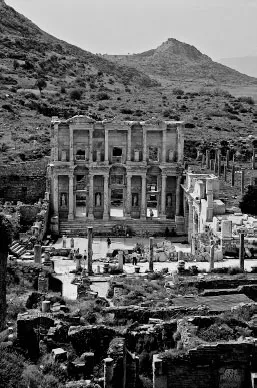
Figure 1.1 General view of Ephesos.
The most famous archaeological sites in the world are often those that have captured a “snapshot in time,” usually as the result of some natural disaster. Pompeii, Herculaneum, and Akrotiri on Santorini were preserved because they were buried by volcanic ash in a sudden catastrophic event. In Ionia, Ephesos is one such site. Here, the central part of the excavated area seen by tourists, the Library of Celsus and the Street of the Curetes, was buried by a landslide that covered the ruins in a great depth of soil and resulted in remarkable preservation (Figure 1.1). The ancient city was located between two hills – Panayır Dağı, to the north, and Bülbül Dağı, to the south – from which the landslide apparently originated. Landslides are often triggered by seismic events like earth tremors, which are common across Ionia.7 The hilly terrain and seismic nature of Ionia therefore combined to contribute to creating the superb preservation conditions seen at Ephesos. A catastrophic flood appears to have destroyed the eighth-century BC Temple of Artemis at Ephesos, and important finds, including a number of amber beads, were protected by the resulting layer of soft sand that covered its ruins.8
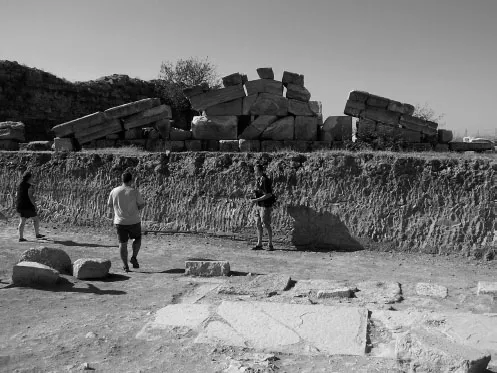
Figure 1.2 Alluvium at Magnesia.
Close to Priene are another set of exceptional ruins – at Magnesia on the Maeander. Although Magnesia was not named as one of the Ionian dodekapolis in the Archaic period, its ruins are worth noting here because it is in a similar geographical zone to other sites in Ionia. Unlike New Priene and Ephesos, Magnesia does not sit immediately under a large hill. Instead, the site is in the low-lying valley bottom and consequently it has been covered in silt from the Büyük Menderes river system. The ruins of Magnesia are in such an excellent state of preservation because they became rapidly covered by a great depth of alluvium (Figure 1.2). Remarkable features of Magnesia that have been preserved in this way include the inscribed slabs of the agora (market place), the Temple of Artemis, and the famous Skylla capital. The alluviation of the Büyük Menderes may also have been responsible for covering over the ruins of Old Priene, so much so that despite exhausti...
Table of contents
- Cover
- Table of Contents
- Title
- Copyright
- Illustrations
- Tables
- Preface
- Acknowledgements
- Prologue
- 1: Finding Ionia
- 2: Constructing Classical Archaeologies of Ionia
- 3: A Dynamic Landscape
- 4: The Wealth of Ionia
- 5: The Cities of Ionia
- 6: The Ionians Overseas
- 7: The Ionians at War
- 8: Cults of Ionia
- 9: The Ornaments of Ionia
- 10: Who were the Ionians?
- Epilogue
- Glossary of ancient Greek [and modern Turkish] terms used in the text
- Bibliography
- Index
- End User License Agreement
Trusted by 375,005 students
Access to over 1.5 million titles for a fair monthly price.
Study more efficiently using our study tools.
Frequently asked questions
Yes, you can cancel anytime from the Subscription tab in your account settings on the Perlego website. Your subscription will stay active until the end of your current billing period. Learn how to cancel your subscription
No, books cannot be downloaded as external files, such as PDFs, for use outside of Perlego. However, you can download books within the Perlego app for offline reading on mobile or tablet. Learn how to download books offline
Perlego offers two plans: Essential and Complete
- Essential is ideal for learners and professionals who enjoy exploring a wide range of subjects. Access the Essential Library with 800,000+ trusted titles and best-sellers across business, personal growth, and the humanities. Includes unlimited reading time and Standard Read Aloud voice.
- Complete: Perfect for advanced learners and researchers needing full, unrestricted access. Unlock 1.5M+ books across hundreds of subjects, including academic and specialized titles. The Complete Plan also includes advanced features like Premium Read Aloud and Research Assistant.
We are an online textbook subscription service, where you can get access to an entire online library for less than the price of a single book per month. With over 1.5 million books across 990+ topics, we’ve got you covered! Learn about our mission
Look out for the read-aloud symbol on your next book to see if you can listen to it. The read-aloud tool reads text aloud for you, highlighting the text as it is being read. You can pause it, speed it up and slow it down. Learn more about Read Aloud
Yes! You can use the Perlego app on both iOS and Android devices to read anytime, anywhere — even offline. Perfect for commutes or when you’re on the go.
Please note we cannot support devices running on iOS 13 and Android 7 or earlier. Learn more about using the app
Please note we cannot support devices running on iOS 13 and Android 7 or earlier. Learn more about using the app
Yes, you can access The Land of Ionia by Alan M. Greaves in PDF and/or ePUB format, as well as other popular books in Literature & Ancient & Classical Literary Criticism. We have over 1.5 million books available in our catalogue for you to explore.