Part I
Go On In – It’s Only the Kitchen
In this part . . .
There’s no doubt about it, if you want to learn to cook, you have to go into the kitchen. But never fear! The kitchen may seem like it’s full of strange appliances, oddly shaped tools, and bottles and jars and packages of ingredients you know nothing about, but as a beginner cook, this is where the fun begins! We help you navigate, use, and even enjoy your kitchen with organisational strategies and supply lists.
Chapter 1
Cooking with Confidence
In This Chapter
Taking a good look at your kitchen Familiarising yourself with some basic cooking techniques Making your kitchen safe and user-friendly So you want to find out how to cook? Good for you! Cooking is fun, relaxing, exciting, and even therapeutic. It enables you to eat for less money than ordering take-aways or dining in a restaurant every night, and it allows you to know exactly what you’re eating and to make conscious, healthy food choices. Cooking lets you easily adapt your meals to suit your own nutritional and gastronomic preferences, whether you’re eating low-carb or vegetarian, or you’re determined to immerse yourself in classic French cuisine. Plus, cooking the food you eat puts you in closer touch to the process of nourishing your own body, and that can make you feel better about yourself, your health, your body, and your life. Yes, cooking can be that powerful!
In this chapter, we give you a broad overview of what you need to know to be an effective cook. We talk about how to set up your cooking space, introduce you to the major kitchen appliances, and give you a glimpse of some basic cooking techniques. Then we discuss menu planning and kitchen safety.
Warming Up to Your Kitchen
There it is: the kitchen. Maybe you don’t go in there very much, or maybe you like to hang around watching other people cook. Or maybe you cook dinner in there every night, but you don’t enjoy it very much. Never fear. Your kitchen can easily become a place you love to cook in and be in. It’s all a matter of organisation.
Setting up your cooking space
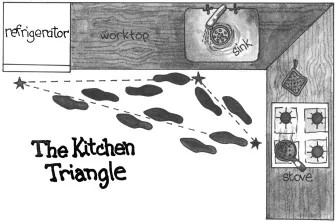
You don’t need a fabulous kitchen to prepare fabulous food. But a well-designed workplace sure makes cooking much easier and more pleasurable. Ideally, you should be able to move from your worktop space to the hob and the refrigerator in a smooth, unobstructed fashion. This working space actually has a name: the kitchen triangle (see Figure 1-1). If a table, plant, or small child is blocking the way, move it! Even if you can’t design your kitchen space, you can arrange what you need in a way that works for you. Here’s how to do that.
Figure 1-1: An efficient kitchen triangle.
Decluttering your worktop
The most important key for organising your worktop space is to keep it clear of most stuff. Unless you use an appliance at least several times a week – the kettle, toaster, and blender, for example – put it away. That’s precious work space you’re filling up with all that stuff! Also remember that a kitchen worktop is not a magazine rack, plant holder, wine rack, or phone book shelf, so try not to use it for these purposes if you actually want to cook!
In addition to keeping your worktop clutter free, take steps to care for them. Use chopping boards for cutting and trivets for hot pots and pans, and wipe up spills quickly to prevent stains.
Let there be lighting
Kitchens should be well lit – the cooking area and workspaces most of all. Nothing is worse than trying to check your food in a dimly lit area. Lights under the cookerhood can really help. You haven’t replaced that burned-out bulb in a year? Time to do it!
Another option is to have special lighting for the cooking area, either inset into overhead cabinets or in the ceiling – alternatively, the least expensive solution is a wall-mounted supplementary light.
Staple city: Organising your cupboards
Unless you like to be different from the rest, the likelihood is you keep your basic cooking staples, as well as other dry goods, in your kitchen cupboards. Dry goods are foods that aren’t refrigerated or fr...