eBook - ePub
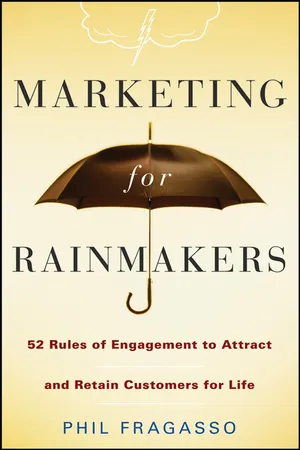
Marketing for Rainmakers
52 Rules of Engagement to Attract and Retain Customers for Life
- English
- ePUB (mobile friendly)
- Available on iOS & Android
eBook - ePub
Marketing for Rainmakers
52 Rules of Engagement to Attract and Retain Customers for Life
About this book
You are a successful entrepreneur with a brain for business, but you're indecisive about marketing and need a guide that will help your company distinguish itself, inspire customer loyalty and increase profits. Marketing for Rainmakers: 52 Rules of Engagement to Attract and Retain Customers for Life presents practical concepts, helpful tips and real-life examples to help you take your business to the next level with marketing that focuses on the customers' needs. Fifty-two business-building ideas will inspire you to take immediate action and develop a marketing mindset.
Section Three
THE TACTICAL RAINMAKING MARKETER
ROE #17
CELEBRATE SMILESTONES
With so much emphasis on long-term strategies, brand building, and big-picture thinking, it’s easy to lose sight of and appreciation for the day-to-day progress we make towards our grand vision. There’s even a school of thought that congratulating ourselves on smaller victories would lessen our focus on the long-term goal. Bill Belichick, coach of the New England Patriots and highly respected throughout the NFL as a great strategist and team leader, appears to be solidly in that camp. He never wants to dwell on a victory but instead always points to the Super Bowl as the only “W” that really matters. As much as I admire Belichick and all he has accomplished for New England, every once in a while I’d love to see him, and his similarly discreet players, stand up after a game and shout, “we whupped their scrawny asses good and we’ll do it again the next time they crawl into town.” Then, after that one indulgent indiscretion, they can go back to their gentlemanly “it’s business not personal” ways.
Bill Belichick’s stoic approach is especially prevalent in professional services firms where automaton-like behavior is often preferred over flesh-and-blood emotion. But if you really do believe that marketing, at its core, is designed to motivate; and you believe that an emotional connection is the greatest motivator of all; then you need to put aside time to celebrate, encourage, and recognize the efforts and achievements of your colleagues, your clients, and yourself.
The One-Minute Manager, written by Ken Blanchard in 1981 but still highly relevant today, focuses on this idea of “catching someone doing something right” and then recognizing them on the spot. I read the book when it first came out, back when I was a very junior marketer at Wang Labs. Shortly thereafter, I distinctly remember our Group Managing Director, whom I had rarely spoken to, coming into my cube, placing a hand on my shoulder, and telling me—for all my cubemates to hear—what a great job I was doing on a particular project. I remember thinking to myself that he had learned this technique from The One-Minute Manager, but that was okay. He was sincere and specific in his praise, and it made my day. Whatever your role or level, try to make someone else’s day on a regular basis—and spread the praise around to your colleagues, spouse, children, and friends. And don’t forget your clients.
Here’s a great example of how one entrepreneur wins loyalty points by celebrating his clients’ small victories. I recently produced a music CD and one of the distribution outlets was CDbaby.com, a self-described “little online record store that sells albums by independent musicians.” CDbaby was founded in 1998 by Derek Sivers, a musician turned rainmaker, and has paid over $50 million in royalties to its artists. Every aspect of Derek’s approach to business celebrates and encourages his clients, including his royalty checks:
Hey Philip
I just sent you a direct ACH deposit for $50.73. If the bank numbers you gave us are correct, it should appear in your account in the next two days.
Yes it’s good to get paid paid paid paid for making music!
I hope I write you a million more checks.
I hope you write a million more songs.
I hope you get a million more fans
who give you a million kisses
all because of CD Baby.
Ciao!
Derek Sivers
who give you a million kisses
all because of CD Baby.
Ciao!
Derek Sivers
When you experience CDbaby—whether as an artist or a customer—it becomes very clear that Sivers had a visceral vision of what he wanted to build from the first day he opened his online storefront. Most importantly, he had the courage and discipline to pursue that vision one step at a time. It’s easy to picture Sivers smiling to himself as he crafted the royalty communication shown above or wrote the equally jovial confirmation emails that are sent to customers when purchasing CDs or designed the whimsical CDbaby web site. Each of these steps represented a milestone in Sivers’ business plan, and by turning them into “smilestones” he further motivated himself to keep at the hard work of building a business. That’s what rainmakers do.
Joseph Priestley, the eighteenth century English philosopher, once commented on Sir Isaac Newton that had we “traced all the steps by which he produced his great works, we might see nothing very extraordinary in the process.” That comment aptly describes kaizen, the Japanese philosophy of continuous improvement driven by small but steady steps. What Isaac Newton and Japanese powerhouses like Toyota and Sony have in common is a well-visualized long-term goal supported by an equally clear visualization of how to get there.
A vision is not the same as a daydream. There is no magical snapping of fingers or clicking of heels that can immediately deliver one’s vision fully realized and ready to go. The process of vision-actualization is a continuum. Think of it as a chain, with each link representing a milestone and each link making the chain longer, stronger, and more versatile. Each link constitutes an entity unto itself and is essential to the efficacy of the final product, but it’s pretty much worthless on its own.
That’s why we tend to ignore milestones and don’t give them their celebratory due. Most milestones are indeed relatively “worthless on their own” (e.g., breaking ground for a new building, filing an affidavit, or designing a logo). If the projects were to end there, nothing of lasting import would have been accomplished. You’d have a big hole in the ground, a few sheets of paper imprinted with heretofors and forthwiths, and an all-hat-no-cattle business.
Milestones are important because they represent the means to a specific end. And rather than contributing to a loss of focus on the big picture, milestones help to make the big picture more real and serve to tightly connect people to the grand scheme. They provide a deeper understanding of what success will look like and the effort that will be required to achieve that success. Milestones are very similar to the anticipatory build-up to events like a high school prom. The anticipation is often more exciting than the real thing. And while you would never skip or otherwise disavow the real event, it was in the planning and anticipatory phase where the “heavy lifting” occurred and strongest memories were implanted.
In the business world, it’s way too easy to focus on weaknesses and missteps rather than strengths and victories. It’s part of human nature. Notwithstanding that most performance appraisal systems are designed as coaching and developmental tools, the manager and subordinate typically spend the vast majority of their time on the single “needs improvement” rating rather than the dozen “above average” ratings. The Pollyanna in you will argue that this is a good thing because it’s focused on improvement, perhaps even continuous improvement. The counter-argument is that we simply don’t spend enough time recognizing and leveraging all the good stuff we do. The good stuff is expected. That’s what we’re paid to do.
The cliché about the chain being only as strong as its weakest link became a cliché because it’s true. The best way to ensure that even the weakest link is as strong as possible is to recognize its value from the outset and then reaffirm its value when completed. Take a moment to celebrate the small accomplishments before moving on to the next. That’s what rainmakers do. And that’s what good marketing is about.
ROE #18
IGNORE THE BLISS
Notwithstanding all that Smilestones schmaltz in ROE #17, no one really cares about what you accomplished yesterday. Bruce Springsteen captured the sentiment perfectly in “Glory Days,” his ode to middle-aged mediocrity when “time slips away and leaves you with nothing, mister, but boring stories of glory days.”
Success is something we all strive to achieve, but it has a dark side as well. Success can breed complacency. It’s easy to get fat, dumb, and happy as we rest on our laurels. A pat on the back for a job well done is great—but stay smart and stay focused, and you’ll also stay well ahead of the pack.
If only it were that easy. As part of my career in marketing, I’ve hired and listened to countless dozens of professional speakers. These are typically folks who are regulars on television and radio, have written a book, have held senior-level positions in the government or corporate America, won an award, surmounted some obstacle, or did something else that qualifies them to charge $25,000 for a one-hour speech. They are highly skilled and respected individuals, experts, and champions in their respective fields, but when they take the stage you literally want to shoot yourself. They move around the stage in quite a life-like fashion, talking, gesturing, and chuckling along with the audience. But it’s a sham. A charade. They may have done something at some time that wowed someone, but that day is long gone. Now, they’re simply going through the motions, playing a role. Words are being spoken, but the speaker is not engaged or engaging. The jokes are mechanical and the heartfelt sentiments are cloying. The whole thing comes across like a comeback tour for a 1980s glam band (i.e., it’s being done solely for the money with no pretense of adding anything of value). They’re reaping the rewards today for what they accomplished in the past.
I don’t mean to single out professional speakers because this tendency to coast once success is achieved is surprisingly—and disturbingly—rampant. It stems from feelings of self-satisfaction and enchantment with one’s press clippings; and it manifests itself in a lack of preparation for meetings, overconfidence in one’s abilities, overreliance on past techniques and strategies, disregard for the thoughts and insight of others, and obliviousness to all of the preceding. It’s all driven by delight in having achieved the pinnacle of success—a level of personal success that cannot possibly be surpassed.
When you’re the best, you’re the best. Except when you’re Tiger Woods.
As overused as they are, sports analogies do work well to bring certain business concepts to light. I think it’s because of the hardwired mindset of professional athletes that is best expressed via the adage that “Amateurs practice to get it right; professionals practice to never get it wrong.” You need to look no further than Tiger Woods, who may very well be today’s best athlete in any sport. After winning several majors and climbing to the number one ranking in the world, Woods completely retooled his swing. The naysayers clucked when Tiger stumbled out of the box with his new technique and showed himself to be mortal after all. Within eighteen months of introducing the “new” Tiger, however, he again began to dominate his PGA colleagues and continued his attack on the record books. The moral is that if Tiger Woods needs to continually review and enhance his skills, everyone does.
Here are some easy techniques to retool your professional swing and ensure that you stay at the top of the rainmaking game:
• Treat existing customers like prospects
• Treat employees like you’re still recruiting them
• Create an agenda for every meeting and identify exactly what you want to accomplish, then grade yourself afterward
• Document your professional accomplishments on a timeline to see if major wins are as frequent today as they were in the past
• “Google” yourself periodically to see if your online identity and listed accomplishments reflect what you’re doing today or what you did last year
• Approach every day as though it’s your first day on the job
• Conduct a 360-degree performance review to gain perspective on your performance from peers, superiors, and subordinates
• Conduct skip-level meetings with the people who report to your direct reports
• Write your obituary including only those successes that were achieved from this day forward
• Learn something new every day
• Teach something new every day
• Talk with someone new every day
ROE #19
STICK IT
Stickiness is the new black; and sticky has replaced permission, viral, one-to-one, and word-of-mouth as the newest buzz word of marketing. And it makes sense because stickiness—the ability to help people remember and be emotionally engaged by what they see, read, or hear—is key to effective marketing. In truth, the idea of stickiness gets at the very heart of what good marketing is all about. But it’s hardly a new concept.
Way back in the time of Moses, the biblical writers recognized that brevity was key to ensuring the stickiness of a message. As a result, despite the citation of sixteen “imperative statements” in the Exodus and Deuteronomy passages relating to the commandments, the Bible specifically refers to ten commandments. Various religions combine the sixteen imperatives in different ways, but there is clear unanimity in the need to reduce the total to a more manageable, memorable, and authoritative-sounding number.
During the presidential campaign of 1840, William Henry Harrison used the slogan, “Tippecanoe and Tyler Too,” to remind voters that he was the hero of the Battle of Tippecanoe and his running mate for Vice President was John Tyler. And just as with more recent political sound bites like “Read my lips” and “It’s the economy, stupid,” the sing-song phrase helped with the election.
In 1904, the Campbell Soup Company introduced an illustration of two cherubic children for a trolley car advertisement. This was one of the first uses of a brand “spokesperson.” The “Kids” became widely popular and serve to this day as iconic images of the value of a warm meal and good nutrition for children.
In more recent years, the stickiness meter has gone off the charts with advertising mantras like Wendy’s “Where’s the beef?” campaign. Rather than stating that their hamburgers were X-percent larger than the competition’s, Wendy’s demonstrated in a powerful, funny, and memorable way that the size difference was plainly visible for anyone to see.
And is there anyone in the lower forty-eight over the age of thirty who can recite the words “Plop, plop, fizz, fizz” without following the beat of the Alka-Seltzer jingle or refrain from adding the “oh what a relief it is” lyric? It’s become part of our core memory.
The more jaded of you may question what relevance any of this has to the world and work of rainmakers. My response is that the stickiest phrase of the 1990s was coined by a rainmaking defense attorney, Johnnie Cochran, when he held up a glove and said, “if it doesn’t fit, you must acquit.” He was marketing his case to the jury, and he wanted his message to stick. (Unfortunately, he was successful.)
Regardless of what business you’re in, you communicate for a reason. You want your message to be understood and remembered. You want your words to resonate and reflect positively on you and your business. And you want to motivate your audience to take action. That’s what stickiness can do, and that’s why it needs to become an integral part of everything you do and say.
HOW TO STICK IT GOOD
While stickiness is something of an art, it can be learned. It also has the additional benefit of being fun. Who wouldn’t enjoy being able to turn a phrase that captures people’s attention and positively affects the way they view you and your product or service offerings? There is no downside with stickiness. So, with no pretense of being all-inclusive, here are some easy-to-implement ways to add stickiness to your day-to-day communications.
• Tell stories - Stories are the single greatest contributor to stickiness. Indeed, if you consider all the examples included in the previous section you’ll see that each tells a story. (See ROE #44: Tell a Story Worth a Thousand Pictures, for more examples regarding the stickiness of stories.)
• Include visuals - A good friend of mine, let’s call her Trisha (since that is her real name), is a top salesperson of alternative investment products—i.e., hedge fund strategies offered in retail mutual funds. Trisha always begins her presentation with two images side-by-side. One image shows the luxury and pampering of an airline first-class cabin and the other shows an overcrowded, cramped, and largely ignored coach cabin. As her audience absorbs the images, Trisha reminds them what it feels like to be in coach, wondering what happens behind the curtain that separates them from the first-class passengers. She then makes a comparison to how individual investors look enviously at endowments, hedge funds, and other institutional investors and wish they could share in the wealth. “Well,” says Trisha, “with my company you can, because we bring first-class to coach. We can deliver institutional-style investment strategies to the small investor.” Her clients always remember the “bring first-class to coach” imagery, and she always remains at the top of the sales charts.
• Get specific - Gabriel Garcia Marquez, author of One Hundred Years of Solitude and one of the truly great writers of the twentieth century, once told the Paris Review that, “If you say there are elephants flying in the sky, people are not going to believe you. But if you say there are four hundred and twenty-five elephants in the sky, they probably will believe you.” Specificity demonstrates confidence in the information you’re sharing, and makes it more meaningful and memorable. You would never tell a friend that you just bought a sports car; rather you’d name the make and model, and maybe even the color (e.g. “I bought a red Porsche Boxster just to prove I really am having a mid-life crisis.”). As you market your firm and yourself, then, avoid the generalities that we all tend to use and replace them with concrete facts and figures. Don’t say cost-effective when you can say twenty percent less expensive than ABC or XYZ. Don’t say industry-leading when you can say “ranked first” in something by someone. And don’t ever allow clients to decipher vagaries on their own.
• Make it rhyme - There is something comforting about rhymes due to their cadence and childlike simplicity. Most importantly, however, rhyming serves as a strong mne...
Table of contents
- Title Page
- Copyright Page
- Dedication
- Acknowledgements
- Introduction
- Section One - THE BRAND-FOCUSED RAINMAKING MARKETER
- Section Two - THE STRATEGIC RAINMAKING MARKETER
- Section Three - THE TACTICAL RAINMAKING MARKETER
- Section Four - THE CUSTOMER-FOCUSED RAINMAKING MARKETER
- Section Five - THE COMPETITIVE RAINMAKING MARKETER
- Section Six - THE HARDWIRED RAINMAKING MARKETER
- INDEX
Trusted by 375,005 students
Access to over 1.5 million titles for a fair monthly price.
Study more efficiently using our study tools.
Frequently asked questions
Yes, you can cancel anytime from the Subscription tab in your account settings on the Perlego website. Your subscription will stay active until the end of your current billing period. Learn how to cancel your subscription
No, books cannot be downloaded as external files, such as PDFs, for use outside of Perlego. However, you can download books within the Perlego app for offline reading on mobile or tablet. Learn how to download books offline
Perlego offers two plans: Essential and Complete
- Essential is ideal for learners and professionals who enjoy exploring a wide range of subjects. Access the Essential Library with 800,000+ trusted titles and best-sellers across business, personal growth, and the humanities. Includes unlimited reading time and Standard Read Aloud voice.
- Complete: Perfect for advanced learners and researchers needing full, unrestricted access. Unlock 1.5M+ books across hundreds of subjects, including academic and specialized titles. The Complete Plan also includes advanced features like Premium Read Aloud and Research Assistant.
We are an online textbook subscription service, where you can get access to an entire online library for less than the price of a single book per month. With over 1.5 million books across 990+ topics, we’ve got you covered! Learn about our mission
Look out for the read-aloud symbol on your next book to see if you can listen to it. The read-aloud tool reads text aloud for you, highlighting the text as it is being read. You can pause it, speed it up and slow it down. Learn more about Read Aloud
Yes! You can use the Perlego app on both iOS and Android devices to read anytime, anywhere — even offline. Perfect for commutes or when you’re on the go.
Please note we cannot support devices running on iOS 13 and Android 7 or earlier. Learn more about using the app
Please note we cannot support devices running on iOS 13 and Android 7 or earlier. Learn more about using the app
Yes, you can access Marketing for Rainmakers by Phil Fragasso in PDF and/or ePUB format, as well as other popular books in Business & Sales. We have over 1.5 million books available in our catalogue for you to explore.