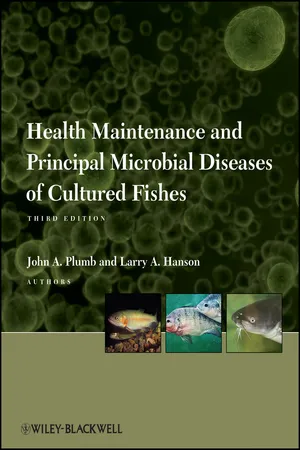
The text is divided into sections on health maintenance, viral diseases, and bacterial diseases, and covers a wide variety of commercially important species, including catfish, salmon, trout, sturgeon, and tilapia. This book is a valuable resource for professionals and students in the areas of aquaculture, aquatic health maintenance, pathobiology, and aquatic farm management.
eBook - ePub
Health Maintenance and Principal Microbial Diseases of Cultured Fishes
- English
- ePUB (mobile friendly)
- Available on iOS & Android
eBook - ePub
Health Maintenance and Principal Microbial Diseases of Cultured Fishes
About this book
Health Maintenance and Principal Microbial Diseases of Cultured Fishes, Third Edition is a thoroughly revised and updated version of the classic text. Building on the wealth of information presented in the previous edition, this new edition offers a major revision of the valuable health maintenance section, with new pathogens added throughout the book. Health Maintenance and Principal Microbial Diseases of Cultured Fishes, Third Edition focuses on maintaining fish health, illustrating how management can reduce the effects of disease.
Information
Part I
Health Maintenance
Fish health maintenance emphasizes many areas that affect the health of cultured fishes. It requires continuous efforts, which include the following: the location and construction of a culture facility; selection and introduction of culture species; and reproduction, culture, and harvesting of the final product. The aquatic habitat—a dynamic and continuously changing environment—is affected by structural material, facility design, soil quality and type, volume, and quality of water, fish species present, amount and quality of nutrients introduced into the system, climate, and daily human activities.
Health maintenance involves a series of principles that apply to most farm-raised animals. However, fish tend to react more quickly to environmental change than terrestrial farm animals. Because of their homeothermic nature, most terrestrial farm animals respond comparatively slowly to unfavorable environmental conditions, whereas fish—being poikilothermic—respond quickly and often fatally to handling, temperature change, excessive or insufficient dissolved gasses in the water, metabolites, or chemical additives, and so forth, to which they are unable to adapt. These factors also increase fish susceptibility to infectious agents and compromise their immune response.
Specific areas of concern addressed in this book include principles of health or health maintenance, epizootiology and pathology of fish diseases, disease recognition, basic concepts in disease diagnosis, and prevention and control of infectious fish diseases. Aquatic animal health management encompasses the entire production process, including disease diagnosis and treatment.
The objective of health maintenance is to help control environmental fluctuations through management practices, thus reducing the magnitude of change and producing a more economical, healthier, and better quality product. The ultimate goals of health management are (1) disease prevention, (2) reduction of infectious disease incidence, and (3) reduction of disease severity when it occurs. Successful health maintenance and disease prevention or control do not depend on any single procedure but are the culmination of the application of integrated concepts and exercising management options.
Chapter 1
Principles of Health Maintenance
“An ounce of prevention is worth a pound of cure” is a familiar phrase that describes one approach to the culture of food animal resources. Health maintenance is a concept in which animals are reared under conditions that optimize the growth rate, feed conversion efficiency, reproduction, and survival while minimizing problems related to infectious, nutritional, and environmental diseases, all within an economical context. “Health maintenance” encompasses the entire production management plan for food animals, whether they are swine, cattle, poultry, or fish. Aquaculture involves man’s intervention in the growth process of fish and other organisms in an aquatic environment. The degree of intervention is progressive, ranging from extensive (few fish per unit of water volume) to increasingly intensive (comparatively greater numbers/weight of fish per unit of water volume) in ponds, raceways, cages, and recirculating systems where higher fish densities are maintained. As culture becomes more intensive, need for intervention increases accordingly, and principles of health maintenance become of greater importance. These principles apply to aquaculture around the world, regardless of fish species, culture method, or climate.
Fish health management is not a new approach to aquaculture. Snieszko (1958) recognized the need for health maintenance in fish culture when he stated, “We are beginning to realize that among animals (including fish) there are populations, strains, or individuals that are not susceptible all of the time, or even temporarily, to some of the infectious diseases.” He theorized that fish possess a certain level of natural resistance to infectious diseases that can be enhanced through proper management, and that environmental stressors and/or fish cultural practices can adversely affect that natural resistance. Another contributor to a health maintenance concept for aquatic animals is Klontz (1973), who established a fish health management course at Texas A & M University that combined fish culture and infectious diseases into health management. The Great Lakes Fishery Commission published a Guide to Integrated Fish Health Management in the Great Lakes Basin, which was a regional concept for fish health management (Meyer et al. 1983). These references deal with the improvement of aquatic animal health through management. The most in-depth contribution to maintaining health of domestic (cultured) animals was Schnurrenberger and Sharman (1983), who set forth a series of principles for animal health maintenance, which apply in a general sense to all domesticated food animals. In the following pages these principles are applied to aquaculture. Theoretically, if these principles are utilized in daily, monthly, yearly, and long-term management of an aquatic culture facility, there will be fewer environmental and disease problems and optimum production will be more readily obtained.
Biosecurity is the term recently applied to fish health management (Bebak-Williams et al. 2007) in which biosecurity is aimed at reducing the risk of pathogens being introduced to a facility, reducing the risk of pathogens being spread throughout the facility, and alleviating conditions that increase susceptibility to infections. It is emphasized that biosecurity cannot completely prevent entry of or eliminate all pathogens from the culture facility but emphasizes reduction of pathogens rather than their complete elimination. Biosecurity begins with selection of the aquaculture site and continues throughout production with complete control of water and human access.
Health Maintenance
In an aquatic environment, there is a profound and inverse relationship between environmental quality and disease status of fish. As environmental conditions deteriorate, severity of infectious diseases increases; therefore, sound health maintenance practices can play a major role in maintaining a suitable environment where healthy fish can be grown. The aquatic environment is a dynamic ecosystem that changes over a 24-hour period and seasonally, particularly in ponds with limited water exchange. Tucker and Van der Pflog (1993) noted that in static catfish ponds, periods of poorest water quality occurred during summer months when feeding, temperature, and standing crops were at a maximum, but rainfall and available water were at a minimum, thus producing a higher potential for stressful conditions requiring health management.
Fish health management is a positive concept that aids in disease prevention, emphasizes interruption of a disease cycle, deals with multiple segments of health maintenance, and results in more efficient production. Health maintenance does not simply target infectious diseases, but emphasizes proper utilization of physical facilities; use of genetically improved fish and certified “specific pathogen free” (SPF) stocks whenever available and/or feasible; environmental control; prophylactic therapy; feed quality and quantity, pond, cage, raceway, tank, or recirculating system management; control of vegetation; aeration and use of other water quality maintenance practices; and a management commitment to provide an optimum habitat in terms of water quality for fish being cultured. Its goal is to improve the health and well-being of animals that appear to be generally healthy. If sound health maintenance principles are followed, production will be more efficient and result in a healthier product. Obviously, all activities, policies, and improvements must be based on sound economic criteria.
Stress
“Stress” is difficult to define because it is used to describe many adverse situations that affect the well being of individuals, but generally it is the reaction of an animal to a physical, physiological, or chemical insult (Barton 1997). Stress may also produce a nonspecific response to factors that are perceived as harmful; however, stress in fish is usually related to handling, transport, environmental quality, or fright. For clarification in this text, “stressors” are factors that cause a “stress response,” which is the sum of physiological changes that occur as fish react to physical, chemical, or biological stressors as the fish attempt to compensate for changes that result from these stressors (Wedemeyer 1996). The corticosteroid level in plasma is the usual quantitative measure for stress; however, amounts of glucose, lactic acid, and ions will also increase during stressful conditions (McDonald and Milligan 1997).
The aquatic environment is in a continuous state of flux, and because fish are poikilotherms and body functions are controlled by temperature, oxygen concentration, and many other water quality parameters, they must continually adapt physiologically to environmental changes. An inability to adjust to these changes may be manifested in lower productivity, reduced weight gain, poor feed conversion, decreased immunity, reduced natural disease resistance, increase in infectious disease, lowered hardiness in general, death, reduced profits for the commercial fish farmer, and reduced production.
Some commonly known stressors in the aquatic environment are unionized ammonia, nitrite, chronic exposure to low concentrations of pesticides or heavy metals, insufficient oxygen, high concentrations of carbon dioxide (CO2), rapidly changing or extremes in pH or water temperature, external salinities, nutrition, and fish density (Barton 1997). Low alkalinity and hardness are also not conducive to good fish health or performance (Boyd 1990). Many of these factors are exacerbated by type, quality, and quantity of feed put in a pond, and by waste accumulation. Sensitivity to these conditions will vary with fish species. Successful and efficient health maintenance programs for aquaculture facilities will include measures to reduce and modify stressful conditions that may be present in a fish popu-lation.
Hazard Reduction by Management
Experience has shown that a wide variety of viral, bacterial, parasitic, and other fish diseases will cause mortality if cultured fish are held in unfavorable environmental conditions (Wedemeyer 1996). Health and environmental management decisions are not independent and a change in one area should not be made without evaluating its effect in other areas. Notable stressor-related fish diseases that result from a culmination of management and biological factors are furunculosis, enteric redmouth, motile Aeromonas septicemia, columnaris, vibriosis, bacterial gill disease, streptococcus, external fungal infections, and some protozoan parasites (Table 1.1).
Table 1.1 Microbial diseases of fish commonly considered stress mediated
Source: Walters and Plumb (1980), Piper et al. (1982), Roberts (1989), Wedemeyer (1996).
| Disease | Predisposing Environmental Factor |
| Spring viremia of carp | Handling after over wintering |
| Bacterial gill disease | Crowding, poor water quality, elevated presence of causative bacteria |
| Columnaris | Crowding, poor water quality, handling, seining, adverse temperature, physical injury |
| Cold-water disease | Temperature decrease from >10°C to <10°C |
| Enteric redmouth | High stocking density, elevated water temperature, handling, transport, poor water quality |
| Furunculosis | Low oxygen, handling, environmental stress |
| Motile Aeromonas septicemia | Injury to skin, transport, improper handling, temperature stress, poor water quality, other parasites |
| Ulcer disease of winter or goldfish and carp erythrodermatitis | Handling and stocking in late early spring |
| Vibriosis | Handling, poor environmental conditions, moving from freshwater to salt water |
| Streptococcicosis | Handling, poor water quality, parasites |
Stress on fish increases when environmental conditions approach the host’s limit of tolerance (Snieszko 1973). For example, if water temperature is critically high and oxygen concentration is adequate, fish may survive, and if oxygen is critically low and water temperature is normal, fish may also adjust and survive...
Table of contents
- Cover
- Title Page
- Copyright
- About the Authors
- Preface
- Acknowledgments
- Part I: Health Maintenance
- Part II: Viral Diseases
- Part III: Bacterial Diseases
- Part IV: Appendices
- Index
Trusted by 375,005 students
Access to over 1.5 million titles for a fair monthly price.
Study more efficiently using our study tools.
Frequently asked questions
Yes, you can cancel anytime from the Subscription tab in your account settings on the Perlego website. Your subscription will stay active until the end of your current billing period. Learn how to cancel your subscription
No, books cannot be downloaded as external files, such as PDFs, for use outside of Perlego. However, you can download books within the Perlego app for offline reading on mobile or tablet. Learn how to download books offline
Perlego offers two plans: Essential and Complete
- Essential is ideal for learners and professionals who enjoy exploring a wide range of subjects. Access the Essential Library with 800,000+ trusted titles and best-sellers across business, personal growth, and the humanities. Includes unlimited reading time and Standard Read Aloud voice.
- Complete: Perfect for advanced learners and researchers needing full, unrestricted access. Unlock 1.5M+ books across hundreds of subjects, including academic and specialized titles. The Complete Plan also includes advanced features like Premium Read Aloud and Research Assistant.
We are an online textbook subscription service, where you can get access to an entire online library for less than the price of a single book per month. With over 1.5 million books across 990+ topics, we’ve got you covered! Learn about our mission
Look out for the read-aloud symbol on your next book to see if you can listen to it. The read-aloud tool reads text aloud for you, highlighting the text as it is being read. You can pause it, speed it up and slow it down. Learn more about Read Aloud
Yes! You can use the Perlego app on both iOS and Android devices to read anytime, anywhere — even offline. Perfect for commutes or when you’re on the go.
Please note we cannot support devices running on iOS 13 and Android 7 or earlier. Learn more about using the app
Please note we cannot support devices running on iOS 13 and Android 7 or earlier. Learn more about using the app
Yes, you can access Health Maintenance and Principal Microbial Diseases of Cultured Fishes by John A. Plumb,Larry A. Hanson in PDF and/or ePUB format, as well as other popular books in Technik & Maschinenbau & Fischerei & Aquakultur. We have over 1.5 million books available in our catalogue for you to explore.