The author of the bestseller Selling to VITO returns with a 10-step plan for getting to the Very Important Top Officer's top of mind, top of wallet, and top of their "to-do" list
Anthony Parinello's Selling to VITO introduced salespeople everywhere to the Very Important Top Officer-and taught them the precise steps of how to sell to the person with the ultimate veto power. Now, Parinello returns with Getting to VITO, a one-of-a-kind sales resource that offers proven, best-practices advice on how-to get into VITO's head, get into their budgets, and get on their team as a "trusted advisor."
Based on Parinello's own extensive sales experience-as well as the experiences of the more than one million salespeople who've studied his VITO process-Getting to VITO shows salespeople how to:
* Find and pre-qualify the real VITO
* Establish real value in VITO's eyes
* Cut to the chase with seven different correspondence modalities
* Disarm every first-call objection a salesperson may encounter
* Deliver the show-stopper "elevator" pitch for every industry
* One-on-one coaching from Parinello's own professional coach!
Anthony Parinello (San Diego, CA) is the country's foremost expert on selling to top officers. His bestselling book and audiotape program Selling to VITO (The Very Important Top Officer) has sold more than 500,000 copies. Parinello's Secrets of VITO: Think and Sell Like a CEO was a Wall Street Journal bestseller and his most recent book Getting the Second Appointment has been accepted by his following as the new sales process of "choice."
eBook - ePub
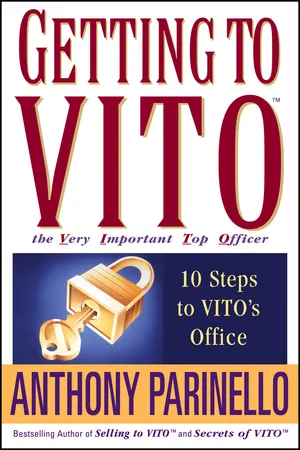
Getting to VITO (The Very Important Top Officer)
10 Steps to VITO's Office
- English
- ePUB (mobile friendly)
- Available on iOS & Android
eBook - ePub
Part One
VITO SELLING: THE NEW GENERATION
1
SETTING THE STAGE
VITO Principle #1: Everything changes.
Who is VITO?
VITO is the Very Important Top Officer—the man or woman who sits at the top of every single one of your target groups of prospects and customers who has the ultimate authority to make your sale materialize or disappear.
If VITO doesn’t want to buy your stuff, the sale is not going to happen, no matter how many purchasing peons, interns, or technical experts say it’s a great idea. Ever had a “sure thing” sale evaporate mysteriously? Five will get you ten that VITO, whom you never met, happened to mention to someone that what you were offering didn’t seem like a great idea. Whoosh. You went from the hot new thing to radioactive in 10 seconds.
If VITO does want to buy your stuff, then the sale is going to happen, no matter how many senior VPs, entrenched suppliers, or relatives of the current vendor think it’s a dumb idea to buy from you.
You want VITO on your side. This book is about getting VITO on your side.

I’ve spent a good many years writing articles and books, creating audio programs, building e-learning lessons, and teaching and coaching salespeople how to get appointments with VITO—the person who has the ultimate veto power. And over the years, like everything else in this universe, the process has changed.
Why? VITO has changed. Levels of authority continue to migrate upward within the enterprise. The tougher regulatory and legal environment of the last few years has made VITO more cautious. When people at the top exercise caution, they typically delegate and empower others in an effort to mitigate risk.
So I’ll share with you, right now, the big lesson I’ve learned about VITO since I wrote my first book. It is this: Contrary to popular opinion (and my own assessment in the early 1990s), today’s VITOs aren’t really risk takers.
Actually, by the time VITO approves a decision—either through empowerment, delegation, or (gasp!) taking direction from individuals lower down and higher up in the executive ranks of VITO Inc.—the “risk” has typically become nonexistent. The decision turns into a well-informed strategic choice, one that puts someone else’s neck on the line. (Or, better yet, a bunch of someone elses’.)
I realize that there are dangers in any generalization, and I know that what I’ve just described is not the way all VITOs operate these days. But it is an increasingly common pattern in today’s business environment, and it seems likely to me—given some of the challenges faced by a number of visible “hard-charging” executives who really were serious risk takers—to remain a common pattern in years to come.
DON’T KILL THE MESSENGER!
You’re not going to like the facts of selling life that you’re about to read. Just remember that I am on your side, and when you get to the end of this chapter I will still be on your side.
Ready? Here are six things you need to acknowledge about your selling career.
1. Right now, your sales cycle is, in all likelihood, about 50% longer than it can and should be.
2. You’ve been lied to repeatedly by the decision makers you’ve been dealing with for lo these many years. They’ve told you that they have the authority to say No to the vendors they deal with. They really don’t have this power.
3. You’ve been selling to individuals who don’t like to be sold to.
4. You’ve been annoying the hell out of them in the process.
5. Whether you realize it now or not, every VITO has a VITO.
6. If you want to sell to a VITO, you have to think like a VITO.
Let’s look at each of these in depth.
THING YOU NEED TO ACKNOWLEDGE ABOUT YOUR SELLING CAREER #1:
Your Sales Cycle Is 50% Longer than It Should Be.
I know, I know. The threadbare phrase “time is money” has been beaten into your skull for years. But is that any reason to ignore it?
The cost of a person-to-person “sales call” continues to rise in too many of today’s sales organizations. Many sales managers still insist on getting salespeople to focus on “activity”—and not on results. In startling numbers, lines of business executives (like VPs of sales) are watching their ROS (return on sales) dwindle.
And guess what?
While all of this is happening, you and your contemporaries are, in all likelihood, using tactics that are actually lengthening rather than shortening your sales cycle! That means you’re making these already lousy numbers worse, not better!
Dubious? Don’t be. In the pages that follow, you’ll learn what the (all-too-common) problems are and how to turn them around.
THING YOU NEED TO ACKNOWLEDGE ABOUT YOUR SELLING CAREER #2:
You’ve Been Lied to: Decision Makers Really Cannot Say No.
There are, by my count, five important players in each and every account that you and I sell to. For now, I want to focus on the role of just one of these players: the Decision Maker, or DM.
Fact Number One
The DMs’ job is to say Yes. They have to. It’s in their job description.
They have a need to fill, a job to do, and they need the help of “business partners” to do it. Keep in mind, then, that whenever you get what sounds like a No from a DM, that means that they have said Yes to someone else, like your competition. I know that’s not cool, but that’s the way it is.
Fact Number Two
In the not-so-distant past (like, say, within the last 12 to 24 months) a few players changed their roles in your prospects’ and customers’ organization. You most likely didn’t notice this, mainly because your prospects and customers didn’t want you to know anything about it.
But it happened. DMs grew in numbers. They are now sprinkled all over the enterprise. And they tend to act out a role in our sales process that looks a lot more important than it really is.
DMs did at one time actually possess the “signature authority” for some pretty substantial numbers. Example: I sell to large Fortune 500 organizations. The VP of sales is typically the person who signs my agreement when I get a “yes” answer. In days past, the VP of sales had decision authority for upwards of $250,000. Today, that same VP in that same Fortune 500 account has a $2,500 authority level.
Look at it again. Was: a quarter of a million bucks. Is: twenty-five hundred bucks.
DMs are not about to tell us about this (very important!) trend. So, then, who is making the real decision?
Consider the following situation.
Imaginary Case Study
Ms. VITO Importanta, the CEO of VITO, Inc., wants to capture the Pacific Rim opportunity for her line of wireless products. She’s done her own research, and she’s confident that her vision and mission will take the competition by surprise and win the market share that she needs to attract round two of investors. Her most trusted line-of-business executive, who has proven his ability to get things done ahead of time and under budget, is her chief operations officer (COO), Mr. Joe Kickass.
Mr. Kickass is empowered, during a simple one-on-one meeting with Ms. Importanta, to find all of the necessary channels to make this push across the Pacific Ocean a reality. The COO will take all of the tactical steps to make this happen. Ms. Importanta ends her directive with these words: “Kickass, once you’ve decided on the right suppliers, pass them by me before you sign anything.”
What just took place? Ms. Importanta kept her veto power . . . and turned over the risk to Mr. K.
So here’s what the situation looks like to the typical salesperson: Mr. K is the Decision Maker. The buck stops right on his desk. The typical salesperson thinks, “If Kickass says ‘No,’ I’m out of the game. If Kickass says ‘Yes,’ I just hit pay dirt.”
Wrong on both counts!
If you think that the formal Decision Maker (Joe Kickass) is the person who is approving your sale, I have news for you. The numbers show different. The numbers also show that you’re going to be surprised during your discussions with Mr. Kickass after he says “yes” to you, and most of the time you are not going to be pleasantly surprised.
A recent poll of my Selling to VITO alumni indicates that more often than not when a DM says “you’re in the running and everything is looking good,” your sale is still very much in jeopardy. A whopping 30% of the time the sale is denied. Even if you look at the world with that famous cup-half-full perspective, that means you’re only getting seven out of ten deals, when you thought you had ten out of ten. Ouch!
Who’s Who Continues to Change
The business landscape has changed since I wrote Selling to VITO, and so have the players and their roles. Here’s the lineup (from the bottom up) as it appears today, in th...
Table of contents
- Title Page
- Copyright Page
- Dedication
- VITO SELLING
- Acknowledgments
- PREFACE
- DON’T SKIP THIS PART
- Part One - VITO SELLING: THE NEW GENERATION
- Part Two - MAKING CONTACT
- Part Three - BEST PRACTICES
- Appendix A - TEMPLATE OF IDEAL PROSPECTS
- Appendix B - MEET YOUR COACH
- Appendix C - THE GREATEST TIMESAVING TOOL IN THE FREE WORLD
- INDEX
Trusted by 375,005 students
Access to over 1.5 million titles for a fair monthly price.
Study more efficiently using our study tools.
Frequently asked questions
Yes, you can cancel anytime from the Subscription tab in your account settings on the Perlego website. Your subscription will stay active until the end of your current billing period. Learn how to cancel your subscription
No, books cannot be downloaded as external files, such as PDFs, for use outside of Perlego. However, you can download books within the Perlego app for offline reading on mobile or tablet. Learn how to download books offline
Perlego offers two plans: Essential and Complete
- Essential is ideal for learners and professionals who enjoy exploring a wide range of subjects. Access the Essential Library with 800,000+ trusted titles and best-sellers across business, personal growth, and the humanities. Includes unlimited reading time and Standard Read Aloud voice.
- Complete: Perfect for advanced learners and researchers needing full, unrestricted access. Unlock 1.5M+ books across hundreds of subjects, including academic and specialized titles. The Complete Plan also includes advanced features like Premium Read Aloud and Research Assistant.
We are an online textbook subscription service, where you can get access to an entire online library for less than the price of a single book per month. With over 1.5 million books across 990+ topics, we’ve got you covered! Learn about our mission
Look out for the read-aloud symbol on your next book to see if you can listen to it. The read-aloud tool reads text aloud for you, highlighting the text as it is being read. You can pause it, speed it up and slow it down. Learn more about Read Aloud
Yes! You can use the Perlego app on both iOS and Android devices to read anytime, anywhere — even offline. Perfect for commutes or when you’re on the go.
Please note we cannot support devices running on iOS 13 and Android 7 or earlier. Learn more about using the app
Please note we cannot support devices running on iOS 13 and Android 7 or earlier. Learn more about using the app
Yes, you can access Getting to VITO (The Very Important Top Officer) by Anthony Parinello in PDF and/or ePUB format, as well as other popular books in Business & Sales. We have over 1.5 million books available in our catalogue for you to explore.