Increase Profits, Be more Organized, attract a Higher Quality & Quantity of Referrals, Run Your Business so That It Doesn't Run You, Take Your Business to the Next Level... With Breakthrough Business Development!
Breakthrough Business Development shows you how to attract and keep great clients, while running a profitable and efficient business. It helps every knowledge-for-profit professional to maximize your most valuable client relationships, and to develop a personalized business development plan to mine the untapped potential in your business.
Praise for the Pareto System, Featured in Breakthrough Business Development.
"I am just beside myself on the results gathered so far from instituting the Pareto System. I use an agenda for meetings now and have formulated a standard package given to new clients. Already I have sent out twenty thank-you cards to new referrals. I even got a referral from a referral if that makes sense. Some clients didn't know that I was still expanding my business. I am also finding advocates that I didn't classify as such. Opening twenty accounts in this short time span is amazing but already I have another ten leads in the pipeline. You guys were right, it does work."
"We have been building client relationships for 45 years... Pareto Systems successfully helped us to pause and then guided us through the process of defining the appropriate business structure and systems which will strengthen and enhance our best client relationships. We are now focusing on a comprehensive, systematized program for select clients. The results have been amazing-client satisfaction is way up and so are revenues."
eBook - ePub
Breakthrough Business Development
A 90-Day Plan to Build Your Client Base and Take Your Business to the Next Level
- English
- ePUB (mobile friendly)
- Available on iOS & Android
eBook - ePub
Breakthrough Business Development
A 90-Day Plan to Build Your Client Base and Take Your Business to the Next Level
PART 1:
STRATEGIC ANALYSIS (WEEKS 1-4)
CHAPTER 1
YOUR UNTAPPED OPPORTUNITIES
Order is a temporary illusion. Strategy is a moving target.
Rosabeth Moss Cantor
The first part of this book is designed to urge you to step back and reflect on how you have shaped your business up until now. We’ve all done a lot of things right over the years and we’ve all made a few mistakes here and there. Well, going forward, the goal is to try not to repeat those errors in judgment, while building on our momentum.
This personal assessment will reveal even minor adjustments that could and should be made in order to improve your effectiveness. Often, these minor adjustments can lead to major improvements. There’s a law in business called the Law of Optimization (you’ll soon realize we really like universal laws of business and life), which states that no matter how well an approach or process works, it can always be refined and improved upon, even if those refinements and improvements are very subtle.
This approach is especially important for entrepreneurs because we have a tendency to operate in a vacuum with very little input or support from others. Entrepreneurs are independent by nature and can unconsciously drift onto a track that isn’t as efficient as it could be. Too often, we’ve met business owners with ten years of experience who in fact really had one year of experience ten times over. They were in a loop, a pattern of simply repeating their approaches with little refinement. Yes, this can achieve results, but there is a fine line between being in a groove and being in a rut.
The strategic analysis also reminds us of the importance of being realistic. Peter Drucker, legendary management authority and elder statesman of quality in business, said, “As an entrepreneur you have to deal with things as they are, not as you wish they were.” We can relate. The vast majority of entrepreneurs we know are incredibly optimistic and even sometimes optimistic to a fault, to the point where it actually negatively affects their judgment. We understand because we are also entrepreneurs and even we don’t always deal with today’s realities. Instead, we might subconsciously focus on how good things will be in the future and overlook certain realities that need to be addressed right now. As Aldous Huxley said, “Facts don’t cease to exist because they are ignored.”
Yes, we absolutely must be optimistic to run our own businesses. The Reality Principle simply reminds us we can’t always trust our own judgment or believe our own hype. To be objective we have to be brutally honest with ourselves and have a process that forces us out of our vacuum. (As Canadians, we know all about optimism. Why else would we spend $30 on a snow shovel and $500 on a lawn mower?)
IDENTIFY AND TAKE ADVANTAGE
In the spirit of striving to achieve clarity, one of the first things you want to do as part of the strategic analysis is strive to identify untapped opportunities in your business. Every entrepreneur we’ve ever met, to varying degrees, was sitting on a virtual gold mine of untapped opportunity. Most don’t even realize it. Acres of Diamonds, a great little book by Russell Conwell, tells a story about an ambitious farmer who got a little bored and wanted to go out into the world to find his pot of gold. He sold his farm to raise some money and away he went. He ended up dying a pauper. Meanwhile, the farm he sold turned out to be loaded with diamonds. Admittedly that is a little dramatic but we see entrepreneurs—again, to varying degrees—sitting on those acres of unrealized wealth. One of the most tangibly rewarding aspects of the solutions we provide is helping business owners identify their own untapped potential. The next few pages will hopefully help you discover the same.
Remember
• Sound judgment leads to good decisions.
• Apply the Law of Optimization and the Reality Principle as you analyze your business.
Take Action Now! (Week 1)
• Download the STAR Business Planning Tool found on our website, www.paretoplatform.com, to begin the process of gaining clarity for your own untapped opportunities and overlooked vulnerabilities.
• Visit www.breakthroughbusinessdevelopment.com to see insights and stories from the field on this topic and others.
CHAPTER 2
MARKETING PILLARS AND THE LOYALTY LADDER
It’s more important to reach people who count than it is to count the number of people you are reaching.
Marketing Maxim
In keeping with striving to identify your untapped opportunities, your next step is to establish what we refer to as your marketing pillars. When we sit down with an entrepreneur and scrutinize his or her business, one of the first things we’ll do is draw three vertical lines on a sheet of paper. Each line is a pillar representing an existing or prospective target marketing opportunity. We call them pillars because, in a perfect world, you want a business built on a strong foundation that creates multiple income streams—steady streams of predictable, sustainable business.
Let’s define each of the fundamental pillars that can be created for virtually any business. The first and most important pillar, and this should be self-evident, is made up of your existing client relationships —especially the twenty percent who generate eighty percent of your business. They are the most valuable asset you’ll ever possess. Your client relationships are proprietary and often take years to nurture and maximize in terms of their potential. Yet too many entrepreneurs strive to pursue new clients using flawed and expensive prospecting tactics and, in the process, take existing clients for granted and leave them twisting in the wind. As you’ll see in a moment, this becomes a huge untapped opportunity.
The second pillar represents promotional partners. These are strategic alliances—the people in the marketplace with whom you collaborate to achieve a mutually beneficial outcome.
The third pillar represents your prospective target markets based on geographic, demographic and/or socio-economic opportunities available to you.
Later in the book, we’ll be expanding on your second and third pillars, but for now let’s zero in on your most important untapped opportunity—your existing client relationships. Obviously we don’t know how many clients you have right now and frankly it doesn’t really matter. What does matter, however, is that your existing clients represent what we call your inner circle. And as we said, your inner circle of clients is the most valuable asset you’ll ever possess.
A powerful and immutable marketing rule referred to as the Rule of Fifty-Two supports this point. It states that every single client you have right now in your inner circle has their own personal inner circle of approximately fifty-two friends, family members and business associates. Some have more, some have less, but again that’s not the point. Do the math, though. If you have, for example, five hundred clients, multiply five hundred times fifty-two. How much opportunity do you have there? A lot. Enough new prospective clients to keep you entertained for three lifetimes.
Said another way, clients are not an “end,” but a means to an end, meaning they can be a springboard to tremendous amounts of new business over time. Simply bringing on a new client is no reason to celebrate. If you gain access to each client’s friends and acquaintances and maximize each relationship, then you have an exciting business.
IDENTIFY YOUR MVPs
This brings us to our next point—understanding who your Most Valuable Prospects (MVPs) are. Most entrepreneurs think their MVPs are new people in their respective city or market area, when in fact they are the friends and family members of their existing clients. Is it possible that one of your most significant untapped opportunities is a result of your inability to capitalize on each of your existing client relationships vis-à-vis repeat or ongoing business and referrals?
Based on the fact that your clients will have significantly more persuasive impact on their friends and family than you ever will, you need a process to transform your clients into a sales team that will wave your flag. This will ensure that the moment a conversation between your client and any of his or her fifty-two (plus or minus) friends, associates or family members turns to what you do for them, your client will brag about you. That said, are you satisfied with the degree of refer-ability and the quality and quantity of endorsements you are currently attracting?
If you get nothing else from this book, we hope you get this—it is the core of our marketing and business development philosophy. We are referring to the Loyalty Ladder. We didn’t invent this concept. It’s been around for a long time. We’ve simply adjusted it for clarity as it relates to entrepreneurs specifically. And we are convinced that it will be tremendously helpful to you.
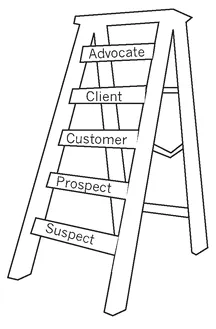
As you can see, the Loyalty Ladder has five rungs and every single person in your market area is on one of those five rungs. You are striving to achieve something called conversion. Your objective is to convert as many people as possible all the way through to the top of the ladder. Let’s start at the bottom.
The bottom rung on the ladder is for suspects. A suspect is, frankly, anybody with a pulse. Anyone who can fog a mirror is a suspect. Will a business owner receive a good return on his or her investment of time, money, energy and lung capacity from talking to suspects? Clearly not. But we see people all the time who mistake movement for achievement. Or, as Hemingway said, “mistake motion for action.” These people are very busy stirring the proverbial pot. But they’ve yet to figure out the distinction between suspects and the next rung on the ladder, prospects.
The difference between a suspect and a prospect is profound and we can sum up the difference with one word, a word worth an MBA in marketing: pre-disposition. It’s another way of saying self-motivated. A prospect is somebody who has been motivated in advance of you ever talking to them. You want your prospects to be motivated but you can’t want it more than they do. Wouldn’t it be great if every prospect you ever talked to already “wanted it,” meaning they were already self-motivated? Motivating people is draining; it can be like pumping air into a leaky tire. True prospects are self-motivated. They are your MVPs.
Your objective is to sift the prospects out of the mass of suspects and, most important, give them a reason to contact you. It’s not unlike mining for gold. You have to sift a lot of dirt to find an ounce of gold but you’re not trying to turn dirt into gold. With prospects, you’re trying to find them, not create them. You’re trying to attract them, not chase them. This is what truly defines a prospect. They contact you or a client of yours calls you on their friend’s behalf.
Does it get any better than when your phone rings? You pick it up and it’s one of your favorite clients calling you saying, “Look, I know you’re busy and I don’t even know if you’re accepting new clients right now, but you’ve got to talk to my buddy.” Or maybe a complete stranger calls you up and says, “I was talking to my friend over the weekend and she told me I have to talk to you.” Your goal is to increase the frequency of this type of inbound call.
THE LAW OF ATTRACTION
This Law, like most of them, has several layers. From a business development perspective it simply means that there are two ways to get new clients: Chase them or attract them. Which of the two do you feel would be more fulfilling over the long haul? One of our goals is to help you attract, for lack of a better term, more attractive clients to your business. Interestingly enough, your clients will be instrumental in helping you draw a steady stream of quality inbound calls to your business.
It is for this reason that we are not big fans of cold-calling, the rawest form of out-bounding. You might be saddened to know we’re not going to suggest you engage in cold-calling. Some people like it. Some people defend it and say, “What are you talking about? It’s a great way to build a business.” Sure. You can also cut down a tree with a hammer if you try hard enough or keep at it long enough.
Any expenditure of effort will garner a return on investment, but we would prefer that you to maximize your return by employing the Law of Attraction so that you can make your phone ring consistently. We’ll expand on this for you when we outline our prospecting process and when we reveal our referral process later on in the book. For now, let’s get back to the Loyalty Ladder.
Once you’ve got your true prospects, your MVPs, in sight, your next job is to convert those prospects into customers. At the very least, you want them as customers. You may wonder what we mean by saying “at the very least.” A profound difference exists between a customer and the next rung on the ladder—a client.
Some people use these terms—client and customer—interchangeably and to them it may all be semantics, but we’re going to explain our definition, which will hold true throughout this book. Clients are exclusive to you. They empower you fully. Every single thing they need that you provide, they empower you to deliver. Those are clients. Customers, on the other hand, do some business with you, but they also do business with one or more of your competitors. Customers buy something; clients buy into something. Based on that, is there a chance that some of your clients are really only customers? Talk about an untapped oppor...
Table of contents
- Praise
- Title Page
- Copyright Page
- Dedication
- PREFACE
- Acknowledgements
- Introduction
- PART 1: - STRATEGIC ANALYSIS (WEEKS 1-4)
- PART 2: - TARGETS AND GOALS (WEEK 4)
- PART 3: - ACTIVITIES: YOUR BUSINESS DEVELOPMENT ACTIONS (WEEKS 5-12)
- PART 4: - REALITY CHECK (WEEK 12)
- ACTIONABLE TEMPLATES ARCHIVED ON WWW.PARETOPLATFORM.COM
- ABOUT PARETO SYSTEMS CUSTOMIZED COACHING AND CONSULTING SERVICES
- PARETO PLATFORM SPOTLIGHT
- A CALL TO ACTION FOR COACHES
- LOOKING FOR HELP WITH IMPLEMENTATION?
- INDEX
Trusted by 375,005 students
Access to over 1.5 million titles for a fair monthly price.
Study more efficiently using our study tools.
Frequently asked questions
Yes, you can cancel anytime from the Subscription tab in your account settings on the Perlego website. Your subscription will stay active until the end of your current billing period. Learn how to cancel your subscription
No, books cannot be downloaded as external files, such as PDFs, for use outside of Perlego. However, you can download books within the Perlego app for offline reading on mobile or tablet. Learn how to download books offline
Perlego offers two plans: Essential and Complete
- Essential is ideal for learners and professionals who enjoy exploring a wide range of subjects. Access the Essential Library with 800,000+ trusted titles and best-sellers across business, personal growth, and the humanities. Includes unlimited reading time and Standard Read Aloud voice.
- Complete: Perfect for advanced learners and researchers needing full, unrestricted access. Unlock 1.5M+ books across hundreds of subjects, including academic and specialized titles. The Complete Plan also includes advanced features like Premium Read Aloud and Research Assistant.
We are an online textbook subscription service, where you can get access to an entire online library for less than the price of a single book per month. With over 1.5 million books across 990+ topics, we’ve got you covered! Learn about our mission
Look out for the read-aloud symbol on your next book to see if you can listen to it. The read-aloud tool reads text aloud for you, highlighting the text as it is being read. You can pause it, speed it up and slow it down. Learn more about Read Aloud
Yes! You can use the Perlego app on both iOS and Android devices to read anytime, anywhere — even offline. Perfect for commutes or when you’re on the go.
Please note we cannot support devices running on iOS 13 and Android 7 or earlier. Learn more about using the app
Please note we cannot support devices running on iOS 13 and Android 7 or earlier. Learn more about using the app
Yes, you can access Breakthrough Business Development by Duncan MacPherson,David Miller in PDF and/or ePUB format, as well as other popular books in Business & Vendite. We have over 1.5 million books available in our catalogue for you to explore.