- English
- ePUB (mobile friendly)
- Available on iOS & Android
eBook - ePub
About this book
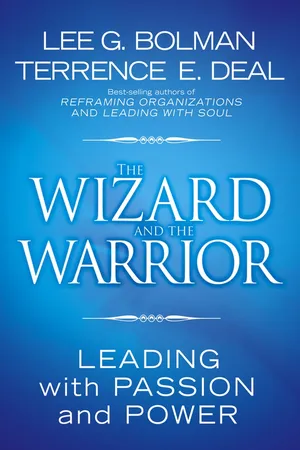
The Wizard and the Warrior gives leaders the insight and courage they need to take risks on behalf of values they cherish and the people they guide. Great leaders must act both as wizard, calling on imagination, creativity, meaning, and magic, and as warrior, mobilizing strength, courage, and willingness to fight as necessary to fulfill their mission. Best-selling authors Lee Bolman and Terrence Deal present the defining moments and experiences of exemplary leaders such as Carly Fiorina, Thomas Keller (head chef of French Laundry), David Neeleman (CEO of Jet Blue), Mary Kay Ash, Warren Buffet, Anne Mulcahy, and Abraham Lincoln¾all of whom have wrested with their own inner warrior and wizard. These engaging, realistic case studies are followed by commentaries that will raise questions and suggest possibilities without rushing to resolution or simple answers.
Information
PART ONE
CONFRONTING THE WIZARD AND WARRIOR WITHIN
Why a book about wizards and warriors as models for leadership? Because, as Peter Drucker once said, everything you learned is wrong. At best, it is misleading and insufficient. You typically learn in school, workshops, and seminars that if you can manage the work and serve the people, you have what it takes. It’s not true. Maybe you have enough stuff to be a pretty good manager, but it takes a lot more to be a good leader.
In our earlier book, Reframing Organizations, we argued that managers need first to get an accurate reading on situations before taking action. The problem, we found, is that they typically relied on two lenses (we call them frames) when they needed four. The two they use focus on structure and people, and both are important and valuable perspectives. They help you become sensible and humane. But they work best in a rational world populated by reasonable people. No one lives in such an orderly world anymore. Today’s organizations are inherently messy and unpredictable.
That’s why bad things keep happening to good managers. They get blindsided. Their career gets stunted or goes off the rails. The boss blames them for things that weren’t their fault. Someone else gets a promotion that they deserved. A coworker flubs a project but tosses the dead cat into their yard. After a particularly devastating day at the office, one disillusioned manager commented, “I thought I had covered all the bases, and then realized that everyone else was playing football. I had a great strategy for the wrong game.”
This happens because managers are running on two cylinders when they need four. Two other frames—political and symbolic—are required to make sense of the roiling, moving targets that organizations serve up every day. They take us into a world dominated by power and passion. The bad news: that’s just where managers are usually weakest. We know this from our research worldwide and across sectors. Inattention to these two ways of thinking and behaving is a debilitating Achilles’ heel.1
Managers shy away from politics because they see its dynamics as sordid or because conflict scares them. They fear losing control and losing out. They cling to the illusion that if organizations were run right, they wouldn’t be political. Most managers have an even harder time grasping the elusive and mysterious influence of symbols. Discounting culture as fuzzy and flaky, they don’t see it, even though it’s there and influencing everything they do. Great leadership doesn’t happen without addressing these political and cultural issues head-on. Leaders cannot afford to stay on the sidelines and play it safe. Someone has to be willing to stand up and put it on the line. That’s why we need more wizards and warriors.
Leaders are defined by their legacy, which is shaped over time from hard decisions they must often make—whether to lay off or not, to fight or withdraw, to merge or go it alone, to go against the grain to achieve more or follow the rules but gain less. At such critical choice points, great leaders access the wizard’s mastery of the symbols and the warrior’s command of power. The wizard role enables them to bring imagination, creativity, meaning, and magic. The warrior role mobilizes strength, courage, and willingness to fight as hard and long as necessary to fulfill their mission.
The wizard and the warrior inhabit two distinct but overlapping worlds. The warrior’s world is a place of combat, of allies and antagonists, courage and cowardice, honor and betrayal, strength and weakness. It is sometimes a world of danger and destruction—war really is hell. One of the noblest and most enduring human quests is the search for peace, for a way to avoid war’s terrible costs. Yet combat and conflict continue to be endemic in human life. A group or organization that has no warriors is at great risk—of being overrun by one that does.
The wizard inhabits a realm of possibility, magic, and mystery. The wizard’s strength lies not in arms or physical courage, but in wisdom, foresight, the ability to see below and beyond appearances. The wizard brings unshakable faith that something new and better really is out there. The tools of the wizard’s trade are values, icons, ritual, ceremonies, and stories that weave day-to-day details of life together in a meaningful symbolic tapestry. An enterprise without wizards is sterile and often toxic. People are out for themselves rather than bonded together by a shared spirit.
The greatest leaders move in and out of both roles, even if they are more comfortable with one or the other. Or they partner with someone who has talent in a role they find hard to assume. Look, for example, at Time magazine’s millennial list of the greatest leaders and revolutionaries of the twentieth century.2 It includes both angels (Pope John Paul II) and devils (Adolph Hitler). Some, like Margaret Thatcher and Mao Zedong, were legendary warriors, known for their steely resolve and zest for combat. But Thatcher and Mao were both talented wizards as well. Others, such as Mahatma Gandhi and Nelson Mandela, were best known for near-miraculous impact on their respective nations, relying more on spiritual than political or military resources. But neither was a stranger to combat. The three U.S. presidents on Time’s list—Theodore Roosevelt, Franklin D. Roosevelt, and Ronald Reagan—all combined the warrior’s courage and strength with the wizard’s alluring magic and hot hope.
What is true for world leaders holds for a growing number of practitioners who have become successful because they have learned to appreciate these fundamental dimensions of power and passion. An example is Dr. Jim Hager, a candidate for National Superintendent of the Year in 2004:
During the first half of this decade, my focus as a superintendent was on improving student learning by concentrating on people and structure. I now spend considerable energy and time dealing with individuals and narrow interest groups bent on immediate satisfaction of their parochial needs and wants, regardless of the consequences for the common good. More time is spent resolving conflicts that roil as special interests compete for power and resources. I also have to devote time and energy to symbolic issues to ensure the essence of public education. Since the current villagers have no sense of the village, today’s superintendent must use rituals, stories, ceremonies and other symbols to transform a splintered culture into a common community focus on shared educational values.3

It is tragic to subject young people, our hope for a better future, to the crossfire of special interests and a cacophony of values. We’ll reap the consequences later on. But it’s not only our nation’s schools at peril. Hager echoes the observations of many other leaders across the country and around the world. Wise leaders in business, health care, the military, and nonprofit endeavors wrestle with the same vexations. Hager has an advantage—he recognizes the political and symbolic challenges he faces and acts accordingly. Many would-be leaders are less fortunate. They persist in believing that creating a humane and rational workplace is enough for high performance. Year after year they are disappointed when their labors fall short.
Wizard and warrior are roles that you can choose to play and learn to play better. This book can help you become more versatile and make better choices, armed with an expanded repertoire of possibilities. Wizard and warrior images are metaphors to help you think on your feet. When, for example, you are in dangerous and highly charged political situations, what are your options? We will provide examples of three kinds of warrior—toxic, relentless, and principled—and feature exemplars who highlight the costs and benefits of each stance. We will also examine the key attributes that warriors need to be successful—mind, heart, skill, and weapons.
When the culture of your enterprise needs tweaking or transforming, what are your wisest moves? We identify three wizardly roles—authentic, wannabe, and harmful—and demonstrate how leaders can inspire, deflate, or destroy a company. To be successful, wizards need to discover their own magic and spiritual core and then summon the collective spirit through example, values, ritual, ceremony, and stories.
We will study defining moments in the lives of famous and notso-famous leaders from different eras and places to illuminate pathways to follow and pitfalls to avoid. Those lessons can provide insight and perspective that will be invaluable in your own defining moments. Knowing when to fight or when to invoke key symbols can determine whether you succeed or run aground.
Consider an example of a university leader under fire. Before he became the seventh commissioner of major league baseball, A. Bartlett Giamatti was the president of Yale University. In 1984, he struggled to cope with a divisive strike that was tearing Yale apart. Clerical and technical workers had walked out, demanding higher wages and better benefits. Students and faculty were sharply divided. The strike was taking a heavy toll. A senior Yale administrator described his experience of the strike as “a pressure cooker, just terrible, horrible. Sheer utter hell.”4 Giamatti was feeling the heat:
No human being enjoys having to have a bodyguard to walk around the campus. No human being enjoys having his family subjected to the kinds of things mine were. No human being enjoys being held up to contempt and ridicule. But no human being who confronts that and then changes all his beliefs about what the place stands for and how money is allocated would be worth very much.5

Talk-show host Phil Donahue called President Giamatti with a provocative invitation: Why not bring the whole mess on my show? Lacking obviously better options, Giamatti replied, “Why not?”
Donahue’s show often pitted two sides of a heated controversy against one another, with the host acting as provocateur. In the show’s first segment, Donahue went after the union and subjected union reps to audience reactions. Next, Giamatti was put on the hot seat. He faced poking and prodding first from Donahue and then from the audience. There were both supporters and opponents, but the opposition was more vocal. Giamatti was barraged with angry criticism. Like a good warrior he took the blows and responded with well-placed jabs. He continually emphasized that university resources were in short supply and that many demands, including those of the strikers, had to be tallied against a finite financial pot. In the giveand-take between Giamatti and the audience it became clear that there were no villains, only distinct interests with legitimate claims. But politically, how could all be satisfied when there wasn’t enough to go around? Some unifying thread was needed.
At the end of the show, each side got one minute for a summation. Giamatti was first, and opened by acknowledging the legitimacy of both sides. Then he switched roles from pugilistic warrior to poetic wizard. His language and posture changed as he launched into a story he had never before told in public. His father, Valentine Giamatti, was a son of Italian immigrants who spoke no English when he started grade school, but eventually became a strong student. When Valentine graduated from high school, he had two options: take a job in a local factory or go to school at the local college, which happened to be Yale. He was able to choose the latter only because Yale admitted people based on ability and supported them according to their needs. Passion in his voice, Giamatti underscored the ability-need formula as a core value that would never be sacrificed to short-term demands so long as he was president. The magic worked. The un...
Table of contents
- Praise
- Title Page
- Copyright Page
- Dedication
- PART ONE - CONFRONTING THE WIZARD AND WARRIOR WITHIN
- PART TWO - WARRIOR ROLES
- PART THREE - THE WARRIOR PATH
- PART FOUR - WIZARD ROLES
- PART FIVE - WIZARDS AT WORK
- PART SIX - THE LEADER’S JOURNEY
- NOTES
- Acknowledgments
- THE AUTHORS
- INDEX
Trusted by 375,005 students
Access to over 1.5 million titles for a fair monthly price.
Study more efficiently using our study tools.
Frequently asked questions
Yes, you can cancel anytime from the Subscription tab in your account settings on the Perlego website. Your subscription will stay active until the end of your current billing period. Learn how to cancel your subscription
No, books cannot be downloaded as external files, such as PDFs, for use outside of Perlego. However, you can download books within the Perlego app for offline reading on mobile or tablet. Learn how to download books offline
Perlego offers two plans: Essential and Complete
- Essential is ideal for learners and professionals who enjoy exploring a wide range of subjects. Access the Essential Library with 800,000+ trusted titles and best-sellers across business, personal growth, and the humanities. Includes unlimited reading time and Standard Read Aloud voice.
- Complete: Perfect for advanced learners and researchers needing full, unrestricted access. Unlock 1.5M+ books across hundreds of subjects, including academic and specialized titles. The Complete Plan also includes advanced features like Premium Read Aloud and Research Assistant.
We are an online textbook subscription service, where you can get access to an entire online library for less than the price of a single book per month. With over 1.5 million books across 990+ topics, we’ve got you covered! Learn about our mission
Look out for the read-aloud symbol on your next book to see if you can listen to it. The read-aloud tool reads text aloud for you, highlighting the text as it is being read. You can pause it, speed it up and slow it down. Learn more about Read Aloud
Yes! You can use the Perlego app on both iOS and Android devices to read anytime, anywhere — even offline. Perfect for commutes or when you’re on the go.
Please note we cannot support devices running on iOS 13 and Android 7 or earlier. Learn more about using the app
Please note we cannot support devices running on iOS 13 and Android 7 or earlier. Learn more about using the app
Yes, you can access The Wizard and the Warrior by Lee G. Bolman,Terrence E. Deal in PDF and/or ePUB format, as well as other popular books in Business & Leadership. We have over 1.5 million books available in our catalogue for you to explore.