- English
- ePUB (mobile friendly)
- Available on iOS & Android
eBook - ePub
About this book
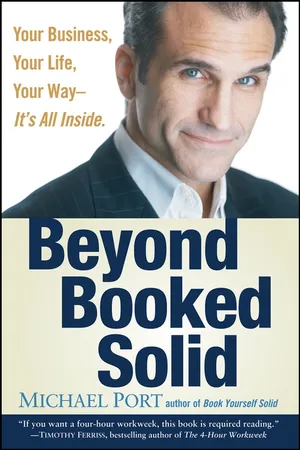
In Beyond Booked Solid, Michael Port returns with new tactics for growing your business even bigger. Port's Book Yourself Solid was a huge hit among professional service providers and small business owners who learned to master the art of attracting clients and keeping them happy. In this book, he helps your business keep growing by taking the next step, beyond booked solid. That means maximizing your business while working less and earning more. This is the ultimate guide for your growing business.
1
How and Why—Doing and Being
In all living there is a certain narrowness of application which leads to breadth of power. We have to concentrate on a thing in order to master it. Then we must be broad enough not to be narrowed by our specialties.
—Ralf W. Sockman
So you want to go beyond booked solid? Great. Now what? Before we plunge in, let’s understand the framework of our future success—what I call the how and the why: how we will build a bigger, better business and why we will achieve our objective.
Going beyond booked solid means working on your business. E-Myth author Michael E. Gerber best describes this idea of working on your business while working in your business. Working in your business is making sure the service or the product you offer to the market is as good as it can be. You’ve successfully figured out how best to work in your business. That’s why you’re booked solid. Now you need to work on your business. Working on your business refers to the improvements you can make in everything from how you approach your business, to how it’s structured, to the systems you have in place to help you run the business. There’s a catch: You can’t just stop working in your business to focus on the business. You need to work “on” your business, while working “in” your business. This allows you to make money and to get real-time results at the same time. It helps you to create, produce, and sustain your business faster. It is how you will succeed.
However, it’s not enough to work in and on your business. To that, let’s add while working on yourself. Your business is a reflection of who you are and what you can handle. And, of course, the real bottom line is your life—and enjoyment of it. You can work all you want, but if in the end you are dissatisfied with your life, unfulfilled, and alienated from your family and friends because you never see them, what’s the point? As we work through this book, keep in mind what it’s all for. It’s important to stay tuned in to your needs from the beginning. Working on yourself is about more than just your personal well-being. It’s about your professional and business well-being, too. It’s about having your business, and your life, your way. It is why you will succeed. It is why you will be able to absorb and to implement the extraordinary amount of content—tools, methods, and strategies to build your business—that you will find in these pages.
Where to start? That’s a question that can stop a project cold. You might feel overwhelmed by the number of things you can list right off the top of your head to do to work on your business, not to mention all the work you have to do in it. Then I come along with this book and suggest, for example, that you design a new architecture for your business. And that’s just one piece of how you will work on your business. But showing you how to work on your business is not enough. I will also show you why some people succeed and others don’t. Why? To go beyond booked solid, you’ll need to learn how to let go of some of your old ideas and get creative in your business—innovate. This innovation process requires you to open yourself up to new ideas, to find new ways of being—that’s why I call it working on yourself.
Innovation
Maybe you’re thinking, “It’s business. What’s this about opening up?” Here’s why. Creating and sustaining a business at a new, higher level requires innovation. Without innovation, your ideas, the new business architecture you’ll design, will stay just that—ideas and dreams. Innovation starts with you. Every successful entrepreneur, indeed every successful person, is an innovator. You might be saying to yourself, “Not me, I’ll never invent the lightbulb.” Don’t confuse the idea of innovation with the idea of invention. Innovation is an inward-and outward-looking process. It is an essential part of the process of self-actualization or the pursuit of mastery, a concept I think is vital to success.
An innovator can change perspective and adopt new habits. Innovation is changing the way you do and see things. It is asking yourself, “How will I view my business differently today than I did yesterday?” I know you’re ready to do that because you’re reading this book. Of course, it is possible to shift perspective without taking deliberate action. We’re going to do more than that. We are going to develop new perspectives (that’s why this approach works) and then adopt new goals and new practices to reach those goals (that’s how this approach works).
For many people, innovation can be overwhelming. It can be scary. We can feel trapped by our business, stuck in habits, practices, and perspectives. “I conduct seminars,” you might think. The idea of webinars or monthly newsletters may seem beyond your reach. You feel safe with your present practices. I know. I’ve been there. I still am, because it’s not a one-shot deal. You can’t innovate and be done with it. Innovation, building a bigger, better business, is an organic process, iterative and ongoing. Every time you solve a problem or meet a challenge, a new one presents itself. It is a process of creation, maintenance, and destruction followed by re-creation and so on. It’s very rare to be able to dust off your hands and say, “Now then, I’m done.”
Hal Macomber, whose insight was invaluable to this book, likes to use the orange juice carton example to illustrate this cycle of innovation. For a long time, orange juice was sold in cardboard cartons with cardboard spouts. But orange juice in this form (i.e., not frozen concentrate) didn’t last very long. So something had to be done to give the orange juice longer shelf life. Pasteurization turned out to be the answer, which was great, except for one thing: Orange juice (which is a long-lasting acid liquid) degraded the cardboard spout. One challenge solved, another presented. Something had to be done, or the paperboard industry couldn’t supply cartons to the orange juice producers anymore. The next innovation was the plastic spout on the cardboard juice container. Great, again. Of course, the plastic spout likely brought its own new challenges, but we won’t get into those. As each new hurdle is overcome, another presents itself. And the cycle repeats again and again.
If you want to go beyond booked solid, you’ll need to take the plunge and become an innovator. I’ll show you that it’s not nearly as daunting as it seems. In fact, it can and should be exhilarating, which is not to say it won’t be hard work—it will be, but that’s okay because in the end you’ll be earning more and working less, and the process of innovation will continue. On top of that, you’ll be experiencing the deep sense of purpose that comes from the pursuit of mastery.
What does it really mean to innovate? Divesting the busywork that takes up too much of your time, which would be better spent with your clients on your “real” work—that’s innovating. Figuring out how to outsource the mechanisms for keeping in touch with clients through regular mailings or other contact—that’s innovating. Implementing new record-keeping systems—that’s innovating. Finding little ways to alleviate annoyances—that’s innovating. Restructuring your business so it’s built for growth, while at the same time lightening your load—that’s innovating.
In fact, this whole book is about innovating—learning and developing new ways of doing things, and committing to mastery. Now that you’re booked solid, what you want next is up to you. It’s not just about choosing and implementing. It’s not about becoming remarkable—because being able to keep a business afloat is a remarkable achievement in its own right. You’ve already done that and better. You’re booked solid or on your way. Innovating is about being able to create a new story for your future without being trapped by your past. It means being someone who can simultaneously transcend their history to achieve goals well beyond their standard expectations, while at the same time respecting and incorporating the best of what they’ve learned from their past (being what’s called ahistorical.) This book suggests a way of engaging in the world that will keep you innovating, creating (and recreating) the business you want.
Real life is messy. Be prepared to leap ahead at points and circle back at others. You’ll be cultivating your innovation skills at the same time that you’re building your new architecture. You’ll be implementing systems at the same time that you’re choosing the right business building blocks. Your business, like life, is an always changing, dynamic enterprise. The most importantly thing might be flexibility. Like the tree that bends in the wind but doesn’t break, you need to be open and resilient. It’s a lifelong process. So, we’ll talk, too, about how to stay on course. That said, here goes.
Where You Are
If you are booked solid, you are in one of two camps: Either you are pleased with the size of your business but would like to increase your fees, spend fewer hours working, and feel more confident using your Red Velvet Rope Policy (I talked about this policy in Book Yourself Solid; it is your filtration system that ensures you work with ideal clients who energize and inspire you and, most importantly, allow you to do your best work); or you want to significantly grow your business and serve many more people, open more locations, and hire more staff. In both cases what you will learn to do is leverage more so you work less. When I say “bigger,” that can mean more profitable but not necessarily a larger operation. It’s a matter of scope.
Your instinct might be to resist implementing the new ideas you’ll find in these pages: you are not sure whether they will work, whether your customers will like them, or whether you can maintain the current business while building the new business. The changes to your business can’t and won’t happen overnight. You are already too busy. But it will happen. It might involve a change in attitude and a little extra work for a while, but the long-term payoff of working more efficiently will profoundly change your future. And that’s what this book is about—your future.
Designing your business architecture is an ongoing process—the business is never complete, just as people are never complete. We are all a work in progress. Getting a degree, getting married, or starting your business may seem like end goals while you are working toward them, but they are really just starting points for the ever-evolving landscape of your life. Going beyond booked solid is committing to a life of mastery, always making changes and striving to improve.
Let’s look at how you will grow a bigger, better business and why you will succeed.
2
Decide—The Change You Want to Make
Nothing is more difficult, and therefore more precious, than to be able to decide.
—Napoleon I
You’re booked solid. Now what?
Bigger is not always better, says Seth Godin, author of Small Is the New Big. And he may be right. What you are changing is the scope of your business. The scale may change, too, but it’s not a requirement of moving beyond booked solid. Don’t make assumptions regarding what you should do with your business. Even if you are perfectly clear on what you want to do, what I propose is that you consider multiple alternative structures for your emerging business. I’d like to help you choose your direction. I don’t want you to end up at the top rung of the ladder only to realize that you’ve climbed to the wrong destination. The choices you make are critical. Now that you’re booked solid, or are on your way, there’s a great deal at stake. You have less time to experiment and more expectations to meet based on promises that you’ve been making to your customers, associates, and partners (never mind promises you’ve made to family, friends, and yourself about where you want your life to be). This chapter offers a set of options to consider and to help you crystallize your vision and stoke your imagination. The actions you will ultimately take as a result of this thinking are a crucial part of how you will grow.
You may resist some of the suggestions or options. You may have preconceived notions and expectations that are limiting your growth. We all do. If you’ve believed something for a long time, it’s understandable that you may reject an alternative belief or option without reflecting on it fully or experiencing the alternative. If it were easy to build a bigger, better business that leverages the power of people and processes, then everyone would do it at the earliest possible moment. When you feel yourself resisting, consider why you feel constrained. Is the constraint real or self-imposed (self-inflicted)?
I have found, and continue to find, this process challenging. Over time, many of my beliefs and assumptions have been shattered. I’ve gotten knocked off my feet by a wave, only to stand up and get knocked down again. But I know in my heart that character is built not by chance, but by the number of times I keep getting back up. I’ve come to see the entrepreneurial initiative as an opportunity to lose something every day—something holding me back—and in the process earn success.
I once heard it said that the only person who likes change is a baby with a dirty diaper. Change is such an extraordinary, sometimes uncomfortable thing, isn’t it? So many of us crave it but fiercely resist it, fueling an ever-escalating inner civil war. In our society, we may have taken the privilege of comfort too far. It’s so easy to stay comfortable. Too warm? Adjust the air-conditioning another degree cooler. Too cold now? Turn the heat up a few degrees. We insulate ourselves against anything that is the least bit uncomfortable. I’m not talking about the extreme discomfort of not having a roof over your head or of being the victim of abuse or some other horrible circumstances. I’m talking about the everyday entitlement that leads us to believe that everything we want should be handed to us, that mastery can be attained through a bit of dabbling or by short bursts of obsessive attention.
I believe the process that we go through in this book will be rewarding if you are willing to purposely create a certain amount of discomfort for yourself, your associates, and probably for your family and friends, too. You will become more comfortable with discomfort. Then big things will happen. The goal is not making changes simply for the sake of change, but rather for the sake of continuing to serve the people you’re meant to serve and, at the same time, fulfill your destiny.
To help determine the best course of action for you, let’s establish where you are now, and then let’s see which of the two scenarios that follow best represents your situation.
Current State
You have a decent stable of clients who like (maybe love) you. You’re making ends meet. You love working with your clients; spending time with them; and dealing with their issues, needs, and desires (but maybe not as much as you used to). You’re relatively comfortable, except that you are spending a considerable—okay, a ridiculous—amount of time on stuff you hate doing and may not be very good at doing. You’re missing time with your family and friends. You’ve all b...
Table of contents
- Praise
- Title Page
- Copyright Page
- Dedication
- Acknowledgments
- Preface
- Chapter 1 - How and Why—Doing and Being
- Chapter 2 - Decide—The Change You Want to Make
- Chapter 3 - How Do You Feel about the Future?—Be Disposed toward Success
- Chapter 4 - Business—Building Blocks
- Chapter 5 - How Can You Get There?—Preparing Yourself for the Future
- Chapter 6 - The Right Architecture for You—and Keeping It Flexible
- Chapter 7 - What Do You Need to Get There?—What You Have, What You Need
- Chapter 8 - What Do You Want?—Defining and Measuring Your Objectives
- Chapter 9 - Projects—How to Get Things Done
- Chapter 10 - Systems—A Business That Runs Itself
- Chapter 11 - How To—Hire Others, Outsource, and Leverage Yourself
- Chapter 12 - Integrate—People and Process
- Chapter 13 - Live—The Balance
- Chapter 14 - Case Studies—Real People, Real Businesses
- Bibliography
- Index
- About the Author
Trusted by 375,005 students
Access to over 1.5 million titles for a fair monthly price.
Study more efficiently using our study tools.
Frequently asked questions
Yes, you can cancel anytime from the Subscription tab in your account settings on the Perlego website. Your subscription will stay active until the end of your current billing period. Learn how to cancel your subscription
No, books cannot be downloaded as external files, such as PDFs, for use outside of Perlego. However, you can download books within the Perlego app for offline reading on mobile or tablet. Learn how to download books offline
Perlego offers two plans: Essential and Complete
- Essential is ideal for learners and professionals who enjoy exploring a wide range of subjects. Access the Essential Library with 800,000+ trusted titles and best-sellers across business, personal growth, and the humanities. Includes unlimited reading time and Standard Read Aloud voice.
- Complete: Perfect for advanced learners and researchers needing full, unrestricted access. Unlock 1.5M+ books across hundreds of subjects, including academic and specialized titles. The Complete Plan also includes advanced features like Premium Read Aloud and Research Assistant.
We are an online textbook subscription service, where you can get access to an entire online library for less than the price of a single book per month. With over 1.5 million books across 990+ topics, we’ve got you covered! Learn about our mission
Look out for the read-aloud symbol on your next book to see if you can listen to it. The read-aloud tool reads text aloud for you, highlighting the text as it is being read. You can pause it, speed it up and slow it down. Learn more about Read Aloud
Yes! You can use the Perlego app on both iOS and Android devices to read anytime, anywhere — even offline. Perfect for commutes or when you’re on the go.
Please note we cannot support devices running on iOS 13 and Android 7 or earlier. Learn more about using the app
Please note we cannot support devices running on iOS 13 and Android 7 or earlier. Learn more about using the app
Yes, you can access Beyond Booked Solid by Michael Port in PDF and/or ePUB format, as well as other popular books in Business & Sales. We have over 1.5 million books available in our catalogue for you to explore.