- English
- ePUB (mobile friendly)
- Available on iOS & Android
eBook - ePub
About this book
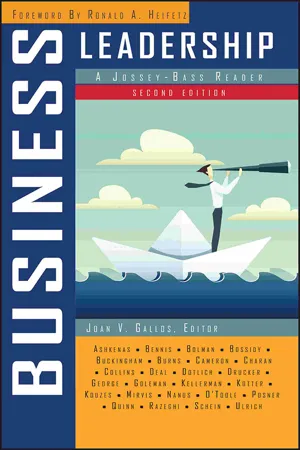
The second edition of best-selling Business Leadership contains the best thinking on leadership from the biggest names in the business. It offers leaders everything they need to know to prepare for today's—and tomorrow's—leadership challenges: how to understand the leadership process, identify opportunities, get things started right, avoid predictable pitfalls, and maximize success. Effective leaders use mind, heart, and spirit in their work, and this volume is designed to guide and support leaders in their efforts. With an introduction by Joan V. Gallos—editor of the highly praised Organization Development: A Jossey-Bass Reader—the author list for this invaluable resource reads like the who's who of business leadership.
Information
Part One
Framing the Issues: What Is Leadership?
The chapters in Part One offer answers to the basic question, What is leadership? They remind us that leadership is a complex social process, rooted in the values, skills, knowledge, and ways of thinking of both leaders and followers. Leadership always involves adaptive change, as Ronald Heifetz notes in the Foreword to this volume, and we think too simply when we equate leadership with the search for a simple answer to a current problem. Leaders help us understand our current reality and forge a brighter future from it. They see new opportunities, and manage a complex interactive process that supports individual and collective growth. In the process of this work, leaders face critical choices based on their reading of the circumstances, the individuals involved, and the possibilities that they see. And although there is widespread agreement that leadership is important and that effective leadership is vital, there is less clarity about what that really means or how that translates into effective action.
The word leadership has become an incantation, cautions John Gardner (1993), and its meaning has risen above common workplace usage. “There seems to be a feeling that if we invoke it often enough with sufficient ardor we can ease our sense of having lost our way, our sense of things unaccomplished, of duties unfulfilled” (p. 1). This kind of thinking clouds our perspectives toward everyday leaders and leadership—and makes it hard to understand how ordinary people can successfully wear the mantle. It also keeps us from looking below the surface—beyond leadership’s aura—so that we fail to fully appreciate what leadership is and how it works.
The chapters in this section decompose leadership. They distinguish leadership from other forms of influence, like power, authority, and dominance; identify essential elements and skills; and correct common myths about leading. Together they offer the basis for a grounded framework and help us see that success requires
- A simple, not simplistic, definition of the leadership process
- Insight into one’s purpose for leading
- Understanding of the organizational context in which one leads
- Appreciation for the unique challenges and opportunities inherent in each situation
- Clarity about what one brings to the leadership table
Savvy leaders develop their own conceptual framework about all this, a repertoire of skills to call upon, capacities for self-reflection and learning from experience, and a healthy respect for the difficulties and risks. The authors in this section provide rich opportunities to think more systematically about leadership basics, applications, and competencies for success.
Part One begins with a classic article from the Harvard Business Review by John P. Kotter, “What Leaders Really Do.” This chapter explores the seminal distinction between leadership and management, identifying the two as complementary functions that contribute significantly and in their own ways to organizational effectiveness. Managers, says Kotter, bring order from chaos through planning, organizing, and controlling. Leaders, in contrast, help organizations cope with change and opportunity by focusing on vision, network building, and the relationships needed for a strong organizational future.
Good leadership is emotionally compelling. Effective leaders inspire and motivate, and those who know how to bring out the best in themselves and others help their organizations to thrive and grow. In fact, say Daniel Goleman, Richard Boyatzis, and Annie McKee, the core of leadership lies in leaders’ abilities to manage their own and others’ emotional responses to each situation. The three authors explore the foundational role of emotional intelligence in leadership in Chapter Two, “Primal Leadership: The Hidden Power of Emotional Intelligence.”
Leadership is about the ongoing process of building and sustaining a relationship between those who aspire to lead and those willing to follow. In Chapter Three, “The Five Practices of Exemplary Leadership,” an excerpt from their best-selling book The Leadership Challenge: How to Keep Getting Extraordinary Things Done in Organizations, James M. Kouzes and Barry Z. Posner explore common patterns of action at the core of effective leadership. Authenticity, initiative, courage, and inspiration, as well as the abilities to frame engaging opportunities, foster collaboration, and empower others—qualities available to all no matter where they sit in the hierarchy—can enable groups of ordinary individuals to accomplish extraordinary things.
Leadership is multidimensional in skill and orientation. Successful leaders need to understand people and organizations, tasks and processes, self and others. They must attend to current realities while envisioning future possibilities, and need confidence and strategies for working competently across a wide range of diverse issues—from fostering the organizational clarity that comes from sound structures and policies to unleashing energy and creativity through bold visions, from creating learning organizations where workers mature and develop as everyday leaders to managing the conflict inevitable in a world of enduring differences. Leaders use mind, heart, and spirit in their work and require a map to guide and direct their shuttling among multiple organizational levels, processes, issues, and domains.
In Chapter Four, “Reframing Leadership,” Lee G. Bolman and Terrence E. Deal propose four sets of common organizational issues or frames—structure, people, politics, and symbols—as a way to sort the myriad activities and concerns that compete for a leader’s attention. Organizations are simultaneously sets of structural arrangements and practices, opportunities for human contribution, political arenas for negotiating differences, and creative outlets for individual passion and collective purpose. Successful leaders realize this, consciously balance their attention across all four sets of issues, and reframe—discipline themselves to deliberately view a situation or challenge from multiple perspectives.
Leadership is a human invention and process, and it is tempting to equate successful business leadership with a powerful CEO or charismatic senior executive. Although these individuals may indeed bring leadership to their organizations, James O’Toole reminds us in Chapter Five, “When Leadership Is an Organizational Trait,” that overreliance on a single heroic figure distorts appreciation of leadership as an organizational function. High-performing companies, O’Toole has found, institutionalize the central tasks and responsibilities of leadership by incorporating them into their organizational cultures, systems, policies, and practices. In the process they avoid overreliance on one individual, compensate for weakness and leadership gaps at the top, and build organizational systems and structures of shared accountability that withstand the test of time, shifting markets, and succession plans.
Reference
Gardner, J. (1993). On leadership. New York: Free Press.
Chapter One
What Leaders Really Do
John P. Kotter
Leadership is different from management, but not for the reasons most people think. Leadership isn’t mystical and mysterious. It has nothing to do with having “charisma” or other exotic personality traits. It is not the province of a chosen few. Nor is leadership necessarily better than management or a replacement for it. Rather, leadership and management are two distinctive and complementary systems of action. Each has its own function and characteristic activities. Both are necessary for success in an increasingly complex and volatile business environment.
Most U.S. corporations today are overmanaged and underled. They need to develop their capacity to exercise leadership. Successful corporations don’t wait for leaders to come along. They actively seek out people with leadership potential and expose them to career experiences designed to develop that potential. Indeed, with careful selection, nurturing, and encouragement, dozens of people can play important leadership roles in a business organization.
But while improving their ability to lead, companies should remember that strong leadership with weak management is no better, and is sometimes actually worse, than the reverse. The real challenge is to combine strong leadership and strong management and use each to balance the other.
Of course, not everyone can be good at both leading and managing. Some people have the capacity to become excellent managers but not strong leaders. Others have great leadership potential but, for a variety of reasons, have great difficulty becoming strong managers. Smart companies value both kinds of people and work hard to make them a part of the team.
But when it comes to preparing people for executive jobs, such companies rightly ignore the recent literature that says people cannot manage and lead. They try to develop leader-managers. Once companies understand the fundamental difference between leadership and management, they can begin to groom their top people to provide both.
THE DIFFERENCE BETWEEN MANAGEMENT AND LEADERSHIP
Management is about coping with complexity. Its practices and procedures are largely a response to one of the most significant developments of the twentieth century: the emergence of large organizations. Without good management, complex enterprises tend to become chaotic in ways that threaten their very existence. Good management brings a degree of order and consistency to key dimensions like the quality and profitability of products.
Leadership, by contrast, is about coping with change. Part of the reason it has become so important in recent years is that the...
Table of contents
- Cover
- Contents
- Title
- Copyright
- Dedication
- Foreword
- Introduction and Acknowledgments
- About the Editor
- Part One: Framing the Issues: What Is Leadership?
- Part Two: Becoming a Leader, Preparing for the Opportunities
- Part Three: Understanding the Territory, Anticipating the Challenges
- Part Four: Making It Happen
- Part Five: Sustaining the Leader
- Credits
- End User License Agreement
Trusted by 375,005 students
Access to over 1.5 million titles for a fair monthly price.
Study more efficiently using our study tools.
Frequently asked questions
Yes, you can cancel anytime from the Subscription tab in your account settings on the Perlego website. Your subscription will stay active until the end of your current billing period. Learn how to cancel your subscription
No, books cannot be downloaded as external files, such as PDFs, for use outside of Perlego. However, you can download books within the Perlego app for offline reading on mobile or tablet. Learn how to download books offline
We are an online textbook subscription service, where you can get access to an entire online library for less than the price of a single book per month. With over 1.5 million books across 990+ topics, we’ve got you covered! Learn about our mission
Look out for the read-aloud symbol on your next book to see if you can listen to it. The read-aloud tool reads text aloud for you, highlighting the text as it is being read. You can pause it, speed it up and slow it down. Learn more about Read Aloud
Yes! You can use the Perlego app on both iOS and Android devices to read anytime, anywhere — even offline. Perfect for commutes or when you’re on the go.
Please note we cannot support devices running on iOS 13 and Android 7 or earlier. Learn more about using the app
Please note we cannot support devices running on iOS 13 and Android 7 or earlier. Learn more about using the app
Yes, you can access Business Leadership by Joan V. Gallos in PDF and/or ePUB format, as well as other popular books in Business & Business Strategy. We have over 1.5 million books available in our catalogue for you to explore.