eBook - ePub
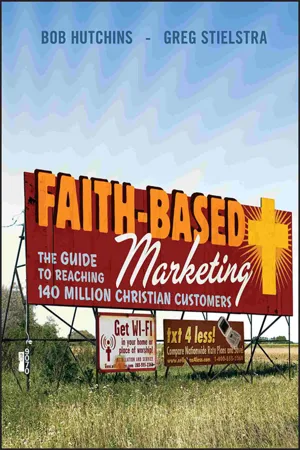
Faith-Based Marketing
The Guide to Reaching 140 Million Christian Customers
- English
- ePUB (mobile friendly)
- Available on iOS & Android
eBook - ePub
Faith-Based Marketing
The Guide to Reaching 140 Million Christian Customers
About this book
Most businesses don't have a good understanding of the faith community and how to market to this huge audience in effective, culturally sensitive ways. Many attempts to market to Christians have backfired, because the marketers had little understanding of Christians' values, taboos, and "hot buttons". Yet the size of the opportunity is enormous. Faith-Based Marketing provides everything business leaders need to understand 140 million Christian consumers and effectively reach them. It explains who Christians are, what they want, and provides traditional, new media, and word-of-mouth strategies to communicate with and engage them and their churches. The book also includes a valuable directory of top Christian organizations, churches, and events, to help marketers and business leaders find out whom to contact and how. The book includes a free subscription to a companion website with bonus content.
PART I
MEET THE CHRISTIAN CONSUMER
CHAPTER ONE
THE OVERLOOKED 140 MILLION PERSON MARKET
It’s Super Bowl Sunday, and crowds begin to gather. Space by space parking lots fill as attendants direct vehicles to open spots farther and farther from the huge edifice. People stream from their cars and head toward the sidewalks—a confluence of humanity emptying into a sea of men and women pressing toward the entrances.
Pulled irresistibly by their common passion, people all across the country follow a similar ritual. Many attend in person; still others listen on the radio or watch on television or the Internet. In total, more than 140 million men, women, and children take part in this weekend spectacle. They are rich and poor, young and old, black, white, Asian, and Hispanic. They form a collection of consumers whose combined spending power totals more than $5.1 trillion annually!
It was the Holy Grail for marketers, but is not what you think. It was Super Bowl Sunday all right, but this was not the Super Bowl. Kick-off for the big game was still more than eight hours away.
This is the church.
Companies that will spend more than $3 million for a 30-second spot during the Super Bowl are missing an even greater opportunity. Surprisingly, the Super Bowl isn’t the biggest marketing opportunity of the year. It’s not even the biggest opportunity on Super Bowl Sunday. A prize far more tantalizing arrives every Sunday morning for those who know where to find it and how to access its power. If you haven’t spent much time in church—or even if you regularly attend your church of choice—you may not think of church as a potential target for your marketing efforts, but several recent success stories have awakened many in the business world to the size and scope of the U.S. Christian community.
Fully nine out of ten Americans say they believe in God or a higher power, according to most polls. Despite growing religious diversity, the vast majority of Americans define themselves as Christians. In an NBC/Wall Street Journal survey conducted in September 2008 (http://www.online.wsj.com/public/resources/documents/WSJ_NBCPoll_092408.pdf), three-fourths of the respondents identified themselves as Protestants or Catholics. And reliable pollsters such as the Gallup Poll, the Institute for Social Research’s World Values, and the National Opinion Research Center report that from 40 to 45 percent of Americans regularly attend church. Not exactly a tiny niche when it comes to marketing, as many large companies have discovered.
Fueled by a church-based campaign, The Purpose Driven Life, a book explaining God’s five purposes for successful living, sold 30 million copies in three years to become the fastest-selling hardcover in U.S. history—faster than any Harry Potter book, faster than a John Grisham novel, faster even than the Bible, the all-time best-selling book in history. The book’s author and publisher set aside conventional marketing wisdom to rely on their vast knowledge of the church and the behavior of Christian consumers, demonstrating an important principle we will discuss in this book: To reach this $5.1 trillion market, you need to understand it. Intimately. And we will show you how to do that.
While The Purpose Driven Life is a phenomenal success story, it’s not the only one. Mel Gibson’s blockbuster movie, The Passion of the Christ, grossed over $551 million in its first nine weeks despite the use of obscure foreign languages, English subtitles, harsh criticism, and a comparatively modest marketing budget. Instead of wasting precious marketing dollars on traditional strategies, Gibson and his producers focused their efforts on church leaders and Christian opinion shapers who then became voluntary consumer evangelists to more than half of the U.S. population that regularly attend church. Just one example: 100,000 pastors were e-mailed, asking them to mention the movie in a Sunday sermon; much smarter—and far less expensive—than running trailers on expensive television ads. But you don’t just randomly collect e-mail lists and start plugging your product. You need to understand the difference between a dispensational Baptist and a Missouri Synod Lutheran, or you’ll do more harm than good. And we can help you with that, too.
Still need convincing that faith-based marketing is more than a niche? Look at the past two presidential elections. In 2004, many pundits credit the Bush campaign for tapping into the power of the nation’s Bible-belted red states. And both candidates in 2008 poured millions of dollars into trying to reach the nation’s evangelicals, a subset of the total Christian market. And whether you think it was genuine or pandering, both candidates took great pains to explain their own Christian beliefs, further indication that they understood the power of the faith-based community.
On any given Sunday, 44 percent of Americans are in church. Can you name a larger group that demonstrates such a singular behavior so consistently? Okay, nearly nine out of ten workers commute to work by car, which is why radio is such a great way to market to consumers. Have you ever targeted your marketing to Hispanics (14 percent of the population), African Americans (11 percent), or retirees (12 percent)? You should, but what if you could reach a demographic larger than those three combined and do it effectively and economically? You can, but you may need to change the way you think about those “religious people.”
Christians are not the tiny lunatic fringe so many once thought. Rather, they form a global network of immense size and power comprised of every country, every social or ethnic group, and every economic stratum. Christians now number 2.3 billion or one out of every three people on the planet. That’s nearly as large as China and India combined.
Okay, maybe you’re not the marketing director for a Hollywood film company or a multinational, global conglomerate; instead, you own a hardware store in a midsize city. Can you grow your business by focusing some of your marketing efforts on people of faith? Absolutely. Forty-four percent of the people living in your community go to church regularly and take their faith seriously. They need to buy garden tools, snow shovels, and paint, just like anyone else. They can choose from among several retailers to buy those products, but if you could learn how to reach them effectively—if you can develop a relationship with them—they will choose you over your competition. But it takes more than putting a religious symbol in a display ad in your local newspaper. Just like any other affinity group, you need to know who they are, what’s important to them, and what their needs are. You also need to know how to communicate with them without offending them.
In November 2007, the home improvement chain, Lowe’s, sent out a flier that contained an advertisement for “Family Trees,” which looked an awful lot like the trees people decorate in their homes during the Christmas season. Lowes received more than 100,000 e-mails from Christians protesting the removal of the word “Christmas,” and Lowe’s responded with an apology and a return to calling Christmas trees, well, Christmas trees. “It was not our intention to try and be politically correct or to take the significance of Christ out of Christmas,” company spokeswoman Karen Cobb replied. Regardless of their reasons for changing the name of Christmas trees, Lowe’s learned an important lesson: if you want to do business with Christians, you need to know what’s important to them or you could unintentionally offend them. Had they done some research before selecting a new name for Christmas trees, they would have spared themselves a major public relations blunder.
On a more positive note, consider how many local grocery stores have reached out to churches by offering to donate a percentage of their revenue on a particular day. The church promotes this for several weeks ahead of time (free advertising), and on the appointed day the grocery store has a record number of customers show up (more traffic). Increased sales for the store, greater exposure to new customers, and the church gets a nice check to help send their youth group on a mission trip.
The buying power of Christians is evident in the way teenage Christians purchase music. According to Dan Michaels, vice-president of marketing and promotion for INO Records, a Christian label, it’s not unusual for a Christian recording artist to sell into the millions of CDs. One of his own artists, the popular band, Mercy Me, has sold more than four million CDs since they were launched in early 2,000. “Christian parents support their kids’ interest in our music because of the positive message it conveys,” Michaels explained. “You don’t always have that with other genres.”
People of faith are the largest niche in your market. Whether you are selling cars or carpet, they represent a significant portion of your overall market. You can hope that your current marketing strategies will reach them, and they might. But your competition will be doing the same thing, so to grow your business, you need an edge. We hope to give you that edge in this book, but first, a few words of caution.
COMMERCIALIZING CHRISTIANITY?
We almost hesitate to describe the size of the faith-based market because it could produce unhelpful responses from two groups. Businesses might mistakenly see only dollar signs, while Christian consumers might only see businesses seeing dollar signs. In other words, everyone might jump to the conclusion that the sole purpose of this book is to help businesses make a lot of money off of Christians. To be absolutely truthful, if you apply the principles we outline in this book, your business should benefit financially, but our overarching purpose isn’t to help businesses make more money by exploiting Christians because that will only produce short-term gains and long-time resentment. Money is basically the best measure for how well a business conducts itself in every area, from producing a product to marketing it, to selling it to treating its employees fairly, and so on. We want to help your business grow, which means you will make more money, and we feel the best way to do that is to understand and respect the faith-based community. So here’s what we would say to both groups who may be either overly optimistic or skeptical about mixing business and faith.
First, to businesses: if you’re only interested in exploiting Christians, this book will not be much help. We won’t provide you with ways to exploit Christians or anyone else. However, if you are interested in creating long-term, loyal customers who will choose your business over your competition, this book is for you. Our goal is to help you better understand the Christian community—their needs, their aspirations, and the reservations some have about you—so that you make more money. If you have a product or a service that will improve the lives of Christians—one that they will truly value—and you carefully follow the principles we outline, you will increase your chances of partnering with Christians in a manner that will result in long-term financial growth.
And to our fellow Christians who may be suspicious about mixing commerce and faith, our goal is to erase the unfair caricatures you’ve endured and give the business community a more accurate picture of you, your faith, and your traditions. We believe that if businesses know you better, they can serve you better. If you receive better service from a company, you are more likely to do business with it because your needs are being met. So in the end, both you and the business win, and that is our motivation for writing this book—to build a better relationship between business and believers so that both benefit. If a business truly understands Christians then it will be more likely to accommodate them and less likely to do things that offend. If Christians understand businesses better, they will be able to make more intelligent choices about the products and services they buy.
MARKETING TO CHRISTIANS (OR ANYONE ELSE)
John B. is an independent insurance agent in a midsize city in Illinois. As competition in his area increased, he began looking for better ways to target his modest advertising budget. Sitting in church one Sunday, he looked around and thought there had to be a way to reach people just like him with information about the various types of insurance he sold. Feeling only mildly guilty for daydreaming about his job during church, he nonetheless made a mental note to call the pastor Monday to see what it would cost to place a banner ad on the church’s web site. He was surprised—and a little miffed—to learn that the church had a policy forbidding advertising on its web site. But then he had an idea: “Maybe I could teach a free one-day seminar on insurance.” He called the pastor, who loved the idea, and four weeks later John was in a meeting room explaining insurance to 45 couples.
Even though John was active in his church, he didn’t fully understand the challenges he would face marketing to his own church. While it is true that the church represents a huge opportunity for successful marketing, ignorance of the church could close that door of opportunity. Many churches are a little leery of mixing business with ministry, even to the point of not allowing any kind of commercial enterprise to access its constituents. There are legitimate reasons for this but before we share them with you, we need to be clear about what we mean when we say marketing.
Many consumers—Christian and otherwise—view marketing as an annoying attempt to trick them into buying something they don’t need. Unfortunately, we’ve met people in the marketing profession who pretty much live down to that description. But as a professional marketer, you know that any attempt to force people to buy something, exploit them, or otherwise get them to do something they don’t want to do will ultimately fail. The best example of that occurred when Coca-Cola, normally brilliant marketers, tried to force “New Coke” on their consumers in 1985. After secretly working on a new formula to replace the most popular cola beverage in the world, they rolled out New Coke on April 23 with a massive television and print ad campaign, which was flatly rejected by consumers. Sales of the new beverage plummeted as people began paying up to $30 a case for the old coke and hoarding as much as they could get their hands on, fearing it would never again be available. Less than three months later, on July 11, Coca-Cola pulled the plug on its new product, replacing it on store shelves with the old formula, which it dubbed “Classic Coke” to further reassure consumers their favorite cola was back. According to Sam Craig, professor of marketing and international business at the Stern School of Business of New York University, Coca-Cola marketers failed to ask the critical question of its consumers: “Do you want a new Coke?”
Successful marketing always begins with the consumer—understanding what she needs or values. To the extent that you will become successful in marketing to Christians, you will need to understand them, know what they are passionate about, respect what they believe and why, and discover what they need to improve their lives. Like Coca-Cola, you might think every Christian organization in the country will love your product, but unless you’re willing to make the commitment to fully understand this dynamic consumer group, you run the risk of wasting a lot of your company’s time and resources.
Marketing is identifying people with needs and connecting them to the product or service that can...
Table of contents
- Title Page
- Copyright Page
- Acknowledgements
- Introduction
- PART I - MEET THE CHRISTIAN CONSUMER
- PART II - HOW TO MARKET TO CHRISTIANS
- PART III - KEY RESOURCES FOR CHRISTIAN MARKETERS
- MARKETING FIRMS
- PUBLIC RELATIONS FIRMS
- FILM AND VIDEO PRODUCTION
- MUSIC FESTIVALS
- CHURCHES
- RADIO
- TRADE ASSOCIATIONS
- TRADE MEDIA
- RETAILERS
- DISTRIBUTORS
- MAGAZINES
- PARACHURCH AND MINISTRY ORGANIZATIONS
- INDEX
Trusted by 375,005 students
Access to over 1.5 million titles for a fair monthly price.
Study more efficiently using our study tools.
Frequently asked questions
Yes, you can cancel anytime from the Subscription tab in your account settings on the Perlego website. Your subscription will stay active until the end of your current billing period. Learn how to cancel your subscription
No, books cannot be downloaded as external files, such as PDFs, for use outside of Perlego. However, you can download books within the Perlego app for offline reading on mobile or tablet. Learn how to download books offline
Perlego offers two plans: Essential and Complete
- Essential is ideal for learners and professionals who enjoy exploring a wide range of subjects. Access the Essential Library with 800,000+ trusted titles and best-sellers across business, personal growth, and the humanities. Includes unlimited reading time and Standard Read Aloud voice.
- Complete: Perfect for advanced learners and researchers needing full, unrestricted access. Unlock 1.5M+ books across hundreds of subjects, including academic and specialized titles. The Complete Plan also includes advanced features like Premium Read Aloud and Research Assistant.
We are an online textbook subscription service, where you can get access to an entire online library for less than the price of a single book per month. With over 1.5 million books across 990+ topics, we’ve got you covered! Learn about our mission
Look out for the read-aloud symbol on your next book to see if you can listen to it. The read-aloud tool reads text aloud for you, highlighting the text as it is being read. You can pause it, speed it up and slow it down. Learn more about Read Aloud
Yes! You can use the Perlego app on both iOS and Android devices to read anytime, anywhere — even offline. Perfect for commutes or when you’re on the go.
Please note we cannot support devices running on iOS 13 and Android 7 or earlier. Learn more about using the app
Please note we cannot support devices running on iOS 13 and Android 7 or earlier. Learn more about using the app
Yes, you can access Faith-Based Marketing by Bob Hutchins,Greg Stielstra in PDF and/or ePUB format, as well as other popular books in Business & Marketing. We have over 1.5 million books available in our catalogue for you to explore.