- English
- ePUB (mobile friendly)
- Available on iOS & Android
eBook - ePub
About this book
By studying the work of hundreds of the most original and effective business minds, the authors present a common architecture that illuminates exceptional analysis and creative performance. 2 x 2 Thinking is characterized by a fundamental appreciation for the dynamic and complex nature of business. The best strategists go out of their way to tackle dilemmas rather than merely solve problems. They use opposition, creative tension, iteration and transcendence to get to the heart of issues and involve critical others in finding the best solutions. The authors demonstrate how to apply the 2 x 2 approach to a wide range of important business challenges.
Information
PART ONE
2× 2 THINKING
CHAPTER ONE
THE DNA OF GREAT PROBLEM SOLVING
Everything craves its contrary, and not for its like.
—Socrates
It was a snowy, winter night in 1994 at the Leadership Centre of the Canadian Imperial Bank of Commerce (CIBC) north of Toronto. A small group of executives had been working for many hours trying to solve an organizational crisis that was becoming more worrisome each day. The commercial part of the bank, serving roughly seventy-five thousand small to medium-sized businesses, was in need of serious redesign if the bank were to remain competitive and viable in this important sector. Several years of complacency had led to products falling out of touch with changing client needs. Add to this the growing ineffectiveness of the group’s middle management to set meaningful performance standards and motivate staff, and prospects for a simple fix seemed dim. The bank’s competitors were charging forward with newly found creativity and energy, and had started to make inroads into some of the CIBC’s oldest and most secure client accounts.
At a critical juncture in the discussion, the vice president of leadership and learning, Hubert Saint-Onge, jumped to the white board and drew a simple diagram like the one in Figure 1.1. “Our problem,” he began, “is striking a balance between Alignment on the one hand and Autonomy on the other. Some of our best staff are out of control . . . behaving like cowboys. They need to be reined in. Others have become too comfortable and passive. They act as if they expect the bank to tell them what to do at every moment; they’re afraid to make decisions or take even the smallest risk. Well, that won’t work. We need an approach that moves staff into the upper right quadrant [pointing to the 2 × 2 model] .”
Figure 1.1. Alignment versus Autonomy Matrix
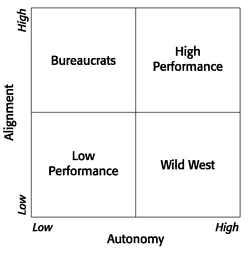
When he finished talking, there was a noticeable sense of relief among those in the room. Something important and profound had changed. The debate for the last while had raged over how to motivate loan officers to take more initiative without the bank losing control of assessing quality and riskiness of applicants. The Gordian knot was cut. A simple 2 × 2 framework intervention at the pivotal moment had reframed the crisis, allowing the group to move beyond the place where only moments before they had felt paralyzed.
2× 2 THINKING: A COMMON PATH TO EXTRAORDINARY ENDS
Although the facts of the case described above are specific to the financial industry, the method that Saint-Onge applied had little to do with banking. Rather, it is both universal and highly transferable. We call this approach 2 × 2 Thinking. A complex situation is modeled as a set of dueling interests. The hunt for a single correct solution is supplanted by the search for understanding, perspective, and insight. The game is in effect redefined:
• Tension becomes a good thing. Instead of trying to eliminate tension, we let it lead us to important topics and questions.
• Conflicting goals are seized upon, becoming useful markers that set the parameters for our search (in the example, these are Alignment and Autonomy).
• In place of a single right answer, a set of plausible options is created by considering high and low cases of the two conflicting needs.
• The four options may be illuminating or not. Generally, if the two axes are well defined, the options will be rich in explanatory or provocative power. If this not the case, it is usually worth redefining one or both of the axes and trying again.
In the bank example, introduction of the 2 × 2 matrix did several things. By naming the two issues, the group acknowledged a core dilemma that had been getting in the way of progress. The matrix provided a common and acceptable vocabulary that allowed the group to talk through an issue that had become rather sensitive. Perhaps most important, once group members had bought into the validity of the matrix as a model of their situation, they were able to move on to considering alternative solutions.
Deciding on which of the options to embrace presents a different set of challenges. It often appears that the upper right quadrant, High-High, is the preferable choice; however, the decision is rarely so simple because each solution is accompanied by a set of costs and benefits. Sometimes the costs and risks associated with the ideal solution are simply too great. For example, the banking planning group was reluctant to hand front-line staff free rein; however, they did indeed want these staff members to be fully aligned with the business vision. By recognizing that the autonomy gap represented a barrier to succeeding, they began to construct a path that involved things like adjusting risk management mechanisms to define authority limits in a way that reflected performance. The upper right quadrant option, High Performance, became the aspirational solution they would work toward.
2 × 2 Thinking is remarkably flexible on a number of levels. The scope of issue scales easily from personal decisions to large strategic conundrums. If you have any doubt about this, scan the three chapters of 2 × 2 frameworks in Part Three of this book. The approach is as applicable in a retail business setting as it is to designing a supply chain or addressing global trade-offs regarding the environment. The mode of application is equally effective when applied within a group setting or by an individual working alone. And the basic approach is just as powerful for analysis as it is for generating new ideas.
AT THE FEET OF MASTERS
The ability to think in a 2 × 2 fashion may be universal, but it is by no means easy. Although it is applicable at the individual level for tackling a single issue, it becomes increasingly challenging and subtle as we enter the realms of leadership, strategy, and intervention. These are arenas where excellent problem-solving skills and tools can have the greatest leverage.
To understand what is required to apply 2 × 2 Thinking under these kinds of circumstances, we interviewed a number of the most talented 2 × 2 practitioners in the world. Front-line consultants like Hubert Saint-Onge and writers like Steven Covey, Paul Hersey, and Watts Wacker generously shared their stories and insights. We were interested in hearing about their frameworks, but more important, we wanted to understand how and why they designed them and what they did when applying them that increased their impact. Through the discussions, we gained a clearer picture of the deep structure underlying effective use of the seemingly innocent 2 × 2 matrix. Nested in stories like the one above, a set of master principles of practice emerged:
• Struggle is a necessary condition for breakthrough. It is generally only after a group has worked hard on a problem, even gotten stuck in it, that positive change and new insights become possible.
• Timing is critical. The same idea at the wrong moment isn’t half as powerful. The most complex situations benefit from a 2 × 2 analysis if the timing is right. Assertions that it is too simplistic are always problems with timing and delivery.
• Simplicity in methods is desirable when mapping complex and highly charged material. Some of the best frameworks have not had a single word altered in over thirty years. Their creators have in effect become their protectors, so that people can view the ideas as stable and reliable.
• Ownership is essential. Groups and organizations derive the greatest value when they actively participate in development and interpretation. This includes naming the issues, the axes of the framework, and the quadrants inside it. In the banking example in this chapter, Saint-Onge chose words that would resonate with people based on a familiarity with their discussion. If they preferred different wording or believed another factor needed to be introduced, he would happily make the change.
• Skin in the game. It has to matter, and participants need to be prepared to be accountable for their opinions and commitments. The process is not casual and is characterized by passion and personal investment in the outcome. Without this, tension is false, and something will go wrong. That something could be innocuous and boring, leading to dissolution of an effort, or it could be explosive and damaging, as when a key activity is dropped or someone feels betrayed and loses faith.
The intangible element, the energy of processes, is ultimately more telling than structures, tools, and matrices. Don’t get hung up on the 2 × 2 form. Use it as a convenient medium and device to achieve important ends. 2 × 2 modeling brings focus and tension, often making issues clearer. It creates the context; the rest is up to you. Like the framework introduced by Peter Drucker looking at Doing the Right Job versus Doing the Job Right, if you are working on the right material and act with integrity, you are much more likely to succeed.
THE PROBLEM-SOLVING MIND
In 1997, Garry Kasparov fought and lost the chess match of the millennium to IBM’s Deep Blue. Kasparov brought to the contest perhaps the greatest human chess mind ever to exist. Deep Blue had been modeled on masters and could evaluate 20 billion moves in the three minutes allowed per move. Kasparov could have won, he said afterward, but he played the game wrong, trying to outcompute the fastest computational game machine in history. A rematch of sorts, against Blue Junior, occurred in 2003 at the New York Athletic Club. This time Kasparov did what he thought he should have tried at the previous encounter: confuse the computer with unusual, even suboptimal and odd, moves. Although this worked spectacularly in the first game, the match ended in a 3-3 tie.
Whatever the outcome, the episode helps to illuminate the process of superior problem solving. Kasparov could never match the ever increasing processing speed of computers. Deep Blue software engineer Joe Hoane observed that chess geniuses like Kasparov “are doing some mysterious computation we can’t figure out.”1 Computation, however, may not be the best way to describe this. As a master problem solver, his exceptional skill is a combination of three uniquely human aptitudes: organization, visualization, and experimentation. Taken together, they make it possible to invent and solve problems in holistic and idiosyncratic ways that are at once lateral and judgmental:
• Organization. In a manner closer to what a great artist does than conventional science, we are able to deconstruct situations and rapidly reconstruct them into new perspectives, problems, and approaches. When Kasparov sees an appealing way to reframe the situation, he settles on it and models a set of possible next steps and outcomes. In a way, he is thinking both literally and metaphorically at the same time and is being guided by both perspectives. If, for a moment, the setup on the board reminds him of his favorite tragic opera aria or a touching moment spent with his mother on a mountain...
Table of contents
- Title Page
- Praise
- Copyright Page
- Foreword
- Acknowledgments
- THE AUTHORS
- Introduction
- PART ONE - 2× 2 THINKING
- PART TWO - 2× 2 PRACTICE
- PART THREE - 2× 2 FRAMEWORKS INVENTORY
- NOTES
- INDEX
Trusted by 375,005 students
Access to over 1.5 million titles for a fair monthly price.
Study more efficiently using our study tools.
Frequently asked questions
Yes, you can cancel anytime from the Subscription tab in your account settings on the Perlego website. Your subscription will stay active until the end of your current billing period. Learn how to cancel your subscription
No, books cannot be downloaded as external files, such as PDFs, for use outside of Perlego. However, you can download books within the Perlego app for offline reading on mobile or tablet. Learn how to download books offline
Perlego offers two plans: Essential and Complete
- Essential is ideal for learners and professionals who enjoy exploring a wide range of subjects. Access the Essential Library with 800,000+ trusted titles and best-sellers across business, personal growth, and the humanities. Includes unlimited reading time and Standard Read Aloud voice.
- Complete: Perfect for advanced learners and researchers needing full, unrestricted access. Unlock 1.5M+ books across hundreds of subjects, including academic and specialized titles. The Complete Plan also includes advanced features like Premium Read Aloud and Research Assistant.
We are an online textbook subscription service, where you can get access to an entire online library for less than the price of a single book per month. With over 1.5 million books across 990+ topics, we’ve got you covered! Learn about our mission
Look out for the read-aloud symbol on your next book to see if you can listen to it. The read-aloud tool reads text aloud for you, highlighting the text as it is being read. You can pause it, speed it up and slow it down. Learn more about Read Aloud
Yes! You can use the Perlego app on both iOS and Android devices to read anytime, anywhere — even offline. Perfect for commutes or when you’re on the go.
Please note we cannot support devices running on iOS 13 and Android 7 or earlier. Learn more about using the app
Please note we cannot support devices running on iOS 13 and Android 7 or earlier. Learn more about using the app
Yes, you can access The Power of the 2 x 2 Matrix by Alex Lowy,Phil Hood in PDF and/or ePUB format, as well as other popular books in Business & Management. We have over 1.5 million books available in our catalogue for you to explore.