- A frank, professionally informed and playful discussion of cannabis usage in relation to philosophical inquiry
- Considers the meaning of a 'high', the morality of smoking marijuana for pleasure, the slippery slope to more dangerous drugs, and the human drive to alter our consciousness
- Not only incorporates contributions from philosophers, psychologists, sociologists or legal, pharmacological, and medical experts, but also non-academics associated with the cultivation, distribution, and sale of cannabis
- Brings together an international team of writers from the United States, Canada, UK, Finland, Switzerland, South Africa, and New Zealand
eBook - ePub
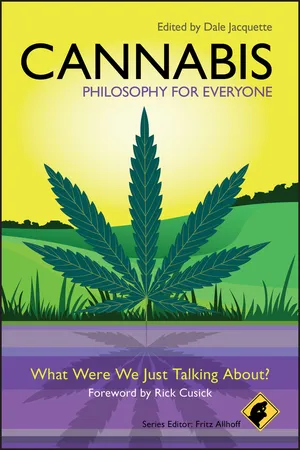
Cannabis - Philosophy for Everyone
What Were We Just Talking About?
- English
- ePUB (mobile friendly)
- Available on iOS & Android
eBook - ePub
About this book
The debate on the status and legality of cannabis continues to gain momentum. Here, personal anecdotes combined with academic and scientific reports combine to sharpen some of the fascinating philosophical issues associated with cannabis use.
Information
If the words “life, liberty, and the pursuit of happiness”
don’t include the right to experiment with your own
consciousness, then the Declaration of Independence
isn’t worth the hemp it was written on.
don’t include the right to experiment with your own
consciousness, then the Declaration of Independence
isn’t worth the hemp it was written on.
Terence McKenna
Live in New York
The Music Faucet
June 20, 1993
The Music Faucet
June 20, 1993
FOREWORD
Three men come up against a locked door. The first man is drunk out of his mind. The second man is tripping wildly on LSD, and the third man is stoned on really good marijuana.
The first man says, “Let’s knock down the Goddamn door!”
The second man says, “Let’s float through the keyhole…”
And the third man says, “Let’s sit down and wait for someone to show up with the key.”
After nearly a century of American marijuana prohibition – the first US anti-cannabis law passed in Utah in 1915 – it’s beginning to look as if someone is finally about to show up with the key.
In 2010 there are an unprecedented forty-plus marijuana law reform bills pending in twenty-three states. These encompass a wide range of reform including proposals for medical marijuana, decriminalization, and legalization. In January New Jersey became the fourteenth state to legalize the medical use of cannabis and full legalization will be included on the California ballot in November.
These are heady days indeed. Hyperbolic prohibitionists insist we stand on the high precipice of increased psychosis, and that the metaphorical door is really a gateway to a hard drug hell. Proponents of marijuana law reform oraculate a more positive future filled with fiber, fuel, and fun, of miracle medicine and good vibrations. I suspect the upcoming reality will be far more nuanced than either side is willing to admit. The truth is no one knows what’s going to happen if and when marijuana finally becomes legal in the United States.
Will use rise? Will prices drop? Will madness or laughter prevail? Certainly, over 800,000 American arrests will fall off the radar and that can’t be a bad thing. Medical patients will stop worrying about getting busted for medicine, which in itself will have a palliative effect. But will my teenage daughter be more or less likely to take up smoking pot after criminal sanctions disappear? I don’t know the answer but I am bedeviled by the question.
Certainly, I worry more about other demons. I tell her that if she takes up hard drugs she may very well die because those vile pursuits have killed so many good people. I tell her to be very careful of spirits – of wine, whisky, and beer – because those habits very nearly killed me when I was young and perhaps the propensity lies nestled in her genes. I tell her that if she smokes cigarettes “I might kill you myself just for being that stupid,” and then I smile (and we’ll see how that works out). My many warnings regarding weed, however, are much less straightforward and far more faceted because I don’t want to be a hypocrite and because that conversation is necessarily more… philosophical.
I believe that marijuana is not for children and as the associate publisher of High Times magazine I know something about the subject. I think it should be an honorable widespread activity among responsible adults – like sex or driving a car. I tell my young daughter that she could undoubtedly switch on the engine, put it in gear, and might even get someplace; but without that necessary judgment that comes with experience she might very well cause a terrible accident along the way that will hurt her or hurt someone else.
Then I warn her about driving.
I tell her of the Bashilange: in the nineteenth century, at the time of the dissolution of the great Luba Empire in Central Africa, a number of smaller kingdoms emerged. The Baluba chief, Kalamba-Moukengee, subjugated neighboring tribes at gunpoint and, struggling to unify his new confederation, ordered all the ancient fetishes to be burned in public, and in their place instituted the Bantu custom of smoking hemp to reincarnate the soul. The Baluba men gathered around the fire in the center of the village each night and solemnly smoked cannabis from a huge calabash, and a tribal offender was publicly punished by being forced to smoke hemp until he lost consciousness.
A tribal faction within this new coalition, the aggressive Bashilange led by Moamba Mputt, established the Ben-Riamba cult – the so-called “Sons of Hemp” – who quickly put down their spears and foreswore their warlike ways. The Sons of Hemp quickly gained many followers. The Bashilange became less violent, began to treat with other tribes, and made more laws. The land of the hemp smokers along the banks of the Lulua River began to be called Lubuku, which is translated as “Friendship,” and the partisans of riamba were widely known as “Friends” and greeted each other with the Bashilangen word for life (Moio! ).
It’s a pretty tale as far as it goes, but not all was perfect in paradise. Bashilangen women were not allowed to smoke hemp and were consigned to work in the fields, keep the house, and raise the children, while the men made cloth, went hunting or, for the most part, smoked hemp and talked “with incredible fluency.”
I urge my daughter and our readers to remember the Bashilange.
The homespun philosopher Yogi Berra (who knew something about baseball) famously observed that “It ain’t over ‘till it’s over,” which reminds us that anything can happen. It’s possible I suppose that marijuana reform could be repealed instead of marijuana law, but I have my doubts because we’ve mitigated the hype and because Americans can no longer afford to ignore the billions of dollars in tax revenue that marijuana law reform will provide. While I personally believe that legalizing cannabis would encourage a more civilized society, I also recognize that reasonable people can disagree. That’s why this book is so timely and important. There are overblown claims on both sides of the equation and we need to have the more disciplined discourse that philosophy provides. Philosophy, at its best, is the art of reason tempered by the science of thought, and our conversations regarding cannabis need to be more reasonable, more thoughtful, and more civilized – now more than ever. This book is a good place to start. We stand before a locked door or a dangerous precipice – you are free to choose your own metaphor – but whichever you prefer, one thing seems clear. We are about to turn the key or take the jump.
Before we do, let’s think about that.
PREFACE
This book came about as part of a larger effort to relate contemporary philosophical discourse directly to the interests and concerns of persons outside the tweedy world of professional academic philosophy. No doubt philosophy and the world outside its ivy towers can each benefit from a little positive interaction. But why cannabis? Why weed versus tweed?
Cannabis use is widespread and increasing in worldwide popularity. It is estimated that approximately one out of three Americans has tried or uses marijuana with some frequency. Elsewhere in many parts of the world the percentages of active regular cannabis enjoyment are equally impressive. Cannabis consumption levels are therefore sufficiently noteworthy to draw philosophical attention at the very least as a social phenomenon, and the use, effects, and contemporary prohibition of cannabis raise intriguing philosophical questions.
No doubt it says something interesting about America in the twenty-first century that there exist laws against marijuana, and that so many people continue to risk violating the law for the sake of getting high. The two facts together arguably bespeak a dominant trend in the United States, for a hip and hedonistic part of the population to challenge the Puritanism latent within the culture that goes hand in glove with a severe and often joyless work ethic that seems to have rooted itself into the American grain even after the Puritans themselves had long gone from this earth. The plain fact is that, thus far, not enough responsible adult Americans, even if they smoke pot, have organized themselves politically with any degree of success to revoke the present-day draconian anti-cannabis laws.
Some laggards may reason that pot smoking should remain illegal because, after all, you can still always get it, while in the meantime we should be cautious until we better understand what social impact cannabis legalization might have, say, for the world our children will inherit. Will all of North America start to look like Amsterdam’s red light district? Surely not, although some parts of North America could do worse. Nor should we overlook the fact that the Netherlands has friendly non-menacing coffeeshops elsewhere in Amsterdam and all over the country for casual cannabis purchase and use on the premises or at home by responsible, gainfully employed, tax-paying adults, and that the rest of the country does not at all look like Amsterdam’s red light district, whatever your opinion of its aesthetics.
Still, what would it be like for the children? We must never cease to ask such questions, it seems, but instead shape all our social policy around the imperative of offering a better future for our eventually ungrateful progeny. What will their world be like if cannabis becomes more freely available potentially in every neighborhood? Even if good models of controlled dispensing are followed, it is axiomatic that cannabis is going to be more freely available if it is legalized than if it were kept illegal. After all, we do not know what it will do to our way of life for cannabis to become no more inaccessible to responsible adults than a visit to the corner liquor store. Things are hard enough as they are, this reasonable-sounding reckoning continues, so let us continue to support or in any case not get active to defeat anti-marijuana laws, and keep things more or less as they are, even if we personally like to smoke and continue to sneak one ourselves from time to time.
This line of argument is no doubt partly to blame for the snail’s pace of progress toward cannabis legalization. For all its appearance of good logic, such thinking is nevertheless seriously flawed in one important respect. Parents and other concerned community members need to wonder in practical terms, first, what the probabilities are that their children will someday experiment with and perhaps even come regularly to use cannabis. If the adults in question have also at least experimented with marijuana, then they might understand the attraction, and recognize that their children at some point are more than likely at least to try marijuana for the sake of getting high. If it seems more than likely than not that this will occur, then, secondly, the same responsible-for-our-children’s-future adults need to ask themselves whether they would also prefer to have these same children when they’re grown up go to jail some day for getting caught holding a little joint. If that does not seem like a good thing, then it appears that persons concerned about the future of today’s youth do not have a strong argument for a conservative stance against relaxing marijuana prohibition.
Cannabis laws are currently in flux, which is arguably a good sign. As I write these words, Mexico has just legalized possession of small amounts of a surprising list of drugs that includes cannabis, and Argentina has ruled that, although its sale is still illegal there, it is unconstitutional to imprison anyone for possession of cannabis. It is indeed and ought to be recognized everywhere that it is unconstitutional to prosecute the possession and use of a little noble bud. The cannabis reform movement has been slower to hit a responsive chord with legislators in the United States, but there are already many places today where you will not suffer more than paying a fine if caught with a personal use amount of cannabis, whatever that means according to local ordinance or state law. Still, why should anyone have to pay a fine, as though they were doing something wrong beyond breaking an astoundingly stupid law? If the only wrong you do is break the –… my apologies, not stupid, but, let’s say, this time, possibly well-intentioned although not impressively competent or morally justifiable, and sometimes even more stupidly enforced… – law, then you are being prohibited from exercising what ought to be among the sacred freedoms included as a right of responsible and otherwise law-abiding persons. The pursuit of individually defined happiness that does not harm others, promised by the American Declaration of Independence and its counterpart social contracts for citizens in many places around the globe, ought to stub out antiquated cannabis prohibition legislation like a spent roach.
Why is marijuana prohibition tolerated? Here, undoubtedly, we run smack up against part of the mystery that is twenty-first century America. Why, in the past, was slavery tolerated? Why was alcohol prohibition tolerated? Why is same-sex marriage so emotionally resisted by a heterosexual majority? What’s it to them, anyway, and how does it hurt them, if gay and lesbian couples want to tie the knot? Why is the virtually unlimited availability of firearms with all the harm they cause put up with today as a sane and historically accurate interpretation of the Constitution’s Second Amendment to the Bill of Rights? NPR (National Public Radio) reported just this afternoon as I was sunning on the terrace that the number of bullets sold across the counter in the United States in 2008 was enough to provide every living man, woman, and child in the country with no less than 33 bullets. With a currently estimated population of 305 million souls, that’s an astonishing 10,065,000,000 rounds of ammunition beyond military and police requisitions, purchased in just one year. It makes a person wonder, are there really that many deer and pheasant still running around uncooked? I myself don’t have any of these bullets, nor does my partner, or most people I know, so some greedy individuals are regularly using or stockpiling considerably more than their allotted 33.
Guns and bullets, despite all the damage they cause when people fly off the handle, you can legally buy. A dime of reefer to kick back with nothing else on the burner and get into some Beethoven, Brubeck, or Beck, a Rembrandt exhibit from years ago in a glossy museum catalogue or reruns of The Honeymooners, no. America, like other countries, simply has these quirks. Federal law currently prohibits the purchase, sale, or use of cannabis, even in those states like California that have meaningfully relaxed state and local anti-marijuana legislation. If you use in California, you probably do not risk municipal or California state prosecution, although in theory at least you could still be in trouble with the Feds. So far, the Federal authorities have primarily targeted entrepreneurial medical cannabis dispensaries operating without full legal local approval, but there is no reason why the government in the future could not choose to enforce the Federal anti-cannabis laws at the lowest levels of buyers, sellers, and users. If California or any other state will not enact or enforce subordinate cannabis prohibition laws, then in principle the Federal government might decide that it needs to do so. As things stand today, this would be perfectly legal. In most places in the US, it’s unfortunately true that you can still get into a lot of trouble with the law trying to cop a little high.
Nor is cannabis use a particularly new thing. Samir S. Patel reports the following discovery in the March/April 2009 issue of Archaeology magazine: “At first archaeologists guessed the two pounds of green plant material, buried with a Caucasian man 2,700 years ago in Turpan, was coriander. Tests revealed the truth – it was cannabis, the oldest-known marijuana stash. Lab work also established that it would have been potent stuff, though it is unknown whether it was used for medicinal or religious purposes.” Dope has accordingly been around for a long time and its effects have been understood and appreciated for millennia. It is a sign of the times that the cautious author of this prestigious publication considers only that the Chinese cannabis might have been used for either medicinal or religious purposes. If we read between the lines it is nevertheless not hard to imagine that the owner sent to the afterlife with a lid of good shit in his tomb might have used it primarily for recreational purposes, as is still done today, for the same morally respectable purpose of getting airborne. It also suggests that cannabis was sufficiently available in abundance in the distant Asian past to be considered a desirable grave good.
Leaving the trail of cannabis along ancient trade routes aside, what attitude should contemporary philosophy take toward cannabis? Like other phenomena related to popular culture, philosophy has an opportunity if not an obligation to consider these matters carefully and with all its conceptual analytic tools. There are many philosophical questions raised by the use of cannabis for medicinal, religious ceremonial or sacramental, not to mention for fun and purely recreational, purposes. What is it to get high? How does cannabis alter straight patterns of perception, judgment, and reasoning? Is it morally wrong to use cannabis? Is it morally wrong for legislators and law enforcement officials to prohibit cannabis sale, possession, and use? Can philosophy help us to understand the psychological, phenomenological, ethical, and social implications of cannabis intoxication? Can cannabis, as some users believe, constitute an ally in artistic creativity or in the philosophical pursuit of wisdom?
The essays collected in this book are intended to provide a lively philosophical look at the problems of marijuana use and abuse. The reader should expect many different answers, not always in harmony. It is an essential part of philosophical understanding to collect conflicting arguments relevant to a topic, and to sort through them all carefully and critically, looking for enlightenment in spite of disagreements among the experts, and concerning precisely those matters about which they disagree. We should no more anticipate consensus between writers with philosophical interests reflecting on the nature, cognitive effects, and moral and legal status of marijuana than we would in any other field. Therein lies the philosophical intrigue and whatever philosophical insight we can reasonably hope to attain about this popular and increasingly appreciated but socially still very controversial drug.
I am grateful to Fritz Allhoff for inviting me to edit this volume for his new Wiley-Blackwell series, Philosophy for Everyone, and to Jeff Dean, philosophy editor at the press, for nursing me through some of my early moments of editorial denial. I thank the authors for their superb contributions, and the production team at Wiley-Blackwell for helping to bring this volume to completion with such flair. I am indebted above all to my wife Tina for her encouragement, and for sharing with me all these years her invaluable anecdotal perspective on the vagaries of herbal aviation.
Dale Jacquette
Sydney, Australia
Sydney, Australia
INTRODUCTION
What is Cannabis and How Can We Get Some?
Are You Anywhere?
Cannabis is a psychoac...
Table of contents
- Cover
- Contents
- Halftitle page
- Series page
- Title page
- Copyright
- Dedication
- Dedication-1
- Foreword
- Preface
- Introduction: What is Cannabis and How Can We Get Some?
- PART I CANNABIS PHENOMENOLOGY
- PART II MARIJUANA AND SPIRITUAL ENLIGHTENMENT
- PART III CREATIVELY HIGH
- PART IV PSYCHO-SOCIOLOGICAL DIMENSIONS OF CANNABIS CULTURE
- PART V CANNABIS ETHICS AND POLITICS
- Notes on Contributors
Trusted by 375,005 students
Access to over 1.5 million titles for a fair monthly price.
Study more efficiently using our study tools.
Frequently asked questions
Yes, you can cancel anytime from the Subscription tab in your account settings on the Perlego website. Your subscription will stay active until the end of your current billing period. Learn how to cancel your subscription
No, books cannot be downloaded as external files, such as PDFs, for use outside of Perlego. However, you can download books within the Perlego app for offline reading on mobile or tablet. Learn how to download books offline
Perlego offers two plans: Essential and Complete
- Essential is ideal for learners and professionals who enjoy exploring a wide range of subjects. Access the Essential Library with 800,000+ trusted titles and best-sellers across business, personal growth, and the humanities. Includes unlimited reading time and Standard Read Aloud voice.
- Complete: Perfect for advanced learners and researchers needing full, unrestricted access. Unlock 1.5M+ books across hundreds of subjects, including academic and specialized titles. The Complete Plan also includes advanced features like Premium Read Aloud and Research Assistant.
We are an online textbook subscription service, where you can get access to an entire online library for less than the price of a single book per month. With over 1.5 million books across 990+ topics, we’ve got you covered! Learn about our mission
Look out for the read-aloud symbol on your next book to see if you can listen to it. The read-aloud tool reads text aloud for you, highlighting the text as it is being read. You can pause it, speed it up and slow it down. Learn more about Read Aloud
Yes! You can use the Perlego app on both iOS and Android devices to read anytime, anywhere — even offline. Perfect for commutes or when you’re on the go.
Please note we cannot support devices running on iOS 13 and Android 7 or earlier. Learn more about using the app
Please note we cannot support devices running on iOS 13 and Android 7 or earlier. Learn more about using the app
Yes, you can access Cannabis - Philosophy for Everyone by Dale Jacquette, Fritz Allhoff in PDF and/or ePUB format, as well as other popular books in Philosophy & Philosophy History & Theory. We have over 1.5 million books available in our catalogue for you to explore.