This graduate text, and Cooper's companion introductory text ('Introduction to the Technology of Explosives'), serve the same markets as the successful explosives reference by Meyer, now in its 4th edition. VCH also published the International Journal of Propellants, Explosives, and Pyrotechnics. The resulting package would give VCH the major presence in the field.
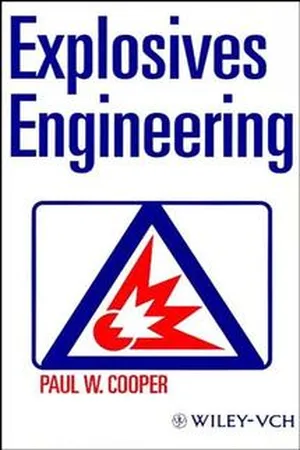
This text presents the basic technologies used in the engineering of explosives and explosive systems, i.e., chemistry, burning, detonation, shock waves, initiation theories, scaling. The book is written for upper-division undergraduate or graduate-level scientists and engineers, and assumes a good grasp of basic physics, chemistry, mechanics and mathematic through calculus. It is based on lecture notes used for graduate courses at the Dept. of Energy Laboratories, and could serve as a core text for a course at schools of mining or military engineering. The intent of the book is to provide the engineer or scientist in the field with an understanding of the phenomena involved and the engineering tools needed to solve/ design/ analyze a broad range of real problems.
- English
- ePUB (mobile friendly)
- Available on iOS & Android
eBook - ePub
Explosives Engineering
About this book
Information
SECTION II
ENERGETICS OF EXPLOSIVES
Introduction
We will review the basic quantities of thermodynamics: energy, temperature, heat, work, and the ideal gas law. These quantities will be used to explain the principles of thermophysics and thermochemistry, which will be applied to the specific reactions of combustion and detonation. Using the thermochemical data of heats of detonation or explosion, we will see how to calculate adiabatic reaction temperatures. These data in turn will be used to analyze or predict pressures of explosions in closed vessels. We shall also see how, using thermochemical data, to predict detonation velocities and detonation pressures.
CHAPTER 7
Basic Terms of Thermodynamics
We shall begin with the basics of thermodynamics and see how these basics are used to develop engineering calculations and estimates dealing with explosives. Hougan, Watson, and Ragatz, i...
Table of contents
- Cover
- Title page
- Copyright page
- Dedication
- Preface
- Section I: Chemistry of Explosives
- Section II: Energetics of Explosives
- Section III: Shock Waves
- Section IV: Detonation
- Section V: Initiation and Initiators
- Section VI: Engineering Applications
- Index
- End User License Agreement
Trusted by 375,005 students
Access to over 1.5 million titles for a fair monthly price.
Study more efficiently using our study tools.
Frequently asked questions
Yes, you can cancel anytime from the Subscription tab in your account settings on the Perlego website. Your subscription will stay active until the end of your current billing period. Learn how to cancel your subscription
No, books cannot be downloaded as external files, such as PDFs, for use outside of Perlego. However, you can download books within the Perlego app for offline reading on mobile or tablet. Learn how to download books offline
Perlego offers two plans: Essential and Complete
- Essential is ideal for learners and professionals who enjoy exploring a wide range of subjects. Access the Essential Library with 800,000+ trusted titles and best-sellers across business, personal growth, and the humanities. Includes unlimited reading time and Standard Read Aloud voice.
- Complete: Perfect for advanced learners and researchers needing full, unrestricted access. Unlock 1.5M+ books across hundreds of subjects, including academic and specialized titles. The Complete Plan also includes advanced features like Premium Read Aloud and Research Assistant.
We are an online textbook subscription service, where you can get access to an entire online library for less than the price of a single book per month. With over 1.5 million books across 990+ topics, we’ve got you covered! Learn about our mission
Look out for the read-aloud symbol on your next book to see if you can listen to it. The read-aloud tool reads text aloud for you, highlighting the text as it is being read. You can pause it, speed it up and slow it down. Learn more about Read Aloud
Yes! You can use the Perlego app on both iOS and Android devices to read anytime, anywhere — even offline. Perfect for commutes or when you’re on the go.
Please note we cannot support devices running on iOS 13 and Android 7 or earlier. Learn more about using the app
Please note we cannot support devices running on iOS 13 and Android 7 or earlier. Learn more about using the app
Yes, you can access Explosives Engineering by Paul W. Cooper in PDF and/or ePUB format, as well as other popular books in Technology & Engineering & Engineering General. We have over 1.5 million books available in our catalogue for you to explore.