![]() PART 1: Topics of Themes
PART 1: Topics of Themes![]()
Chapter 11
E-Travel Agents Selling to Ethnic Customers
1.1. Introduction
Over the past decades, the travel and tourism sector has emerged as one of the most important sectors for developing, as well as developed, countries. The World Travel and Tourism Council 2 [2006] estimates that the relative importance of tourism will grow to approximately 11% of the global gross domestic product (GDP) in 2016. Tourism incorporates many of the features of the information society,3 such as globalization, mobility and information richness. People from all nations, social ranks, professions and different ways of life are potential tourists.
Tourism as a global industry links a worldwide supplier community with consumers, equally distributed worldwide. Its physical and virtual networks enable worldwide traveling, bringing together very distant cultures and habits. The tourism industry is diverse and partly fragmented and the size of tourism principals varies from micro- to global enterprises. Only certain segments, such as airlines, are concentrated into an oligopoly of global alliances.
The growth in the development of transportation after the First World War enabled people to travel to previously inaccessible areas and, furthermore, technological innovations improved transportation and the cost of travel declined, meaning that tourism throughout the world expanded.
Historically, travel agents were tour planners, as well as sales agents, for travel suppliers. Not only would the travel agent sell transport, accommodation and tours for suppliers, they would organize travel plans for customers and provide advice, as well as specialized information on destinations and other travel related information.
In the 1950s and 1960s, airlines entered the era of the jet aircraft and this was soon followed by the rapid introduction of wide-bodied airplanes in the 1970s and 1980s. Airlines viewed the use of travel agencies as an inexpensive and effective method of widening their distribution network in order to reach these new and expanding markets, combined with high labor costs and difficulties in reaching the marketplace. This led to the use of travel agents as intermediaries, to act as sales agents for their products. Airlines soon came to rely heavily on travel agents — often as an extension of their own office — for distribution, airline reservations, ticketing, transactions, travel advice, market coverage, market presence and packaging.
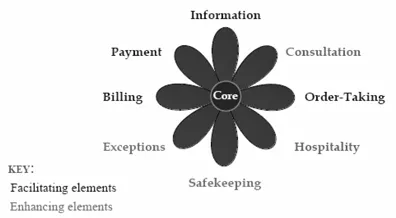
In this chapter, information technology will be addressed as the main type of technology concerning the business interactions of e-travel agencies with customers and more specifically ethnic/immigrant customers. Lovelock and Wright [LOV 02] skillfully adapted the flower of service (see Figure 1.1) to the information technology (IT)4 era, which illustrates ways in which a website can be used to deliver or enhance service for each part of the service diagram, comprehending information, consultation, order taking, hospitality, safe keeping, exceptions, billing and payment.
In most instances, there is an opportunity to improve productivity by encouraging customers to use self-service. For people who are optimists about the new paradigms in communication and distribution, IT enables firms to know more and to communicate more efficiently with their customers:
More continuous connections with customers can provide information that focus groups and surveys cannot … The knowledge of individual customer needs that companies can capture through technology harkens back to the days when the butcher, baker and candlestick maker knew their clientele personally … In that setting, customer service relationships were built on face-to-face transactions … Today’s technology can recreate the conversation between the shopkeeper and the customer [MCK 95].
Our research aimed to investigate the impact of e-commerce in relationship issues. It considered ethnic communities and was based on a survey of Brazilian customers living in Japan. We address the market structure of travel agents, customer relationships through the Internet, services marketing, relationship marketing and then our findings and conclusions.
1.2. Market structure
The travel agent industry is coordination intensive; in other words, it is centered on the communication and processing of information. The commodity-like nature of products offered by travel agents and the ease with which many travel products can be described have led to concern about the future of travel agencies given the evolution of IT. Early indications of this trend towards a shift in the role of travel agents are the significant reduction in agency commissions paid by airlines and the increasing use of the Internet and other online services by customers seeking travel information and making airline reservations.
Trends affecting the travel industry generally include changing customer demands (such as interest in exotic destinations or travel by seniors), increased expectations in terms of value and convenience and increasingly knowledgeable consumers who are themselves users of IT. The travel industry is being fundamentally altered by IT. Historically, airlines and large hotel chains, for instance, have been early adopters of new technologies such as computer reservations systems (CRS).5 The distribution network being used by the travel industry is in many ways outdated, relying on third parties such as CRS vendors or travel agents who have traditionally justified their presence through a specialized technology infrastructure and specific knowledge.
A frequently-cited impact of IT is that the emergence of electronic markets will promote the bypassing of intermediaries [LEW 96]. This hypothesis is principally based on the ability of IT to significantly reduce transaction costs [MAL 94]. A useful way to examine the specific impact of IT on a given type of intermediary may be to compare the value added by an intermediary under different transaction characteristics and determine whether the role of the intermediary is likely to be enhanced or diminished [CHO 97].
The advent of the Internet and other online services, combined with widespread adoption of personal computers by businesses and consumers, has led to a growing role for electronic commerce 6 in the world economy. The emerging electronic commerce marketplace is expected to support all business services that normally depend on paper-based transactions.
Firms choose transactions that economize on coordination costs [STR 97]. These costs include the costs of the information processing that is necessary to coordinate the work of people and machines that perform a primary process, such as manufacturing a product or providing a service. IT allows buyers and sellers to communicate directly over data-rich, easy-to-use information channels. Where products take on a commodity-like nature and are easy to describe, decentralized electronic markets, rather than single-sources sales channels, may be an efficient form of coordination.
Travel products and services possess many characteristics needed to function in the electronic environment. The ease of description and commodity-like nature of many travel products, such as airline seats or hotel rooms, suggests that the travel industry exhibits the product attributes that are favorable for electronic commerce. The structural elements of the industry also support a shift towards more electronic means of carrying out transactions. The current travel agent market structure favors a centralized market configuration [MAL 87] among service providers, travel agents and consumers. Most consumers use a single or a very small number of travel agents for each trip, while most agents have access to all — or most — providers of travel services.
Within the travel agent industry, the traditional centralized market structure is currently under attack from many providers in the marketplace who are trying to access their customers directly. This trend is particularly evident in the airline industry where carriers sell most of their tickets without the use of travel agents. Even established airlines, such as American Airlines, are using more direct channels, such as online services, the Internet and toll-free telephone numbers, to reach customers. In fact, the structure is currently acquiring more decentralized market characteristics where each buyer/consumer has direct access to each seller/provider.
The ability to make travel-related reservations online directly with the provider significantly reduces fixed and variable coordination costs because there is no human intervention between the consumer and the travel provider. Human intervention can take the form of a travel agent or an airline employee in a telephone reservations office or city ticket office, but in either case eliminating human intervention minimizes costs to the airline. This is why many airlines are offering discount fares that are available exclusively to online users and promoting the use of electronic ticketing.
In the travel industry, the two factors mentioned above — product uniqueness and ease of description — have become critical factors in determining whether an intermediary, in most cases a travel agent, will be used by a prospective traveler. Some itineraries, such as a simple business round trip by air, may be just as easy to arrange when dealing directly with a carrier. However, a package tour or cruise is inherently complex to describe and will vary greatly in content and price depending on the different suppliers and options. Such leisure trips often involve pitfalls and uncertainties and the average consumer needs advice on these matters before making a decision.
A number of social and institutional factors mitigate against the elimination of intermediaries. Consumers may choose to continue to use traditional or online intermediaries because those intermediaries in fact represent multiple suppliers of travel products. It has also been argued that electronic markets do not become “disinter-mediated”, but are facilitated by IT, with new intermediaries emerging in an electronic environment [BAI 96].
Travel agents do not have the same biases as the suppliers they represent, although the agents’ behavior can be affected by such practices as commission overrides. Finally, aspects such as trust and social contact are important to many consumers, particularly when planning leisure travel. Face-to-face contact with an agent at a physical retail location will remain important for many travelers.
Travel agents currently play three key roles. First, they act as information brokers, passing information between buyers and suppliers of travel products. Secondly, they process transactions by printing tickets or forwarding money. Thirdly, they act as advisors to travelers [LEW 98]. It is probable that IT will affect the first two roles and force travel agents to focus on the third, advisory role. Travel agencies can play a valuable role by using IT to assist the consumer in dealing with the complexity of the market-place. Despite incentives to do so, travelers will not always want to approach travel suppliers directly. Some agencies have set up website...