In recent years, professional services providers have had to rethink their sales methods and adapt to profound changes in the way clients buy services. In response, Winning the Professional Services Sale argues for fundamental changes in the seller's mindset and sales strategies. Rather than pressing the sale, salespeople must help clients buy--the way that works best for each client. This new approach gives buyers what they now want in a services seller: a consultative problem solver, change agent, and solution integrator, all rolled into one. Author Michael McLaughlin presents a strategy for winning new business with a holistic approach to each client relationship. Only by fully understanding a sale from every angle, including its impact on the client's business and career, can salespeople thrive in the new era of the service economy.
eBook - ePub
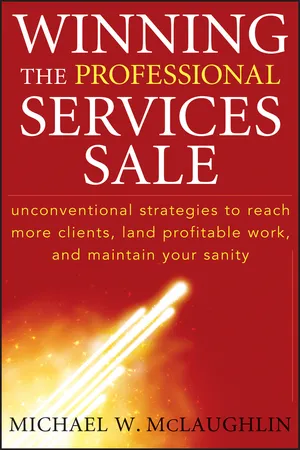
Winning the Professional Services Sale
Unconventional Strategies to Reach More Clients, Land Profitable Work, and Maintain Your Sanity
- English
- ePUB (mobile friendly)
- Available on iOS & Android
eBook - ePub
Winning the Professional Services Sale
Unconventional Strategies to Reach More Clients, Land Profitable Work, and Maintain Your Sanity
PART 1
Connect

CHAPTER 1
Seven Realities of Selling Services
Filmmaker Woody Allen reportedly once said, “80 percent of success is just showing up.”1 If that aphorism were true about selling, there would be little need for the countless books, seminars, web sites, and software programs that claim to be vital to sellers’ success. Especially when it comes to selling services, you’re likely to lose 80 percent of the time if you just show up. Imagine the advantage you would gain if your competitors believed that’s all they had to do.
If you ask 10 successful salespeople how they land profitable work, you will not hear, “Hey, I just go and see what happens.” Their answers will reveal consistent patterns of behavior that contribute to their clients’ success and, by extension, their own. It’s not accurate to call their behaviors customer-centered or client-focused, because that would imply that these sellers were, at some point, not focused on the client, which isn’t the case. Instead, these sellers embraced the transformation of the seller’s role to business adviser long before most people knew a transformation of selling was under way.
They also refuse to accept conventional selling wisdom at face value. Maybe there are cases, for example, when a client relationship is not the most important factor in a services sale. How can there be a list of hard-and-fast rules for selling services when each sales situation presents a unique mix of challenges, issues, and people? After all, today’s winning “rule” can readily become tomorrow’s relic.
Top sellers do share this goal: to deliver extraordinary value to their clients before, during, and after the sale. To accomplish that, they uncover what each client really needs and then use flexible, pragmatic strategies to chalk up wins for all concerned. Most of all, they understand the realities of selling services, and they use that knowledge to help their clients and themselves.
Sales Reality #1: You Must Prove Your Answers to the Three Burning Questions
Not all that long ago, services sellers rarely had to do much more than proclaim the greatness of their experience and promise to deliver results to make a sale. Naturally, even then this wasn’t always sufficient. But often enough, competitive situations became battles of seller promises. And whoever made the most confident claims won.
Sadly for some, those days are gone. The “Assert and Promise” routine always made for a good show. But those who cling to this antiquated approach will watch their profits slip away. Granted, you necessarily make assertions during the sales process. What’s changed is that you have to prove every assertion and show how you’ll fulfill each promise—in detail. It doesn’t matter whether your company is Global Galactic LLC or Two Guys in a Garage, Inc. You must back up everything you say.
Specifically, be ready to prove your answers to the three burning questions every client will ask (or is wondering about):
1. Do you really understand what we need? You have to demonstrate that you understand why the issue must be resolved and the implications of any solution you propose. You need to address risk and how you manage it, complexity, and the realistic level of client effort to get the job done. Clients expect you to take their preliminary ideas about how to manage a challenge and take that thinking a step further. Otherwise, why would they need you? To do that, you must grasp the issue with a degree of depth that allows you to speak authoritatively about resolving it. You prove your competence by conducting substantive discussions on the details of the issue. A superficial understanding will only get you into trouble and will likely lead to a sales process that veers off course. Your efforts to comprehend your clients’ situation send an important signal that you are thinking about their interests. That begins to build trust, which will serve you throughout the sales process and your client relationships.
2. Can you do what you claim? As you talk to clients about your capabilities, imagine them uttering silently to themselves that famous line from the movie, Jerry Maguire, “Show me the money!”2 They’re probably thinking about some version of that demand. Until you prove what you claim, by whatever means your clients want, it’s all puffery. Don’t use an unproven claim anywhere in your proposals, presentations, or discussions with clients. Be ready with your evidence, even if you don’t need all of it.
3. Will you work well with us? Expect clients to test whether you and your team fit with theirs. You don’t have to be clones of your client’s team, so ignore most advice about creating artificial rapport by pretending you’re someone you’re not. On the other hand, don’t be tough to work with, either. Find the balance between being too aggressive and being a pushover, and check your ego at the door. Remember, you may answer the first two questions with flying colors, but fail this one and you’re likely to lose the sale.
Besides seeking answers to these questions, clients will also try to gauge how much you care about what they’re doing. Some clients will assume that your interests are self-serving, but people pick up on the true motives of others in time. Be patient. If you do really care, your clients will figure that out soon enough. If you don’t, they’ll know that, too.
How to Escape the Commodity Trap
Some sellers complain that clients view their services as a commodity, leading them to ask for lower and lower prices. If clients say or imply that they can’t differentiate your services from those of others, what they’re really saying is that they can’t differentiate your ideas. And that shifts the competitive battle to something they can differentiate: price.
You can escape the commodity trap with the power of your ideas. That is, after all, what you are selling. Find the insights and innovative approach that set you apart from others. Clients want your ideas, especially ones they’re not hearing from every other services seller. Communicate your best ideas to clients and avoid the commodity trap.
Sales Reality #2: Insights and Capabilities—Not Relationships—Close Sales
Suggesting that a strong client relationship is important to the services sale is like saying humans need oxygen to survive. Everyone knows that it’s more comfortable, and often more beneficial, to buy from someone you know and trust. But it’s easy to overestimate the power of those relationships, especially when it comes to selling services. The days of clients automatically handing work to their favorites went the way of the threemartini lunch. Even a multiyear client relationship doesn’t earn you a free pass, and it shouldn’t.
Overestimating the influence of a client relationship can lead to complacency and a lack of the pure hustle you used to start that relationship. Maybe the client returns your calls immediately and gives you an audience whenever you like. But that level of access should encourage you to work even harder to make an impact. Some service providers check in with their top clients and use the time for informal conversations about the client’s issues. If you’re not ready to give your client two or three items of value for everything they share with you, that relationship will eventually lose steam.
Think about the first three meetings you had with your best client. Chances are that you prepared with intensity and looked for ways to bring original ideas your client could use. That’s the behavior that got your relationship moving, and that’s what will nurture it. Remember, the value of the relationship to the client lies in your ability to integrate your past experiences and your creativity to generate insightful guidance. Assume that the client holds you to a higher standard of performance than a new competitor, and you’ll keep the relationship vibrant. Building relationships of mutual respect with clients gives any service provider an edge—if you take care of the relationship. But relationships take you only so far. They may open doors for you, but don’t assume that past client relationships will also close sales.
Sanity Check: Maybe the Client Doesn’t Want a “Relationship”
The conventional wisdom is that you should pursue trust-based relationships with every client. While that’s generally good advice, some clients don’t want or need a relationship with you. They are perfectly happy with mutually productive transactions with you and have zero interest in taking it further. Don’t be offended if a client doesn’t want to pursue a long-term relationship, and don’t assume that the client is not right for your business for that reason alone.
Sales Reality #3: The Client Buying Experience Trumps Sales Techniques
Think about the last time you bought a small electronic product like a calculator, watch, or a data storage device. Chances are the product was encased in thick, molded plastic packaging, with no visible way to free the product—except maybe a hacksaw. That packaging makes the seller’s life easier, not the customer’s. Such experiences influence buyers’ opinions. Some people swear they’ll never buy again from a company that makes it so difficult to use their products.
In that sense, the sale of a service is no different. Your client’s experience in working with you has enormous impact on the buying decision. You want that experience to be the opposite of trying to pry open that hard plastic product casing. Your job is to create a buying process that works for your client, not just for you.
The concept isn’t exactly radical: You and the client codesign a buying process together, which allows the client to learn, analyze, and decide how and when to buy. Instead of focusing on how to sell to the client, you work to identify and create the conditions under which the client is comfortable buying. How do you design a client buying experience? Ask questions.
For instance, don’t assume that a client wants to see a presentation, call references, and then read a proposal. Offer alternatives for the client to learn about you. Maybe your client wants a series of small group briefings, an interview with the service delivery team, and a call of support from your boss. The possibilities are endless, but you won’t know how clients want to buy unless you ask. And you’ll get kudos for bringing up the subject.
Some sellers take this codesigned buying concept a step further by offering to help their clients solve some aspect of the current problem as part of the sales process. Maybe the client has questions about managing the prospective change or about how to decide which seller to choose. It’s becoming more common for sellers to lend their expertise in these matters to make the client’s life simpler and to create a positive buying experience.
No matter how your client wants to buy, you’ll still undertake traditional sales activities such as identifying decision makers, positioning your services in a favorable way, and communicating why you are the best choice. You’ll pursue the precise activities, though, in collaboration with the client, not according to some predefined sales process.
Sales Reality #4: Likability Is Overrated
Sales experts tell us that people buy from people they like, so we should get out there and get on the buyer’s good side. Some claim that people never buy from someone they don’t like. The unfortunate result of this perspective is that salespeople get caught up in trying to win a popularity contest. Naturally, you don’t want clients to find you repulsive, and no one wants to hire a jerk. But trying to get a buyer to like you is the epitome of seller-centric behavior, and clients instinctively recognize it as such. When you try to steer attention your way, it diverts everyone’s attention from the problem at hand, and that’s not good for you, the client, or the sale. Robert Cialdini, author of the classic book, Influence, has this take on likability:
In every sales training program, the first rule is that you have to get the buyer to like you. I think that’s wrong. The first rule of sales is for you to come to like the buyer.
When you feel sincere affinity and concern for someone, that person usually senses those feelings, and barriers go down. That’s because you are much more likely to protect that person’s interests, and so both sides win. Besides, you can’t control what the person across the table feels about you, but you can control what you feel toward that person.3
If you are skeptical, ask any politician whether this works and you’ll get eager nods. They know that they must convince voters that they are looking out for the voters’ interests or they won’t win the next election. The reality is that a client may like you, and may even enjoy having you over for dinner, but unless you like your client and behave in ways that demonstrate that, you may be unable to reach a level of trust that encourages that person to buy from you.
Sanity Check: Dump “Business Development” from Your Card
When you begin a sales meeting with the ritual business card swap, what message does the title on your business card send? Many sellers use the title, “Business Development Manager,” “Account Representative,” or something similar. Think about how clients view that seemingly innocuous title. It says that you are there to build your business. Look for a more client-focused title, or leave the title off your card entirely. Your client knows that you’re there to sell. No need to make it any more explicit or create barriers before you even hear the client’s first word.
Sales Reality #5: Your People Are Not Number One for the Buyer
Services sellers often claim that the key to winning is the people they propose to do the work. Some go so far as to say that their company’s talented people are the ultimate differentiator. There’s little doubt that individuals can sway a sale, but to suggest that it’s the primary decision point ignores a simple reality of the sales process: Clients care first about the impact of your services on them; then they think about your people.
Your team does have to make a good impression, and perceived competence is central in selling services. But the people on your team are probably not your buyer’s foremost concern. Consider, for example, the architect who blithely describes the process of demolition and reconstruction of a client’s office space, or the lawyer who suggests t...
Table of contents
- Title Page
- Copyright Page
- Dedication
- Acknowledgements
- Introduction
- PART 1 - Connect
- PART 2 - Collaborate
- PART 3 - Commit
- PART 4 - Challenges
- NOTES
- ——SELLER’S RESOURCE GUIDE——
- ——ABOUT THE AUTHOR——
- INDEX
- Also by Michael W. McLaughlin
Trusted by 375,005 students
Access to over 1.5 million titles for a fair monthly price.
Study more efficiently using our study tools.
Frequently asked questions
Yes, you can cancel anytime from the Subscription tab in your account settings on the Perlego website. Your subscription will stay active until the end of your current billing period. Learn how to cancel your subscription
No, books cannot be downloaded as external files, such as PDFs, for use outside of Perlego. However, you can download books within the Perlego app for offline reading on mobile or tablet. Learn how to download books offline
Perlego offers two plans: Essential and Complete
- Essential is ideal for learners and professionals who enjoy exploring a wide range of subjects. Access the Essential Library with 800,000+ trusted titles and best-sellers across business, personal growth, and the humanities. Includes unlimited reading time and Standard Read Aloud voice.
- Complete: Perfect for advanced learners and researchers needing full, unrestricted access. Unlock 1.5M+ books across hundreds of subjects, including academic and specialized titles. The Complete Plan also includes advanced features like Premium Read Aloud and Research Assistant.
We are an online textbook subscription service, where you can get access to an entire online library for less than the price of a single book per month. With over 1.5 million books across 990+ topics, we’ve got you covered! Learn about our mission
Look out for the read-aloud symbol on your next book to see if you can listen to it. The read-aloud tool reads text aloud for you, highlighting the text as it is being read. You can pause it, speed it up and slow it down. Learn more about Read Aloud
Yes! You can use the Perlego app on both iOS and Android devices to read anytime, anywhere — even offline. Perfect for commutes or when you’re on the go.
Please note we cannot support devices running on iOS 13 and Android 7 or earlier. Learn more about using the app
Please note we cannot support devices running on iOS 13 and Android 7 or earlier. Learn more about using the app
Yes, you can access Winning the Professional Services Sale by Michael W. McLaughlin in PDF and/or ePUB format, as well as other popular books in Commerce & Marketing. We have over 1.5 million books available in our catalogue for you to explore.