![]()
Chapter 1
How Search Has Changed Your Business
Twenty years ago, the World Wide Web as we know it today didn’t exist. Ten years ago, only early technology adopters used search engines, and Google was a struggling young upstart. Now, 92 percent of online Americans use search engines (nearly 60 percent do this every day).1 That’s a lot of potential customers who are looking for you, and those lists of search queries are a lot of market research about what those customers want.
Americans conduct more than 20 billion online searches a month,2 and worldwide, we type into a search box 131 billion times monthly. That’s 29 million searches per minute.3 (Google alone receives more than 1 billion unique visitors per month.)4
And what’s more, we trust the search results that are returned for our queries. An Edelman study found that search engines are our number one go-to source of data (beating news sources, friends, and source media).5 Neal Flieger, chair of Edelman’s research firm StrategyOne, said of the research: “People are behaving like smart consumers when it comes to news and information, turning first to search engines to see what is available on the topic they are interested in, and then seeking out traditional media to confirm or expand on what they learn.”6
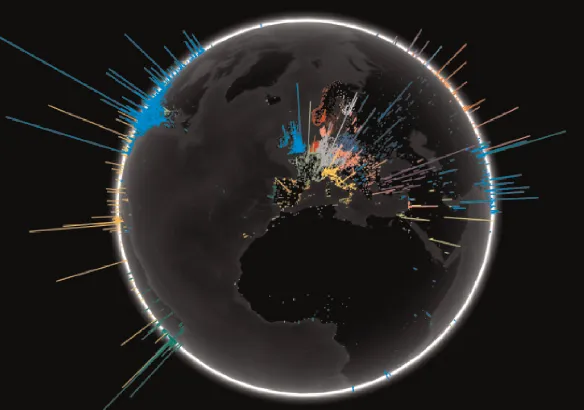
It’s safe to say that we’ve become a searching culture (Figure 1.1).
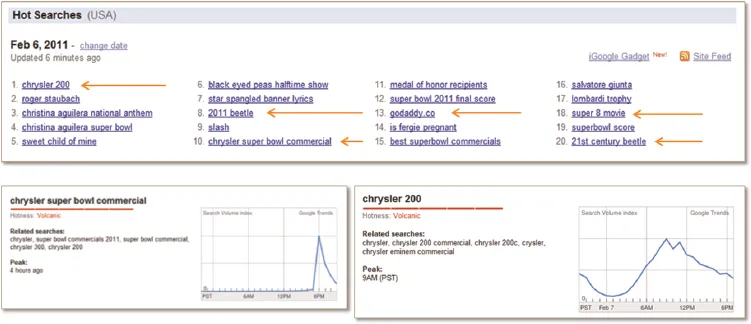
Just take a look at the 2011 Super Bowl to see this in action. Look at the spiking searches on Google during the game. Every single one of the top 20 are game-related (Figure 1.2). Viewers were searching for more information on commercials, performers at the half-time show, and the game itself.7
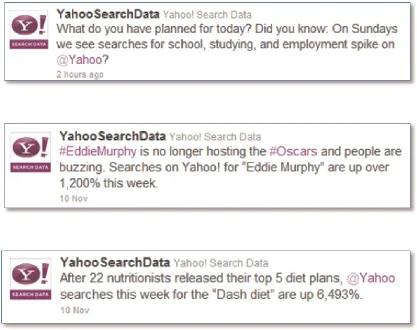
The @YahooSearchData Twitter feed provides daily reminders of our searching culture (Figure 1.3).
When Osama bin Laden was killed in May 2011, Yahoo! reported a nearly 100,000 percent increase in search traffic for related terms.8
Business leaders know that the world is changing. More customer research and transactions take place online now than ever before, and those numbers are only going to increase. Globally, the number of searches grew 46 percent in 2009,10 and every month we continue to search more often and on more devices.
According to Jack Flanagan, comScore executive vice president, “Search is clearly becoming a more ubiquitous behavior among Internet users that drives navigation not only directly from search engines but also within sites and across networks. If you equate the advancement of search with the ability of humans to cultivate information, then the world is rapidly becoming a more knowledgeable ecosystem.” But many professionals simply aren’t sure how to evolve their businesses to best take advantage of this changing landscape. This book will show you how to think about your business in a new way, better connect with your customers through search, and weave the value that search provides into all aspects of your organization.
Through organic search, you can reach potential customers at the very moment they are considering a purchase and provide them information exactly when they are looking for it. Although many businesses are attempting to connect with their potential customers through paid search (such as with Google AdWords), the opportunity to reach these customers through organic search—the results that are algorithmically generated rather than paid for—remains largely untapped.
This remains true two years after I wrote the first edition of this book. U.S. advertisers were projected to spend $14.38 billion on paid search and $12.33 billion on display advertising in 2011,12 far outpacing search engine optimization investment.
A 2011 study found that nearly half of companies planned to spend $25,000 or less on search engine optimization in 2011 and that within that same group of companies, only 25 percent planned to spend that little on paid search.
Never before have we had access to such remarkable amounts of data about potential customers. We know what they search for (and what they don’t). We know how they shop and how they buy. We can even find out where they look on a web page. Businesses spend such significant amounts of time and money on market research, focus groups, and usability studies, yet so many fail to augment this information with the abundance of free data available from those billions of searches a month.
We don’t have to look further than our local newspapers to see how consumer behavior has changed. The newspaper industry spent years trying to get readers to return to their old behaviors of expecting the newspaper at their doors every morning and reading the stories as they were laid out in print. But those readers had moved on to searching online for news on topics of interest and getting that information in real time rather than a day later. Similarly, companies have to adapt and evolve with their customers instead of attempting to get their customers to return to their old ways.
DOESN’T GOOGLE SHOW THE MOST RELEVANT SITES TO SEARCHERS WITHOUT MY INPUT?
When writing the first edition of this book, I talked to Wired magazine senior writer Steven Levy (previously the senior technology editor for Newsweek), who had been spending a lot of time at Google researching his book In the Plex.13 Levy told me he didn’t believe that businesses should have to do anything “special” to their sites for Google since Google’s purpose is to surface the most relevant, useful results to the top. He compared the practice of site owners trying to influence this to students having coaches for the SAT exam.
I told him I didn’t see things that way at all. I see the situation as similar to a retailer who opens a store in a new city. Before leasing a building, the retailer will likely scout out the area to find the best corner. The company will do some competitive research to see where the other retailers are located, as well as some customer research to see where its target consumers shop. (Many even stand on sidewalks and count people walking by!) Retailers know that even if their stores have the most amazing merchandise at super low prices, they might not have many customers if they open their s...