![]()
Part I
Biology, Biochemistry, Nutrition, Microbiology, and Genetics
![]()
Chapter 1
Biology and Classification of Vegetables
Theodore J. K. Radovich
Introduction
Vegetables enrich and diversify the human diet. They are the primary source of mineral nutrients, vitamins, secondary plant metabolites, and other compounds that support human health and nutrition. Vegetables, especially roots and tubers, can also possess significant caloric value, serving as staple crops in many parts of the world, particularly in the tropics. Although vegetables account for less than 1% of the world's plants, the genetic, anatomical, and morphological diversity of vegetables as a group is astounding (Graham et al. 2006; Maynard and Hochmuth 2007). Hundreds of vegetable taxa are grown for food in subsistence and commercial agricultural systems worldwide. This chapter reviews and explains the biology and classification of vegetables.
Biology and Classification of Vegetables
A primary reason for the diversity among vegetable crops is the broad definition of the word “vegetable” itself. Any plant part consumed for food that is not a mature fruit or seed is by definition a vegetable. These include petioles (e.g., celery, Apium graveolens Dulce group), entire leaves (e.g., lettuce, Lactuca sativa), immature fruits (e.g., cucumber, Cucumis sativus), roots (e.g., carrot, Dacus carota), and specialized structures such as bulbs (e.g., onion, Allium cepa Cepa group) and tubers (e.g., white potato, Solanum tuberosum).
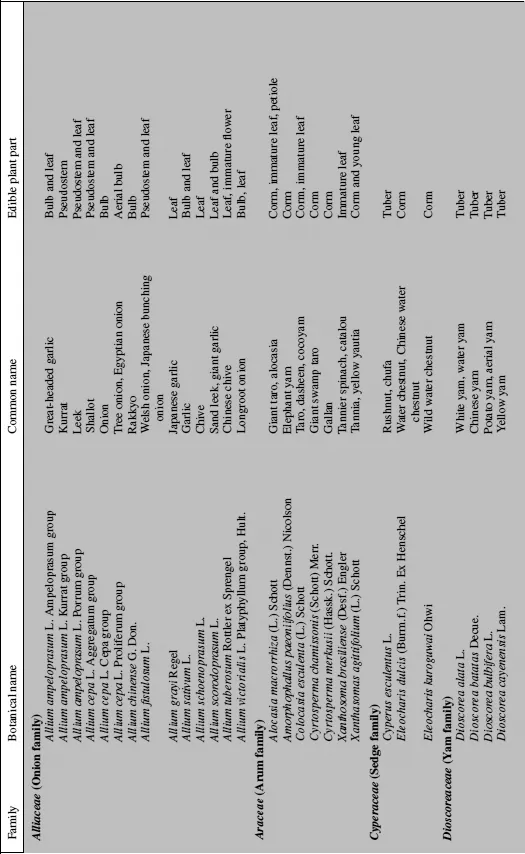
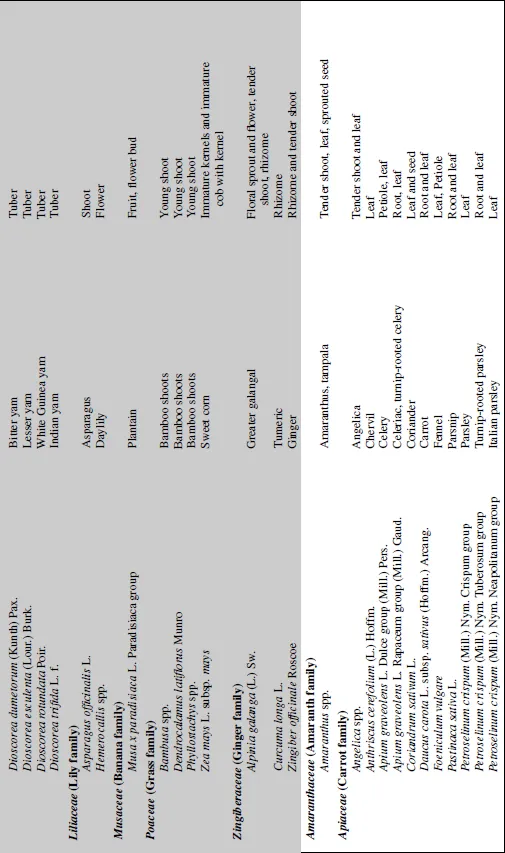
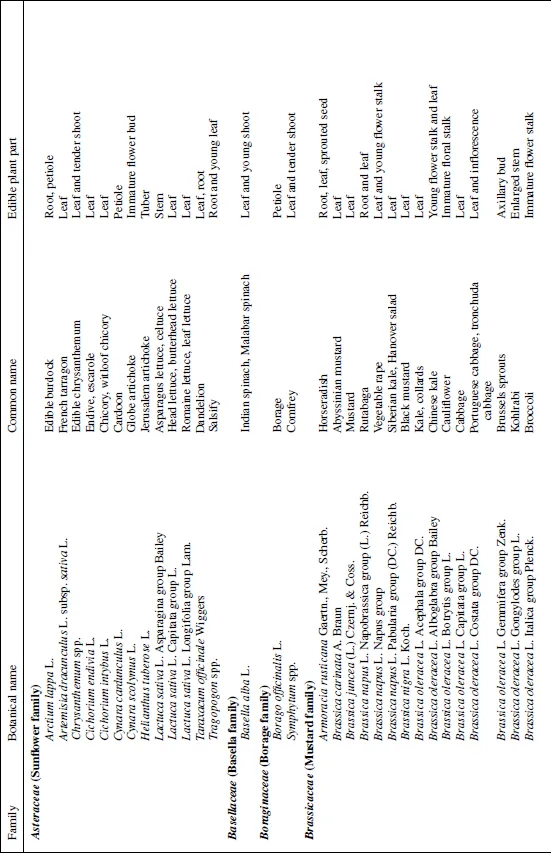
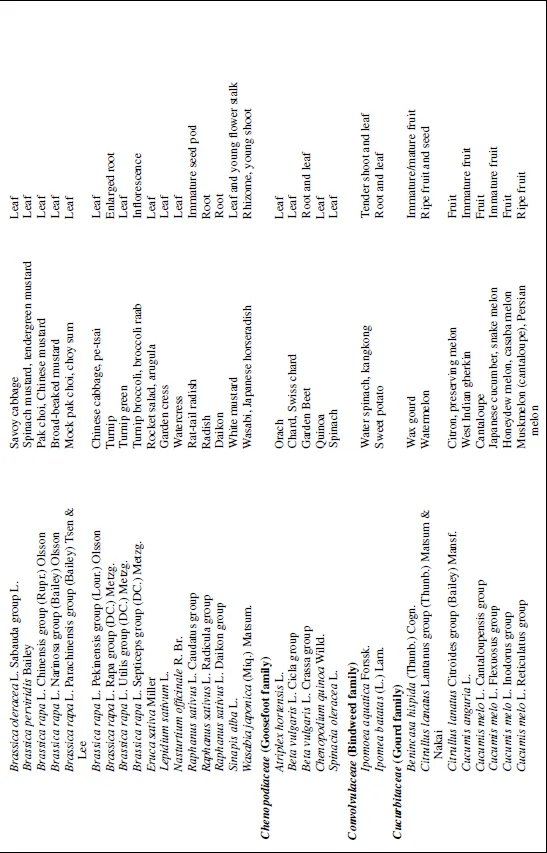
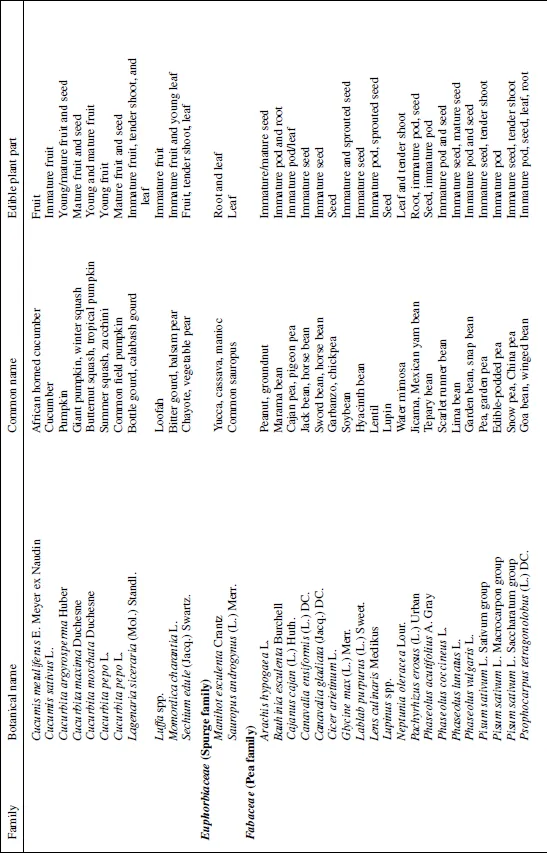
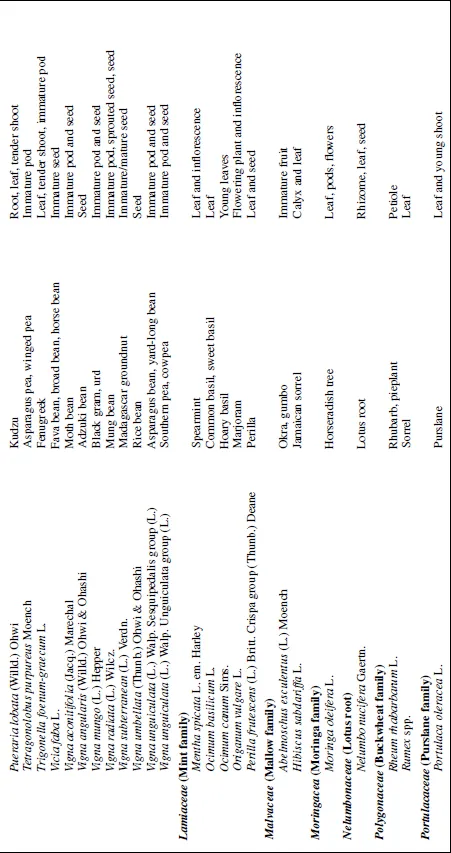
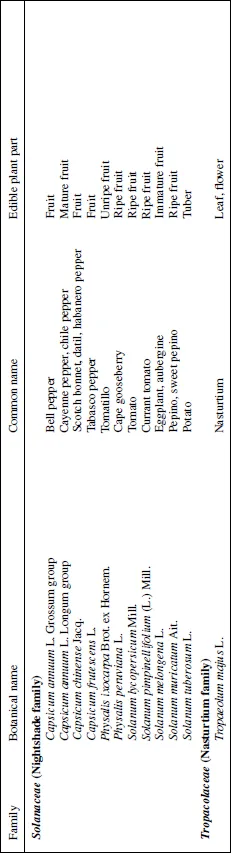
Further expanding this already generous definition is the inclusion of mature fruits that are consumed as part of a main meal rather than dessert (e.g., tomato, Solanum lycopersicum). This culinary exception to the anatomical rule was given legal precedence in the US Supreme Court decision Nix v. Hedden (1893) that confirmed common usage of “vegetable” in reference to tomato. This has since been extended to beans and other fruits. Even dessert melons (e.g., cantaloupe, Cucumis melo Cantalupensis group), which are fruits by every botanical, legal, and culinary definition, are frequently “lumped” in with vegetables because of similarities in biology and culture that they share with their more vegetal cousins in the Cucurbitaceae (Iltis and Doebley 1980) (Table 1.1).
Table 1.1 Botanical names, common names, and edible parts of select vegetables by family. Families in the Monocotyledons are listed first (shaded) followed by families in Dicotyledons
Source: Abridged and modified from Maynard and Hochmuth (2007).
The biological diversity among vegetables necessitates a systematic method for grouping vegetables in order to efficiently access information and make management decisions. Understanding the biology of vegetable crops will aid decision making associated with production, postharvest handling, and marketing. Ultimately, vegetable classification is inextricably linked with crop biology. Three basic approaches toward classification of vegetables that are based on commonalities among groups are as follows:
1. Tissues and organs consumed
2. Ecological adaptation
3. Taxonomy
All three of the above approaches toward classification are based on some level of commonality in crop biology, with the precision of classification varying from relatively low (plant part consumed) to very high (taxonomic). Table 1.2 gives definitions of selected terms related to vegetable anatomy, biology and classification.
Table 1.2 Definitions of selected terms relating to vegetable anatomy, biology, and classification
| Andromonoecious | Staminate and hermaphrodite flowers on same plant |
| Annual | Plant that completes life cycle (sets seed) and dies in one year |
| Axillary bud | Bud occurring in the leaf axil, as in Brussels’ sprouts |
| Berry | Fruit fleshy throughout |
| Biennial | Plant that completes life cycle (sets seed) and dies in two years |
| Bolt | Develop inflorescence prematurely, as in lettuce and spinach |
| Bract | Modified leaf or scale at base of flower |
| Bulb | Bud surrounded by fleshy and papery scales attached to stem plate |
| Calyx | Sepals or outer whorl of perianth |
| Carpel | Individual unit of compound pistil |
| Caryopsis | Fruit (grain) of grass, as in sweet corn |
| Corm | Vertically oriented fleshy, solid stem at or below soil surface, e.g., taro |
| Cortex | Storage tissues of root or stem, between epidermis and vascular tissue |
| Cultivar | Group of cultivated plants with distinguishing characteristics that are retained when plants are reproduced |
| Curd | Fleshy inflorescence with flower buds undifferentiated, e.g., cauliflower |
| Determinant | Branch stops growing at flowering |
| Dioecious | Staminate (male) and pistillate (female) flowers on separate plants |
| Endocarp | Inner layer of fleshy fruit wall |
| Endodermis | Inner layer of cortex, adjacent to vascular tissue |
| Epidermis | Thin outer layer of leaf, stem, or root |
| Exocarp | Outermost layer (e.g., rind or skin) of fruit wall |
| Floret | Small flower on inflorescence, e.g., artichoke |
| Fruit | Mature ovary. |
| Gynoecious | Producing predominantly, or only, female flowers |
| Indeterminant | Branch continues to grow after flowering starts |
| Legume | Single carpel fruit with two sutures, seed attached along one suture |
| Lenticel | Raised, unsuberized dot or pore for gas exchange |
| Mesocarp | Middle layer of pericarp or fruit wall |
| Locule | Seed cavity of fruit. Also compartment of ovary or anther |
| Midrib | Pronounced central vein of leaf |
| Monoecious | Male and female flowers on same plant |
| Node | Enlarged area on stem where buds emerge |
| Pedicel | Stalk or stem of individual flower or floret |
| Peduncle | Primary flower stalk of inflorescence |
| Pepo | Cucurbit fruit, leathery or woody exocarp inseparable from endocarp |
| Perfect flower | Flower with both male and female parts |
| Pericarp | Fruit wall |
| Perennial | Plants persisting for three years or more |
| Petiole | Leaf stalk |
| Rhizome | Horizontally oriented underground stem modified for storage, with nodes capable of forming new roots and shoots |
| Scales | Fleshy or dry modified leaves of a bulb |
| Silique | Specialized fruit of Brassicaceae, with two fused carpels |
| Stele | Central core of vascular strengthening tissue in roots and stems |
| Tuber | Fleshy, enlarged stems occurring at end of rhizomes |
Vegetable Tissues and Organs
The phenotypic diversity among vegetables is actually based on relatively few types of specialized cells and tissues. Dermal, ground, and vascular tissue make up the three basic tissue systems. Ultimately, the structure of these cells and tissues determine their function.
Dermal Tissues
Epidermal cells, together with cutin and cuticular waxes, make up the outer layers of leaves, fruit, and other above-ground structures and protect against water loss and other adverse abiotic and biotic factors. The periderm (cork) layer of mature roots and stems is analogous to the epidermis, but consists of nonliving cells supplemented with suberin. Stomatal guard cells are epidermal cells specialized in regulating gas exchange, and are especially dense on the abaxial surface of leaves. Lenticels are specialized, unsuberized dermal structures (appearing as raised dots or bumps) that regulate gas exchange on roots, stems, and fruits. Trichomes and root hairs are dermal cells with excretory, absorptive, and other functions critical to the ecology of vegetables.
Ground Tissues
Ground tissues are comprised of the parenchyma, collenchyma, and sclerenchyma. Parenchyma cells are thin-walled cells that make up much of the ground tissues of vegetables. Parenchyma cells often serve to store starch and other compounds. The cortex and pith of white potato are examples of ground tissues dominated by parenchyma. Collenchyma cells have alternating thin and thick cell walls that provide flexible support for stems, as in the strings of celery (Apium graveolens). Sclerenchyma tissues include sclerids and fibers with tough cell walls. Sclerenchyma cells are typically scarce in edible vegetable organs, but are important components of seed coats, nut shells, and the stony endocarps of peaches (Prunus persica) and related fruits.
Conducting Tissues
Vascular tissues conduct water, minerals, photosynthates, and other compounds throughout the plant. The xylem is part of the apoplast and consists primarily of nonliving tracheids and vessel elements. The xylem transports water, mineral nutrients, and some organic compounds, generally from the roots to leaves. The phloem is part of the symplast, consists primarily of sieve cells and companion cells, and is important in conducting sugars, amino acids, and other compounds from source (usually leaves) to sink (actively growing meristems, roots, developing fruits, and seeds). Both xylem and phloem are supported by parenchyma cells and fiber. Some xylem cells (i.e., tracheids) have thickened cell walls that contribute significantly to the structural support of tissues.
The differentiation and variable structure of plant tissues result in diverse functions among the plant organs (stems, roots, and leaves) and organ systems (e.g., fruits, flowers, buds, and bulbs) consumed as vegetables. The classification of vegetables by edible parts has been termed “Supermarket Botany” (Graham et al. 2006). Although broad and not always anatomically correct, the grouping of commodities as leafy, fruit, and root vegetables has value to growers, distributors, and others in the market chain because of similarities in cultural and postharvest ...