![]()
CHAPTER 1
STRATEGIC MANAGEMENT
INTRODUCTION
Many works on strategic management treat the subject as consisting of several component parts such as goal formulation, strategic evaluation, strategy implementation and strategic control, but advise that these are components of a framework and may not exist as discrete orderly steps in a strategic management decision-making process. It is further suggested that there are a number of characteristics of strategic decision making concerned with the scope of an organization’s activities, the matching of the organization to the environment and then matching the organization’s activities to its resource capability.
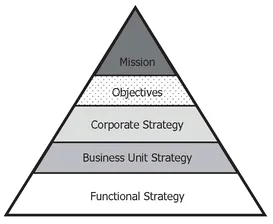
Figure 1.1 Hierarchy of strategies.
From The Essential Management Toolbox: Tools, Models and Notes for Managers and Consultants, S.A. Burtonshaw-Gunn, 2008. Reproduced with permission.
Within this first chapter there are a number of well - known business models, many of which help to achieve a comprehensive analysis of the business in order to determine its future direction, or at least make decisions based on informed choice and then plan how this can be best deployed or realized. In addition, the words “strategy” and “strategic management” relate to a number of levels within an organization and a hierarchy of these together with inter-related strategies is shown in this section (see Figure 1.1). The lowest level of strategy is often referred to as “Functional strategy” which focuses on the day-to-day operational activities that the organization is involved in. Within a business there are often a number of functional strategies which take their lead from the next level of “Business strategy”. This intermediate level business strategy covers the aggregation of the functional strategies for a single business unit or organization with a concentration on the tactics that the business will use to address its threats from competitors and market opportunities with present or targeted customers. The business strategy should reflect the higher level “Corporate strategy”. This highest strategy level needs to consider the overarching strategy of the business to address questions concerning the arena in which the business should compete and how the organization’s activities contribute to its competitive advantage and longer-term sustainability. It should also reflect the organization’s mission, vision and objectives seen in its business plan and covered in detail in Chapter 2.
Whilst there are many books on strategic or corporate management with a natural focus on long-term organizational development, this chapter examines strategic management from the context of operations management and how these two topics can coexist. The strategic “big picture” decisions should not just be about the commercial performance of the business, as they should also include the commitment and development of its operational performance; none more so than with quality, environmental and business continuity management - as these three become more closely aligned through common external standards and interoperability of customer requirements. This first chapter, then, examines how corporate strategy is established, its role and benefits as a prelude to the other chapters and then explores the areas of business operations management.
STRATEGY AND PERFORMANCE DRIVERS
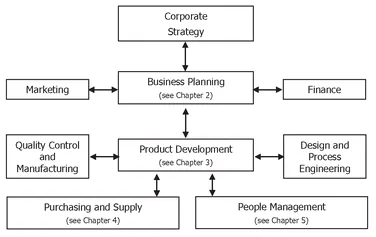
It is useful to remember that within both commerce and industry the raison d’être for the senior level of management, normally the executive board of directors, is to examine the nature of the business and steer the company to its future sustainability. Such direction requires the establishment and implementation of a robust strategy, which will be primarily concerned with the company as a whole, its environment and its future course. Indeed, such strategy formulation will inevitably have to draw on an analysis of its present business role, the future business direction it wishes to take and how the board’s vision and objectives can be successfully implemented and achieved. It has to be said that strategic management is a general term, whereas the above decisions regarding what business to be in are generally covered under the term “corporate strategy”. This task of strategy development involves decisions on plans at the most senior level which recognize both the financial and organizational development of the company with such major decision making regarded as being at the very heart of this branch of management. However, development of a corporate strategy should not be regarded as an isolated task limited to a few but rather it must be integrated with other key corporate or stakeholder functions, as shown in Figure 1.2. As seen, the model also provides a natural linkage to the other topics within this book.
Figure 1.2 Strategy integration.
The model in Figure 1.2 demonstrates the importance of the relationship between corporate strategy and business strategy. This must then be articulated in integrated business plans to envision how the organization will engage in its business activities and in turn how these drive the functional strategies such as product development which details the value-adding work that the organization undertakes.
Strategic management involves not just trying to exploit the strengths of the organization and minimize any weaknesses, but requires that the organization also considers the external environment in which it operates, typically looking for opportunities and threats which it may have to respond to. The strategic perspective goes beyond operational efficiency improvements as the development of an effective strategy will need to focus on delivering and maintaining distinctive quality products, high customer and brand awareness and trust, and must also be seen to support overall business growth targets. In general terms the development of a strategy, whether for a newly established or a mature organization, will involve addressing the following four key areas:
• Analysis of strategic goals (vision, mission and strategic objectives) along with the analysis of the internal and external environment of the organization.
• Decision making on the key areas of organizational development and the most effective ways to address them.
• Implementation by identifying and deploying resources, structures and systems to implement the strategy efficiently and effectively.
• Support from the provision and maintenance of policies, organizational infrastructure, governance, culture and leadership which all play a role in supporting strategy implementation.
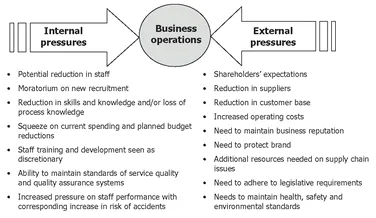
To achieve any degree of success many writers on the topic of strategic management stress that the organization’s corporate vision must be aligned to its core values; to the organization’s mission; and also to its goals and the objectives it wishes to pursue in the short, medium and long term. In general, it is also recognized that the absolute prime importance to any company, irrespective of its size or its public/private ownership state, must be its desire to survive over the long term. This may be achieved by balancing the need to earn an economic profit (and satisfy its shareholders) with the need to invest in its own resources; typically its systems, processes, plant, machinery or its employees. The efficient use of these “human resources” largely governs the success of the organization as it is ultimately reliant on its employees to both formulate and implement strategy. Strategic management may therefore involve the development, review and remoulding of the organizational structure that will best ensure survival within its operating environment, taking into account the internal and external pressures which currently impact or have the potential to impact business operations, as shown in the model of Figure 1.3.
The analysis stage should be fully integrated with wider competitor knowledge and how this will influence the business operation of the organization. The simple Strengths, Weaknesses, Opprtunities and Threats (SWOT) analysis is often a good starting point in exploring the internal and external influences which can then be further refined with other tools and models such as those described below.
Figure 1.3 Business pressures influencing strategy.
1. The Ansoff Matrix
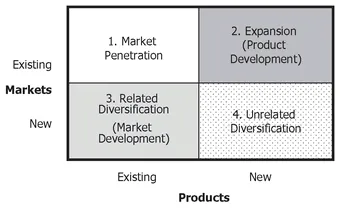
This covers the relationship between market and product and suggests four possible strategies which the business may adopt for each product or service (Figure 1.4). This widely applicable matrix can be used to provide guidance for companies in setting their strategic objectives or for analysis to understand their current market position. It examines choices based on the relationship between the organization’s products and their market position and is usually undertaken for each product or service within the company’s portfolio. Understanding this position offers some direction to future strategy.
Figure 1.4 Product-market growth strategies.
Reprinted by permission of Harvard Business Review. An exhibit from “Strategies for diversification” by H. Igor Ansoff, Sept.-Oct. 1957. Copyright by the President and Fellows of Harvard College. All rights reserved.
2. Porter’s Generic Strategies
Professor Michael Porter sugests that three generic strategies can be adopted, these are:
• Cost leadership.
• Differentiation.
• Focus.
The simplest of the above strategies is cost leadership and by achieving the lowest cost of production in an industry or market sector, a company can either reduce its selling prices or keep the increased profits to invest in research and develop new and more of existing products. The second option of differentiation involves making the product or service appear different in the mind of the consumer, this may be by offering better design, reliablity, service and delivery; for services this may include courtesy, availability, expertise and location. The third strategy of focus is where a company concentrates on a market area, or to deliver niche products or services.
3. “Five forces model”
Professor Porter’s “Five forces model” can be used as part of the organization’s strategy planning process and also to ensure that the actions (current or proposed) are aligned with its strategy and its market position aspirations. The use of the model can help to identify where additional information may be required to assist the company in its strategy development with suggestions for future competitive strategies. Porter’s model covers:
• the bargaining power of suppliers and buyers;
• the threats from subsitutes and new entrants; and
• the intensity of rivalry among competitors.
This model is shown also in Essential Tools for Management Consulting as it provides a good structure to consider the “big picture” external perspectives.
4. Elements of Corporate Strategy
This model is the main proposition for strategic management shown in the textbook Exploring Corporate Strategy by Professors Gerry Johnson and Kevan Scholes. This summary model of the strategic management process concerns three major elements: strategic analysis;...