eBook - ePub
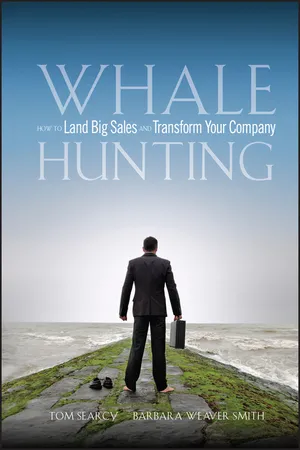
Whale Hunting
How to Land Big Sales and Transform Your Company
- English
- ePUB (mobile friendly)
- Available on iOS & Android
eBook - ePub
About this book
Using the ancient Inuit whale hunt as a metaphor for big sales, Whale Hunting gives you a clear nine-phase model for successfully finding, landing, and harvesting whale-sized sales accounts—the kind of sales that transform your business. Here, you'll learn how to turn the dangerous endeavor of selling to large companies and big contracts into a strategy for continued success and growth. Stop wasting time with little accounts and start landing monster accounts.
1

The Whale Hunters’ Story
COME WITH US TO A PLACE THAT is much darker, much colder, and much more dangerous than wherever you are right now. We are in the far Northwest, along the coast of Alaska, centuries ago. Imagine that along that coast you live in an earthen hut with your close family group of about 30 people. The hut is only 50 feet long and 20 feet wide. There are no windows and there are no doors. Only a few small holes in the ceiling release the smoke from the whale oil lamps that light and heat our space. To come in and out of this space, we crawl through a tunnel in the floor, out toward the coast. We have reinforced our tunnel with the rib cage bones of a whale.
We are not the only hut along this stretch of the coastline. Several other family huts make up our village. But everyone, in every hut, is doing what we are doing.
Waiting.
We have been waiting since we heard the very first pop, exploding like gunfire, letting us know with a roar that the ice floes are beginning to thaw and spring is near. We have been waiting through the long, dark winter. We have been waiting since the Northern Lights have started to fade and we approach more than four hours of daylight.
In our huts, at the earliest signs of spring, we are waiting for the whales. Every year from late winter to early spring, the whales migrate from far south of us, in what today is Baja, California, to places a little farther north than our village. As they come closer to our village, as they come nearer to the coast, we will hunt them.
Scouting the Whale
Although we know the time of year, we don’t know exactly when the whales are coming. So our village sends out scouts. Every boy between the ages of seven and twelve is dispatched along the coast for miles. Well before dawn and long after dusk, the scouts look for the signs of a whale. Every man who is out hunting for caribou, anyone who is fishing in a kayak, is looking out across the coast to see the “whale sign.”
It is a difficult place to spot whales. There are few hours of sunlight in a day. The water appears gray. The sky is gray. The land around us is gray. And we are looking for whales. They are gray, too.
You are probably wondering why it would be hard to spot the largest mammal on earth; and probably you have in your mind a picture of a whale spouting or breaching. But if our first glimpse of the whale is when it expels air and water through its blowhole, or when it propels its entire body wholly above the water, we are already too late. It will take too long to launch a boat and catch a whale at this point in its migration. The whales will be way beyond a point where we can catch them. Our scouts need to look for the signs of the whales before they are visible.
Our scouts know that the first sign of whales is the flocks of birds that precede them. The birds feed on the small fish that are swimming north as part of their migration. The small fish are chased by larger fish and still larger fish. Finally will come the whales.
In our village, everyone awaits the news of whale sign. One morning, a boy runs into the village, electrifying us with the news, “I have the whale sign.”
Hunting the Whale
You are the harpooner. As the captain of your boat, you rally your shaman and six other oarsmen to lift the boat and launch. Your boat is called an umiak. It is 36 feet long, made of cypress wood, and covered in sealskin. That boat is sacred, as is everything related to the whale hunt. It’s all been scrubbed down with fresh water from a river some distance away from the village—the boat, the tackle, the harpoon, the line, everything—so as to keep it pure and clean. Everything that touches the water for the hunt, everything that touches the whale, must be pure, to observe the tradition of our ancestors.
Now we lift the boat from all sides and launch it into the water. At the front, you sit as the harpooner responsible for directing the boat close to the whale. In the back is the shaman, our spiritual leader, who provides for everyone the tradition and history. The shaman knows which chants to sing, which poems to recite, and which practices to follow to ensure that we have a safe and successful whale hunt.
There are six oarsmen in our boat as well. Each crew member has dual responsibilities: one, to row the boat and, two, to serve the hunt. One minds the tackle. Another minds the line. Several fish and prepare food along the journey. The hunt will take weeks out on the open water, and there is much work to accomplish along the way.
Finally, we spot a whale. The harpooner’s job is to direct the boat as close as possible to the whale. Perhaps you can imagine hurling your harpoon toward the whale. But that’s a fiction. A 60-pound harpoon would bounce off 100,000 pounds of blubber. We need to get right next to the whale—even jump on top of the whale. And, as harpooner, you have to drive that harpoon in at just the right spot. You have been practicing all winter for just this moment. And you are successful. Your harpoon penetrates deep into the whale’s blubber, and your umiak is now connected to the whale by a strong line made to withstand the wild and dangerous ride ahead.
Now the whale will do one of three things. It might pull away from the coastline and head deep into the ocean, taking us on a two- to four-day ride in and out of darkness, in and out of ice floes, in a very dangerous place and at a great distance from our village. Or the whale might dive as deep as 650 feet down into the water. And it can wait, silently, as long as four hours. When it surfaces, it can emerge straight up under our boat, dislodging us. But if you are very skillful, and have put your harpoon in exactly the right place, the whale will pull toward the coastline and run along the coast until it tires. On that four-day run, everyone on the boat has a job. Tending the line is critical. If you let out the line too fast, the whale can get free. If you let it out too slowly, the boat may go under, or the line will break. Anyone who gets tangled in the line will be pulled overboard.
Finally, the whale tires. We pull the boat next to the whale and dispatch it. There is still one more job for a crew member. He needs to jump over the side, into the frigid waters, and sew the whale’s mouth shut. If the mouth is left open, the whale fills with water and sinks to the bottom.
Now we must bring this whale to shore. The odds are not in our favor: a 100,000-pound whale against a 3,500-pound boat. Hauling the whale against the tide does not work. Rather, we have to work with the natural forces, the wind and the tide, to steer the whale and beach it.
While we are bringing in the whale, our young scouts are watching the coast to spot our boat. When they see us, they run back to the village to point out where the whale will be beached.
Harvesting the Whale
Everyone in the village heads to the coast as fast as possible. They bring sleds, buckets, and pots. The same tides, the same winds that brought in our whale can take it back out. Left in the open air, the whale will begin to rot. We need to harvest it quickly.
Once the whale has been beached and secured, the entire community helps with the harvest. From the age of four on, everyone has a job. At four, the children learn to harvest the whale oil from the blubber. Later, they are taught how to harvest the blubber and the skin and the meat. Eventually, they learn to handle the bone. We use every part of the whale, except for its head.
The head is preserved and kept free. When the harvest is over, the boat sets out one more time. It takes the whale’s head back out to sea, where it will sink deep within the ocean and be reborn. Our village does not see the whale as a victim of our hunt. Rather, it is a gift from the gods sent to sustain us.
The leaders decide which parts of the whale go to which members of the village. The food is divided based on each one’s contribution to the hunt and what the village needs for the coming year.
After all has been divided, we return to our village for a great celebration. But we do not celebrate the great hunters. We do not celebrate the boat or even the harpooner. The celebration is for the whale. The whale is what gives us life and the opportunity to thrive.
Why do we endure such difficulty and danger to hunt whales? People have been killed hunting whales in this manner, century after century. But when we hunt walrus or caribou, seals or a string of fish, we can eat only for a day or a week or two.
A whale can feed our entire village for a year.
2

Signs of the Times
THE ANCIENT INUIT KNEW EXACTLY THE RIGHT TIME TO HUNT WHALES. It was spring. The ice was breaking. The whales were moving north through the body of water now known as the Bering Sea. We can well imagine that whale hunters wished the whales would move in July or August when the days were never-ending and the temperatures were balmy. Driven by forces beyond their control or knowledge, however, the whales moved during the time when the wind was treacherous, the temperatures below freezing, the ice floes moving erratically, the waves mountainous, and the daylight sharply limited. And so year after year, the Inuit braved these conditions and hunted the whales because it was the right time to do so.
Today’s businesspeople do not have such obvious, unmistakable signs of the correct times to shift their company’s focus from smaller accounts to those 10 to 20 times larger. But if you know where to look, you will see indications that whale hunting should be on your agenda.
In the business environment of the early twenty-first century, we observe signs of the spring’s ice breaking in multiple layers. Ice is breaking at the global level, at a societal level, and within the smaller realms of your industry and your business. Whales are moving. It is time to hunt them. Here is how we know.
Whale hunting, in the business context, is all about smaller companies learning to sell and to deliver big deals with big companies, which we define as whales. It is important, therefore, that smaller companies first understand the whales’ habitat. We are looking especially at how changes in the global business environment have mandated changes in sales and procurement processes.
The international business environment has experienced sea changes in the past 30 years, driven by a host of interrelated factors. Information technology has been and continues to be a prime mover of these changes, creating a new set of both problems and opportunities for big companies, including such diverse issues as financial stress, just-in-time (JIT) inventory, quality control, and consumer capabilities. Let’s look briefly at how these factors have affected how whale-sized companies do business with their suppliers, beginning with the concept of JIT.
Changing Business Environment
JIT was first articulated by Henry Ford, as described in his My Life and Work (Doubleday, Page & Co., Garden City, NY, 1922). It did not become part of business culture, however, until the 1950s when Toyota Motor Corporation of Japan adopted and publicized the practice as an answer to its limited access to capital. In the United States, financial stress provided the impetus to adopt JIT. Traditionally, manufacturers had stockpiled inventories and recorded them as assets on the balance sheet. But that view of warehoused inventories as assets began to change in the 1970s and 1980s. The cash invested in large inventories put a drag on a company’s financial well-being, as did costs for space, utilities, and insurance. In some cases, parts were becoming obsolete before they could be sold. Financial managers and stockholders began applying pressure to business executives to find a better way to manage availability of parts. One solution was to move products back into suppliers’ warehouses and order them when they were needed.
The concept of just-in-time inventory is simple and can be summed up in a few words: having the right product in the right place at the right time and in the exact amount required. Its implementation, however, is not so simple. Once the major manufacturers (whales) emptied their warehouses of inventory, suppliers (smaller companies) were left with the task of having enough material on hand to meet demands—but not so much that the bottom line of their balance sheets became skewed. Suppliers were accustomed to a process of producing goods, sending them to a warehouse, and being paid on delivery. This business model transition required them to rethink their entire business. Instead of setting their own timetables for delivery and payment for goods, they had to cut back on their production but be meticulous about the quality of everything they produced. They had to store any surplus goods themselves. And, of course, since they didn’t get paid until the goods were needed, they had to develop new processes that ensured an intricate system of timing, quality, and pricing.
Demand for quality increased dramatically when supplies of any goods were sharply limited. Under the previous model, another item was available in the vast warehouses of parts. But with the implementation of this model, every part had to be precisely correct so that it could be sold and paid for on demand. New technology systems were developed to meet these demands, intricate systems that followed an item from the original request for proposal (RFP) or order through its delivery to the manufacturer. Quality control activities, many based on statistical models, were required at each step of manufacturing.
Information technology introduced more than just sophisticated inventory management systems. It opened the door to a world of information that few business leaders had previously imagined. Whereas whale-sized companies knew...
Table of contents
- Praise
- Title Page
- Copyright Page
- Dedication
- Foreword
- Preface
- Acknowledgements
- Author Biographies
- Chapter 1
- Chapter 2
- Chapter 3
- Chapter 4
- Chapter 5
- Chapter 6
- Chapter 7
- Chapter 8
- Chapter 9
- Chapter 10
- Chapter 11
- Epilogue
- Glossary
- Index
Trusted by 375,005 students
Access to over 1.5 million titles for a fair monthly price.
Study more efficiently using our study tools.
Frequently asked questions
Yes, you can cancel anytime from the Subscription tab in your account settings on the Perlego website. Your subscription will stay active until the end of your current billing period. Learn how to cancel your subscription
No, books cannot be downloaded as external files, such as PDFs, for use outside of Perlego. However, you can download books within the Perlego app for offline reading on mobile or tablet. Learn how to download books offline
Perlego offers two plans: Essential and Complete
- Essential is ideal for learners and professionals who enjoy exploring a wide range of subjects. Access the Essential Library with 800,000+ trusted titles and best-sellers across business, personal growth, and the humanities. Includes unlimited reading time and Standard Read Aloud voice.
- Complete: Perfect for advanced learners and researchers needing full, unrestricted access. Unlock 1.5M+ books across hundreds of subjects, including academic and specialized titles. The Complete Plan also includes advanced features like Premium Read Aloud and Research Assistant.
We are an online textbook subscription service, where you can get access to an entire online library for less than the price of a single book per month. With over 1.5 million books across 990+ topics, we’ve got you covered! Learn about our mission
Look out for the read-aloud symbol on your next book to see if you can listen to it. The read-aloud tool reads text aloud for you, highlighting the text as it is being read. You can pause it, speed it up and slow it down. Learn more about Read Aloud
Yes! You can use the Perlego app on both iOS and Android devices to read anytime, anywhere — even offline. Perfect for commutes or when you’re on the go.
Please note we cannot support devices running on iOS 13 and Android 7 or earlier. Learn more about using the app
Please note we cannot support devices running on iOS 13 and Android 7 or earlier. Learn more about using the app
Yes, you can access Whale Hunting by Tom Searcy,Barbara Weaver Smith in PDF and/or ePUB format, as well as other popular books in Business & Sales. We have over 1.5 million books available in our catalogue for you to explore.