![]()
chapter one
The GUEST Approach to Selling
“Guests are always welcome.”
In recent years many different businesses have begun to approach their clients differently. They are now calling them guests, which has been the norm in the hotel industry for decades. Many restaurant chains as well as other businesses use this term. A gas station around the corner from my house boasts a sign on its door that reads, “Welcome, guests.”
A simple word like “guest” versus “customer” can make a dramatic difference in the way we perceive the people who pay our salaries. A customer is someone who makes a purchase. A guest is someone we welcome with open arms and look forward to interacting with. A guest is more of a friend, someone we will treat with dignity and respect.
I’m not suggesting that you immediately begin calling all of your customers guests. What I would like to introduce to you is the GUEST model of selling. GUEST is an acronym for a five-step sales process.
1. Greeting your customers.
2. Uncovering the customers’ needs.
3. Explaining the product or service.
4. Solving objections.
5. Telling them to buy.
Many sales-based organizations have their own sales model or structure. The GUEST model is designed to fit into most sales cycles. These five steps are the key components to all successful retail selling. The majority of salespeople in retail don’t follow any structured process, preferring to allow the sale to flow naturally. I’ve heard many justifications and rationalizations for this:
“You can’t follow a structured process.”
“Customers just take control of the sales process.”
“It takes too long to go through a process like this.”
“My store is too busy.”
“I’m too busy.”
“I’ve done it my way for years and I’ve been successful.”
The list could go on and on. In fact, I could probably write another book just listing the excuses I’ve heard from salespeople. Here is the point. The GUEST process works. Ultimately, you need to take control of the sales process. If you don’t, the customer will, which is what happens in approximately 80 percent of all sales transactions that take place on the retail floor. I have seen salespeople shadow customers around the store trying desperately to sell them something.
News flash! Consumers will not buy from a salesperson they don’t trust, don’t like, or who doesn’t show confidence. I have known salespeople with a tremendous amount of experience and knowledge who can’t close the number of sales they are entitled to because they try too hard.
Here’s a typical sales story. The customer is looking at a product. The salesperson launches into a canned pitch about the product. The customer asks some questions and expresses some objections. The salesperson tries to overcome or defend the objections. The process ends with the customer saying, “Got a card? I’ll be back.” These words are the kiss of death in retail because few of these customers ever actually return. The reasons are simple.
• The salesperson did not greet the customer properly.
• The salesperson did not ask the customer any questions.
• The salesperson delivered a rehearsed presentation instead of focusing on the customer’s needs.
• The salesperson did not gather sufficient information to overcome the customer’s objection.
• The salesperson did not give the customer a reason to make the purchase!
The GUEST approach to selling addresses each of these issues. If you make a conscious effort to apply the concepts in this book you will notice an immediate improvement in your sales. The key is to concentrate on the process rather the outcome. If you work through each step instead of trying to close the sale, you will increase your closing ratio. Too many salespeople work hard to close a sale because they need to reach a certain level of sales to earn commission, their boss is hounding them to close a deal, or they haven’t reached their sales quota. The result is a desperate attempt to get the customer to part with their hard-earned money. These customers feel threatened, manipulated, coerced and often leave the store without making any purchase at all.
On the other hand if a salesperson concentrates on the sales process the customer will be more relaxed, feel more comfortable, and will be more likely to buy. In my workshops I encourage salespeople to allow the sale to progress naturally. I instruct them to pay attention to their customers instead of focusing on closing the sale. This runs contrary to most sales training where the emphasis is on closing the sale. My philosophy is that the sale will happen when you put all five components together in a relaxed, comfortable manner.
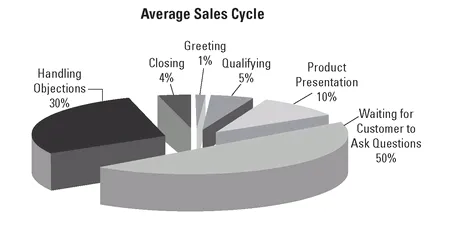
The average salesperson’s sales cycle looks something like this:
Half the sale is spent in a passive role! It’s no wonder consumers aren’t anxious to make a purchase.
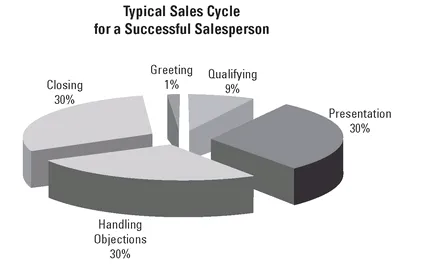
Here is the sales cycle of a typical successful salesperson:
This individual divides his or her time equally among presenting the product, handling objections, and trying to close the sale.
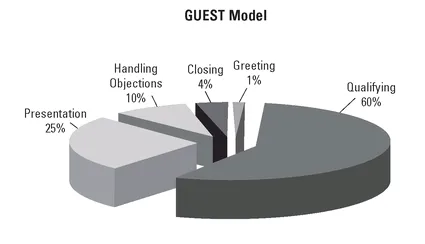
The GUEST model of selling suggests this breakdown:
You will notice that most of the time is invested in uncovering the customer’s needs. When done properly, this step will eliminate many objections. Unfortunately, most salespeople either don’t understand this or refuse to believe it. Most still feel that they have to skate quickly through the qualifying process to have enough time to deal with objections.
A business acquaintance of mine works in advertising. When I approached him to produce a training video he began asking me questions to fully understand what I needed and wanted in a video. Because he took the time to learn about my business needs, I immediately saw the value in this $45,000 investment. Not once did I express an objection about the cost because he demonstrated the value while he uncovered my needs and presented a solution. He made sure that he positioned himself and his company as a problem-solver and a solution-provider.
Another friend of mine owns a training company that provides a variety of training programs to retailers. In his sales training he does not discuss how to overcome objections because he believes, and rightly so, that if you qualify your customer’s needs you won’t hear any objections. My experience in consulting has confirmed this as well.
As you progress through the book you will begin to see how the GUEST model of selling differs from, and is more effective than, the traditional style. It focuses on the customer rather than on closing the sale. It is designed to make people feel important.
Stop treating your customers like a pay cheque and view them as guests in your store. This may sound awkward, particularly if you have been accustomed to using aggressive selling tactics. If you discipline yourself to follow the blueprint provided here, you will soon notice a difference in the way your customers respond to you. In return, they will be more willing to part with their hard-earned money. They will be willing to buy from you—today—at your price!
![]()
chapter two
Powering Up Your Personal Attitude
“Attitude is a little thing that makes a huge difference.”
It has been said that attitude determines altitude. Your personal attitude will definitely determine the level of success you attain more than any other factor. Without the right attitude you will be deterred by the smallest obstacles and will give up long before you reach the level of success you deserve. If you don’t have the right attitude you will not be willing to accept new challenges that will help you grow and develop. You will also fear the risks that are associated with these new challenges. Although attitude alone will not guarantee you success in sales, without it you may well find success elusive.
Exercise
Let’s explore this in a bit more detail. Assume that every letter in the alphabet has a numeric value according to its location. “A” is 1, “B” is 2, “C” is 3, and so on. Take a moment and assign each letter in the word “attitude” its numeric value. Record your answers in your action planner.
Your responses should be A-1, T-20, T-20, I-9, T-20, U-21, D-4, E-5. Now add these figures together and write this number in the circle on your action planner.
If your math was accurate your total should be one hundred. Coincidence? I doubt it very much. This demonstrates that 100 percent of the results we achieve are a direct reflection of our personal attitude. If you begin your day with the attitude that you are going to have a great day regardless of what happens, then you will likely have a great day and good things will happen. On the other hand, if you believe that your day will be one filled with negative situations, then that is what you will attract.
Let’s take this a bit further. You are finishing work one evening and a friend you haven’t seen in a while calls and invites you out for a drink. You are scheduled to work the next morning but accept the invitation anyway. You justify it by saying, “I haven’t seen him in several months. Besides, a couple of drinks won’t be too bad.” The two of you meet and before you realize it time has slipped past and it is now very late. You realize that by the time you get home you will only get about five hours of sleep. “No problem” you say to yourself. “I’ve done that lots of times and always felt fine the next day.” You arrive home later, set the alarm, and promptly fall asleep.
The next morning the alarm sounds. What is the first thing you do? If you are like most people, you hit the snooze button and go back to sleep. Nine minutes later the alarm beeps and again you tap the snooze button. On the alarm’s third warning, you leap out of bed and frantically begin preparing for work. You race to your car thinking that if everything goes right you’ll still make it to the store on time. You fire up the engine and notice that the gas gauge is hovering on empty, and recall that in your haste to get home last night, you said to yourself, “I’ll fill up on the way to work tomorrow.” If you are anything like me this happens more times than you care to admit.
You drive into the corner gas station and are pleasantly surprised to see an empty lane. You pull up to the pump, fill up your car and pay for your gas. You also pick up a coffee and a muffin for breakfast. As you head onto the highway, you look at your watch and think to yourself, “No problem, I’ve still got time to make it. Yeah, this day’s going to turn out all right after all.” No sooner have the words flashed through your head when the traffic comes to a grinding halt. You brake suddenly, spilling hot coffee on yourself. Now, you’re caught in a traffic jam, and you’re wearing coffee-stained clothes. You blast your horn in frustration, drum your fingers impatiently on the steering wheel, shout at other motorists in anger, and look repeatedly at your watch, willing time to stop. You realize with a sinking feeling that you are going to be late.
Ten minutes later the traffic begins to clear and you are on your way. However, your frustration does not dissolve. It seems now that whatever lane you move into, you find your way impeded by cars whose drivers choose to drive for the first time in their lives, right in your path. Slow, slow, slow. You weave in and out of lanes hoping to catch a break in the flow. After what seems an eternity, you arrive at the store, fifteen minutes late for your shift. As you rush through the front door your boss looks at you, taps his or her watch, and asks somewhat caustically, “Do you know what time it is?”
Before you answer let me ask you—are you having a bad day? Or are you having a bad start?
Most people will now have a bad day. They will allow the circumstances of the morning to influence their entire day. When the boss questions their tardiness, they respond with, “You won’t believe the morning I’ve had. First my alarm didn’t go off” (embellishment #1). “Then my car wouldn’t start” (embellishment #2). “And then some jerk cut me off and made me spill my coffee” (embellishment #3). “I got stuck in traffic for ha...