In line with this thinking, The Pirate Inside forwards two key questions: what does it take to be the driver or guardian of a successful Challenger Brand, and what are the demands made by this on character and corporate culture? Building on his answers, Adam Morgan then explores the critical issue of whether big, multi-brand companies can create Challenger micro-climates within their companies, and the benefits that they might achieve by doing so.
eBook - ePub
The Pirate Inside
Building a Challenger Brand Culture Within Yourself and Your Organization
- English
- ePUB (mobile friendly)
- Available on iOS & Android
eBook - ePub
The Pirate Inside
Building a Challenger Brand Culture Within Yourself and Your Organization
About this book
Most marketing and branding books fall into one of two camps: either they are about leaders or they assume that brands can be managed by process alone. The Pirate Inside is different. It forwards the idea that brands are about people, and Challenger Brands are driven by a certain kind of person in a certain kind of way. Challenger Brands don't rely on CEOs or founders, but on the people within the organization whose personal qualities and approach to what they do make the difference between whether the brand turns to gold or falls to dust.
Information
PART I
Behaviours that Stimulate Challenger Brand Cultures
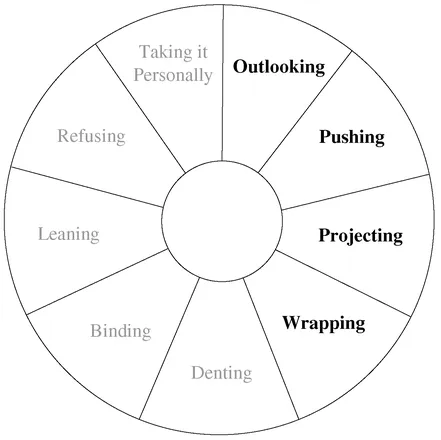
Part I will outline a set of four behaviours that we need to commit to as individuals if we find ourselves in the position of wanting or needing to be Brand Pirates – and the standard behaviours in brand building that we will need to think about differently as we move through the strategic development process.
Chapter 1 Outlooking: A Different Kind of Insight Seeking
There are two kinds of Insight a Challenger needs to distinguish between: Insights that frame the problem and task (Reflective Insights), and Insights that identify where we might build the future (Insights of Opportunity). Outlooking is a way of describing how Challenger individuals seem to find the latter, and the first behaviour we need to bring out in ourselves and our team.
Chapter 2 Pushing: A Different Kind of Approval
Their need to stand out and genuinely reframe the consumer’s perception of them or the category means that the team on a Challenger brand need to be prepared to ‘Push’ an emerging idea in order to make it powerful enough. This represents a different kind of ‘approval’ of ideas emerging in the strategic process: merely being a good idea on brief may not be sufficient – our first questions should be ‘Has it gone far enough? What would happen if we pushed it further?’
Chapter 3 Projecting: A Different Kind of Consistency
This chapter explores the behaviours a Challenger brand team should foster in terms of communicating their pushed idea, once it has emerged. It argues that we have far more media at our disposal than we think we do, and we need to use the potential power of each medium by thinking in terms of consistently ‘projecting’ our identity – evincing a strong sense of who we are and what we stand for – rather than simply relying on the more conventional concept of ‘messages’.
Chapter 4 Wrapping: A Different Kind of Communication
This chapter argues that successful Challengers offer a differentiated culture that their consumer can participate in, and proposes that we should develop a new behaviour to propagate such a culture: ‘Wrapping’ our brand in the belief system, language, customs, rituals and iconography that are the constituents of a distinct culture, and then letting that culture – and the people behind it – be an integral part of our relationship with our consumer.
The Four Behaviours
1
Outlooking: A Different Kind of Insight Seeking
Figure 1.1 Outlooking

We open on Ingvar Kamprad, the founder of IKEA, at an open food market in China. Imagine the sensory energy of the scene: the traders clamouring for our attention in a language we don’t understand, the unusual colours and foreign textures of unfamiliar foods, the rituals and negotiations of money changing hands, the smell of food being cooked at a local stall somewhere just out of sight. Ah, this is what one travels for.
It is not clear what Kamprad is doing there from a business point of view – while IKEA have a restaurant, they don’t actually sell food: they are in the furnishings business. But here he is all the same, and while the market is full of all kinds of produce and people noisily selling all those kinds of produce, what Kamprad is looking at is plucked chickens. Rows and rows and rows and rows of plucked chickens.
Now there are presumably a number of questions we could be asking ourselves at this point if we were in Kamprad’s shoes. ‘Isn’t it about time for a competitive store visit?’ says the consummate professional in us. ‘Where can I check my emails?’ says the networker. ‘What time is lunch?’ says the bon viveur.
But Kamprad isn’t asking himself any of these questions; he is asking himself something completely different.
He is asking himself this: ‘What do they do with all the feathers?’
The Two Kinds of Insight
While we probably tend to think of a call to Piracy as primarily about unconventional marketing and communications, the reality is that we have to start much earlier in the process than this. The fact is that, long before we begin developing communications, Necessary Pirates or Challengers need to find new kinds of opportunities in their categories to compete and survive. They cannot compete head-on with the superior firepower of the Establishment brand, so they have to find a territory that is fresh and new. And to find the opportunities for such strategic territories, Challenger individuals and teams need to have a very different way of looking for insights.
Now it can often be hard to find these kinds of new opportunities for our brands, and this chapter will argue that this is because much of our searching for insight is consciously or unconsciously an ‘Inward’ examination of our brand and the relationships it currently has with the category and the other brands around it.
But Challengers tend not to look inward in this way, because such a perspective usually leads to the creation of small or incremental differences, which are insufficient for a brand or individual with high ambitions and relatively small resources. Instead, they tend to ‘look out’, so to speak – to draw inspiration and ideas for sources of opportunity not from within their consumer’s relationship with their own category, but from all kinds of different categories around them.
As individuals they do this naturally after a while – but we do not, yet. And so, because this may well even run counter to the way we have been naturally taught to do things, perhaps we need to replicate what such Challengers do naturally by the relatively formal assembly of a new lens to look through, which will help inculcate this new behaviour in us; start us systematically seeing things the way Challengers do. We will call this lens Outlooking.
So let’s go back to Kamprad and his chickens, whom we have left suspended in that market in China. Why does he ask that question and what does he do with it? Well, the reason he asks it is because he is Outlooking. He is constantly looking for opportunities, because that is the way someone constantly looking to create a highly differentiated consumer offer naturally thinks. And what he discovers when he asks this question is that what the chicken people do with all the feathers is discard them; they are treated as something of no value, as rubbish. And what does he do with that answer? He makes millions of IKEA feather duvets at prices well below duck and goose. A huge business opportunity for IKEA, and a win for the customer. This is something of a habit for Kamprad: in the early days he used to go into wood factories and look at the offcuts – the timber that was going to be thrown away as waste – and ask himself what furniture he could make with that waste. He knew by taking materials that were not just cheap but of no value to its current owner, he could produce not just wellpriced products but extraordinarily priced products. Something that would create a very high degree of competitive difference, right from the start.
So our first step as Necessary Pirates is going to be to change our behaviour in terms of how we look for Insight. In particular, we are going to recognize that although we tend to talk about Consumer Insights as if they are of one kind, there are two importantly different kinds of insight we can look for, one which we are probably doing well enough now, and the other which we need to further develop our abilities in through Outlooking. We are going to call these two different kind of insights Reflective Insights and Insights of Opportunity. Let us look at Reflective Insights first.
Reflective Insights
Reflective Insights are those that reflect or shed light on the current status of a category, the consumer and the brands within it. Insights that, for instance:
• describe a consumer profile or segmentation;
• outline current market drivers;
• delineate the current relationship with competition;
• unpack a given brand’s rational and emotional equities.
The domain of Reflective Insights is within the relationships described by a fairly straightforward triangle, explored in qualitative or quantitative research (see Figure 1.2).
Figure 1.2 The Reflective Triangle

Now these are of course important relationships to understand, but they very much reflect the present or the past – the consumer’s historical relationship with the category, and the brand’s current relationship with the consumer and its competition. As such, Reflective Insights are potentially excellent for:
• identifying key problems in the current relationships;
• framing the overall task for the business, the brand, and marketing;
• identifying the ‘Brilliant Basics’ that one should consider addressing.
But they are of course necessarily limited by being rooted in the past, and therefore are rarely useful for indicating the way we might want to go forward, particularly if we are looking for large, opportunistic leaps, or even to reframe a profitable portion of the category in our favour.
So let us turn our attention to the other kind of insight.
Insights of Opportunity – Thinking Outside the Triangle
The second kind of insight we need to look at are Insights of Opportunity. Useless at framing the current problem (and therefore being complementary to Reflective Insights rather than alternatives), they instead outline possible opportunities for the brand and category, and in particular how to drive a greater degree of difference between our brand and the competition.
We are going to look at four different examples of these kinds of Insights of Opportunity, each of which comes from looking outwards rather than inwards:
• Emotional Insertion;
• Overlay;
• Brand Neighbourhood;
• Grip.
In a few pages time we will outline what these four are, offer some examples from Challengers that have drawn on insights of this type to develop their brand, and close with exercises that help us apply each in looking for opportunities on our own brand. But first, let us just reinforce why as Challengers it is paramount that we adopt this behaviour in the first place.
The Three Buckets
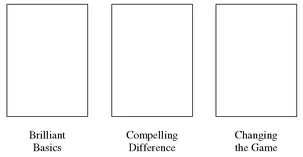
Let us try the following absurdly crude exercise. Let us imagine that we are going to mentally review all the working projects we have on our real or virtual desk at the moment, and place them in one of three buckets (see Figure 1.3), depending on what they are really doing for our brand: ‘Brilliant Basics’, ‘Compelling Difference’ and ‘Changing the Game’. I’ll explain what these buckets are in a little more detail, and then we can fill them in.
The first bucket we can assign a project to is Brilliant Basics. Brilliant Basics are the core activities our brand and product need to do to meet our promise to the consumer – to maintain the contract we already have, if you like. These will include regular product upgrading, development of ease of use, ongoing refinement and modernization of graphics and other brand elements, and so on.
Figure 1.3 Three Empty Buckets
It is important to recognize that Brilliant Basics is in no way a put-down. It is an extremely valid thing (or set of things) for us as a Challenger to pursue – as long as it is not the only thing(s) we pursue.1 We may need to bow to no one in our enthusiasm for difference, but there are still some things in any category that are not actually differentiating, but which still have to be done really well (punctuality in the airline business, for example, or some basic low level stream of fragrance news for household products). They are not always what the category wisdom says they are (the US airline JetBlue made in-seat TV standard, but sacrificed meals completely, for example), but they do have to be delivered on to compete.
The second bucket we can assign a project to is Compelling Difference. This will include anything we are doing that is creating a really compelling difference for our brand versus the other brands in our market (however we are defining that market).
The third bucket we can assign a project to is Changing the Game. Here would go strategic or ideational initiatives that would reframe the whole category in our favour. They will take more time to pull ...
Table of contents
- Title Page
- Copyright Page
- Dedication
- Dramatis Personae
- The Relationship of This Book to Eatbigfish, and The Challenger Project
- Introduction
- PART I - Behaviours that Stimulate Challenger Brand Cultures
- PART II - Personal Qualities that Foster an Internal Challenger Culture
- PART III - How to Be a Pirate in the Navy, Without Getting Hanged
- PART IV - Writing the Articles
- PART V - The Future of Piracy
- Postscript
- Acknowledgements
- Notes and Sources
- Index
Trusted by 375,005 students
Access to over 1.5 million titles for a fair monthly price.
Study more efficiently using our study tools.
Frequently asked questions
Yes, you can cancel anytime from the Subscription tab in your account settings on the Perlego website. Your subscription will stay active until the end of your current billing period. Learn how to cancel your subscription
No, books cannot be downloaded as external files, such as PDFs, for use outside of Perlego. However, you can download books within the Perlego app for offline reading on mobile or tablet. Learn how to download books offline
Perlego offers two plans: Essential and Complete
- Essential is ideal for learners and professionals who enjoy exploring a wide range of subjects. Access the Essential Library with 800,000+ trusted titles and best-sellers across business, personal growth, and the humanities. Includes unlimited reading time and Standard Read Aloud voice.
- Complete: Perfect for advanced learners and researchers needing full, unrestricted access. Unlock 1.5M+ books across hundreds of subjects, including academic and specialized titles. The Complete Plan also includes advanced features like Premium Read Aloud and Research Assistant.
We are an online textbook subscription service, where you can get access to an entire online library for less than the price of a single book per month. With over 1.5 million books across 990+ topics, we’ve got you covered! Learn about our mission
Look out for the read-aloud symbol on your next book to see if you can listen to it. The read-aloud tool reads text aloud for you, highlighting the text as it is being read. You can pause it, speed it up and slow it down. Learn more about Read Aloud
Yes! You can use the Perlego app on both iOS and Android devices to read anytime, anywhere — even offline. Perfect for commutes or when you’re on the go.
Please note we cannot support devices running on iOS 13 and Android 7 or earlier. Learn more about using the app
Please note we cannot support devices running on iOS 13 and Android 7 or earlier. Learn more about using the app
Yes, you can access The Pirate Inside by Adam Morgan in PDF and/or ePUB format, as well as other popular books in Negocios y empresa & Ventas. We have over 1.5 million books available in our catalogue for you to explore.