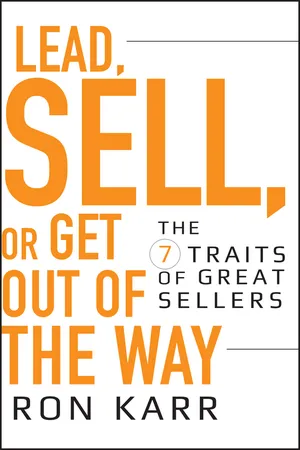
In Lead, Sell, or Get Out of the Way, Ron Karr outlines a repeatable process based on the powerful idea that great sellers lead relationships in the same way that great leaders sell ideas. This customer-focused mindset is the key to Ron Karr's proven leadership selling process. Using 20 years of research with companies of all sizes, Karr reveals what great sellers do, and shows how anyone can implement the same powerful principles. He reveals the seven critical traits of a sales leader, which include vision, customer focus, creative thinking, and accountability. Developing the seven traits is the key that helps salespeople shift from a task-oriented sales process to a purpose-oriented process. When that happens, sales excellence results.
- English
- ePUB (mobile friendly)
- Available on iOS & Android
eBook - ePub
1
The Case for Leadership
On October 1, 1989, my brother-in-law Dan resigned from his position as a junior partner at a well-established law firm. Upon hearing the news, I immediately called him to inquire whether he was crazy; he assured me that he was completely sane. I asked him, “Why on Earth would you leave this position when you’re on the fast track to becoming a senior partner?” His answer caught me by surprise.
My brother-in-law explained to me that he had a choice: He could continue working really hard and take only a small portion of the fees he brought in, or he could start his own firm, hire lawyers under him, and increase his share of the profits.
Dan knew one of the secrets of sales leadership.
The Leader’s Advantage
You will make much more money through the efforts of others than you ever could make solely through your own efforts.
Most of the sales executives whom I encounter face the same choice that my brother-in-law faced—but don’t realize it. They have not yet learned about sales leadership.
Beyond the Lone Ranger
Whether you are selling an idea, professional service, or a product, you are probably hoping to sell more this quarter than you did last quarter, in less time, and at a higher profit. You cannot do this on your own, if indeed you ever could. To hit the targets you now face, you must build and sustain coalitions that will support you and act on your behalf. The “Lone Ranger” selling model may have worked in the past; in fact, many successful Lone Rangers were promoted to sales managers. Unfortunately, what made them successful as a Lone Ranger sometimes becomes their biggest obstacle to success as a sales manager—namely, their inability to get things done through other people.
Nowadays, whether you are a top-producing salesperson, a salesperson who’s trying to improve, a sales manager, or a professional services provider, you should know that the “Lone Ranger” selling model is a concept of the past. To succeed in business today, you must leverage the support and help of others. This book will show you how.
Leaders Don’t Puke
Let’s start with something you probably already know: Customers today don’t want to be sold. In fact, the moment they feel they are being sold, they head for the hills—either by disengaging from the sales process or by simply ending the conversation, either audibly or silently. What customers do want is help in making the right choices. They don’t need you to puke up all the features that your products and services have to offer.
You may wonder why I use the word “puke.” Well, for starters, it’s memorable. Members of my audiences tend to keep the “don’t puke” rule in mind for a long time after I share it with them. Second, the word perfectly describes the basic problem we’re looking at: When you puke up all the features you have to offer, you spray lots of junk around, you make a pretty big mess, and people try to avoid you afterwards. This idea of puking connects to one of the biggest mistakes that some salespeople make: They educate prospects, but don’t sell very many of them.
The Leader’s Advantage
PUKE stands for: People who Utter Knowledge about Everything.
About 10 years ago, a prominent fashion designer was seeking advice on how to sharpen her sales skills; she came to see me. She brought along her portfolio, and I asked her to role-play a little bit, to let me play the buyer and in this way walk me through her sales process. She agreed and immediately launched into a little memorized routine. Without bothering to connect with me in any meaningful way or get any sense of what my priorities were, she immediately opened up her portfolio and went into a long, boring, and extremely detailed description of each of the designs in her folder.
I was being as patient as I possibly could—she was, after all, quite well known in her field. When she got to the eighth design, though, I said, “Stop.” Quizzically, she looked at me and asked what was wrong.
“Well,” I said, “just suppose that the first seven designs you just described didn’t work for me. Do you really think you would have had my attention by the time you got to the eighth design?”
She thought about that for a moment and then smiled sheepishly. She had made the classic sales mistake of believing that she was at the highest level of influence when she was doing the talking.
Actually, as sales leaders know, the opposite is actually true: The person speaking is generally at the lowest level of influence. Your level of influence rises only when the other person becomes engaged in the conversation and participates actively.
The Leader’s Advantage
Even if customers are still looking at you as you speak, they are likely to shut down and stop listening when they decide you are trying to sell them.
If we are to have influence as salespeople and as leaders, we need two things from our prospects: their time and their attention.
When we start a one-on-one meeting with someone, the only thing we can be certain that we have is this person’s time. We have no idea whether we’ve got his or her undivided attention. If we’re doing all the talking, the other person could well be thinking about what else needs to be done today, what’s going to be on the menu for lunch, or when this salesperson is going to shut up. If the prospect’s mind is on other things while you’re puking your features all over the place, how much of your message do you really think will get across? And why does the prospect need to hear about your features, anyway? These days, thanks to the Internet, customers could read all about your features online if they wanted to. They don’t need you to puke on them!
I shared this lesson with the aforementioned fashion designer; she took it to heart and stopped puking everywhere. She started to meet her prospects, build up a little rapport, and find out what they were trying to accomplish in the market. Then she would review the one, two, or three designs that seemed most likely to produce the person’s desired outcomes. She noticed a dramatic increase in interest for her designs, and she closed more business. She learned to do what sales leaders are supposed to do: help their customers get to the promised land—the place they want to go.
That’s your job as a leader: connect with people and find ways to get them to the promised land. Your job is definitely not to puke all over potential customers; rather, it is to find out where the customer is trying to go. Identify the OUTCOME that makes the most sense for both of you, and then remove the obstacles in the way. Your job is to be creative and help customers find more efficient ways of doing things. Your job is to manage multiple constituencies and alliances, and to use those alliances to identify new and better ways of generating the desired results. Your job is to do what most salespeople don’t do: lead the conversation with your prospects and customers about the results they need, the problems they have, and the obstacles they face. Solving these issues will lead them to promotions, increased business, higher profitability, higher productivity, enhanced competitive advantage, and a better quality of life.
The Job of Being a Sales Leader Never Ends
Leadership selling is not restricted to the selling process. You have to excel at getting people to the promised land throughout your entire relationship with them! Once you stop acting as a leader—once you stop trying to identify the interests of the customer and build alliances on behalf of those interests—you can rest assured that your base of business will start to evaporate.
The Leader’s Advantage
In today’s economy, salespeople have to prove their value with every sale. They cannot rely on loyalty from past transactions. The result is they have to have a positive impact on the careers and lives of everyone with whom they connect, every time. Otherwise, they may still have great relationships but only a fraction of the business they need and deserve.
You Sell Ideas
Like all effective leaders, top-producing salespeople sell ideas. They look for ways to find and improve the outcomes that their customers are seeking, and they start by talking about the “what.” What are customers looking for?
As a leader, you must determine the “what” before the “how”—the “how” comes second. Your products and services represent the “how,” which means that they are not what you should be starting the conversation with.
Read that again: You should not start the conversation on your products and services—even though you may have received vast amounts of technical training and even though you may know the “how” of your product and service like the back of your hand. If you start the conversation with the “how,” you will leave out the most important part of the conversation, namely, the outcomes you are going to produce together.
These may sound like obvious points, but the sad truth is that salespeople ignore them routinely.
Beginning with the “how” guarantees that your conversation will be short and will produce little to no forward movement in the sales process. You may not even be given the opportunity to discuss the prospect’s goals or the outcomes you hope to produce with him or her. Imagine how many sales meetings initiated by that fashion designer ended abruptly because of some sudden emergency that came up while she was soliloquizing about her many designs.
People tend to have very short attention spans these days. They have a lot on their mind, and the higher up they are on the food chain the less time they have for things that don’t demonstrate immediate value to them. That’s why we must prove in the first few seconds of a conversation that there is a reason someone should give us their undivided attention and their time.
Initiating a conversation by discussing the outcomes—as a leader does—makes all the difference when it comes to winning attention, winning time, closing more deals, expanding the size of the deal, and increasing margins. Launching the conversation in a different way allows you to lay the foundation for a value proposition that is second to none.
Lead with the Outcome!
Immediately focusing on the “how” limits your conversation with a potential customer strictly to features—features that most customers will think—correctly or incorrectly—that they have heard and seen elsewhere. There is little or no room there for differentiation! By leading with the outcome—as a true sales leader would—you can expand the conversation to other issues, issues that involve a larger piece of the pie. As the conversation expands, more and more opportunities will become available. These opportunities can lead to the sale of other goods and services.
For example, let’s say that you are selling pool products to a homeowner who wants a new pump. You might be tempted to start talking about the features of your very best pool pump. Suppose you were to ask the homeowner what he or she would want from the new pump that the old pump didn’t provide. The homeowner might think for a moment, then answer, “No downtime, better energy efficiency, and lower operating costs.”
When you ask the potential customer to explain their reasons for wanting these features, you might hear a story of how the existing pump used to break down—typically on a hot summer day—and how the whole family would have to wait for the service rep to come and repair it. The use of the pool would be interrupted for days, and there would be a hefty repair bill to deal with.
Armed with this information, you can now talk about the ideas and outcomes that are most likely to make a difference to this buyer: Fewer breakdowns and lower bills! You could offer proof of your pump’s energy efficiency and reliability, in the form of awards and articles praising its performance in these areas. You could then explain that your company offers a special extended warranty on the pump. This extended warranty is designed to reduce the risk of having downtime in the future, and it will also give the customer automatic top priority on service calls without costing a cent more on the repair bill.
You have just engaged your customer and secured his full, undivided attention; every point you make is now landing with impact. You have just dramatically increased your chances of getting the deal, and you’ve done so by talking about the outcomes first. You may even have added to the size of the deal by introducing other products that support the outcomes that the customer is trying to attain.
At the end of the day, the customer is not buying a pump at all. The customer is actually buying uninterrupted pool time, reduced energy costs, and a lower cost of operation. Those are outcomes! Thi...
Table of contents
- Praise
- Title Page
- Copyright Page
- Dedication
- Acknowledgements
- Introduction
- Chapter 1 - The Case for Leadership
- Chapter 2 - The Five Beliefs of Effective Leaders
- Chapter 3 - The Seven Traits of Great Sellers
- Chapter 4 - Visualizing
- Chapter 5 - Positioning
- Chapter 6 - Building Alliances
- Chapter 7 - Asking Good Questions
- Chapter 8 - Creating Powerful Value Propositions
- Chapter 9 - Communicating Persuasively
- Chapter 10 - Holding Yourself Accountable
- Epilogue
- Appendix: Productivity Tools for Sales Leaders
- Index
Trusted by 375,005 students
Access to over 1.5 million titles for a fair monthly price.
Study more efficiently using our study tools.
Frequently asked questions
Yes, you can cancel anytime from the Subscription tab in your account settings on the Perlego website. Your subscription will stay active until the end of your current billing period. Learn how to cancel your subscription
No, books cannot be downloaded as external files, such as PDFs, for use outside of Perlego. However, you can download books within the Perlego app for offline reading on mobile or tablet. Learn how to download books offline
Perlego offers two plans: Essential and Complete
- Essential is ideal for learners and professionals who enjoy exploring a wide range of subjects. Access the Essential Library with 800,000+ trusted titles and best-sellers across business, personal growth, and the humanities. Includes unlimited reading time and Standard Read Aloud voice.
- Complete: Perfect for advanced learners and researchers needing full, unrestricted access. Unlock 1.5M+ books across hundreds of subjects, including academic and specialized titles. The Complete Plan also includes advanced features like Premium Read Aloud and Research Assistant.
We are an online textbook subscription service, where you can get access to an entire online library for less than the price of a single book per month. With over 1.5 million books across 990+ topics, we’ve got you covered! Learn about our mission
Look out for the read-aloud symbol on your next book to see if you can listen to it. The read-aloud tool reads text aloud for you, highlighting the text as it is being read. You can pause it, speed it up and slow it down. Learn more about Read Aloud
Yes! You can use the Perlego app on both iOS and Android devices to read anytime, anywhere — even offline. Perfect for commutes or when you’re on the go.
Please note we cannot support devices running on iOS 13 and Android 7 or earlier. Learn more about using the app
Please note we cannot support devices running on iOS 13 and Android 7 or earlier. Learn more about using the app
Yes, you can access Lead, Sell, or Get Out of the Way by Ron Karr in PDF and/or ePUB format, as well as other popular books in Business & Sales. We have over 1.5 million books available in our catalogue for you to explore.