Note: CD-ROM/DVD and other supplementary materials are not included as part of eBook file.
- English
- ePUB (mobile friendly)
- Available on iOS & Android
eBook - ePub
Essentials of DAS-II Assessment
About this book
Essentials of DAS-II?Assessment is the best source of information on the new edition of the DAS?instrument, providing you with illuminating case reports, expert assessment of the test?s relative strengths and weaknesses, and valuable advice on its clinical applications. Written by Ron Dumont, John Willis, and Colin Elliott, this book is accompanied by a CD-ROM containing customizable Excel worksheets, PDF files, and Microsoft Word documents to conveniently allow you to add your own DAS-II evaluation results.
Information
Five
HOW TO INTERPRET THE DAS-II
INTRODUCTION
In this chapter, we advocate a method of interpretation of a child’s or adolescent’s performance on the DAS-II that is flexible but still based on firm psychometric evidence. We believe that test performance should be integrated with all other information that is available about the individual being evaluated to allow a comprehensive psychological report to be produced. The integrated, comprehensive evaluation also allows a plan of intervention, if needed, to be developed, implemented, and then evaluated. Meaningful interpretation of test results from the DAS-II not only depends on precise administration and flawless scoring, but also requires thorough knowledge of the test’s background, psychometric properties, and materials as well as knowledge about the examinee gained from other sources of information (scores on other tests; medical, social, and educational history; behaviors observed during testing; observations in other settings; and interviews with the examinee and other persons knowledgeable about the examinee, such as teachers or parents).
For examinees referred for assessment of possible specific learning disabilities, the Response to Intervention (RTI) process may have generated detailed curriculum-based measurement or assessment (CBM or CBA) data and other records of attempted interventions and their outcomes. The No Child Left Behind Act of 2001 (P.L. 107-110; U.S. Congress, 2001) is another source of test data for students. Many schools routinely administer nationally normed, multiple-choice, group achievement tests. All of these sources of information must be considered skeptically. The quality and utility of tests created by individual states and schools vary. Tests that are scored by hand may be scored incorrectly. Other errors can occur when tests are administered to large groups and answer sheets are sent away for machine scoring. Nonetheless, such tests may help identify patterns or track trends in the examinee’s performance and may allow you to generate additional questions and hypotheses for your assessment.
Report cards—both marks and comments—are notoriously subjective and unreliable. Again, though, they may alert you to patterns (e.g., math marks always higher than reading and language arts marks) and trends (e.g., marks beginning high and then dropping throughout each year; math grades steadily declining over the years).
Previous individual assessments should be studied carefully, but you should still consider the possibility that they contain errors. If possible, it is helpful to obtain the actual test protocols so you can check the accuracy of recording the birth date, calculating the age, administering and scoring the test, looking up scores, adding scores, and transferring scores to the report.
Before beginning the step-by-step process of interpreting the DAS-II, create a summary of all relevant scores. Report the standard scores associated with the Composites (GCA and or SNC) and core (Verbal, Nonverbal Reasoning, and Spatial) and any relevant diagnostic (Working Memory, Processing Speed, and School Readiness) clusters along with the T scores for each subtest administered. Report the name of each composite or cluster. Most of the information for this summary sheet can be easily found on the DAS-II Record Form. Figure 5.1 shows a portion of a completed DAS-II summary sheet that includes the scores of Marybeth, an 8-year-old second grader who was suspected of having a Nonverbal Learning Disability (NVLD) and was administered 14 subtests from the School-Age battery.
Note that for Composites and Clusters, standard scores may be reported at the 90 percent or 95 percent confidence intervals (CI), along with their corresponding Percentile Rank (PR) and the confidence interval’s descriptive categories. Confidence intervals for the DAS-II Composite and Clusters scores, found in the Tables A.2, A.3, and A.4 (pp. 102-122) in the DAS-II Normative Data Tables Manual, are created using the Standard Error of Estimate (SEe) of the estimated “true” score, as opposed to the Standard Error of Measurement (SEm) of the actual obtained score. When we use this method, we find that the confidence intervals are asymmetrical around the obtained score when the obtained score is well above or below 100. Such confidence intervals based on estimated true scores are a correction for true-score regression toward the mean. For example, a GCA of 148 is associated with a 95 percent confidence interval of -8 to +4 points (140-152); a GCA of 100 is associated with a 95 percent confidence interval of - 6 to +6 points (94 -106); and a GCA of 64 is associated with a 95 percent confidence interval of - 4 to +7 points (60 -71) . We find that these asymmetrical bands usually describe the examinee’s performance most accurately, but Sattler (2008) generally recommends the use of symmetrical confidence bands around the obtained score, using the SEm, for reporting test scores. He suggests using the asymmetrical, SEe-based intervals only if you are predicting a future score on a re-evaluation. However, we find his clearly explained argument unconvincing.
Figure 5.1 Summary of DAS-II Scores for Marybeth, Age 8:4

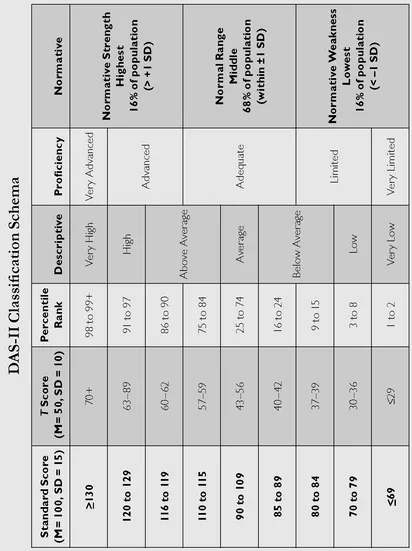
For the Standard Scores, we encourage you to consider not only a single score value, but also its corresponding PR, confidence band, and classification label (i.e., Very High, High, Above Average, Average, Below Average, Low, and Very Low). Rapid Reference 5.1 DAS-II Classification Schema provides Standard Score, T score, and PR ranges that correspond to Descriptive, Proficiency, and Normative classification labels.
Note too that descriptive categories are given for the full range of scores conveyed by a Standard Score’s confidence interval as opposed to simply reporting the description for the obtained score. If, however, the range of the confidence interval covers only one category, that single category is all that should be reported. For example, Marybeth’s GCA score of 110 (PR 75) would have a confidence interval of 104 to 115 and she would be described as functioning at the Average to Above Average range of general conceptual ability. However, her Processing Speed score of 53 (PR <1) would have a confidence interval of 49 to 66 and she would be described as functioning at the Very Low range of ability in processing speed. Using ranges and classification labels aids in the communication of results to parents, teachers, and other lay people who may not have any particular knowledge regarding tests and test results. It also prevents conveying the idea that a single number is accurate and error free. For subtests, only T scores and Percentile Ranks are reported.
Rapid Reference 5.1
STEP BY STEP: STEPS FOR INTERPRETING DAS-II RESULTS
This section addresses an example of how to interpret the DAS-II following a step-by-step interpretive method. Interpretation of DAS-II test results requires several steps, including evaluation of the GCA or SNC, Core and Diagnostic Clusters, and subtest scores for significant differences, and comparison with tests of achievement and adaptive behavior measurements. The name of this battery includes the terms Differential and Scales, which is an acknowledgement that most individuals have different levels of ability in various areas of functioning. Howard Gardner (1983) has said that the focus of psychological assessment should be to detect not how smart a person is, but rather, how the person is smart. This is the philosophy underlying assessment with the DAS-II.
Authorities disagree about the appropriate level of interpretation for tests of cognitive abilities. Many experts insist that the only appropriate use of such tests is to measure psychometric g or an overall, global, general intelligence. There are at least four popular ideas supporting this admonition.
One is that many theorists are persuaded that g is the most important, or even the only important aspect of intelligence. Total scores on various cognitive ability tests measure this psychometric g more or less accurately. From this viewpoint, any significant variations in subtest scores are believed to represent fluctuations around a basic level of intellectual ability or the consequences of disabilities, differences, or disadvantages. However, even when there is significant subtest variability, total test scores, as proxies for psychometric g , generally do predict school performance reasonably well.
Another reason that some authors recommend primary or exclusive attention to total scores on tests of cognitive ability is that the total score is usually more statistically reliable than subtests or scales with fewer items than are included in the total.
A related issue is the relatively low specificity of subtests on many cognitive ability batteries. There is often scant justification for interpreting subtests as anything except as parts of the larger scale or entire battery of which they are components. They have little separate variance of their own.
A fourth reason sometimes cited for focusing on the total score of a test of cognitive abilities is the idea that specific abilities are better measured by very narrow tests that are not contaminated with g than by cognitive-battery subtests that have moderate or high g loadings.
These are serious and thoughtful arguments, but we believe that there is good reason to use multifaceted scales in general and the DAS-II in particular and to interpret the DAS-II clusters and even, if necessary, subtests with confidence.
First, while psychometric g does predict academic achievement and other important outcomes more accurately than do most other variables, there is growing evidence that various combinations of specific abilities, such as Cattell-Horn-Carroll (CHC) broad and narrow abilities, can be even stronger predictors of specific areas of academic achievement. It is possible that some of the evidence for the predictive validity of total scores as proxies for psychometric g may be illusory. For example, a student with very strong verbal abilities and weak spatial, working memory, and fluid reasoning abilities would have a total score considerably lower than the student’s verbal ability. The specific cognitive weaknesses would depress the student’s reading achievement below the level predicted from the student’s verbal ability. The superficial impression would be that the student had only a moderate level of g , which accurately predicted weak reading achievement. However, it might instead be a case of strong intellectual potential, as shown by the higher verbal score, with the total score and the achievement both depressed by specific weaknesses, producing a misleading impression of g mediated by the total score predicting achievement. Willis and Dumont (2002, pp. 131-132) and Dumont and Willis (http://alpha.fdu.edu/psychology/mnemonics_for_ five_issues.htm ) call this situation the “Mark Penalty.” It is true that total scores are generally more statistically reliable than the shorter subtests that make up the totals, although this is not always the case within Item Response Theory (IRT; e.g., Daniel, 1999; Elliott, 2007b; Embretson & Reise, 2000). However, reliability is a necessary, but insufficient virtue for cognitive tests. For example, head circumference has been used to estimate intelligence. Head circumference, except under very unfortunate circumstances, is a highly reliable measure for adults: one hopes not to experience changes in head circumference over time. However, it turned out not be to be an especially valid nor useful measure of intelligence. It is very important for evaluators to select batteries whose clusters have adequate reliability (which the DAS-II clusters do possess), but reliability alone is not enough.
It is also true that low specificity does render a subtest or cluster uninterpretable as a separate measure apart from the larger entity of which it is a component. However, one of the important design characteristics of the DAS-II is strong specificity of subtests and clusters, thereby enabling their scores to be individually interpreted.
The fourth argument—that specific abilities are better measured by highly specific tests with low g loadings—appears plausible at first sight. However, it has been well-known since the 1930s that specific abilities are intercorrelated. It is these intercorrelations that yield broad factors and the general factor. Therefore, there is also a strong argument for building an assessment around a single, multifaceted in...
Table of contents
- Essentials of Psychological Assessment Series
- Title Page
- Copyright Page
- Dedication
- SERIES PREFACE
- Acknowledgements
- One - OVERVIEW
- Two - HOW TO ADMINISTER THE DAS-II
- Three - TEST ADMINISTRATION FEATURES UNIQUE TO THE DAS-II: USE OF ITEM SETS AND ...
- Four - HOW TO SCORE THE DAS-II
- Five - HOW TO INTERPRET THE DAS-II
- Six - STRENGTHS AND WEAKNESSES OF THE DAS-II
- Seven - CLINICAL APPLICATIONS OF THE DAS-II
- Eight - ILLUSTRATIVE CASE REPORTS
- Appendix A - Upper Early Years Interpretive Worksheet
- Appendix B - School-Age Interpretive Worksheet
- References
- Annotated Bibliography
- Index
Trusted by 375,005 students
Access to over 1.5 million titles for a fair monthly price.
Study more efficiently using our study tools.
Frequently asked questions
Yes, you can cancel anytime from the Subscription tab in your account settings on the Perlego website. Your subscription will stay active until the end of your current billing period. Learn how to cancel your subscription
No, books cannot be downloaded as external files, such as PDFs, for use outside of Perlego. However, you can download books within the Perlego app for offline reading on mobile or tablet. Learn how to download books offline
Perlego offers two plans: Essential and Complete
- Essential is ideal for learners and professionals who enjoy exploring a wide range of subjects. Access the Essential Library with 800,000+ trusted titles and best-sellers across business, personal growth, and the humanities. Includes unlimited reading time and Standard Read Aloud voice.
- Complete: Perfect for advanced learners and researchers needing full, unrestricted access. Unlock 1.5M+ books across hundreds of subjects, including academic and specialized titles. The Complete Plan also includes advanced features like Premium Read Aloud and Research Assistant.
We are an online textbook subscription service, where you can get access to an entire online library for less than the price of a single book per month. With over 1.5 million books across 990+ topics, we’ve got you covered! Learn about our mission
Look out for the read-aloud symbol on your next book to see if you can listen to it. The read-aloud tool reads text aloud for you, highlighting the text as it is being read. You can pause it, speed it up and slow it down. Learn more about Read Aloud
Yes! You can use the Perlego app on both iOS and Android devices to read anytime, anywhere — even offline. Perfect for commutes or when you’re on the go.
Please note we cannot support devices running on iOS 13 and Android 7 or earlier. Learn more about using the app
Please note we cannot support devices running on iOS 13 and Android 7 or earlier. Learn more about using the app
Yes, you can access Essentials of DAS-II Assessment by Ron Dumont,John O. Willis,Colin D. Elliott in PDF and/or ePUB format, as well as other popular books in Psychology & Research & Methodology in Psychology. We have over 1.5 million books available in our catalogue for you to explore.