- English
- ePUB (mobile friendly)
- Available on iOS & Android
eBook - ePub
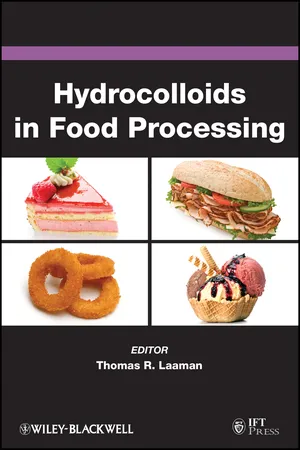
Hydrocolloids in Food Processing
About this book
In Hydrocolloids in Food Processing, a group of the most experienced and impartial experts explains what stabilizers should be used and how they should be used, food product by food product. Numerous actual product formulations are packed into each chapter and the processing procedures to make these formulations are clearly described. Food manufacturers are shown how to accurately use food stabilizers to make the highest quality food products. Coverage includes all the practical details needed to ensure the most accurate QA standards and testing procedures for each hydrocolloid. Finally, Hydrocolloids in Food Processing explains how to navigate the often tricky area of dealing with hydrocolloid suppliers. An informative discussion of how hydrocolloid companies think and operate today is followed by precise strategies to ensure that the most mutually beneficial relationships can be obtained between specific customer types and appropriate types of suppliers.
Information
Chapter 1
Hydrocolloids: Fifteen Practical Tips
Tip One: Dissolving Hydrocolloids—The Influence of Mesh Size
Achieving maximum hydrocolloid functionality in most food products begins with fully dissolving the hydrocolloid. Particle size or mesh size is a fundamental issue influencing solubility. The basic principle is that larger particles, corresponding to a coarser mesh size, such as 40–80 mesh, take longer to dissolve because the water takes longer to penetrate the dry hydrocolloid particle. A finer mesh particle, such as those that pass through 120, 150, or 200 mesh screens, takes less time for water to penetrate and become fully soluble.
However, the converse of this situation is that a coarser size particle is less subject to lumping, while a finer mesh particle lumps more easily. Once lumps are formed, achieving full solubility becomes more difficult and also takes much more mixing to do so.
There are two ways to overcome the potential for lumping for small particle size hydrocolloids. One is to use high agitation mixing. The other is to preblend the hydrocolloid with another dry ingredient such as sugar. By preblending, the hydrocolloid particles are separated from each other before entering the liquid, thereby minimizing lumping.
In summary, if high agitation is used in dispersing the hydrocolloid or if it can be preblended with a dry ingredient then fine mesh grades will allow the most rapid solubility. If mixing is not as vigorous and the hydrocolloid is not preblended then it is safer to use a coarser mesh product to avoid lumping, even though this will require more mixing time to achieve full solubility.
Tip Two: Dissolving Hydrocolloids—The Influence of Temperature
Some hydrocolloids require heat to dissolve. In these cases, it is important to know exactly how much temperature is required for the exact grade being used. There can be a substantial difference in the required temperature based on other ingredients, especially ions. Thus, it is important to heat the food product to different temperatures and determine the minimum temperature to achieve full functionality, in terms of maximum viscosity, gel strength, or stability of the food product.
Temperature should be measured carefully. First, the thermometer or thermal probe being used must be precise and accurate. Mechanical thermometers are especially notorious for requiring frequent calibration to ensure accuracy. Another issue can be that the product mixing is not sufficientlyvigorousduringheating,allowingpocketsofhigherorlower temperature. This must be ascertained by moving the thermometer or thermal probe around to different locations in the mix to determine if temperature gradients exist. The minimum temperature achieved in any part of the mix should be the benchmark used to determine if the temperature is adequate.
One contrary thought is important to add. Although it is important to achieve full functionality of a hydrocolloid, it is also true that some hydrocolloids can be partially degraded by excessive heat, for example, guar gum. Some other hydrocolloids may be degraded if there is a combination of heat and acid, for example, carrageenan. Therefore, the heating should be adequate to fully dissolve all the hydrocolloids and thus gain full viscosity, but not high enough that the viscosity is decreased due to partial hydrolysis of the hydrocolloid.
Tip Three: Dissolving Hydrocolloids—The Influence of Cations
Some hydrocolloids are not highly influenced by ions (except at very highionconcentrations),forexample,agar,xanthangum,guargum,and locust bean gum. Several others are influenced in their solubilization by ions. These include sodium alginate, carrageenan, pectin, gellan gum, and sodium carboxymethyl cellulose (CMC). In these cases divalent cations and in some cases monovalent cations can influence the ability of the hydrocolloid to dissolve.
Calcium is the major issue for sodium alginate, -carrageenan, lowmethoxy pectin, and gellan gum. Potassium is the major issue for κ-carrageenan, and sodium chloride can inhibit full viscosity development for CMC for certain grades. Options to circumvent reduced solubility include the following procedures.
First, the ions can be added to the food product after the hydrocolloid has been dissolved. Second, for gums such as carrageenan, where the ions are present with the gum powder, solubility can be achieved by heating to a higher temperature.
Third, for calcium, sequestrants can be added to bind these ions, at least temporarily, to allow the gum to dissolve. If water used in the processing plants is naturally quite high in calcium, this approach may be necessary if the water is not pretreated to remove these ions. Sequestrants include phosphate compounds such as sodium hexametaphosphate, tetrasodium pyrophosphate, and dipotassium phosphate and also citrates.
Fourth, also for calcium, it is possible to add in very low solubility forms, thus largely delaying the calcium going into solution until after the gum has dissolved. Tricalcium phosphate is a very slow-dissolving calcium source, and dicalcium phosphate is also quite slow, the anhydrous form being slower than the dihydrate form.
Tip Four: Gelling Hydrocolloids—The Effect of Temperature
Some hydrocolloids gel by simply cooling a hot solution. Agar and gelatin are the prime examples. Others gel after cooling, but also require ions to be present. These include - and -carrageenan, low-methoxy pectin,andgellangum.High-methoxypectingelsafter coolinginalowpH or high-sugar environment. Methyl cellulose forms and maintains a gel only while it is being heated.
The first significant aspect is to make sure the gum has been given enough heat to fully dissolve, as discussed in Tip two. Whatever amount of gum is left undissolved will not contribute to the final gel properties. Only fully dissolved gum will gel when cooled. The exact gelling temperature will vary by the product and grade in a similar fashion as the solubility temperature varies. But this is generally less significant since eventually the product will generally be cooled to at least room temperature and fully gel.
The key item to remember when gel formation is occurring during cooling is whether the gel will be broken apart during gel formation or left intact. ι-Carrageenan has some gel “healing” properties, but most gums will not reform a gel well when the gel is broken up by agitation or motion during gelling. For most products, it is imperative that the gelled product is placed into a quiescent situation when the critical gelling temperature is near to being reached. For products where a disrupted gel is sought, it is still important to make sure that disruption occurs in a way to facilitate the exact product texture desired. This may require some experimentation.
There are cases where a semi-gelled structure is sought and in those cases mixing during cooling is often acceptable. One interesting example is the use of κ-carrageenan to suspend cocoa powder and also provide some mouthfeel in chocolate milk. If there is no mixing during the gel formation stage, the cocoa powder will completely settle out. If the product is mixed during cooling, the κ-carrageenan will be able to begin to suspend the cocoa as its weak gel begins to form. In this case the disruption of the gel by mixing is not a negative since the texture and stabilizing functionality that is desired is achieved.
Tip Five: Gelling Hydrocolloids—The Influence of Cations
Cations are needed for gelation of many hydrocolloids. Those requiring heating and cooling simply need adequate amounts of the appropriate cation to fully gel. Some cations may be present in the hydrocolloid powder, some in the other ingredients used to make the food, and some may be added to ensure that an adequate amount is present. Generally, enough should be added to get maximum gel strength, especially if it is a gelled product. If the gel is too strong then it is more economical to reduce the amount of the hydrocolloid used than to have the hydrocolloid starved for gelling ions.
An exception to this principle is when a semi-gelled-type product is sought. This type of product would generally be not seen as a fully gelled product but as something pourable, such as a sauce. However, some linkages used in gelling are allowed to occur to take advantage of the thickening and stabilizing properties of the semi-gelled hydrocolloid.
In the case of sodium alginate, calcium is needed, but no heat, to form a gel. However, calcium also inhibits solubility, and therefore either the calcium must be added after the alginate has solubilized or the calcium must be bound using a sequesterant to allow the alginate to first dissolve, or the calcium can be added in a low solubility form where it slowly releases, mostly after the alginate is dissolved. Once the alginate is dissolved, the calcium may be added in a quickly available form or a slowly available form. The former includes calcium chloride and calcium acetate. The latter includes tri- and dicalcium phosphates. Intermediate is monocalcium phosphate and calcium lactate. If a quick reaction is desired then the product must already be in some mold (such as onion rings) or there must be no worry about a broken gel (such as imitation fruit pieces). If enough time is needed for the food product to be mixed and pumped then a slow-release calcium is used, such as for fruit fillings.
Tip Six: Hydrocolloid Functionality—Texture
Hydrocolloids have an impact, whether desirable or undesirable, on stability, texture, color or appearance, and flavor of the foods in which they are utilized. Hydrocolloids are generally added to a food to have a decisive role in one or both of the first two parameters. The goal should be to have a positive or neutral impact on all four parameters. In terms of the range of texture, hydrocolloids may be used to impart the characteristic texture of the food or be added for stability with the desire to have no noticeable impact on texture.
If the goal is to impart a specific texture then this texture should first be defined, and second measured in some way. Now, of course, food comes in a wide range of textures from thin liquids, to thicker but pourable liquids, to solid foods of many different types. Hydrocolloids are often used to make liquids thicker and even to give fairly thin liquids, such as chocolate milk or eggnog, a noticeable mouthfeel. Solid gelled foods are also frequently given their characteristic texture using hydrocolloids.
A characteristic texture may be the texture of a good prototype or a competitor’s product that is being matched. The first step is to establish what will be the “gold standard” to be matched. The second step requires that by taste testing and/or instrumental testing this gold standard’s texture must be measured in ways that are reproducible. This allows newly developed sample prototypes to be accurately compared to the gold standard. The third step is to figure out what hydrocolloid or blend of gums will allow this texture to be achieved.
Tip Seven: Hydrocolloid Functionality—Stabilization
Stabilization, with or without contributing to important textural parameters, is a prime reason why hydrocolloids are used in foods. Stability can often be defined best by a lack of negative effect: the food product does not fall apart. Loss of stability can be seen in a number of common dilemmas. These include separation of the product into phases, including something dropping to the bottom or separating to the top of the food. Separating components can be gaseous (foams), liquid (oil or aqueous layers), or solid (particulates or even a solid lump). Sometimes there is one main source of separation, and other cases involve multiple problems.
To best understand stability, it is necessary to fully understand instability. The food scientist will comprehend what makes the product stable by pushing at the edges of stability to see when and how an unstable product could occur. The advantage of this is that if problems should occur in the future in plant production, the scientist will have a list of common unstable prototypes and how these were made using deviations of the hydrocolloid levels. It is always good, for example, when 0.5% of a gum is used in a food to know how the product would look at 0.4%, 0.3%, etc., especially testing to see when the product would not hold together, and how it would separate. It could even be the source of new product ideas. What about a drinkable pudding?
Another potential problem with hydrocolloids being used to stabilize foods is overstabilization. This condition is caused by using too high a level of gums in a product, causing it to become too gummy, too firm, or in some other way too strong in texture. There are two approaches that can be taken to gain a more equitable texture while retaining full stability. The first is to lower the gum level or levels until the texture is appropriate and determine if the stability is still adequate. In many cases much of the gum used is not even necessary to achieve stability.
If this does not work then the use of a new stabilizer system may work to bring about full stability while not causing an overstabilized texture.
Too high a gum level can also cause the product to fall apart and separate because some bonds become too strong and therefore disrupt the overall equilibrium of forces holding the product together. A typical example of this concept is an increase of aqueous syneresis, where water is squeezed out of a gelled matrix.
Again, when this type of instability is present, it is useful to consider lowering the level of the stabilizer system to determine if improvement is possible while also avoiding introduction of new stability concerns. It can be a balancing act but is often not that difficult once the overall philosophy is adopted that both too little and too much of these powerful hydrocolloids can cause problems in the food, and therefore the optimum middle level should be sought.
Tip Eight: Hydrocolloid Functionality—Color or Appearance
Hydrocolloids are most often used to provide intentional effects on texture and stability. But hydrocolloids can have noticeable effects on the color and appearance of foods, either intentionally or nonintentionally. These effects can be perceived as both positive and negative depending on the desired food parameters and which hydrocolloids are utilized. Let us review some major color or appearance effects caused by gums.
One major effect is the increase in opacity in foods that can be caused by hydrocolloids. In some cases this is due to insoluble particles found in the gum powder. Microcrystalline cellulose is completely insoluble and has the greatest effect in increasing opacity. If the desired product is a clear beverage, the opacity will be a negative, but in many products opacity is sought, especially if the product is a low-fat version of an established product. Removal of fat can reduce the opacity of foods, for example, in coffee whitener.
If the food product is considered of best quality when it is transparent, then transparent versions of several gums are available, including sodium alginate, xanthan gum, and carrageenan. For these gums the insoluble components are removed during processing. If a gum is not fully dissolved then this can be an additional source of insoluble particulates in the food product and therefore achieving full solubility is important from an appearance as well as textural point of view.
Opacity can also be caused by increased air incorporation, which gums can also contribute to. This can be either desirable or undesirable. If the latter, then the mixing procedure can be altered to minimize air incorporation. Gums can contribute glossiness and sheen to foods, which can be a strong benefit. The natural brightness of the foods can be accentuated this way. This is true of various sauces, fruit fillings and glazes, and many gelled products. Gums can provide an inherently positive benefit, and when compared to alternative texture providers such as modified starches, the contrast in quality can be staggering. The hydrocolloid-stabilized products are often seen to be much more bright, glossy, and full of rich, natural color than pure starch alternatives.
Tip Nine: Hydrocolloid Functionality—Effects on Flavor
Flavor effects are somewhat parallel to effects on color and appearance. Most of the time, the gums are added for reasons other than flavor, but flavor can be impacted. In most cases, flavor will be somewhat suppressed by the use of gums. This can be a negative effect when flavors are added or are naturally present in a food. Some of that flavor will be suppressed, requiring the use of additional flavor. It can be a positive effect when flavors are desired to have less impact, such as acid flavor in salad dressings. In this case, flavor suppression is helpful to allow the product to be less harsh.
Since a thick product requires something to make it thick, the question is not whether flavor suppression occurs but how much is acceptable and to use appropriate choices among hydrocolloids to achieve the best product. As with color, starch tends to have the most flavor-suppressing effect, and therefore substitution by the much lower levels of gums needed tends to cause a large increase in flavor perception. In many cases this is a big positive effect, but in some cases the starch suppresses undesirable flavors. Also, among hydrocolloids there is a wide range of flavor suppression. These are best explored experimentally since it is not simply a matter of more or less flavor, but flavor nuances as well. Certain components of a flavor profile may be suppressed more or less than other components. A comparison of four or five gums in a food system will quickly indicate the differences in flavor release caused by the various gums.
Tip Ten: Using Hydrocolloids—Basic Tests
Hydrocolloids can be complicated to completely understand and use most effectively. One danger is that one or two gums, the easiest to use, will be used again and again in all applications. Product quality and cost savings may both be sacrificed by this approach. It is prudent to take steps to learn about all the major hydrocolloids, at least those that are used in the specific food where product development efforts are focused.
Learning about hydrocolloids can occur on many levels including observing the effects on functional properties and stabilities of foods with various hydrocolloid types and levels. But it is a simple process and well worth the investment of research time to make up pure solutions and/or gels of various hydrocolloids. Simply making up 1% solutions or gels of a number of hydrocolloids in water, or in some cases milk, can be very instructive. Observe the appearance and color of the solutions or gels. Then compare the textures and flavors of the hydrocolloids. Is the texture long or short; that is, is it like jam (long textured) or does the liquid break from itself quickly and cleanly (short)? What kind of mouthfeel does each of the gums provide? Is this the texture desired in the food product itself?
It is also interesting to check stability properties such as suspending ability by adding some spices or other particulates and determining the ability of the gums to stabilize emulsions by adding oil and mixing the oil into the aqueous phase to generate an emulsion.
A day spent in the laboratory with the above-mentioned assignment would add immensely to the practical understanding of the world of hydrocolloids. It is true that within a food system there are a myriad of sometimes complex interactions. At the root of it all, however, are the hydrocolloids and their immense effect on the water within the food.
Tip Eleven: Using Hydrocolloids—Single Gum versus Multiple Gums
Although it may be a challenge to fully understand one hydrocolloid in a food system, it is often desirable to use a combination of gums in a food product. Before discussing how to approach research and product development with two or more gums in a food product, let us quickly review some of the primary reasons for using multiple gums in a formulation. Four of the most common reasons are cost, synergy, serendipity, and quality.
For cost a common rationale involves using a highly effective gum at a low use level to give some needed stabilization to a food and then adding onto that a less expensive gum to fill out the requirement for viscosity and texture. Several gums are synergistic with other gums, meaning that the net viscosity or gel strength, when the two gums are used together, is greater than would be expected from the additive combinations of each gum. The gums form an interaction that creates a more effective three-dimensional network to structure water. Xanthan gum is synergistic with guar gum and locust bean gum. Konjac is synergistic with carrageenan, xanthan gum, and putatively alginate. These are some of the most common examples. Often synergistic gums are most synergistic at a one-to-one ratio with each other.
Serendipity is used to explain that in the real world many prototype formulations are tested with various combinations of gums and one seems to work better than all the others. So this combination is used in the final product. In one case a product development manager tried two complex, but totally disparate, approaches to develop a specialized type of frozen pancake batter and neither was totally acceptable. Finally, he mixed the two different batters together and found t...
Table of contents
- Cover
- Series1
- Title
- Copyright
- Disclaimer
- Series2
- Preface
- Contributor List
- Chapter 1: Hydrocolloids: Fifteen Practical Tips
- Chapter 2: Hydrocolloids in Salad Dressings
- Chapter 3: Hydrocolloids in Muscle Foods
- Chapter 4: Hydrocolloids in Bakery Products
- Chapter 5: Hydrocolloids in Bakery Fillings
- Chapter 6: Hydrocolloids in Frozen Dairy Desserts
- Chapter 7: Hydrocolloids in Cultured Dairy Products
- Chapter 8: Hydrocolloids in Restructured Foods
- Chapter 9: Hydrocolloids in Flavor Stabilization
- Chapter 10: Hydrocolloid Purchasing I: History and Product Grades
- Chapter 11: Hydrocolloid Purchasing II: Pricing and Supplier Evaluation
- Index
Trusted by 375,005 students
Access to over 1.5 million titles for a fair monthly price.
Study more efficiently using our study tools.
Frequently asked questions
Yes, you can cancel anytime from the Subscription tab in your account settings on the Perlego website. Your subscription will stay active until the end of your current billing period. Learn how to cancel your subscription
No, books cannot be downloaded as external files, such as PDFs, for use outside of Perlego. However, you can download books within the Perlego app for offline reading on mobile or tablet. Learn how to download books offline
Perlego offers two plans: Essential and Complete
- Essential is ideal for learners and professionals who enjoy exploring a wide range of subjects. Access the Essential Library with 800,000+ trusted titles and best-sellers across business, personal growth, and the humanities. Includes unlimited reading time and Standard Read Aloud voice.
- Complete: Perfect for advanced learners and researchers needing full, unrestricted access. Unlock 1.5M+ books across hundreds of subjects, including academic and specialized titles. The Complete Plan also includes advanced features like Premium Read Aloud and Research Assistant.
We are an online textbook subscription service, where you can get access to an entire online library for less than the price of a single book per month. With over 1.5 million books across 990+ topics, we’ve got you covered! Learn about our mission
Look out for the read-aloud symbol on your next book to see if you can listen to it. The read-aloud tool reads text aloud for you, highlighting the text as it is being read. You can pause it, speed it up and slow it down. Learn more about Read Aloud
Yes! You can use the Perlego app on both iOS and Android devices to read anytime, anywhere — even offline. Perfect for commutes or when you’re on the go.
Please note we cannot support devices running on iOS 13 and Android 7 or earlier. Learn more about using the app
Please note we cannot support devices running on iOS 13 and Android 7 or earlier. Learn more about using the app
Yes, you can access Hydrocolloids in Food Processing by Thomas R. Laaman in PDF and/or ePUB format, as well as other popular books in Technology & Engineering & Food Science. We have over 1.5 million books available in our catalogue for you to explore.