![]()
chapter ONE
Introducing Networked Nonprofits
Surfers and other ocean enthusiasts share common characteristics of stubborn independence and rugged individualism. Like unherded cats, surfers do what they want to do when they want to do it. Any organization intending to organize them could only succeed by operating very differently from a traditional, top-down institution. And that’s exactly what the Surfrider Foundation has done.
A handful of surfers founded the Surfrider Foundation in 1984 to protect oceans and beaches through conservation, activism, research, and education. They work with a variety of ocean enthusiasts including surfers, bodysurfers, bodyboarders, windsurfers, swimmers, divers, beachcombers, and ocean-loving families.
As of 2009, the organization had a budget of around $5 million and thirty staff people working at the national headquarters in San Clemente, California. Surfrider is an inside-out organization. It opens up its work to the world by sharing its strategic plan, annual reports, financial statements, audit reports, and tax forms. It encourages its staff to talk about the work: CEO Jim Moriarity and other staff are available for discussions on its Oceans Waves Beaches blog and on Twitter.
The organization’s conservation work happens largely through their all-volunteer chapters. Surfrider doesn’t dictate what the chapters do, but rather follows and supports them. The foundation is devoted to building meaningful relationships with supporters that go far beyond asking for donations. Taken in total, Surfrider resembles a social network rather than a traditional stand-alone organization. We call Surfrider and organizations like it Networked Nonprofits.
In 2008, the Surfrider network included over seventy Surfrider chapters located along the East, West, Gulf, Hawaiian, and Puerto Rican coasts. The organization had over fifty thousand paying members and many more thousands of local volunteers. In addition to the local chapters, several hundred groups and pages on Facebook were dedicated to Surfrider and its local chapters.
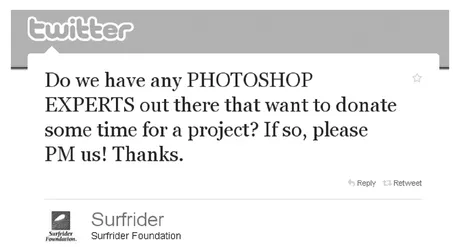
Each chapter works on what the organization calls “atom-based work” on land and “bit-based work” online. The atom-based work includes organizing beach cleanups, testing beach waters, and conducting local education programs. The bit-based work involves many conversations on a variety of social media channels such as Facebook and Twitter, sending out e-mail action alerts, and organizing events online (see Figure 1.1).
Surfrider has created a unique model of engagement to map the participation of volunteers from strangers to friends to supporters, members, activists, and leaders. The organization provides a variety of ways for people to participate at every level. Strangers and friends can buy T-shirts online and sign up for e-mail alerts. More involved supporters and members can download and listen to pod-casts and organize local beach cleanups. Leaders can arrange to meet with elected officials to discuss legislation to protect the shorelines.
Figure 1.1
Example of Surfrider Recruiting Volunteers via Twitter
Source: Reprinted with the permission of the Surfrider Foundation.
Like the surfers, the chapters do what they want to do when they want to do it. The Foundation trusts their distributed network of people to work on its behalf without requiring constant oversight. Chad Nelson, Surfrider’s environmental director, said that while this might annoy the lawyers, the national office rarely polices or intervenes with what the chapters are doing.
And it all works to engage people locally and energetically on behalf of the organization. In 2008, Surfrider had over 200 community outreach campaigns, over 900 local presentations of its Respect the Beach education program, over 8,000 beach water tests taken, and over 600 beach cleanups. Surfrider Chapter representatives attended over 125 meetings and events involving city, county, and state governments. In total, volunteers contributed over 145,000 volunteer hours.1
The Surfrider Foundation ignites the passions of thousands of ocean enthusiasts. In return, this network of participants shares their energy and enthusiasm for Surfrider with their own personal networks of friends, volunteers their time, and donates money to support the organization.
ABOUT NETWORKED NONPROFITS
Networked Nonprofits are simple and transparent organizations. They are easy for outsiders to get in and insiders to get out. They engage people in shaping and sharing their work in order to raise awareness of social issues, organize communities to provide services, or advocate for legislation. In the long run, they are helping to make the world a safer, fairer, healthier place to live.
Networked Nonprofits don’t work harder or longer than other organizations, they work differently. They engage in conversations with people beyond their walls—lots of conversations—to build relationships that spread their work through the network. Incorporating relationship building as a core responsibility of all staffers fundamentally changes their to-do lists. Working this way is only possible because of the advent of social media. All Networked Nonprofits are comfortable using the new social media tool set—digital tools such as e-mail, blogs, and Facebook that encourage two-way conversations between people, and between people and organizations, to enlarge their efforts quickly, easily, and inexpensively.
We know nonprofit staffs often feel overburdened, with too much pressure on too few people to do too much. As we will discuss in Chapter Seven, “Making Nonprofit Organizations Simpler,” nonprofits and the people within them have too much to do because they try to do too much as stand-alone organizations. Networked Nonprofits know their organizations are part of a much larger ecosystem of organizations and individuals that are all incredible resources for their efforts.
Networked Nonprofits are not afraid to lose control of their programs and services, their logos and branding, messages and messengers because they know that in return they will receive the goodwill and passion of many people working on their behalf. Working this way enables these organizations to reach many more people less expensively than they ever could working largely alone.
Some organizations such as the Surfrider Foundation, and others that we will discuss in this book, such as MomsRising and charity: water, are born as Networked Nonprofits. But being Networked Nonprofits is not just an accident of birth. Any organization can become one, and many are in the process of doing so. Venerable nonprofit organizations, such as the American Red Cross, the Humane Society of the United States, Planned Parenthood, and the American Cancer Society, are turning themselves inside out with great success. We will share their stories, struggles, and lessons throughout this book in order to encourage other organizations to become Networked Nonprofits.
But organizations are not the only entities powering social change in this new, connected world. Individuals—we call them free agents—combine their social media savvy with their passion for social causes to accomplish amazing things. Free agents’ facility with social media gives them the power and tools that only organizations had just a few years ago. They have become integral parts of ecosystems within which nonprofit organizations work. While traditional organizations may bristle at their emergence, Networked Nonprofits naturally work with them toward common ends.
THE SOCIAL MEDIA REVOLUTION
Evolutions are incremental improvements of a product or idea. The newest Ford Mustang or iPod may be better iterations than previous versions, but they are still fundamentally the same product. When two teenagers, Shawn Fanning and Sean Parker, created the online music-sharing site Napster in 1999, they sparked a revolution. Power shifted away from music companies toward music listeners. For the first time, consumers had the ability to shape their own collection of songs any way they wanted, and perhaps more important, share these songs with the world online.
It wasn’t legal, it still isn’t, but it was inevitable given that millions of people could easily and inexpensively access and use the tools. Even if services such as iTunes slow down the free sharing of music files online, they will never erase it entirely. The genie has popped out of the bottle, and she won’t be put back in. Social media are revolutionary in their power and reach.
In the 1980s, personal computers landed on everyone’s desk and changed the way information was stored and organized. In the 1990s, the World Wide Web connected a universe of people and made information accessible. This century has seen the rise of the social graph; the relationships people are making and renewing using social media tools, particularly social networking sites, enable rapid, collective activity.
We define social media as the array of digital tools such as instant messaging, text messaging, blogs, videos, and social networking sites like Facebook and MySpace that are inexpensive and easy to use. Social media enable people to create their own stories, videos, and photos and to manipulate them and share them widely at almost no cost. Included in this book is a Glossary to provide more definitions of specific tools and processes.
Social media tools integral to nonprofits fall into three general categories of use:
• Conversation starters like blogs, YouTube, and Twitter
• Collaboration tools including wikis and Google Groups
• Network builders like social networking sites such as Facebook, MySpace, and Twitter
Social media are not a fad or a trend. With near-universal access to the World Wide Web in the United States, and the ubiquity of mobile phones and e-mail, the use of social media will only continue growing. Social media use is becoming ingrained in the way that people relate to one another and work together. In particular, social media are shaping the way that young people think, connect, engage, and work together.
We want to caution readers that knowing how to use social media well is not just about knowing which button to push. Technological wizardry shouldn’t overshadow the truly revolutionary power of social media, which is its ability to connect people to one another and help build strong, resilient, trusting relationships. But the only way to understand this distinction is to use the toolset personally. There is no other way to fully understand the power of using social media to connect friends and strangers with common interests than to experience it personally. In other words: Social media use is a contact sport, not a spectator sport.
We also warn you that there is no universal rule about which tool will work under which circumstances for which people. Networked Nonprofits do not use just one tool. They use many tools to engage in different kinds of conversations with different groups of people.
More important, keep in mind that tools will come and go, but strategy sustains organizations. Choosing and using any specific tool is less important to organizational success than embracing the principles and strategies that make social media effective. Using social media is a way of being more than a way of doing.
Unfortunately, too many nonprofit organizations are losing ground today because they fear what might happen if they open themselves up to this new world. These organizations are crashing into this set-me-free world powered by social media, unprepared to become Networked Nonprofits. Many of these fears are unfounded. Let’s begin by facing and overcoming the fears and myths about social media use that simply aren’t true.
BUSTING THE SOCIAL MEDIA MYTHS
The array of social media tools look complex from the outside—a beeping, flashing, chattering din. Watching young people glide through the social media world with ease adds to the perception that social media is only for the technologically savvy or the young. Neither perception is true. But you don’t have to take our word for it; we’ll let Peggy Padden explain.
Fate dealt Peggy’s family the cruelest blow when two of her three sons were born with a genetic blood disorder called Fanconi Anemia (FA), which leads to bone marrow failure. Her eldest son died after a failed bone marrow transplant, while her younger son is still fighting the disease. But by nature Peggy is a doer, so she energetically began to raise money for the Fanconi Anemia Research Fund to help find a cure for this terrible disease. She organized 5k runs/walks on Valentine’s Day and golf tournaments as fundraisers in Portland, Oregon, where she lives.
In December 2007, Peggy saw an article in PARADE magazine about a new fundraising contest called America’s Giving Challenge. The Case Foundation, the family philanthropy started by AOL founder Steve Case and his wife Jean, sponsored the Challenge. They encouraged individuals to join the Challenge by signing up online at PARADE magazine’s site or on Facebook.
Over a fifty-day period, these individuals, or champions, competed to raise the largest number of people to give at least $10 each for their cause. The eight champions who raised the largest number of friends during the contest would win the money they raised, plus $50 thousand from the Case Foundation.
Peggy’s reaction when she read the challenge description was, “That’s a lot of money!” She decided to give it a try.
Peggy was the first to admit that all the newfangled technology tools—all of that “Face page stuff” in her words—was not meant for a fifty-year-old woman like her. She knew enough to get by, she thought. She read and sent e-mail, surfed the Web a bit, and was very excited when she learned how to cut and paste in a Word document. But that was it; she left the rest for her children. That is what made Peggy’s success in America’s Giving Challenge, a fundraising effort that hinged on using new social media tools like Facebook, such a huge surprise.
A few clicks on the PARADE magazine Web site and Peggy had registered her cause for the Challenge and added her name as the champion. “I was a beginner; I’ve never done anything like a badge before,” she says. “I was able to figure it out except for the picture; I couldn’t get it any bigger.” She waited for her son to get home to fix the photo.
Once she set up the badge, Peggy began to do what she felt most comfortable doing: she e-mailed her family, friends, acquaintances, and the 250 families on the Fanconi Anemia listserv and asked them to become a friend to her cause and donate $10. It was a long shot, she said, but they could possibly win $50 thousand and that money would go toward our only hope for a cure for Fanconi Anemia. She a...