![]()
Part One
Introduction of Concepts
![]()
Chapter One
The Secret Sauce for Nonprofits
Networked Strategies + Measurement = Amazing Success
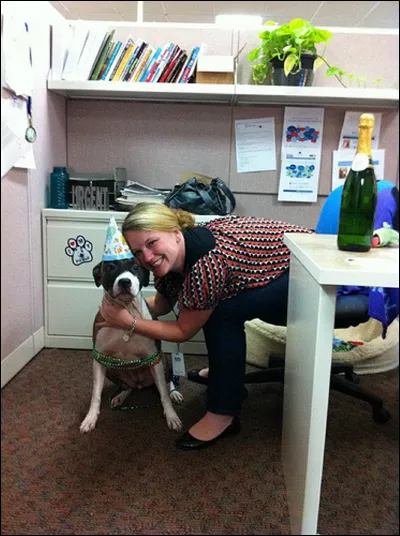
Carie Lewis positioned the party hat on her dog Bella’s head, leaned down from her desk, and said, “Say cheeseburger!” Carie’s boss snapped a photo with a mobile phone and shared it on the nonprofit organization’s Facebook page (Figure 1.1).1
You may be wondering why Carie’s dog was in her office wearing a party hat. Perhaps you’re even more curious as to why the photo was posted on Facebook. Carie Lewis is the director of emerging media for The Humane Society of the United States (HSUS), the nation’s largest animal protection organization, where she has been responsible for social media for more than five years. The HSUS has a pet-friendly office policy because its staff, like its constituents, are animal lovers. The party hats? They were celebrating because The HSUS Facebook page had just broken the 1 million fan mark.
Says Lewis, “Although we prefer not to focus on numbers of fans as a measure of ultimate success, 1 million fans is a huge landmark that we celebrated with our online community of animal lovers.” According to a 2011 nonprofit social media benchmark study sponsored by Craig Newmark, animal charities are among the most active on social networks, perhaps because people love photos of cute animals.2 But there was more to it than that.
The HSUS fans are more than just fans; they love to talk about how much they love their pets and care for animals. They share photos online, donate to The HSUS (and tell their friends to do so), and take action on animal rights issues when they receive a call to action. In answer to the question of how The HSUS built a fan base on Facebook that is not only large but is always ready get involved in supporting animals, Lewis responds, “We would not be successful if we were not using measurement to track and learn and constantly improve.”3
Lewis is a curator of social media metrics. She and her colleagues in other departments build their integrated advocacy or fundraising campaigns around outcomes, key performance indicators, and associated metrics. “We look at three things,” Lewis noted: “actions taken, donations made, and customer service wins. That’s also how our department has been able to obtain more resources to handle the volume we have.” They use measurable objectives for specific campaigns, and Lewis tracks everything they do on social networks in order to improve and get better results.
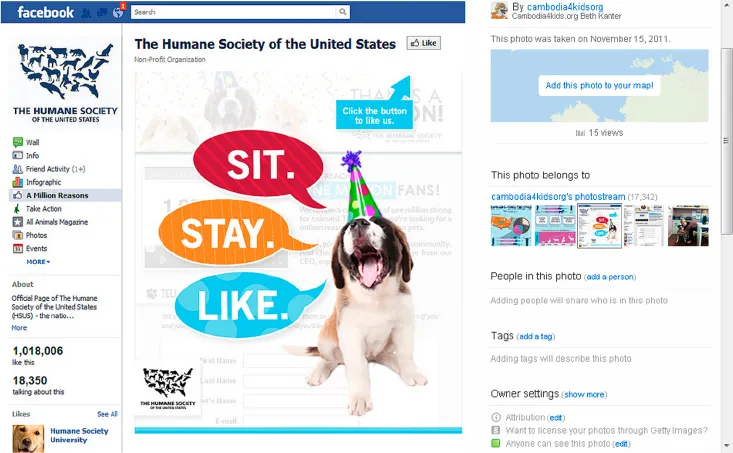
For its campaign to reach 1 million fans, depicted in the screen capture in Figure 1.2, The HSUS wanted to create a celebration so that fans could engage and participate in the fun. They wanted to create a personalized experience that makes the fans feel that they are a part of something really great. Carie noted, “Because we’ve been using measurement to improve our social media use for years, we know that we need to make these participatory campaigns as easy and simple as possible for stakeholders.”
Lewis found that getting everyone in her organization on the same page about evaluating results is crucial: “Before launching any campaign, I present the measurable objectives and strategies at a cross-department meeting. We spend a lot of time clarifying what success looks like and what metrics we will collect to measure it.” These sessions also generate many great ideas for strategy, including the idea to create an infographic describing the organization’s fans on Facebook.
Lewis is often called in to consult with different departments or affiliates: “We’ve codified our best practices on measurement and offer a menu of social media tactics that we review with them, letting them know the options, and use cases for each. Most important is a report template that helps them collect the right metrics and to do a content analysis. We even have a section that asks, ‘What did you learn?’”
Carie writes out “the objectives and metrics and measurement plan before we launch. That way we know what it will take to reach the goals, but also we get an opportunity to continuously improve what we’re doing. In the long run, we know it is helping the animals we all love. Working as a networked nonprofit without a measurement plan is a waste of resources and does a disservice to our mission.”
THE KEYS TO NONPROFIT SUCCESS: NETWORKING AND MEASUREMENT
Two key processes lead to tremendous success for nonprofits: becoming networked and using measurement. This book, through numerous examples and practical techniques, explores the many ways in which these two concepts dramatically improve the efficiency and success of nonprofits.
A networked nonprofit is an organization that uses social networks and the technology of social media to greatly extend its reach, capabilities, and effectiveness. Measurement is the process of collecting data on your communications results and using the data to learn and improve your programs. An organization with a data-informed culture uses data to help make decisions and uses measurement to continuously improve and refine its systems. Each chapter of this book provides examples of organizations that are using these techniques to achieve success.
Most nonprofit organizations use at least some sort of informal measurement and some form of social media–enabled networking. Many nonprofits are striving to build a data-informed culture and networked mind-set. But few organizations use these powerful techniques to their greatest potential. One of these is MomsRising.org, a poster child for networked nonprofits and nonprofit measurement mavens.
MOMSRISING: A SUPERSTAR OF NETWORKED NONPROFITS KNOWS THE JOYS OF MEASUREMENT
Kristin Rowe-Finkbeiner and Joan Blades founded MomsRising in 2006. To design this nonprofit, they combined their experience in grassroots organizing and social media with successful ideas from organizations like MoveOn, ColorOfChange, League of Conservation Voters, and others. The result was an organization that embraces constant learning from experience and embeds this powerful concept in its organizational culture and processes. It has fueled the organization’s growth from zero members in May 2006 to over a million active members—moms, dads, grandparents, aunts, and uncles—today.
MomsRising uses measurement to achieve tremendous success. As you read this book, you will find several themes concerning the value of measurement and many examples of how it is used. Here are nine of them.
Theme 1: “Likes” on Facebook Is Not a Victory—Social Change Is
Proper measurement keeps organizations focused on results rather than the tools they use, a theme we explore in greater detail in Chapter Four. MomsRising, for instance, does not simply count “likes” on Facebook. Instead, it uses social change to define its successes and develops metrics accordingly. Its most important goals generally include these:
- Getting policies passed on family-related issues
- Increasing capacity
- Increasing the movement size by increasing membership
- Working with aligned partner organizations
- Garnering attention from all media through creative engagement
For MomsRising, the holy grail of results is getting legislatures to pass family-friendly policies. This requires grabbing the attention of policymakers. As one indicator of progress toward that goal, it counted an invitation to bring mothers to the White House to talk with policymakers about their experience with Medicaid. The White House blogged about the power of people’s stories, and MomsRising members blogged about their White House experience, resulting in even greater exposure for their messages. Says Rowe-Finkbeiner, “The after-story is just as important because it will often get picked up by mainstream media outlets like NPR or the Huffington Post.”
Theme 2: Measurement Helps Nonprofits Understand and Improve Their Social Networks
Another theme of this book is that measurement helps nonprofits listen to and engage with their constituents. Measurement enables organizations to assess and improve their relationships with their members and stakeholders. This powerful technique will help you understand how your stakeholders perceive you, what they do with the information you send to them, and how it bears on their behavior. This theme is explored in more detail in Chapter Five.
An important part of MomsRising’s decision making is the use of member feedback in the form of stories or comments on social channels or e-mail and in more structured ways such as surveys. Says Rowe-Finkbeiner, “We are in constant dialogue with our members to figure out what works and what doesn’t. The data keeps us focused on our mission of building a movement for family economic security, while listening and engaging with our members breathes life into our movement.”
Theme 3: Measurement Means Data for Decisions, Not for Data’s Sake
Unfortunately, many organizations see measurement as collecting data to dump on the boardroom table or the executive director’s desk. But measurement isn’t about justifying one’s existence or budget, and it isn’t about it filling spreadsheets with lots of “just-in-case” data to throw over the fence.
Measurement is about using data to learn to become more effective and more efficient. It’s about doing your job better, and helping your organization achieve its mission with fewer resources. It’s about reaching more people, and becoming better at saving the world.
Theme 4: Measurement Makes You Plan for Success
More and more nonprofits are making larger investments in social media: hiring dedicated staff, upgrading Web sites to incorporate social features, and using more powerful professional tools to do the work. Measurement helps you make smarter investments and helps you use those investments in a smarter way. Having a social media measurement plan and approach is no longer an afterthought. It’s the smart way to run an organization.
Theme 5: Good Measurement Is Good Governance
As networked nonprofits become more skilled in their social media practice, their boards and senior management are becoming more knowledgeable about this area. They expect reports showing social media results, and they expect results expressed in the kind of language that measurement provides. In addition, foundations and other funders want credible evaluation reports and demonstrations of impact. Today boards and foundations increasingly include executives from the for-profit world who have come to expect actionable data and standardized measurement systems.
Theme 6: Data Without Insight Is Just Trivia
The key to MomsRising’s success is that it uses data to refine its strategies and tactics. It has achieved its success not by luck or gut instinct but by using measurement to make decisions.
MomsR...