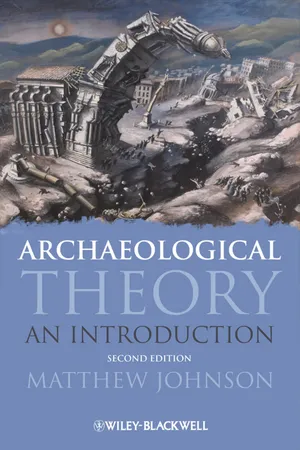
- New edition of a popular introductory text that explores the increasing diversity of approaches to archaeological theory
- Features more extended coverage of 'traditional' or culture-historical archaeology
- Examines theory across the English-speaking world and beyond
- Offers greatly expanded coverage of evolutionary theory, divided into sociocultural and Darwinist approaches
- Includes an expanded glossary, bibliography, and useful suggestions for further readings
- English
- ePUB (mobile friendly)
- Available on iOS & Android
eBook - ePub
About this book
Archaeological Theory, 2nd Edition is the most current and comprehensive introduction to the field available. Thoroughly revised and updated, this engaging text offers students an ideal entry point to the major concepts and ongoing debates in archaeological research.
Information
1
Common Sense is Not Enough
Archaeology can be very boring, distressing and physically uncomfortable. Every year we excavate thousands of sites, some with painstaking and mind-numbing patience, some in a great and undignified hurry. Every year we get chilled to the marrow or bitten half to death by mosquitoes while visiting some unprepossessing, grassy mound in the middle of nowhere. Miles from a decent restaurant or even a warm bath, we try to look interested while the rain comes down in sheets and some great professor whose best work was 20 years ago witters on in a monotone about what was found in Trench 4B. Every year we churn out thousands of interminable, stultifyingly dull site reports, fretting over the accuracy of plans and diagrams, collating lists of grubby artefacts to publish that few will ever consult or use again.
Why?
We could spend the money on hospitals. Alternatively we could quietly pocket the cash and write a much more entertaining, fictitious version of what the past was like while we sat on a sun-kissed terrace somewhere in southern California. If we were feeling ideologically sound we could raise an International Brigade for a liberation struggle somewhere. Each of these alternatives has its attractions, but we don’t do any of these things. We go on as we have done before.
One reason we don’t do these things is because archaeology is very important. The past is dead and gone, but it is also very powerful. It is so powerful that an entire nation (Zimbabwe) can name itself after an archaeological site. It is so powerful that archaeological sites are surrounded by police and are the subject of attempted occupations by New Age travellers. It is so powerful that even individual groups of artefacts like the Parthenon frieze are the subject of major international disputes.
The question ‘why do we do archaeology?’ is therefore bound up with the question ‘why is archaeology – the study of the past through its material remains – so important to us?’ And this again leads on to the question of ‘us’, of our identity – who are we? And these are all theoretical questions.
Definitions of Theory
‘Theory’ is a very difficult word to define. Indeed, I shall return to this topic in the final chapter, since different theoretical views define ‘theory’ in different ways. Different definitions cannot therefore be fully explored without prior explanation of those views.
For the time being, I propose to define theory as follows: theory is the order we put facts in. I will go on to discuss the extent to which ‘facts’ exist independently of theory, and how we might define ‘facts’. We can also note that most archaeologists would include within the purview of theory why we do archaeology and the social and cultural context of archaeology. They would also refer to issues of interpretation. Most archaeologists would agree that the way we interpret the past has ‘theoretical’ aspects in the broad sense. For example, we could cite general theories such as cultural and biological evolution, issues of how we go about testing our ideas, debates over how we should think about stylistic or decorative change in artefacts.
There is disagreement over whether many concepts can be considered ‘theoretical’ or whether they are merely neutral techniques or methods outside the purview of theory. Stratigraphy, excavation and recording techniques, and the use of statistical methods are, for example, clearly all examples of putting facts in a certain order. However, they might be considered ‘theoretical’ by some but ‘just practical’ or ‘simply techniques’ by others. Theory and method are often confused by archaeologists. In this more restricted sense of theory, if theory covers the ‘why’ questions, method or methodology covers the ‘how’ questions. So theory covers why we selected this site to dig, method how we dig it. However, theory and method are obviously closely related, and many archaeologists including myself regard such a straightforward division as too simple.
To give an example of the relationship between theory and method, we might consider different methods of investigating social inequality in the archaeological record. Thus the method archaeologists might use would be to compare graves ‘richly’ endowed with lots of grave goods with poorer, unadorned graves. It is evident in this exercise that certain ideas or theories about the nature of social inequality are being assumed (that social status will be reflected in treatment of the body at death, that material goods are unequally distributed through society and that this has a direct relationship to social inequality, and so on). These ideas are themselves theoretical in nature.
Perhaps theory and method are one and the same thing and cannot be separated; perhaps they have to be separated if archaeology is to be a rigorous discipline that is capable of testing its theories against its data. This is a debate we shall return to in chapter 4.
I’m sorry to butt in, but all this discussion of theory and method clearly demonstrates just how sterile and boring theory really is. You’re already lost in definitions and semantics, you haven’t mentioned a single fact about the past, and I’m beginning to wish I hadn’t bothered to start reading this and had turned my attention to that new book about the Hopewell culture instead. Theory is irrelevant to the practice of archaeology; we can just use our common sense.
Ah, Roger, the eternal empiricist. (Roger Beefy is an undergraduate student at Northern University, England, though women and men like Roger can be found in any archaeological institution. Roger fell in love with archaeology when he was a child, scrambling up and down the ruins of local castles, churches, burial mounds and other sites. Roger spent a year after school before coming to Northern University digging and working in museums. Roger loves handling archaeological material, and is happiest when drawing a section or talking about seriation techniques over a beer. Now, in his second year at Northern University, Roger has found himself in the middle of a compulsory ‘theory course’. Full of twaddle about middle-range theory, hermeneutics and postcoloniality, it seems to have nothing to do with the subject he loves.)
So, you want to know why theory is ‘relevant’ to archaeological practice. Perhaps you will bear with me while I discuss four possible reasons.
1 We need to justify what we do
Our audience (other archaeologists, people in other disciplines, the ‘general public’ or ‘community’ however defined) needs to have a clear idea from archaeologists of why our research is important, why it is worth paying for, why we are worth listening to. There are a hundred possible answers to this challenge of justification, for example:
- The past is intrinsically important, and we need to find out about it for its own sake.
- We need to know where we came from to know where we’re going next. Knowledge of the past leads to better judgements about the future.
- Only archaeology has the time depth of many thousands of years needed to generate comparative observations about long-term culture processes.
- Archaeology is one medium of cultural revolution that will emancipate ordinary people from repressive ideologies.
The chances are that you disagree with at least one of these statements, and agree with at least one other. That doesn’t change the fact that each statement is a theoretical proposition that needs justifying, arguing through, and debating before it can be accepted or rejected. None of the statements given above is obvious, self-evident or common-sensical when examined closely. Indeed, very little in the world is obvious or self-evident when examined closely, though our political leaders would have us think otherwise.
2 We need to evaluate one interpretation of the past against another, to decide which is the stronger
Archaeology relies in part for its intellectual credibility on being able to distinguish ‘good’ from ‘bad’ interpretations of the past. Were the people who lived on this site hunter-gatherers, or were they aliens from the planet Zog? Which is the stronger interpretation?
It’s impossible to decide what is a strong archaeological interpretation on the basis of ‘common sense’ alone. Common sense might suggest, for example, that we accept the explanation that covers the greatest number of facts. There may be thousands of sherds of pottery dating from the first millennium BC on a site, all factual in their own way, but one other fact – a treering date of ad 750, for example – may suggest that they might be all ‘residual’ or left over from an earlier period. In practice, every day of our working lives as archaeologists, we decide on which order to put our facts in, what degree of importance to place on different pieces of evidence. When we do this, we use theoretical criteria to decide which facts are important and which are not worth bothering with.
A good example of the inadequacy of common sense in deciding what is a strong or weak archaeological explanation is that of ley lines. Ley lines were ‘discovered’ by Alfred Watkins in the 1920s, when he noticed that many ancient archaeological sites in Britain could be linked up by straight lines. The idea that ancient sites lay on straight lines could be ‘proved’ easily by taking a map upon which such ancient monuments were marked and drawing such lines through them. Watkins suggested these lines represented prehistoric trackways. Nonsense, said the professional archaeological community. It was common sense that prehistoric peoples living thousands of years before literacy or formal geometry were far too primitive to lay out such geometrically sophisticated lines. Watkins had intended his book as a genuine contribution to archaeology, but his research, sincerely carried out, was laughed out of court and consigned to the ranks of lunatic ‘fringe archaeology’. Other writers took his thesis up in succeeding decades but extended it by suggesting that the lines were of sacred significance or mystical power.
Now it is quite clear today that prehistoric peoples would have been quite capable of laying out such lines. The original, common-sensical criteria used by archaeologists for rejecting Watkins’s thesis were completely invalid.
Ley lines do not exist. This was shown by Tom Williamson and Liz Bellamy in Ley Lines in Question, which analysed such lines statistically and showed that the density of archaeological sites in the British landscape is so great that a line drawn through virtually anywhere will ‘clip’ a number of sites. It took Williamson and Bellamy a book’s worth of effort and statistical sophistication to prove this, however.
The moral of the debate over ley lines is that what is considered to constitute a strong or a weak explanation is not simply a matter of ‘common sense’. I would argue that if we really want to understand what drove and continues to drive the ley line debate, we have to look, in part, at class divides in British archaeology. In his time Watkins was derided as a...
Table of contents
- Cover
- Table of contents
- Preface: The Contradictions of Theory
- 1 Common Sense is Not Enough
- 2 The ‘New Archaeology’
- 3 Archaeology as a Science
- 4 Middle-range Theory, Ethnoarchaeology and Material Culture Studies
- 5 Culture and Process
- 6 Thoughts and Ideologies
- 7 Postprocessual and Interpretive Archaeologies
- 8 Archaeology, Gender and Identity
- 9 Archaeology and Cultural Evolution
- 10 Archaeology and Darwinian Evolution
- 11 Archaeology and History
- 12 Archaeology, Politics and Culture
- 13 Conclusion: The Future of Theory
- Selective Glossary
- Further Reading
- Bibliography
- Index
- End User License Agreement
Trusted by 375,005 students
Access to over 1.5 million titles for a fair monthly price.
Study more efficiently using our study tools.
Frequently asked questions
Yes, you can cancel anytime from the Subscription tab in your account settings on the Perlego website. Your subscription will stay active until the end of your current billing period. Learn how to cancel your subscription
No, books cannot be downloaded as external files, such as PDFs, for use outside of Perlego. However, you can download books within the Perlego app for offline reading on mobile or tablet. Learn how to download books offline
Perlego offers two plans: Essential and Complete
- Essential is ideal for learners and professionals who enjoy exploring a wide range of subjects. Access the Essential Library with 800,000+ trusted titles and best-sellers across business, personal growth, and the humanities. Includes unlimited reading time and Standard Read Aloud voice.
- Complete: Perfect for advanced learners and researchers needing full, unrestricted access. Unlock 1.5M+ books across hundreds of subjects, including academic and specialized titles. The Complete Plan also includes advanced features like Premium Read Aloud and Research Assistant.
We are an online textbook subscription service, where you can get access to an entire online library for less than the price of a single book per month. With over 1.5 million books across 990+ topics, we’ve got you covered! Learn about our mission
Look out for the read-aloud symbol on your next book to see if you can listen to it. The read-aloud tool reads text aloud for you, highlighting the text as it is being read. You can pause it, speed it up and slow it down. Learn more about Read Aloud
Yes! You can use the Perlego app on both iOS and Android devices to read anytime, anywhere — even offline. Perfect for commutes or when you’re on the go.
Please note we cannot support devices running on iOS 13 and Android 7 or earlier. Learn more about using the app
Please note we cannot support devices running on iOS 13 and Android 7 or earlier. Learn more about using the app
Yes, you can access Archaeological Theory by Matthew Johnson in PDF and/or ePUB format, as well as other popular books in Social Sciences & Archaeology. We have over 1.5 million books available in our catalogue for you to explore.