![]()
CHAPTER 1
INTRODUCTION TO SPONSORSHIP
Sponsorship, correctly conceived and creatively executed, has unparalleled power to build brands, engage stakeholders and present profitable commercial opportunities.
This chapter introduces the basic building blocks required to understand sponsorship and the environment in which it operates, including:
- What sponsorship is, and is not, in the context of modern sponsorship practice.
- The size of the industry, and why it continues to see growth at a time when advertising spend is slowing.
- The key players and the range of sponsorship opportunities, target audiences and possible sponsorship objectives that should be taken into consideration.
- Tangible and intangible sponsorship assets and how some of these might be valued.
- The process of sponsorship from both a sponsor’s and a rights-holder’s perspective.
- A discussion about when to use internal headcount versus external support to deliver on sponsorship objectives.
This is the subject of much current debate especially with take up of social media which we discuss in Chapter 10. At best, sponsorship is an associative marketing tool that creates mutual brand and business value for both the sponsor and the sponsored activity. At worst, it is an excuse for the Chairman to indulge his wife’s interests at the shareholders’ expense. The most widely accepted definition currently is that of the International Chamber of Commerce:
“Any commercial agreement by which a sponsor, for the mutual benefit of the sponsor and sponsored party, contractually provides financing or other support in order to establish an association between the sponsor’s image, brands or products and a sponsorship property in return for rights to promote this association and/or for the granting of certain agreed direct or indirect benefits.”
The key words in this rather long statement are:
- Commercial: Modern sponsorship of the sort undertaken by businesses large and small is targeted at delivering some sort of commercial outcome for business owners, whether the company is publicly or privately owned. The benefits may be accrued in terms of additional revenues or cost savings in the profit and loss account, or as an increase in the value of brand equity on the balance sheet. While an individual undertaking a challenge to raise money for good causes – such as running a marathon or learning a new skill – is a laudable activity, it is outside the scope of this definition, and therefore this book.
- Mutual: There is progressive acceptance that the benefits of a sponsorship relationship should represent a win–win partnership for both the sponsor’s organization and that of the sponsored activity.
- Contract: This may be written out in detail or be based on an oral agreement, but the fundamentals of contract law, as applied in the appropriate judicial system, will apply to the relationship. The rights-holder is offering for sale the right of association and possibly other benefits, which are accepted by the sponsor and confirmed by the provision of some form of consideration, which may be cash or defined value in kind. An informal agreement of mutual association with no consideration does not constitute sponsorship under the ICC definition.
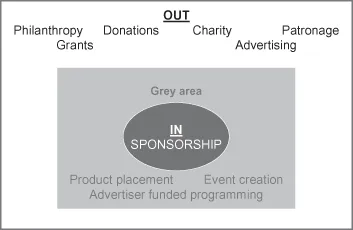
This definition therefore excludes many activities that historically might have been given the name of sponsorship, such as philanthropy, donations or patronage. However, one of the reasons the definition of sponsorship is currently causing such controversy is the development of other associative marketing activities that, from the average consumer’s standpoint, look and feel like some sort of sponsorship (see Figure 1.1). These include:
- Cause-related marketing – Red, the global AIDS-related fundraising initiative, is a good example where a variety of brands have come together to raise money to fight AIDS while benefiting from enhanced brand equity.
- Product placement – Whether it is BMW in the Bond movies or Coca-Cola being prominently consumed by X Factor USA judges, consumers are progressively aware that brands are capitalizing on collective aspirations to market their products.
- Advertiser-funded programming – Gillette’s World of Sport is the classic example of the genre, associating shaving products with performance.
- Event creation – The Red Bull Air Race or Nike 10k Runs look like sponsored events but are both in fact owned by the relevant brand, representing a desire by them to have more control of the activity than would normally be available in a true sponsorship relationship.
This book will largely limit itself to the discussion of those principles and processes that relate to the core sponsorship definition, but it should be understood that many of those issues will also be applicable to other activities within the associative marketing spectrum.
Industry Development
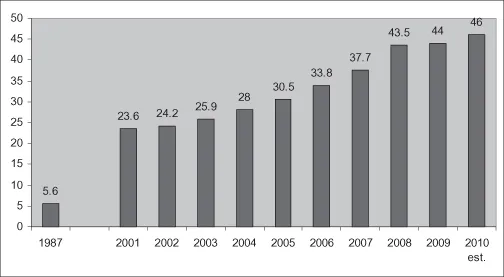
Sponsorship has experienced unprecedented growth over the last decade, with the level of investment in purchasing sponsorship rights of association almost doubling (see Figure 1.2).
This compares favourably with the growth in spend on advertising over the same period. Of particular note is the continued growth in sponsorship during the 2008–9 recession, albeit at a slower rate than previous years, at a time when advertising spend contracted by around 5%. The increased investment in sponsorship is underpinned by three core trends: economic development, social evolution, and the technological revolution.
- Economic development is currently focusing attention on sponsorship as a marketing tool because of the aspirations that greater economic freedom brings to individuals. In agrarian society wealth is highly concentrated with the majority existing at or below subsistence level with nothing to spare for discretionary activity. Economic development creates both the time and the cash for individuals to spend on discretionary items, usually initially allocated to physical comfort. As prosperity becomes the norm, so more money is available to allocate, first, to burden-reducing services, and then to leisure pursuits. Fully mature markets have now moved into an experience economy where people are looking for self-actualizing experiences. This is a need to which brands are responding, whether it is the “terrific experience” of dining at Pizza Hut, shopping at Apple or applying a grooming product. The challenge for many brands is to make these experiences real for customers. Sponsorship facilitates the bringing alive of brand experiences.
- Social evolution is the second trend driving growth in the sponsorship industry. Historically people identified themselves by the feudal lord they served. More recently, identity was linked to the company that provided your employment. Similarly, women started to gain their own identity, no longer recognized as merely their father’s daughter or husband’s wife. The outcomes of these societal changes are that people are looking for new badges of allegiance. These may be found in politics, sport, religion or other pursuits which bind groups together in real or virtual communities at the consumer level.
This social evolution has also impacted how corporations see their role in society. The introduction of triple bottom line accounting has meant that companies can no longer focus merely on economic success in terms of profit and dividends. Now they also have to consider their social and environmental impact. This has led companies to invest at grass roots levels in education, health, sport and culture, aiming not only to make a contribution at the local community level but also to have a global impact.
- However, the technological revolution represe...