- Contains thirty chapters by the leading Hitchcock scholars
- Covers his long career, from his earliest contributions to other directors' silent films to his last uncompleted last film
- Details the enduring legacy he left to filmmakers and audiences alike
- English
- ePUB (mobile friendly)
- Available on iOS & Android
eBook - ePub
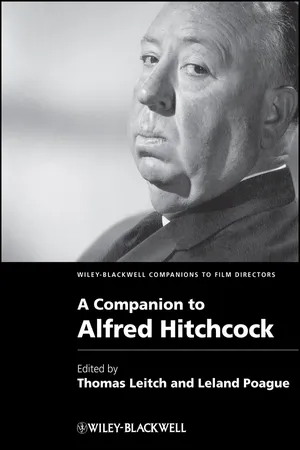
A Companion to Alfred Hitchcock
About this book
The most comprehensive volume ever published on Alfred Hitchcock, covering his career and legacy as well as the broader cultural and intellectual contexts of his work.
Information
PART I
Background
1
Hitchcock’s Lives
The appearance of Donald Spoto’s Spellbound by Beauty (2008) marks a turning point in Hitchcock studies, though hardly for the reasons the author indicates. The dust-jacket description of the book as “the final volume in master biographer Donald Spoto’s Hitchcock trilogy” will not be taken seriously by anyone who has read The Art of Alfred Hitchcock, the formal and thematic study of Hitchcock’s films distinguished from other film-by-film surveys largely by Spoto’s access to the production of Family Plot (1976), or The Dark Side of Genius (1983), the full-dress biography that cast Hitchcock as a tormented loner who delighted in sadistically teasing and sometimes torturing audiences and colleagues alike. Despite publisher claims of a volume “[r]ich with fresh revelations based on previously undisclosed” testimony or with materials offering “important insights into the life of a brilliant, powerful, eccentric and tortured artist,” Spoto’s new book, accurately subtitled Alfred Hitchcock and His Leading Ladies, does not complete a trilogy because it is neither a sequel nor a complement to his earlier volumes. It is something altogether more interesting.
Spoto is admirably direct in explaining the reasons he returned to Hitchcock after The Dark Side of Genius launched his career as a celebrity biographer whose subjects have included Marilyn Monroe, Princess Diana, Joan of Arc, and Jesus of Nazareth. Several of the collaborators he interviewed in preparation for the earlier volume asked him “to omit certain comments either for some years or until after their own deaths” (xxi). So much of Hitchcock’s conduct toward his actresses “can only be called sexual harassment” that “his biography remains a cautionary tale of what can go wrong in any life” (xxi). Spoto felt particularly obliged to respond to legions of Hitchcock fans “who will not hear a syllable spoken against” him (xx). For Spoto, however, “the craft of biography requires that the shadow side of subjects be set forth and comprehended” (xx). Armed with previously withheld confidences and a more comprehensive sense of Hitchcock’s life, Spoto intends by focusing on the most problematic aspect of the director’s professional life – his relationships with the actresses “for whom he had a strange amalgam of adoration and contempt” (xviii) – to rescue Hitchcock in all his dark complexity from a horde of uncritical admirers by offering “new insights into Hitchcock the filmmaker – in particular, how he understood the element of collaboration” (xxiii).
But these claims ring just as hollow as the publisher’s claim that Spellbound by Beauty completes a trilogy. The new material at Spoto’s disposal is of five kinds: new interviews he conducted with Alida Valli, Gregory Peck, Ann Todd, Diane Baker, and especially Tippi Hedren; previously withheld comments from interviews with a somewhat wider array of sources; the interviews with and writings by Hitchcock that Sidney Gottlieb collected in Hitchcock on Hitchcock and Alfred Hitchcock: Interviews; critical studies of Hitchcock’s life, films, and working habits by Leonard J. Leff, Bill Krohn, and Ken Mogg published since The Dark Side of Genius; and intervening biographies of Hitchcock by Patrick McGilligan and Charlotte Chandler, as well as Patricia Hitchcock O’Connell’s biography of her mother, Alma Reville, Hitchcock’s wife.
All but the first two of these, of course, have been equally at the disposal of other commentators for years, but Spoto treats them as if they were his own private preserve. It is sadly ironic to see an author who so regularly castigates Hitchcock for his well-known inability to credit any of his collaborators for the success of his films – he shrewdly suggests that Hitchcock resented his screenwriters because “he wanted to write the script entirely on his own but could not” (50) – display an equal lack of generosity toward his own sources. Chandler is never identified by name outside Spoto’s notes, for example, while John Russell Taylor is referred to by name only thrice in Spoto’s text. Though Spoto cites McGilligan a dozen times in his notes, the only time he mentions McGilligan by name in his text is in his disapproving reference to McGilligan’s account of a sexual liaison between Alma Reville and screenwriter Whitfield Cook, the single most salacious revelation in McGilligan’s 864-page biography.
Just as he takes pains to correct the title of the 1936 film Secret Agent (57) – though this error has not appeared in Hitchcock commentary for years – Spoto treats Leonard J. Leff’s long-ago-published revelations (Hitchcock and Selznick, 1987) about Hitchcock’s bullying treatment of Joan Fontaine on and off the set of Rebecca (1940) and Bill Krohn’s more recent account (Hitchcock at Work, 2000) of Hitchcock’s often serendipitous collaborative working methods as if they were breaking news. Though biographers commonly depend on the work of earlier biographers and interpreters and scholars, it is surprising to see Spoto, who certainly was under no obligation to return to the subject of Hitchcock after 26 years, offer so little new material of his own. Apart from repeated denunciations of Hitchcock’s misogynist cruelty and toilet humor, the most substantial additions Spoto makes here to the portrait of the director he presented in The Dark Side of Genius are a series of supplementary portraits, interpolated biographical sketches of leading ladies from Virginia Valli to Madeleine Carroll to Ingrid Bergman to Tippi Hedren. In order to flesh out the Sardou motto – “Torture the women!” (xix) – that Hitchcock applied to plot construction and Spoto to Hitchcock’s life in The Dark Side of Genius, he adds a catalog of variously vulnerable young actresses Hitchcock either adoringly sought to dominate (Ingrid Bergman, Grace Kelly, Vera Miles) or tormented (June Howard-Tripp, Lilian Hall-Davis, Jessie Matthews, Madeleine Carroll, Joan Fontaine, Kim Novak) or both (Tippi Hedren), while passing hastily over his collaborations with actresses who fell into neither category (Isabel Jeans, Betty Balfour, Anny Ondra, Norah Baring, Joan Barry, Edna Best, Sylvia Sidney, Nova Pilbeam, Margaret Lockwood, Maureen O’Hara, Laraine Day, Carole Lombard, Priscilla Lane, Teresa Wright, Tallulah Bankhead, Marlene Dietrich, Ruth Roman, Shirley MacLaine, Eva Marie Saint, Janet Leigh, Julie Andrews, and Barbara Harris, the last of whom Spoto curiously fails to mention even in passing). The obvious conclusion, that Hitchcock tormented all his actresses except for the ones he didn’t, adds nothing compelling or new to the case Spoto documented so persuasively in The Dark Side of Genius.
In the years since Spoto’s influential biography was first published, many commentators, as he accurately notes, have taken exception to its portrait of Hitchcock as dominated by dark fantasies he felt compelled to play out onscreen. Except at book signings, however, it is hard to imagine where Spoto has run into fans quite as obtuse about either Hitchcock or sexual harassment as his description of “the consensus” would indicate. In The Dark Side of Genius, Spoto had revealingly noted the labored attempts of “Hitchcock’s admirers (this author among the most defensive of them)” to justify the “sloppy technique” of Hitchcock’s 1964 film, Marnie (476). In Spellbound by Beauty, his principal antagonist still seems to be the Spoto who wrote The Art of Alfred Hitchcock. On the whole, however, he redirects his unhappiness with uncritical defenses of Hitchcock onto other targets, like Patricia Hitchcock O’Connell’s reticence about her childhood in England, her relation to her father, and her mother’s contribution to Hitchcock’s films. Of O’Connell’s early days, he concludes that “her life sounded thumpingly dull – nothing stands out at all” (75). He disputes her recollection of her parents as “ordinary people. I know a lot of people insist that my father must have had a dark imagination. Well, he did not. He was a brilliant filmmaker and he knew how to tell a story. That’s all” (76).
Most characteristic of all is Spoto’s response to O’Connell’s claims that “her father ‘made all the important decisions with Alma as his closest collaborator’ and that ‘Alma’s participation was constant’” (89). These claims would seem to support Spoto’s view of Hitchcock, based on Bill Krohn’s research, as “a senior supervising collaborator” rather than “the sole creative force behind his pictures” (84). But Spoto remains curiously unconvinced: “The idea may provide a tender revisionist history in praise of a supposedly underrated wife, but it does not stand up to scrutiny, and Alma herself would swiftly have deflected such hyperbolic praise (indeed, she did when it was implied over the years)” (89–90). More curious yet is the fact that the contentious issue of Alma’s collaboration with her husband surfaces in Spoto’s discussion of Rebecca, where Alma’s participation in the scripting process is frequently attested to, despite the lack of a formal screen credit. And the evidence Spoto does adduce to discount Patricia Hitchcock’s suggestion that Hitchcock depended on his wife’s collaboration seems just as ephemeral as Patricia Hitchcock O’Connell’s familial perspective.
In fact, so few verifiable details are available concerning the extent of Reville’s influence on Hitchcock’s films that commentators are unlikely to reach a consensus on the subject anytime soon. Attempting to rise above this debate rather than entering into it, Spoto mostly reiterates the position he had taken in The Dark Side of Genius. So it is throughout Spellbound by Beauty. Although Spoto’s avowed purpose in returning to Hitchcock is to set the record straight, he offers no compelling new evidence that would refute the biographers, critics, or scholars who have the temerity to present Hitchcocks different from his own. In the end, his decision to revisit Hitchcock produces nothing more than another visit, an invitation to reconsider Hitchcock directed toward a politically insensitive, art-for-art’s-sake audience that in all likelihood no longer exists.
Even so, Spellbound by Beauty is much more interesting than a more successful book would have been because its very failure suggests a remarkable possibility: the depletion of Hitchcock’s biography. Just because Spoto cannot find anything new to say about Hitchcock’s life, of course, is no reason to conclude that there is nothing new to be said. But Spellbound by Beauty seems to mark a point of exhaustion in the course of Hitchcock biography. When it appeared in 1978, Taylor’s authorized biography, Hitch: The Life and Times of Alfred Hitchcock, had presented an official, public life that focused on the director’s career, larded with the sorts of anecdotes Hitchcock had been sharing with interviewers for years. Taylor’s Hitchcock was an inveterate practical joker, but his pranks – inventive, good-humored, and often enough repaid in kind by “like-minded friends” (121) who knew that “if Hitch felt he had gone a little too far … he always made generous amends” (121–22) – simply “kept his units cheery and ready for anything” (122) and incidentally provided leavening for a blow-by-blow chronicle of his public life, since Taylor provided little insight into Hitchcock’s private life except the tacit implication that it was not eventful enough to be worth examining. Taylor’s Hitchcock was neurotically fearful and obsessive in his professional habits, but urbanely, even comically so.
Five years later, Spoto, taking his cue from interviews with Hitchcock’s collaborators rather than restricting his point of view to the director himself, portrayed a dramatically different Hitchcock in The Dark Side of Genius: The Life of Alfred Hitchcock. This filmmaker was still a practical joker, but in Spoto’s telling the jokes did not provide relief from the tedious routine of filmmaking. Beginning with a prophetic childhood prank in which he and “an accomplice” dragged their younger schoolmate Robert Goold to the basement boiler room at St. Ignatius College, pinned “a string of firecrackers … to his underwear and ignited” them (32), Spoto charts the way Hitchcock’s pranks became “carefully controlled antisocial gestures” (112) that revealed “a cruder and crueler streak” (111) even as they “exterioriz[ed] his own deepest fears” (112) in the same way Hitchcock’s films did. Spoto’s Hitchcock, an intensely private person, was sexually repressed, voyeuristic, possessive, defensive, often sadistic, ungenerous and mean-spirited to collaborators, and addicted to playing Svengali to a series of ingénues he sought to mold into Hitchcock blondes, especially Joan Fontaine, Grace Kelly, Vera Miles, and Tippi Hedren. Like Edmund Wilson, whose 1941 study The Wound and the Bow had posited a generation earlier “the conception of superior strength as inseparable from disability” (468), Spoto presented a Hitchcock who could shape the nightmares of so many filmgoers because of his success in putting his own private torment onscreen. The result was to recast Taylor as remaining on the surface that Spoto dared to go beneath. The genial raconteur whom Taylor had taken to be the author of Hitchcock’s films became in Spoto a public mask that concealed dark dreams of lust and power, dreams that became more explicitly rendered onscreen with the eclipse of the 1930 Production Code and the director’s advancing age, so that the climactic attack on Melanie Daniels in The Birds (1963) and the murder sequences in Psycho (1960), Frenzy (1972), and the unproduced The Short Night became “the last expression of the darkest desire that had occupied Hitchcock’s imagination for decades” (544).
If Spoto’s controversial biography – was it true? and if it was true, should it be published? – posed an antithesis to Taylor’s Hitchcock, Patrick McGilligan’s Alfred Hitchcock: A Life in Darkness and Light (2003) might have been expected to provide a synthesis. And in some ways, that is exactly what it did provide. McGilligan’s Hitchcock had all the dark complexity of Spoto’s. En route to terrifying audiences around the world, he deceived scriptwriters, humiliated technicians, and tyrannized actresses. He never outgrew an adolescent sense of humor, and professional success only accentuated his mania for complete control over his films. But the public behavior Spoto dismissed as a mask McGilligan took to be equally authentic, representative of the radically divided nature indicated by his subtitle. McGilligan’s Hitchcock was a devoted son, a faithful if undersexed husband, a tender and affectionate father, and a colleague as capable of unexpected generosity as of cruelty. If Spoto’s Hitchcock struggled his whole life to repress a sociopathic side that sprang to life in a series of films that chart the return of the repressed, McGilligan’s Hitchcock, whose weight fluctuated wildly throughout his adult life, struggled as well to balance the conflicting sides of his nature.
According to Hegelian dialectics, McGilligan’s attempted synthesis of Taylor and Spoto should have led to a new antithesis. But neither of the biographies produced more recently by a pair of professional journalists revealed anything like a new Hitchcock. Despite lengthy and sometimes revealing quotations from many interviews with Hitchcock’s surviving colleagues, Charlotte Chandler’s aptly titled It’s Only a Movie: Alfred Hitchcock: A Personal Biography (2005), which reads like an extended magazine profile, retreats into Taylor territory. Chandler’s gossipy tone, virtually indistinguishable from that of her interviewees, normalizes the anecdotes and revelations about Hitchcock’s working habits but works against integration. She offers no new insight into Hitchcock’s private life, no rationale of his career, and no explanation of how the witty, mischievous Hitchcock his colleagues describe, voluble yet withdrawn, came to make the films that made his name. The result is that although almost everyone Chandler quotes attempts to encapsulate Hitchcock’s life or work – from Ronald Neame’s “Hitchcock wasn’t ever ruffled by anything” (73) to Melanie Griffith’s “He was a motherfucker. And you can quote me” (272) – she never does. Nor does Quentin Falk in Mr. Hitchcock (2007), which begins with a guileless warning not to “expect … anything startlingly new in terms of original research” (2). Like Chandler’s montage of interviews, Falk’s brisk survey of Hitchcock’s career, framed by new interviews with Hitchcock’s collaborators on Frenzy, uses that career as a familiar story that can be retold with charm and profit.
Both Chandler and Falk, like Spoto in Spellbound by Beauty, invite their readers to revisit Hitchcock rather than offering any major new revelations about him. In doing so, they present Hitchcock’s life as a known quantity that can still give pleasure even after repeated doses if it is repackaged or approached from a slightly different angle or with new details filled in. In retrospect, they suggest that McGilligan’s Hitchcock was not so much a synthesis as a compromise, his biographer less interested in presenting a new Hitchcock than in judiciously correcting the record. McGilligan gets Robert Goold, who “entered St. Ignatius a full term after Hitchcock departed,” to admit ...
Table of contents
- Cover
- Contents
- Halftitle page
- Series page
- Title page
- Copyright
- Notes on Contributors
- Introduction
- Part I Background
- Part II Genre
- Part III Collaboration
- Part IV Style
- Part V Development
- Part VI Auteurism
- Part VII Ideology
- Part VIII Ethics
- Part IX Beyond Hitchcock
- Index
Trusted by 375,005 students
Access to over 1.5 million titles for a fair monthly price.
Study more efficiently using our study tools.
Frequently asked questions
Yes, you can cancel anytime from the Subscription tab in your account settings on the Perlego website. Your subscription will stay active until the end of your current billing period. Learn how to cancel your subscription
No, books cannot be downloaded as external files, such as PDFs, for use outside of Perlego. However, you can download books within the Perlego app for offline reading on mobile or tablet. Learn how to download books offline
Perlego offers two plans: Essential and Complete
- Essential is ideal for learners and professionals who enjoy exploring a wide range of subjects. Access the Essential Library with 800,000+ trusted titles and best-sellers across business, personal growth, and the humanities. Includes unlimited reading time and Standard Read Aloud voice.
- Complete: Perfect for advanced learners and researchers needing full, unrestricted access. Unlock 1.5M+ books across hundreds of subjects, including academic and specialized titles. The Complete Plan also includes advanced features like Premium Read Aloud and Research Assistant.
We are an online textbook subscription service, where you can get access to an entire online library for less than the price of a single book per month. With over 1.5 million books across 990+ topics, we’ve got you covered! Learn about our mission
Look out for the read-aloud symbol on your next book to see if you can listen to it. The read-aloud tool reads text aloud for you, highlighting the text as it is being read. You can pause it, speed it up and slow it down. Learn more about Read Aloud
Yes! You can use the Perlego app on both iOS and Android devices to read anytime, anywhere — even offline. Perfect for commutes or when you’re on the go.
Please note we cannot support devices running on iOS 13 and Android 7 or earlier. Learn more about using the app
Please note we cannot support devices running on iOS 13 and Android 7 or earlier. Learn more about using the app
Yes, you can access A Companion to Alfred Hitchcock by Thomas Leitch, Leland Poague, Thomas Leitch,Leland Poague in PDF and/or ePUB format, as well as other popular books in Media & Performing Arts & Film History & Criticism. We have over 1.5 million books available in our catalogue for you to explore.