- Defines the relevance of archaeology and the social sciences more generally to the modern world
- Challenges the traditional boundaries between prehistoric and historical archaeologies
- Discusses how archaeology articulates such contemporary topics and issues as landscape and natures; agency, meaning and practice; sexuality, embodiment and personhood; race, class, and ethnicity; materiality, memory, and historical silence; colonialism, nationalism, and empire; heritage, patrimony, and social justice; media, museums, and publics
- Examines the influence of American pragmatism on archaeology
- Offers 32 new chapters by leading archaeologists and cultural anthropologists
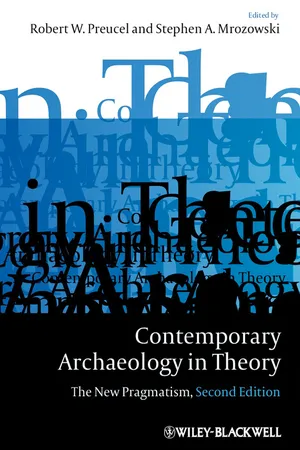
eBook - ePub
Contemporary Archaeology in Theory
The New Pragmatism
- English
- ePUB (mobile friendly)
- Available on iOS & Android
eBook - ePub
Contemporary Archaeology in Theory
The New Pragmatism
About this book
The second edition of Contemporary Archaeology in Theory: The New Pragmatism, has been thoroughly updated and revised, and features top scholars who redefine the theoretical and political agendas of the field, and challenge the usual distinctions between time, space, processes, and people.
Information
Part I
The New Pragmatism
NEW EDITIONS OF TEXTBOOKS OR READERS are generally of two kinds. Typically, they stay close to the structure of the first edition and add in new material to acknowledge the ways in which the field has changed since its original publication date. Less frequently do they represent a complete rewrite or a new engagement with the field. This second edition of Contemporary Archaeology in Theory is of this latter kind and, indeed, it is why we have chosen to add the subtitle The New Pragmatism.
The first edition, edited by Robert Preucel, an American Southwesternist, and Ian Hodder, a British prehistorian, was an attempt to review the landscape of archaeological theory circa 1995 (Preucel and Hodder 1996). We began by acknowledging the challenges and risks of the project. Readers are a distinctive publication genre. They bind together a group of essays written by diverse scholars for different purposes into a single volume where their common threads are highlighted by the editors. There is a sense of authority and completeness about them that is exciting when they first come out, but that quickly fades with passage of time. Because each reader brings his or her own experience and knowledge to bear in the process of reading, we wished our Reader to be fluid and open to multiple interpretations. We were aware that our introductory essays and our essay selections could be perceived as an attempt to establish a canon, even though this was certainly not our intention.
We then discussed possible ways of organizing the Reader to emphasize the point that organizational decisions are not neutral and they have an effect upon interpretation. Some of the possible organizational structures we reviewed included dividing the book by historical periods (antiquarianism, culture-historical archaeology, processual archaeology, postprocessual archaeology), by types of societies (band, tribe, chief-dom, state), or by subject and national origin (Paleolithic archaeology, Roman archaeology, Chinese archaeology). We then raised the question of whether it was possible to develop an organizational schema that does not suffer from an evolutionary or imperialist bias. We concluded that while there can be no definitive account of theory in archaeology, there can nonetheless be productive engagements that are forged through a process of discourse and dialogue. This perspective requires a commitment to a more democratic archaeology where all views and positionalities have the right to be included in the discourse (which is, of course, not the same thing as saying that all views are equally valid). This is the basis for doing applied anthropology as well as a socially committed or action archaeology.
This second edition, edited by Preucel and Stephen Mrozowski, an American historical archaeologist, adopts a somewhat different approach. It is not so much a review of the field as it is an investigation of a particular movement or spirit in the human sciences. We have called this investigation the “new pragmatism.” This spirit does not refer to the dominance of any one theory, but rather to the more explicit integration of archaeology and its social context in ways that serve contemporary needs. While it is true that archaeology has always had a social purpose, it is becoming clear that archaeology and the social are inextricably intertwined. It is no longer possible to hold that archaeology is an objective science first and a social practice second. Archaeology is irreducibly both at the same time. Archaeologists are increasingly asking the following questions: How can archaeology better contribute to broader dialogues concerning the myriad social challenges humanity faces at this point in its history? What is archaeology’s role in the development of social theory? What are the practical consequences of holding a particular theory? Does archaeology matter?
In the past 15 years, there has been a growing emphasis on the social and an interest more generally in establishing the relevance of social sciences to the modern world. In philosophy, this has meant the reemergence of pragmatism and the importance it places on self-referential knowledge and its practical application to contemporary social issues (Baert 2005). In archaeology, this is perhaps exemplified by the emergence of postprocessual archaeologies and the gradual incorporation of questions of identity, meaning, agency, and practice alongside those of system, process, and structure. This development, of course, should not be interpreted to mean that process or structure has been superseded. The social must always be positioned within a longterm trajectory and linked to the cognitive. Rather, it means that in terms of the doing of archaeology, there are increasingly more studies deploying social categories in pursuit of a past that holds relevance in today’s world. It is no longer possible to justify archaeology on some abstract terms; rather, the ethics of archaeology now require that we join diverse interest groups in the common project of understanding the multiple meanings of the past for the present. The obvious question to ask is why is this happening now? This Reader is an attempt to interrogate this question from several different, but interrelated, directions.
Disciplinary Anxieties
All fields and disciplines undergo periodic reevaluations when they take stock of their current situation and chart possible courses for the future. This is a healthy thing since knowledge grows and interests shift. In anthropological archaeology, one such reevaluation took place in the 1960s and early 1970s and turned on the degree to which positivism was an appropriate epistemology for the scientific investigation of past cultures and societies (Fritz and Plog 1970; Watson et al. 1971; Flannery 1973, Renfrew 1982). Ironically, this reevaluation came precisely at the moment that philosophers of science were moving away from positivism and advocating alternative approaches, some of which came to be called postpositivism (Rorty 1979, 1982; Wylie 1981, 2002). This “epistemic delay” is typical of those social sciences, like archaeology, that have attempted to emulate the physical sciences. There is now a growing sense that there are multiple legitimate ways of knowing the world. Indeed, science studies scholars have concluded that, as important as it is, science cannot be claimed on philosophical grounds to be a privileged enterprise (Latour and Woolgar 1979; Pickering 1995; Barnes et al. 1996; Knorr Cetina 1999). Rather, science is but one among many ways of knowing, each of which serves particular social purposes. This is not a statement in favor of relativism, since all forms of knowledge acquisition are manifestly not equivalent. It simply means that knowledge claims must be continually justified against one another in discourse and dialogue. This conclusion is central to a pragmatic archaeology.
In the 1960s, Lewis Binford and his students at the University of Chicago introduced an explicitly scientific approach to explaining the past known as the “new archaeology.” What was new was the placement of theory building, particularly systems theory, ecological theory, and evolutionary theory, at the core of the archaeological agenda (Binford 1962; Flannery 1972). The ultimate goal was for archaeology to take its place along other empirical, lawgenerating sciences and apply itself to explaining the past as a predictable trajectory. This new focus contrasted with the particularistic nature of standard traditional or culture-historical archaeology and had the advantage of directly linking archaeology to other newly reformulated sciences, such as evolutionary ecology, sociology, and human geography. David Clarke (1968) at Cambridge University offered a somewhat different, but largely congruent, version of the new archaeology that emphasized quantitative and analytic methods borrowed from many of these same sciences. Enthusiasm among archaeologists was high and some even touted this movement as a “paradigm shift” in the Kuhnian sense (Kuhn 1962) because it was perceived as marking a radical break with the approaches and methods of culture-historical archaeology (Sterud 1973).
The excitement of the new archaeology, however, was short-lived and internal critiques quickly came to the surface. Although occasionally forgotten, these early critiques would, in some instances, presage changes that would shape the field as a whole. One area of dispute was the nature of scientific explanation. John Fritz and Fred Plog (1970) promoted the hypothetico-deductive method as devised by Hempel and Oppenheim (1948) in their classic account of the logic of scientific explanation. Patty Jo Watson, Steven LeBlanc, and Charles Redman (1971) observed that this method would bring archaeology in line with other sciences. Colin Renfrew (1982), however, questioned the appropriateness of a strict allegiance to positivism, and Merrilee and Wesley Salmon proposed the statistical-relevance model in place of the covering-law model (Salmon and Salmon 1979; Salmon 1982).
A second topic of debate was the integrity of the archaeological record and the impact of “site formation processes.” Michael Schiffer (1976) critiqued the new archaeologists who had naively assumed that the archaeological record was a “fossil record” of past behavior. He introduced a discussion of post-depositional processes, pointing out that they often introduced patterns of their own which “distorted” the record. A proper explanation of a given problem must thus proceed first by identifying natural and cultural transforms and then factoring them out to reveal the underlying behavior of interest. Binford (1980) quickly took issue with Schiffer, arguing that he assumed the “Pompeii premise,” namely the existence of some real past waiting to be discovered. For Binford, the record is the normal consequence of the operation of dynamic living systems and is generated continuously. This important insight challenged the standard opposition of past and present and foreshadowed the dialectical arguments by postprocessualists (Shanks and Tilley 1987a, 1987b).
Schiffer and his University of Arizona colleagues, J. Jefferson Reid and William Rathje, responded to this intellectual fragmentation by offering “behavioral archaeology” to unify the field into a coherent program (Reid et al. 1975; Schiffer 1995). The basic premise of behavioral archaeology is the belief that the proper goal of archaeology is the study of the relations between people and material culture at all times and places. The unification of archaeology was to be accomplished through the integration of four distinct research strategies (Reid et al. 1975). Strategy 1 was devoted to using material culture produced in the past to answer specific questions about past human behavior. Strategy 2 focused on contemporary material culture to derive laws of human behavior useful for explaining the past. Strategy 3 was the use of past material culture to generate laws of human behavior. Strategy 4 was the use of present material culture to explain present human behavior. According to this framework, Strategies 2 and 3 were the nomothetic or law-generating strategies and Strategies 1 and 4 were the idiographic or lawusing ones. This approach, with some modifications, is still influential today (Schiffer 1995, 1999; Skibo and Schiffer 2008).
Yet another debate turned on the proper role of analogy (see Wylie 1985). Binford (1967) argued that analogy was to be used not for explanation, but rather for the construction of hypotheses about the past that could then be tested against the archaeological record. Explanation was thus a two-step process involving hypothesis generation and hypothesis testing. Left unresolved, however, was the stopping point, the stage of testing at which an analogy might be considered validated. In the late 1970s, Richard Gould offered a pessimistic view on the use of analogy. He felt that archaeology could never hope to address more than a “limited and rather unimportant part of the story of the human species” because of its reliance on material culture (Gould 1980:3). For Gould (1980), symbolic behavior, the most important and interesting aspects of human behavior, could only be understood in contemporary human societies. This meant that ethnography could only be used negatively to identify anomalies, the so-called “spoiler approach.” Patty Jo Watson (1982), on the other hand, took the more positive view that the archaeological record could be used to confront scientific hypotheses. Binford (1985) critiqued Gould, claiming that he ignored the role of theory, specifically how it provides a context for interpretation. Gould (1985) responded by arguing that theory alone was not sufficient and that empirical research was essential for the building of middle-range theory, of what he called operational theory (Gould 1990). This debate is particularly interesting in that it contains elements of a social constructivist position. While arguing for greater objectivity, Binford explicitly acknowledged that our theories and assumptions fundamentally condition what we accept as fact.
What underlay processual archaeology, and its variants, was the view that archaeology could be divorced from its social context. One does archaeology first and then attends to its social contexts and consequences. The implication here is that the doing of archaeology can be separated off from its social uses and that only the former was true archaeology. Some prescient archaeologists did challenge aspects of this view and raised issues of relevance. As John Fritz and Fred Plog (1970:411–412) put it, “We suspect that unless archaeologists find ways to make their research increasingly relevant to the modern world, the modern world will find itself increasingly capable of getting along without archaeologists.” Their justification for this statement was that archaeology is largely funded by the public in the form of federal grants and programs. Fritz (1973) later drew attention to how archaeology had the potential to help provide a deeper understanding of poorly assimilated technological change, unchecked population growth, environmental mismanagement, and social disintegration. Similarly, Richard Ford (1973) held that a scientific archaeology had the potential to promote a universal humanism.
In the 1980s, “postprocessualism” emerged as a new and forceful critique of processual archaeology. Ian Hodder and his students at Cambridge University were the main leaders of this movement. Significantly, Hodder, a student of David Clarke, was an early advocate of the new archaeology, and was particularly interested in the spatial organization of human behavior (Hodder and Orton 1976; Hodder 1978). And like Binford, Hodder took up ethnoarchaeology to study the relationship between material culture patterning and behavior. However, unlike Binford, he drew the conclusion that social boundaries were dynamic and fluid, always in the process of negotiation (Hodder 1979, 1982c). He interpreted material culture as actively constituting social action and not merely passively reflecting it. This perspective drew support from the work of historical archaeologists working in both North America and Africa who stressed that the meaning attached to material culture could only be understood by examining material practices in their cultural-historical contexts (see Hodder 1982c:229). In 1984, Hodder introduced the term “postprocessual” to describe an archaeology that takes greater account of meaning, the individual, culture, and history (Hodder 1984). He later extended the term to encompass a variety of alternatives to processualism, including neo-Marxist, indigenous, and feminist perspectives (Hodder 1986). Christopher Tilley (1989a:185) has heralded this development and not the rise of the new archaeology as the true paradigm shift in archaeological theory.
At the same time, a group of scholars inspired by Marxist approaches developed their own critiques of processual archaeology. Some of these individuals identified with classical historical materialism and argued that class relations were the driving force for culture change (Spriggs 1984; Gilman 1989; McGuire and Paynter 1991; Muller 1997). Others were more interested in Althusser and Foucault and issues of ideology and power (Leone 1982, 1984; Miller and Tilley 1984; Shanks and Tilley 1987a, 1987b). Despite their common Marxist lineage, these two directions were not entirely congruent. Indeed, the classical Marxists possessed certain affinities with processualists and the neo-Marxists shared many interests with postprocessualists. There were tensions between the advocates of Marxist and neo-Marxist perspectives, and these tended to be expressed over notions of agency, class, structure, and meaning. Bruce Trigger (1985), for example, critiqued the neo-Marxists for what he saw as tendencies toward relativism (see also Patterson 1989). The main area of overlap, however, was the common belief in an emancipatory archaeology, the idea that archaeology has a transformative role to play in the modern world.
Perhaps the most important development of this period was the archaeology of gender. Margaret Conkey and Janet Spector published the first widely read feminist piece in Anglo-American archaeology in 1984. Their review article was essentially a call to arms, an attempt to introduce gender as a legitimate topic of archaeological research and to draw attention to the status inequalities of women in the profession (Conkey and Spector 1984). Contemporaneous with this was Joan Gero’s (1983, 1985) work on how our Western ideological construction of womanhood affects the research and funding opportunities of women in archaeology and the sciences. Her results pointed to clear discrepancies in the funding of male and female scholars by the National Science Foundation. In 1988, Gero and Conkey (1991) organized the Wedge Conference at the Wedge Plantation in Georgetown, South Carolina, as the first group effort to explore different approaches to women and production in prehistory. They invited a range of women and men, some of whom had never before considered the implications of feminism and gender in archaeology. As an example of the fresh insights that this new approach could bring, Patty Jo Watson revisited the origins of agriculture in North America and exposed the logical contradictions between its standard presentation as the result of male bias and the general acceptance that women were gatherers (Watson and Kennedy 1991). A year later, the archaeology of gender was the theme of the annual Chacmool Conference in Calgary, drawing a large number of participants (Walde and Willows 1991). This conference helped legitimize gender as a research topic and united various strands of feminist theory.
Processual archaeology has now diversified broadly in response to both internal and external critiques. A good example of this is “cognitive processual archaeology,” an approach closely associated with the work of Colin Renfrew at Cambridge University. Renfrew (1994a:5) has characterized cognitive archaeology in general terms as the study of the “specially human ability to construct and use symbols” in order to understand how cognitive processes operated in specific contexts. It draws from palaeoanthropology, animal ethology, evolutionary psychology, artificial intelligence, neuroscience, and cognitive science. While there is, as yet, no clear theoretical consensus, it is heuristically useful to differentiate “evolutionary studies” from “cognitive processual studies.” The former encompasses the origins and evolution of human cognitive abilities, particularly consciousness, language, and tool using (Mellars 1991; Wynn 1991; de Beaune et al. 2009). The latter addresses the identification of cognitive processes of past modern peoples and their relationships to general cognitive principles (Flannery and Marcus 1993; Zubrow 1994). What unites these approaches, then, is their refutation of the standard processualist thesis that the mind is epiphenomenal and their methodological commitment to some form of positivism.
Gender studies have also proliferated, and exhibit a considerable range of diversity from empirical to idealist, from positivist to hermeneutic. These studies indicate the evolution of feminist thinking from dichotomous models of sex and gender to a concern for multivalent issues of identity, embodiment, and subjectivity. Here the work of Judith Butler (1990, 1993) and her ideas of performativity have been particularly important (Perry and Joyce 2001). The categories of sex and sexuality have been interrogated and retheorized (Meskell 1999; Joyce 2000a, 2000b; Schmidt and Voss 2000; Wilkie and Hayes 2006). Women have been placed at the center of new models of human evolution (Zihlman 1989; Hagar 1997). Special symposia and sessions at professional meetings are routinely devoted to such topics as equity issues, career development, and historical struggles (see Siefert 1991; Claassen 1992; Claassen and Joyce 1994; Nelson et al. 1994; Geller and Stockett 2006). Special committees and workgroups have been established within the professional associations. There is now a journal devoted to women in archaeology (Kvinner in Archaeologi) and a handbook on gender in archaeology (Nelson 2006). This interest in feminism and gender research is now firmly established at the international level, most notably in England (Braithwaite 1982; Moore 1986, 1988, 2007; Gibbs 1987; Gilchrist 1994, 1999), Norway (Dommasnes 1992; Dommasnes et al. 1998; Englestad 1991, 2004), and Australia (du Cros and Smith 1993).
Evolutionary approaches have also diversified. One of these, known as “selectionism” or “Darwinian archaeology,” is associated with Robert Dunnell (1980, 1989) and his students at the University of Washington. They have offered the controversial view that culture change can be modeled in Darwinian terms. More specifically, they claim that natural selection is responsible for functional variation in cultural traits. Neutral or stylistic traits are those traits that are conditioned only by the processes of cultural transmission. Robert Leonard and George Jones (1987) have expanded Dunnell’s approach by introducing the notion of “replicative fitness.” For them, there is an important distinction to be made between individuals, who have differential reproductive success, a...
Table of contents
- Cover
- Title page
- Copyright
- Dedication
- Contents
- List of Tables and Figures
- List of Contributors
- Preface
- Acknowledgments
- Part I: The New Pragmatism
- Part II: Landscapes, Spaces, and Natures
- Part III: Agency, Meaning, and Practice
- Part IV: Sexuality, Embodiment, and Personhood
- Part V: Race, Class, and Ethnicity
- Part VI: Materiality, Memory, and Historical Silence
- Part VII: Colonialism, Empire, and Nationalism
- Part VIII: Heritage, Patrimony, and Social Justice
- Part IX: Media, Museums, and Publics
- Index
Trusted by 375,005 students
Access to over 1.5 million titles for a fair monthly price.
Study more efficiently using our study tools.
Frequently asked questions
Yes, you can cancel anytime from the Subscription tab in your account settings on the Perlego website. Your subscription will stay active until the end of your current billing period. Learn how to cancel your subscription
No, books cannot be downloaded as external files, such as PDFs, for use outside of Perlego. However, you can download books within the Perlego app for offline reading on mobile or tablet. Learn how to download books offline
We are an online textbook subscription service, where you can get access to an entire online library for less than the price of a single book per month. With over 1.5 million books across 990+ topics, we’ve got you covered! Learn about our mission
Look out for the read-aloud symbol on your next book to see if you can listen to it. The read-aloud tool reads text aloud for you, highlighting the text as it is being read. You can pause it, speed it up and slow it down. Learn more about Read Aloud
Yes! You can use the Perlego app on both iOS and Android devices to read anytime, anywhere — even offline. Perfect for commutes or when you’re on the go.
Please note we cannot support devices running on iOS 13 and Android 7 or earlier. Learn more about using the app
Please note we cannot support devices running on iOS 13 and Android 7 or earlier. Learn more about using the app
Yes, you can access Contemporary Archaeology in Theory by Robert W. Preucel, Stephen A. Mrozowski, Robert W. Preucel,Stephen A. Mrozowski in PDF and/or ePUB format, as well as other popular books in Social Sciences & Archaeology. We have over 1.5 million books available in our catalogue for you to explore.