- A comprehensive guide to one of the most important modern philosophers
- Essays are written in an accessible manner and draw on the most up-to-date Hegel research
- Contributions are drawn from across the world and from a wide variety of philosophical approaches and traditions
- Examines Hegel's influence on a range of thinkers, from Kierkegaard and Marx to Heidegger, Adorno and Derrida
- Begins with a chronology of Hegel's life and work and is then split into sections covering topics such as Philosophy of Nature, Aesthetics, and Philosophy of Religion
- English
- ePUB (mobile friendly)
- Available on iOS & Android
eBook - ePub
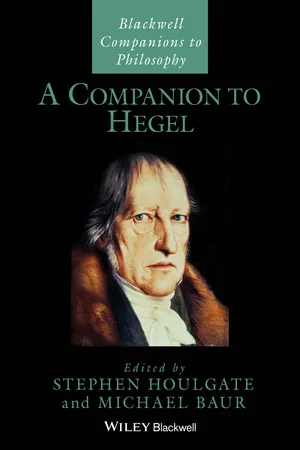
A Companion to Hegel
About this book
This companion provides original, scholarly, and cutting-edge essays that cover the whole range of Hegel's mature thought and his lasting influence.
Information
Part I: Early Writings
1
Religion, Love, and Law: Hegel’s Early Metaphysics of Morals
Hegel’s concern with the moral choices of concretely situated individuals, which was once thought to cast doubt on the very possibility of formulating a Hegelian ethics, is now regularly viewed as the expression of a genuine ethical stance; ‘Hegelian’ has come to mean attentive to the social and political context in which moral agency is exercised.1 So a Hegelian ethics is an ethics that emphasizes context, history, community, and the roles and relations that give substance to our moral life. This is often defined in contrast to the ambition, associated with Kant’s moral philosophy, to provide a metaphysics of morals, to engage, that is, in an abstract interrogation of the a priori possibilities of moral agency. And yet, this is precisely the project that occupies Hegel in the period from the late 1790s to the early 1800s. In these early works, he engages deeply with the problems that arise for moral agency from the incompatibility between the order of reason, which is shaped by laws that give expression to human freedom, and the order of nature, which is shaped by laws of physics that describe the causal relations between natural phenomena.
Hegel’s continuing engagement with the metaphysics of morals is easy to miss because the ostensible themes of his early writings are not in any obvious way ‘moral.’ Among the works discussed here, “The Positivity of the Christian Religion,” the “Love” fragment, and the essay “On the Scientific Treatment of Natural Law,” the first two belong to the so-called ‘theological’ writings and the third addresses a key topic of modern political philosophy.2 The passage from religion to politics is generally seen as marking different stages in Hegel’s ongoing search for a model of a modern ethical community – a modern Sittlichkeit.3 On this reading, the strong bonds and sense of belonging fostered in religious communities explain Hegel’s early interest in religion. If we take a step back, however, to consider the context in which the theological writings took shape, a more complex picture emerges. “The Positivity of the Christian Religion,” given this title by Hegel’s editor, Herman Nohl, was written in 1795 and 1796, with a final part written in 1800 that contains a revision of the original preface. It remained unfinished. The “Love” fragment dates from 1797 to 1798. The dates are significant in situating these pieces in a distinctively German philosophical tradition of religious-theological debate. Appreciating Hegel’s participation in this debate will help with identifying the moral-metaphysical concerns of these early pieces.
The intellectual environment in which Hegel composed these pieces is saturated with debates about the continuing role of religion in human life in light of the aspiration to organize one’s life on rational principles. Fichte’s Attempt at a Critique of All Revelation, at first thought by many to be authored by Kant, appeared anonymously in 1792, and then in Fichte’s name in 1800. Kant’s own Religion Within the Limits of Reason Alone appeared in part in 1792, then fully in 1793, with a revised version coming out the following year. Fichte and Kant follow on the steps of an earlier generation of German Aufklärer who sought to show that religious content can be claimed by enlightened reason and reshaped in accordance with rational moral ideals. The idea that a rationally vindicable human telos is compatible with a divinely commanded one is mainly associated with Lessing.4 He argued that the moral message of revealed religion, laid bare and freed of its external historical manifestations, chiefly its cultic form, is directly accessible by reason; in effect revelation and reason share the same truth. What is left unresolved, however, is what we might call the ‘hermeneutic’ question: how does one identify what is to count as ‘external’? Unless a satisfactory answer can be found to this question – and what may be satisfactory for the philosopher may not be so for the believer – the assurance that religion and reason are compatible will be in vain. A sobering lesson from the history of biblical hermeneutics is that what in each case counts as authoritative interpretation reflects concerns traceable to the context of appropriation of the purportedly authentic message.
It is directly to these difficulties that Hegel addresses himself when at the very beginning of the “Positivity” essay he writes about the different ‘methods’ of treating Christianity and distances himself both from those who submit religion to the test of ‘reason and morality,’ and from those who appeal to the authority of tradition, ‘the wisdom of centuries’ (ETW 67; 152). Hegel can do so because his own approach is primarily diagnostic: he does not set out to defend a particular interpretation of the truth of the religious message; he is interested rather in analysing what is at stake in modern, morally oriented investigations of Christianity. Hegel’s analysis is explicitly located within a post-Kantian moral universe. His aim is to show how, for a modern audience grappling with the compatibility of reason and religion, the life of Jesus and his teaching make vivid key concerns about the nature of moral commands and the way in which these are taken up by finite human agents. Hegel’s guiding insight is that the hermeneutic question, which can be posed with reference to the religious message, can also be posed with reference to the moral law itself: which of our substantive moral commitments genuinely represent the moral law, and which are merely ‘external,’ a matter of habit and conformity to ‘positive’ practices? The question is an urgent one because it concerns the kinds of commands that may legitimately be thought to have authority over us. Allied to this is the problem that the purer our conception of the moral law is, the more difficult it becomes to identify with any certainty any specific duties as authentic expressions of it.
Note that Hegel’s approach to the moral law is indirect: he offers a diagnostic analysis within a religious context of the problems of modern moral metaphysics. That he undertakes this diagnosis within a religious context is not simply a matter of historical accident. Though he certainly shares the view of his contemporaries that religion raises distinctive problems for a purely rational morality, he is also concerned (as we shall see below in Section 1) to identify the brittle points of a conception of agency that takes its law from a transcendent authority. In this part of his argument, his chief interlocutor is not Lessing, but Kant.
Kant’s project of a ‘critique’ of reason, which sets limits to reason’s cognitive power, was taken to caution against rationalist immodesty. On the other hand, in his moral philosophy, Kant insists that reason is sufficient as moral legislator and indeed necessary for the achievement of true morality and the genuine exercise of our freedom. In short, moral agency is a rational agency, and rational agency gives its proper meaning to free agency. God’s existence, though explicitly postulated within the practical sphere, appears to be a matter of subjective need – the need to assure ourselves that the natural universe we inhabit is not hostile to reason’s moral commands, and that happiness is proportionate to morality. Although, as Kant says, this “hope … first arises with religion,” rational morality also has to address this need (Rel 87; VI:131). The need for assurance does not arise only out of a natural human concern with happiness but also out of the desire to view our moral ends as realizable. Kant treats this topic in Religion when he interprets the biblical announcement of the advent of God’s kingdom here on earth in terms of the achievement of an ‘ethico-civil’ union, or an ‘ethical commonwealth’ (ein ethisches gemeines Wesen) (Rel 86; VI:130). What is left out of this hopeful prospect is an account of how nature, which for Kant himself as well as for his naturalistically minded contemporaries is explicable according to its own laws, might be amenable to the demands of a rational morality, which Kant states takes its cue from pure reason alone.5 It is just such an account that Hegel seeks to elaborate in his early works, starting, as we said earlier, with what appears to be the more tractable problem of how a purely rational moral command – the moral law – can find expression in the kinds of practices and substantive commitments that make up the moral world in which we find ourselves.
One of the advantages of foregrounding Hegel’s moral-metaphysical concerns is that it becomes possible to address a cluster of issues that Hegel saw as related: reason in relation to morality, to freedom, and to nature, and the metaphysical and historical conditions for the realization of moral agency. Each of these topics forms a discrete element of a philosophical tradition dominated by Kant, which Hegel inherits and with which he engages critically, but also largely constructively and synthetically. To unpack the cluster, we may start with reason itself. The notion, mainly owed to Kant, that reason is an active determining force in our moral lives means that reasoning is not just a matter of instrumental satisfaction of whatever ends we happen to have, but rather that it can help us identify ends that are morally worthy. Obviously, this process of evaluation of ends would be empty if we were not in position to put into practice what we rationally choose. So, as Kant admits, we need to assume freedom in order to think of rational agency in the first place. But a more interesting conception of freedom emerges from the idea that we are free insofar as we can give rational shape to our lives through the appropriate choice of ends. When it comes to identifying some content as ‘free’ and so as ‘rational’ and ‘moral,’ however, we find that it is easier to provide a negative definition: we are free to the extent that we manage to exclude anything that can appear as given – not only natural inclinations and received opinion but also previously endorsed maxims that are part of our own personal history. The danger with this entirely negative conception of rational freedom is that it commits us to permanent self-testing: nothing is taken on trust, not even our own earlier testimony. Apart from other inconveniences, such as the onset of moral paranoia, this absolutist version of the demand for rational vigilance presents us with the task of identifying what is effectively a philosophical chimera, a self-authenticating insight that is capable of instructing us in a direct and epistemically sound way about what is morally right. Even assuming we had access to such action-guiding intuitions, we would not be able to tell why any specific norm rightly commands assent and is not just a matter of ad hoc conviction. It is important to note that Kant’s test for what can be universalized is in part conceived to free us from such chimerical pursuits. What remains a problem for Hegel is that within the Kantian critical framework, it is difficult to identify with any confidence a specific content – this action, this end – that is rational and free in the requisite sense.
The problem of rational content, as becomes evident already in the “Positivity” essay, is for Hegel symptomatic of the metaphysical gap that separates pure practical reason and nature. One of the ways he formulates this question in “Positivity” is to ask how the deliverances of pure practical reason can be felt in our lives – how we, natural and also socially situated beings, heed reason’s commands. He offers a tentative answer in the “Love” fragment when he entertains the thought that reason can be naturalized, and so not only speak to us through feeling but also be active through our natural desires. The problem with this solution is that the identification of feelings, say love, to explain how it is possible for nature to conform to reason runs the risk of making reason altogether redundant. In a fully closed naturalistic system, it is nature that determines us “to judge as well as to breathe and feel” (Hume 1949:183). Hegel is sufficiently committed to the Kantian (or more generally rationalist) view of reason to be dissatisfied with such an outcome. So although he remains throughout his career sympathetic to various naturalizing options, his chief concern is to show that these are compatible with an emphatic conception of rational agency. As we saw, a key obstacle in thinking about reason’s activity in shaping our ends is a strictly negative notion of rational freedom that remains at a further remove from the actual commitments and actions that make up our moral lives. It is to address this problem that Hegel turns to consider the conception of freedom that must be presupposed for rational agency. This is the topic of the “Natural Law” essay.
Hegel holds that the worldly shape of practical reason is not mysterious; it is the shape of ethical life, Sittlichkeit. What he wants to show is that ‘ethical’ is not just an empty honorific title for events following a natural causal pattern, and that the events that make up a life can be recognized as actions brought about by agents who have both an understanding of their freedom and the capacity to act on such understanding. The “Natural Law” essay is an attempt to show that ethical life – and so human life – is the product of freedom. Of the three works considered here, it is the only one that Hegel prepared for publication. It appeared in consecutive issues of the Critical Journal in 1802 and 1803. Thematically, the essay is situated within the natural law tradition, that is, a tradition of enquiry that seeks to identify the principles of right that should form the basis of legislation, irrespective of whatever ‘positive’ law is in force in particular legislatures. Methodologically, it stands out from other writings of this period because of Hegel’s stated ambition to treat his topic ‘scientifically.’ For Hegel’s readers, this would have signalled the adoption of a mode of argumentation, broadly based on Kant’s transcendental method, where the emphasis is placed on the a priori deduction of the philosophical concepts applicable to the problem at hand.6 The essay contains a highly abstract, almost geometrical treatment of empirical natural law theories followed by a discussion of the practical philosophies of Kant and Fichte, and a lengthy analysis of ethical life. Hegel’s account of ethical life, ‘deduced’ a priori from the notion of freedom, represents at once a synthesis of freedom and nature, and, significantly, an explicit acknowledgment of a necessary gap between the two. This acknowledgment suggests that there is no further to go with the metaphysical investigation of the problem of agency. The “Natural Law” essay can be seen then as completing the philosophical task that Hegel sets himself in these early works, namely to offer a metaphysics of morals by describing the utmost bounds of this type of analysis.
Though written at different periods of Hegel’s early development, coinciding with his stay in Berne (1793–1796), Frankfurt (1797–1800), and Jena (1801–1807), these three pieces show a consistent preoccupation with the fundamental possibilities of human agency. They also display a degree of philosophical experimentation that is not often associated with Hegel. Accordingly, the aim of the present chapter is to show the philosophical openness of the early works, their deep engagement with moral-metaphysical questions, and to identify the elements of a philosophical propaedeutic that although situated outside Hegel’s system, nonetheless informs the ‘Hegelian’ ethics of the mature philosophy.
1. Religion: A Moral-Metaphysical Interpretation of ‘Positivity’
“The aim and essence of all true religion, our religion included,” Hegel states, “is human morality” (ETW 68; 153). The claim that religious teaching is in its essence moral teaching seems to follow on the tradition of Lessing’s and Kant’s writings on religion. But there is something new here. The key term is ‘human morality.’ Hegel asserts that when it comes to appraising the ‘worth’ and ‘sanctity’ of religious prescriptions with respect to obligations, we have a ‘measure’: human morality (ETW 6...
Table of contents
- Cover
- Blackwell Companions to Philosophy
- Title page
- Copyright page
- Notes on Contributors
- Chronology of Hegel’s Life and Work
- G.W.F. Hegel: An Introduction to His Life and Thought
- Part I: Early Writings
- Part II: Phenomenology of Spirit
- Part III: Logic
- Part IV: Philosophy of Nature
- Part V: Philosophy of Subjective Spirit
- Part VI: Philosophy of Right
- Part VII: Philosophy of History
- Part VIII: Aesthetics
- Part IX: Philosophy of Religion
- Part X: History of Philosophy
- Part XI: Hegel and Post-Hegelian Thought
- Index
- Blackwell Companions to Philosophy
Trusted by 375,005 students
Access to over 1.5 million titles for a fair monthly price.
Study more efficiently using our study tools.
Frequently asked questions
Yes, you can cancel anytime from the Subscription tab in your account settings on the Perlego website. Your subscription will stay active until the end of your current billing period. Learn how to cancel your subscription
No, books cannot be downloaded as external files, such as PDFs, for use outside of Perlego. However, you can download books within the Perlego app for offline reading on mobile or tablet. Learn how to download books offline
Perlego offers two plans: Essential and Complete
- Essential is ideal for learners and professionals who enjoy exploring a wide range of subjects. Access the Essential Library with 800,000+ trusted titles and best-sellers across business, personal growth, and the humanities. Includes unlimited reading time and Standard Read Aloud voice.
- Complete: Perfect for advanced learners and researchers needing full, unrestricted access. Unlock 1.5M+ books across hundreds of subjects, including academic and specialized titles. The Complete Plan also includes advanced features like Premium Read Aloud and Research Assistant.
We are an online textbook subscription service, where you can get access to an entire online library for less than the price of a single book per month. With over 1.5 million books across 990+ topics, we’ve got you covered! Learn about our mission
Look out for the read-aloud symbol on your next book to see if you can listen to it. The read-aloud tool reads text aloud for you, highlighting the text as it is being read. You can pause it, speed it up and slow it down. Learn more about Read Aloud
Yes! You can use the Perlego app on both iOS and Android devices to read anytime, anywhere — even offline. Perfect for commutes or when you’re on the go.
Please note we cannot support devices running on iOS 13 and Android 7 or earlier. Learn more about using the app
Please note we cannot support devices running on iOS 13 and Android 7 or earlier. Learn more about using the app
Yes, you can access A Companion to Hegel by Stephen Houlgate, Michael Baur, Stephen Houlgate,Michael Baur in PDF and/or ePUB format, as well as other popular books in Philosophy & Philosophy History & Theory. We have over 1.5 million books available in our catalogue for you to explore.