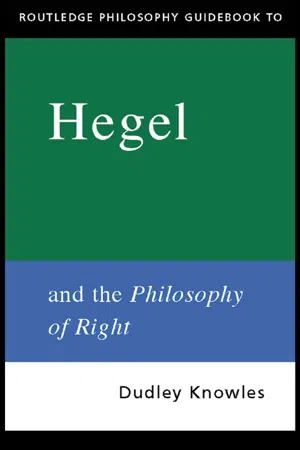
Hegel is one of the most important figures in the history of ideas and political thought. His Philosophy of Right is widely recognised as one of the greatest works of political philosophy.
Hegel and the Philosophy of Right introduces and assesses:
* Hegel's life and the background of the Philosophy of Right
* The ideas and text of the Philosophy of Right
* The continuing importance of Hegel's work to philosophy and political thought.
- 400 pages
- English
- ePUB (mobile friendly)
- Available on iOS & Android
eBook - ePub
Routledge Philosophy GuideBook to Hegel and the Philosophy of Right
About this book
Information
Chapter 1
Hegel’s life, work and influence
Life
Georg Wilhelm Friedrich Hegel was born in Stuttgart in August 1770, the eldest of three surviving children. His father, Georg Ludwig Hegel, was a minor civil servant at the court of the Duchy of Württemberg. He was an intelligent and studious child, but never docile. At 14 he went to the Stuttgarter Gymnasium, where he encountered Enlightenment ideas, reading Rousseau (at first or second hand), Adam Smith (in translation), and Lessing, who influenced his recorded aspiration to become a man of letters, a popular educator. From the Gymnasium he advanced in 1788 to the Tübingen Stift, a Protestant seminary designed to qualify students as pastors in the Lutheran Church. By an extraordinary coincidence he found himself in the same class as Friedrich Hölderlin, who would become one of the finest German poets. In 1790 these two close friends found another fellow philosophical spirit in the person of Friedrich Wilhelm Joseph von Schelling, all three sharing a room and nursing disgruntlements against the old-fashioned studies and regime of the Stift, which they believed to embody the reactionary, claustrophobic spirit of old-fashioned Württemberg. Jointly they followed the events of the French Revolution and enthused over the victories of the revolutionary army against the forces of the Hapsburg Empire.
The three friends had plenty to talk about other than their studies. Believing as so many great thinkers have done that they lived in an age of transition, they speculated on what form the new world should take. In particular, they derived from Rousseau and Lessing a concern to identify the spiritual contours of the society that would emerge from the revolutionary turmoil, and under the influence of Hölderlin in particular, they looked backwards to an idealized conception of ancient Greece as a world of beauty and harmony and forward to a society that could accommodate the revolutionary aspiration to freedom. Hostile to the orthodox Christianity drummed into them at the Seminary (and no doubt regurgitated in their successful examination performances) the three friends were entranced by Jacobi’s critical revelation of Lessing’s alleged Spinozistic pantheism. From these controversies Hegel was to develop an early preoccupation with the form of religion or spirituality that would serve as the lifeblood of the emergent new civilization. Though fascinated by the political developments of their age, their response was that of rarefied spiritual analysis as much as close political study and debate.
The group split at the end of their studies in Tübingen. In 1793 both Hegel and Hölderlin took up positions as house tutors, Hegel moving to Berne, Hölderlin moving to Waltershausen, Jena and Weimar before settling in Frankfurt where Hegel was to join him in 1797. By the time Hegel arrived in Frankfurt his ambitions had crystallized. He no longer aspired to be a man of letters, influencing events through the plausibility and cogency of his understanding of modern religion and current affairs, and by writing articles and pamphlets. He had decided to be an academic philosopher (and unfortunately took this to mean that henceforth he had to speak a different language in his writing from that which he used with his wine-merchants and whist partners). Prompted by Hölderlin, who in these early years was approaching the height of his poetical achievement, Hegel perceived, but darkly, the truth of a variety of absolute idealism, which for the while aligned itself with the work of Schelling, but in historical terms advanced the trajectory of Kant’s and Fichte’s idealism.
In 1801 this strong commitment to academia induced him to follow Schelling (already an established professor) to Jena, to a post as Privatdozent, a (virtually unpaid) tutorial assistant – plus ça change. Jena at that time must have been a dazzling university community, strongly research orientated, with celebrity professors, and in consequence, students flocking in. Unfortunately, shortly after or just before Hegel arrived most of Jena’s academic stars left. Schelling, his youthful friend, and latterly patron, departed for Würzburg in 1803 in the wake of a sex scandal. So Hegel found himself as isolated as before. Hegel stayed in Jena until 1807 – never finding a fully paid, permanent position – spinning out a legacy and applying for jobs all over the place, even claiming the ability to teach botany when a job turned up. He did good philosophical work, first in Schelling’s orbit as author of a text describing The Difference between Fichte’s and Schelling’s Systems of Philosophy (1801), next as co-editor of, and contributor to, the Critical Journal of Philosophy (1802–3). In these capacities Hegel published in 1802–3 his essay on Natural Law – ‘On the Scientific Ways of Treating Natural Law, on its Place in Practical Philosophy, and its Relation to the Positive Sciences of Right’ (PW: 102–80 / SW 1: 435–537). In this important early work Hegel introduces criticisms of ‘individualist’ normative ethics, notably social contract theories of the state and Kantian ethics, which he kept in place for the rest of his intellectual life, and which he would redeploy in the Philosophy of Right. Then, wonderfully, following Schelling’s departure, he completed The Phenomenology of Spirit (1806–7).
Hegel’s commitment to an academic career had not diminished his interest in ethical and political affairs and in the Phenomenology he introduced readers to the domain of Geist or spirit, encountered first in the chapter on self-consciousness as the development of social-cum-psychological structures which enhance self-understanding through creating the necessity for mutual recognition. This process, partly historical, partly analytical, includes the celebrated section on ‘Master and Slave’. Two further quasi-narratives follow. In the chapter on ‘Reason’ Hegel explores man’s attempt to employ reason in the quest to understand both the natural world and the moral rules governing our behaviour. In so far as this is a project engaged by individual seekers after truth, epitomized in Kant’s attempt to display how a conception of one’s own rational agency can be quarried to yield the truths of morality, it must fail. Self-consciousness is shown to be an intersubjective phenomenon in the chapter on ‘Spirit’ and again it is explained as a historical formation. Beginning with the tragic conflict of family, religious and political allegiances revealed in Sophocles’s Antigone, Hegel quickly traverses the Roman world and pre-Reformation Christianity to take up the story of the development of spirit in modern Europe. Once again it is a story of conflict and failure as forms of social life are shown to be inadequately structured to permit modern persons to feel at home in their ethical surroundings. Political absolutism corrupts those who collude in its aristocratic rigmaroles. The opposing eighteenth-century projects of ‘Enlightenment’ and ‘Faith’ ensure that neither the party of scepticism nor the proponents of genuine religious feeling can give a satisfying account of the modern temper. The revolutionary aspiration to freedom ends in the horror of the Terror period of the French Revolution. Neither Romanticism, nor Kantian moral self-legislation, nor the Rousseauian retreat of the conscientious ‘beautiful soul’ can heal the divisions in the modern soul and the modern nation-state.
Having disclosed the disastrous spiritual condition of the modern world, Hegel identifies religion and philosophy as the successively more adequate resources to reintegrate our fragmented personalities and shattered social structures. They offer first a glimpse, then a certainty, that man’s attempt to comprehend himself, the natural world in which he is located, and the social world to which he must accommodate himself, can finally be successful.
Hegel could not have been satisfied with many elements of the Phenomenology.1 It was a major victory that, after years of intellectual struggle, it finally saw the light of day in print. It provided the opportunity for him to map out the contours of his mature philosophical doctrines, but in the books to follow, many of these would have to be reworked. In the particular sphere of social and political philosophy it is primarily a critical text. History has bequeathed us a legacy of muddled insight and partial truth which reveal that we are living on the cusp of a new rational world. Hegel clearly needed to take himself back to the drawing board before he could portray the modern state as a rational structure which permits self-identification and mutual recognition, which does justice to man’s aspiration to freedom in a social world from which there is no escape.
In March 1807, a month after his landlady in Jena had given birth to his illegitimate child and a month before publication of the Phenomenology, Hegel took up a post in Bamberg as editor of a daily newspaper, the Bamberger Zeitung. He clearly enjoyed the immersion in current affairs, but after less than two years in the post he chose to return to education, not as a university teacher, but as rector of the Gymnasium in Nuremberg. His friend Niethammer, the commissioner for education in Bavaria, engaged Hegel as a pioneering educationalist, trusting him to deliver the reforms he had been devising. In addition to general administration, Hegel was to be principal teacher of philosophy, charged with introducing pupils to speculative philosophy (a subject he was later to judge to be too difficult for schoolchildren). In this role he prepared for his pupils The Philosophical Propaedeutik designed to cover in elementary fashion central doctrines in his philosophy (PP). In Nuremberg Hegel married and settled down to a stable, well-respected position in the community. He took his professional duties seriously and found time to carry forward his philosophical work, publishing the Science of Logic in three volumes (1812–16).
He stayed nearly eight years in Nuremberg, gaining his first fully professional university post as professor in Heidelberg in 1816. A year later he published the Encyclopaedia of the Philosophical Sciences as a handbook to accompany his lectures. Following the format he had introduced for his teaching materials in Nuremberg, this book is a series of numbered paragraphs, often expanded with exegetical notes (Remarks), which he spoke about in his lectures. (Given his lame, stumbling performances in the lecture theatre, these must have been of considerable assistance to his students. More useful still must have been his extempore comments, which were written up by the students and are nowadays published alongside the text.) Hegel was to retain this format three years later in the Philosophy of Right.
It makes for an astonishing stylistic performance. In the main paragraphs Hegel demonstrates that he has mastered the canonical professional voice of the philosopher, first sanctified by Kant, then developed by Fichte and Schelling. This requires that argument be radically compressed, the chief instrument of compression being the severe weight of jargon introduced into the discipline. This makes for density and obscurity. It gives the appearance of science and systematicity, whilst fostering ambiguity and equivocation. In suggesting that true philosophy needs to speak in its own voice, it has been a professional disaster in eliciting the complicity of readers in a love of arcana. Mercifully, and contrary to the implicit judgement that this severe and forbidding voice is absolutely necessary for obiter dicta at the cutting edge of philosophy, the Remarks (and in most editions, the interpolated lecture notes compiled by students – Zusätze: Additions) amplify and clarify the main text. The effect is to give the Encyclopaedia and the Philosophy of Right a multiple stylistic personality, reading sometimes as impenetrable cant, sometimes as careful philosophical argumentation, and sometimes even as crisp journalistic prose.
Hegel moved on quickly from Heidelberg to the philosophy chair in Berlin (1818), though not before he had given the first version of the lectures that were to be written up as the Philosophy of Right (VPR 17). Arguably, for the first time in Hegel’s writings, questions of life and work get entangled in the specific sense that scholars have forced us to take a view on how far Hegel’s responses to the immediate political issues of his day dictated the content (and hence settle the interpretation) of his published writings. In a broad sense, this was always true. Hegel was proud to be identified as one of the generation of the French Revolution, in much the same sentimental way that I might claim to be a child of the 1960s. Hegel remembered (and celebrated) the fall of the Bastille in 1789 just as I bore my children with tales of Grosvenor Square and demonstrations against the US war in Vietnam. He was appalled by Robespierre’s Terror (1792–3), but for years had a rose-tinted view of Napoleon as the sweeper-clean of anachronistic institutions, imposing rational norms on the antiquated social and political structures of those portions of Europe that had the good fortune to be conquered by the French armies.
Prussia was one of the German states that had been set on the track of reform during the Napoleonic era. Ancient privileges were to be swept away in the service of administrative and economic efficiency. Bowing to the spirit of the times, the king, in 1812, had promised a constitution which, though neither democratic nor republican, would acknowledge and regulate competing claims to power in a manner that, he and his ministers trusted, would enlist the willing allegiance of all sectors of the community to the central authority. Hegel was naturally sympathetic to these reformist aspirations as the legacy of Napoleonic rationality. Following the final defeat of Napoleon in 1815, the programme of reform slowed down. Metternich’s influence at the Congress of Vienna sanctioned the assertion of the old particular interests of ancien régime German states which would be compromised by any explicit constitution. Nonetheless the times were not right for a forceful reclamation of any ancient local privileges which would disempower those elements of the middle classes who were attracted by the Napoleonic ideal of the career open to talents in business or in government.
Repression needed the excuse of an incipient breakdown of law and order before it could take off the velvet gloves. As ever, the occasion was provided by the spectacular revolutionary act of a soft-brained youth. In March 1819 a radical student, Karl Sand, assassinated the reactionary playwright August von Kotzebue. The spectre of revolutionary anarchy was raised. Sand was convicted and executed, and the hunt was on for revolutionary ‘demagogues’. (Plato’s equation of democracy and demagoguery has been a constant of anti-democratic political rhetoric since fourth-century BCE Athens.) In the second half of the twentieth century mankind became used to student revolt. This has been the inevitable result of structural confrontations within modern states that both require a cadre of educated specialists, motivated by the ideal of the career open to talents, if they are to keep up with the technological advances of economic competitors, and which yet retain a regime of inherited privilege wishing to reserve the political fruit of any technological and administrative advances for themselves. I guess (not being a historian) that Prussia, just at the time that Hegel arrived in Berlin to advance his academic career in the glow of unpressured success, was the first nation to identify the modern university as a crucial site of social instability. This was most unfortunate.
That Sand was a student, that ‘Jacobin’ students were organizing their subversive activities in Burschenschaften (student societies distinguished for their drinking exploits as much as for their political agendas), focussed the attention of the political authorities on the universities as the source of political turmoil. Reaction throughout Germany was swift. The Carlsbad decrees of 1819, devised by Metternich and accepted by the King of Prussia with little reluctance, struck directly at the universities of Germany as the sources of subversion. Amongst other measures, they made direct provision for the dismissal of any university teachers who engaged in subversive activities and forbad their reinstatement in other universities.
Hegel was undoubtedly very anxious. A student of his (Asverus) was arrested, fellow-teachers in Berlin were under suspicion, one of them (the theologian de Wette) was dismissed. Hegel himself was having difficulty appointing a teaching assistant, since his nominee (Carové) was ideologically suspect. Hegel could have taken the view that the government repression was excessive, serving to thwart justified reform in the interest of reactionary forces. But it seems he did not. Instead he held Fries and his acolytes (including de Wette) responsible for stirring up student passions and provoking the severe reaction of the state. Jacob Friedrich Fries (1773–1843) was an old philosophical rival, a critic of Hegel’s work and previously a (successful) competitor for academic jobs. Hegel attacks him directly in the Preface to the Philosophy of Right and concludes that the government is quite right to investigate the content of these subversive philosophical doctrines.
These principles identify what is right with subjective ends and opinions, with subjective feeling and particular conviction, and they lead to the destruction of inner ethics and the upright conscience, of love and right among private persons, as well as the destruction of public order and the laws of the state.
(PR: 17/21–2)
If a philosophy leads in this direction – the destruction of public order – no wonder that the state will suppress it.
The explicitness of Hegel’s attacks on his contemporaries (who were being investigated and fired from their posts), together with fawning remarks about the patronage of the state for philosophy, led many contemporary readers of the Philosophy of Right to denounce it as a reactionary tract, serving the private ends of its author and the public policy of a reactionary regime. Hegel’s denunciations in the Preface are clear and explicit to the point that no-one should suppose that the rational state will provide any protection for academic freedom. Any self-respecting philosopher will shiver at Hegel’s defence of a close state scrutiny of the philosophical doctrines taught in the university. Whatever his private views of Fries or his professional views of Fries’s work in philosophy, nothing can excuse this self-serving public comment. And note: it is written in the lively, direct prose of the engaged journalist; it is not concealed in the jargon of technical philosophy. It is up front, making Hegel’s allegiances clear to the censor who will not read beyond the first pages of the book. It is exactly what it was intended to be: a statement that makes clear Hegel’s position on the burning political issue of the day, a statement which tells readers what view those who share his philosophical commitments should take on the state repression which was being conducted as the Philosophy of Right was being seen through the press.2
How do these dismal facts affect our reading of the Philosophy of Right? The crucial questions concern the charges of conservatism and authoritarianism that have been brought against it. The doctrine of the Philosophy of Right is conservative if it ascribes normative force to the status quo, if the fact that certain institutions are in place serves to justify those institutions and derogate prescriptions for reform and commands as to how things ‘ought to be’. Conservatism of this stripe is a philosophical position; it is conservatism with a small ‘c’ and it has nothing to do with the doctrines of the Conservative Party or any such political allegiance. As we shall see in Chapter 3, there are good reasons for ascribing this variety of conservatism to Hegel and there are als...
Table of contents
- Cover Page
- Title Page
- Copyright Page
- Preface
- Abbreviations
- Chapter 1: Hegel’s Life, Work and Influence
- Chapter 2: The Introduction to the Philosophy of Right
- Chapter 3: Hegel’s Preface
- Chapter 4: Abstract Right 1. Persons and Their Rights: §§34–43
- Chapter 5: Abstract Right 2. Property and Contract: §§44–81
- Chapter 6: Abstract Right 3. Wrongdoing and Punishment: §§82–104
- Chapter 7: Morality 1. Hegel’s Philosophy of Action and Moral Psychology: §§105–28
- Chapter 8: Morality 2. The Good: §§129–41
- Chapter 9: The Concept of Ethical Life: §§142–57
- Chapter 10: The Family: §§158–81
- Chapter 11: Civil Society 1: The System of Needs and the Administration of Justice: §§182–229
- Chapter 12: Civil Society 2. The Police and the Corporations: §§230–56
- Chapter 13: The State: §§257–360
- Notes
- Further Reading
- Bibliography
Trusted by 375,005 students
Access to over 1.5 million titles for a fair monthly price.
Study more efficiently using our study tools.
Frequently asked questions
Yes, you can cancel anytime from the Subscription tab in your account settings on the Perlego website. Your subscription will stay active until the end of your current billing period. Learn how to cancel your subscription
No, books cannot be downloaded as external files, such as PDFs, for use outside of Perlego. However, you can download books within the Perlego app for offline reading on mobile or tablet. Learn how to download books offline
Perlego offers two plans: Essential and Complete
- Essential is ideal for learners and professionals who enjoy exploring a wide range of subjects. Access the Essential Library with 800,000+ trusted titles and best-sellers across business, personal growth, and the humanities. Includes unlimited reading time and Standard Read Aloud voice.
- Complete: Perfect for advanced learners and researchers needing full, unrestricted access. Unlock 1.5M+ books across hundreds of subjects, including academic and specialized titles. The Complete Plan also includes advanced features like Premium Read Aloud and Research Assistant.
We are an online textbook subscription service, where you can get access to an entire online library for less than the price of a single book per month. With over 1.5 million books across 990+ topics, we’ve got you covered! Learn about our mission
Look out for the read-aloud symbol on your next book to see if you can listen to it. The read-aloud tool reads text aloud for you, highlighting the text as it is being read. You can pause it, speed it up and slow it down. Learn more about Read Aloud
Yes! You can use the Perlego app on both iOS and Android devices to read anytime, anywhere — even offline. Perfect for commutes or when you’re on the go.
Please note we cannot support devices running on iOS 13 and Android 7 or earlier. Learn more about using the app
Please note we cannot support devices running on iOS 13 and Android 7 or earlier. Learn more about using the app
Yes, you can access Routledge Philosophy GuideBook to Hegel and the Philosophy of Right by Dudley Knowles in PDF and/or ePUB format, as well as other popular books in Philosophy & Modern Philosophy. We have over 1.5 million books available in our catalogue for you to explore.