![]()
Why “Buy Now”?
When choosing a name for this book it was important for us to grab your attention and communicate to you two things: One, you have a strong need for something. Two, we can fulfill it. That’s a hard thing to do in the brevity of a book cover, yet you did pick up the book with some degree of interest. We would like to think that we stacked the deck a little in our favor to get you to take that action. We did, in fact. In the context of this book, we’ll tell you how and why; better, we’ll teach you how to do it.
Understand that we are interested in your success. Most folks want to hold something that is uniquely theirs alone, a secret. We don’t have a secret. The fact is, there is not one; there are many. What this book will give you is the ingredients; the secret ingredients, if you will. Every single person who has used these secrets has gained some measure of success. The key is not in the ingredients as much as in the cook. Certainly, the ingredients count; you, in fact, cannot make a success in this business without them. When you personally apply them, you bring the largest unknown quantity to the mix: the genius that is you.
This much we can tell you for sure. Direct marketing is a humbling experience. We highly recommend you bring a fair share of humility to it, or the business will provide it for you. The encouraging news is that all you need is just one hit. One at bat where you connect, and you can have the opportunity to be financially set for life—if you stay smart and keep your head in the game.
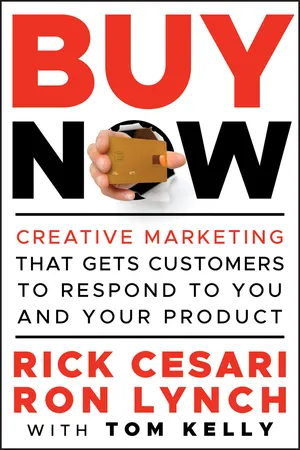
Now, why Buy Now as the title? First, it’s a command. Not a suggestion, not an insinuation, but a real command that grabs you by the collar and tells you what to do. Does it make you buy? No. Did it make you pay attention? Absolutely! Did we choose an image of a hand with a credit card to give you the notion that there was something in it for you financially? Certainly. Why did we choose a gold card? Why the bold, open-block red font? Were these all just happenstance created by the book’s publisher? Not a chance. That’s just one aspect of what you’ll learn in this book: how to think at a level of marketing detail that will enable you to weave such a complex web that, in the end, looks beautiful and works so simply. Like in the fairy tale “Hansel and Gretel,” our goal as marketers is to lay the breadcrumbs that lead you and your customer home.
Remember, the average American is blasted by tens of thousands of marketing messages a day. How do you grab their attention, engage them with interest, and begin a meaningful sales dialogue in just seconds? It’s possible. We do it all the time. Frankly, you probably experience it all the time and don’t realize it; you just become interested. You are drawn in.
The Direct Response Solution
We are routinely approached these days by large American corporations that are looking for our expertise and guidance to help them clear one of two primary hurdles. They want to either launch a new brand or revive a quality product that has dying sales caused by lack of attention or shelf crowding. Both are attainable through our methodology. Why the new interest in direct response? The answer is probably driven from a number of directions, but the easiest and most obvious one is the absolutely brutal environment out there for consumer dollars. The economy has tanked, and consumers have closed their wallets. Manufacturers are in a spin, not just to grow sales but to minimize shrinking sales as fast as they can. Stockholders are putting knives to the necks of CEOs, who are no doubt living in fear. The shift that you may not have noticed in the past decade is that “CEO” does not mean what it used to.
Once upon a time, the CEO was royalty, walking through the halls of his or her company like a god or Godzilla, leaving a trail of either bowing subjects or destruction behind. Today’s CEO most likely is not the person who started the company, nor even the person hired by the company. More often today, the CEO is the person hired by the conglomerate consolidator or the venture fund that bought the company, in the hopes of reselling it to the next-highest bidder. That is the ill of the American corporation. The most senior plant manager, executive secretary, or marketing director usually has a greater idea of the lifeblood of a company than the well-educated Columbia grad who is now saddled with title of CEO and the blame for shrinking sales in a shriveling economy. If you are running a company in which you did not rise to the top organically, you shouldn’t do a thing until you spend a week working in every department at the level at which you can do the work. Get trained in the business before you try to run the business.
Whom does the CEO traditionally turn to when sales need to increase? The chief marketing officer (CMO), who has an acute interest in saving his or her own skin. Blame the sales on the sales guy; and don’t forget to cut his or her marketing budget and tell staff they are now accountable for every penny. Sounds dumb, but people do it all the time.
That’s where we come in. One way or another, dozens of companies show up every year at our office wanting to talk about this mysterious form of advertising that allows you to directly measure sales against advertising spend. Understand, direct response marketing is not taught as a major at any university in the world. Most don’t have a single class in it. All of the true experts in the field you can count on your two hands. The truly unusual fact is that direct response is one of the oldest and most perseverant forms of marketing in the history of the United States, and probably the world.
Carnival Beginnings
Now, you may know a man named Mel Arthur, he is the face and voice of the Internet phone connection device MagicJack. This is not Mel’s first rodeo. He has been around the pitch business for years and has had great success on the shopping networks. Ron met him one afternoon while directing a show called the “FlavorWave Oven,” in which Mel’s company had an interest. He relayed a story on how he got started in the business as a kid. Mel, Ron Popeil, Arthur Morris, and a guy named Charles Bronson—yes, that Charles Bronson—used to go down to the Atlantic City Pier as kids, and one of their fathers (which one escapes me) would pick up cases of product that these 10- to 15-year-olds, would sell on the boardwalk all summer long. One day it would be flatware, the next day cigars, linens, handbags, kitchen knives, or beauty cream. You name it, these kids were direct-marketing it. Mel relayed that the joy he has always had from this business is in the connection with his customers. Dating back to those Atlantic City days, where he’d get return customers who were happy with the last product and engaged by his entertaining pitch style, and who looked forward to his next product. Mel really shared the joy of selling—giving people a good value on a product that would help them solve a real problem in their lives.
Something clicked. I recalled my college days of being a lifeguard on the Florida beaches. I got so bored, and wanted to talk to the girls, so I started selling suntan lotions. It was really simple. People on the beach all had the same problem and didn’t know it. They were at risk of getting sunburn, and hurt, and I was pointing out the problem, offering them a really good solution, creating a transaction that made me money and helped them at the same time. In that quick flashback, I realized that Ron, Mel Arthur, and I shared a certain DNA that all natural salespeople have, one that makes us a little different from the rest of the world. We know in our core that selling is good. Selling helps people. People are grateful to be sold something they truly want and need. Unlock this door in your mind and you will sell more, sell better, and care about the people you are selling to.
Why Direct Response?
The question of whether direct response is a valid form of marketing and launch vehicle is fair.
We’ve sat in hundreds of focus groups and asked thousands of consumers what they think of infomercials. They are, at best, bemused by them; at worst, they are hostile, even volatile about the style and tone that the word “infomercial” connotes. We understand; we still have successful clients to this day who resist the word “infomercial.”
Ask the next question and you will find that about 90 percent of the exact same consumer group have called the number on the screen; they’ve even purchased. Most, more than once. Many don’t even realize they have until pressed. Dig deeper and they will tell you that not only were they compelled, most felt they made an informed buying decision and were ultimately satisfied with the product. Why? They discovered through the program that they needed it.
Do you see it? All marketing is bad—unless, of course, it is for something I want and need.
What, after all, is an infomercial? It’s really an entertaining seminar directed at a specific demographic segment that has a common set of problems. The seminar offers an explanation of an innovative solution and an opportunity to participate in trying that solution. In it, you learn the details of the innovation, and typically hear from the experts who created it, the outside experts who endorse it, and long-term and new users who rely on it. Infomercials come in primarily one length: the half-hour show; 28:30, to be exact, is the most prevalent. The offshoot of the half-hour is the 2-minute, 1-minute, and, now, 30-second spots. In the industry, these are referred to as “short forms.”
Do you own a George Foreman Grill? Have you brightened your laundry with OxiClean? Gotten a better dental checkup with your Sonicare toothbrush? Or rented a Rug Doctor to clean your carpets? You are an infomercial customer. If you have considered yourself a potential customer for Viagra, Cialis, eHarmony, Overstock.com, GEICO, FreeCreditReport.com, TD AMERITRADE, or even ordered a pizza over the phone, you’ve been touched by our industry. Even if you tried only one of these products after seeing it in retail, you’ve participated in the most powerful marketing model ever created.
We are not pet rocks. As an industry with a reputation for cheesy products, slimy hosts, and phony testimonials, our industry has consistently bounced back with reputable products, quality brands, and truth-in-advertising. If you think infomercials are just for shoddy start-up gadgets or stand-alone companies that operate in the dark, think again. Hewlett-Packard, Nintendo, Range Rover, Johnson & Johnson, Microsoft, Kodak, and many more blue-chip organizations are turning to the direct response sales model because it is respected by the consumer and is an efficient and consistent form of detailed messaging; most importantly, it can be very profitable while building the brand.
This need to explain complex products in pragmatic ways has been utilized over and over, with great results by others, including Apple, Thermos, and Carnival Cruise Lines. We even saw Barack Obama create unique infomercials during the 2008 political season in an attempt to gain ground against opponents. Obama went as far to have his dubbed into Spanish to make sure he had reached a voter segment whose support he felt he needed to win. Apparently, it worked.
Today, our direct response economic model magic resides in the fact that we often, initially, can swim against the tide of brick-and-mortar retail sales. That is, if you stop and think how many hands, loading docks, distributors, freight companies, sales associates, and retailers most products pass through to get to your hands, you will be amazed. Now add an incremental cost to each step in the process; then you get to the retailer and the keystone (double the wholesale cost as the price to the consumer) to compensate for having sale merchandise at the end of the cycle. You can start to see how much of what you pay for in a product is not the product but the process.
We recapture the money spent on traditional supply chain retail economics and use the huge gap between manufacturer and consumer to buy airtime and bundle products with offers retailers generally can’t touch. We deliver in a drop-ship fashion. It’s basically a better deal for the house and a better deal for the consumer, and they both know it. In fact, there’s an ever growing subculture of consumers worldwide who fuel our industry because they have learned the value over time.
This has not gone unnoticed by more and more companies in the past decade. Before we go deeper, it’s important to stop and take a closer look at the myths that surround marketing and sales.
Often, the advertising world and the art world overlap. The personalities that are drawn to filmmaking, writing, fine arts, costuming, theater, makeup, producing, writing, and performance are frequently mixed in our medium. I often hear what I will call “art snobs” say things like, “I don’t watch TV; I only watch PBS or National Geographic.” I have to laugh: The last time I checked, those were on TV! We have even worked with TV producers who were passionately excited to tell us they did not own a television. This is similar to a homebuilder saying he doesn’t have a hammer. I once saw a bumper sticker that read: “Theater is life. Film is art. Television is furniture.” What a load of garbage!
Television is the form of communication that has universally changed the human experience faster and more powerfully than any technology before it. It is the definitive educational and social difference that has made the baby boomer generation the most important segmentation of consumers for 50 years running. We witness real human events live. Invasions, rescues, police chases, and celebrity revelations connect us emotionally as we learn the dynamic subtleties of the entire planet from the comfort of our living rooms, our boats, RVs, or streaming on our phones. We cry. We laugh. We become enraged. We connect. Alone in our homes, in the dark, we connect. You name it, we watch it.
We went to a Dallas Cowboys game earlier this year and were amazed at the enormous television suspended from the ceiling. More amazing was witnessing how many people sitting in a stadium of 80,000 unconsciously devoted the majority of their attention to watching the jumbo screen, instead of the live game going on below it.
We as American consumers are professional television viewers. We are adept, and good at it. Because of TV we have all become incredible experts at the subtle detection of truth versus fiction. Before we go further, though, we want to expose some of the social fiction that surrounds the topic of advertising, sales, and marketing. Like saying “I don’t watch television,” here are some other basic myths we tell ourselves, and too often believe.
Liar, Liar, Pants on Fire
Myth 1: Advertising is a method of getting people to purchase things they do not want or need.
Truth: Humans want and need products and services. It is a very basic human drive, the “tool making” and “gathering” of our ancestors that ensure we are always on the lookout for something external to our being that will help us live better, happier lives. Filtering, assessing, and acquisition are unavoidable human instincts, which are good. Being consumers in the prehistoric sense is what prevented us from being consumed in the literal sense. But not all people need every product.
Most advertisers work diligently to make people aware of their products. Often highly stylized, oversexed, and abundant in fluff is the narrow scope of advertising that jumps to our consciousness when we hear the word “advertising,” mainly because that powerful imagery works to leave an impression. The fact is, most advertising is ineffective, goes unnoticed, and is lacking in creativity. Our storage sensors instantly reject most because it’s not speaking “to us.”
Direct response has the constant, unique element of almost always pointing out a problem or a need, which the product aims to resolve for you personally. It’s the very posing of the question or the problem that opens your mind to the question, “Are they talking to me?” The very direct nature is actually beneficial for the audience and helps us achieve success in particular avenues of media. You can target media to ask the right question to the right group of customers to get them engaged.
Myth 2: People who are selling are doing us a disservice.
Truth: “Salespeople” are generally good. Doesn’t mean you want to have holiday meals with them, but a good salesperson listens and facilitates an even-handed buying decision on your part. They are doing you a service.
We have all purchased something—you probably did today—that made you feel good. You might feel better about yourself in the right article of clothing; see yourself as a good negotiator because you got a great deal; or believed you finally discovered the perfect electronics item with all the bells and whistles, constructed in a sleek, user-friendly, modern way. Provided he or she was courteous, the person (or entity) who led you to that proud purchase is most likely someone you appreciated at some level.
Bad salespeople exist. So what? So do bad singers. Move on.
Myth 3: Products advertised through infomercials are junk.
Truth: Most infomercials you see consistently are only on air because they are successfully selling to satisfied customers. The more identified the maker of the product, the higher your chances of having a successful experience. Known brand makers rely on direct response primarily to describe the value of products that can’t be full...