- Features original chapters contributed by an international cast of leading and emerging sociology scholars
- Represents the most innovative and 'state-of-the-art' thinking about the discipline
- Includes a general introduction and section introductions with chapters summaries by the editor
- English
- ePUB (mobile friendly)
- Available on iOS & Android
eBook - ePub
The Wiley-Blackwell Companion to Sociology
About this book
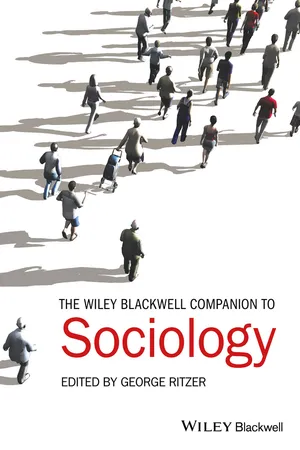
Featuring a collection of original chapters by leading and emerging scholars, The Wiley-Blackwell Companion to Sociology presents a comprehensive and balanced overview of the major topics and emerging trends in the discipline of sociology today.
Information
Part I: Introduction
1
Philosophy and Sociology
Sociology is a discipline based on a philosophical idea: that there could be a science of social life. Beyond this bare thought there is a great deal of dispute. The disputes range from the question of whether it is true in any sense that there can be a science of the social, to the question of what kind of science it could be, to what “the social,” “social life,” “society” (or the many variants on this term) could be. The idea of a social science was born not in an empty field, but in a domain that was already crowded – with fields like philosophy, religion, ethics, legal science, and various other disciplines and sciences which had claims to explain or correctly describe this domain. There is no well-defined boundary to sociology as a discipline. Different national traditions have managed the relation to other disciplines differently, and operated in the context of disciplines that were and still are different. The term science and the German term Wissenschaft take in different territory. Wissenschaft includes any organized body of knowledge – and, in the hands of the neo-Kantian philosophers who dominated at the time of the birth of German sociology, the logical organization of the field in terms of fundamental concepts had special implications. In this chapter I will discuss both philosophical sources of sociology: the law and cause tradition begun by Comte and Mill and the tradition that develops from Kant.
COMPLEXITY: THE CORE ISSUE
John Stuart Mill grasped a basic issue with the idea that social science could be composed of causal laws, as the rest of science was: the complexity of the causes that work together to produce social consequences. Indeed, causal complexity is at the historical center of discussions of the problem of social science knowledge: too many variables, too many interacting causes, and no good way to untangle these causes. The key problem arises from the addition and mixture of causal effects: unless the scientist is in a position to calculate the joint effects of two causes, and to extend the calculations to the addition of other causes, prediction of outcomes involving multiple causes is impossible. But the identification and discovery of predictive laws faces the same problem: the actual causal facts or relationships which appear empirically are already compounded of a long list of mixed-up causes, from which laws must be extracted and discovered. In a very simple case, one might be able to hypothesize both the laws and the mathematical nature of the additive relationship and find that one set of laws and one rule for combination of causes actually predicted the outcomes. But such simple cases are never found (Mill [1843] 1974: 591–603; Turner 1986: 40–59).
The most sophisticated American enthusiasts of the idea of science, including those who influenced “mainstream sociology,” such as Franklin Giddings, understood by 1901 that sociology was not going to consist of laws (Giddings 1901). The causal knowledge of sociology would consist, they thought, of correlations, and, at best, sociology would discover a set of variables whose correlations persisted in a variety of circumstances (Giddings 1924: 33). There was a difficult philosophical problem with this answer. What is the relation between cause and correlation? Karl Pearson, who was the source for Giddings, took the view that the distinction between correlation and cause was bogus, and that the laws of physics themselves were correlations, just strong ones, and that there was no intrinsic or special connection between the two variables in the correlation other than one coming before the other (Pearson [1892] 1911). Applying this to social science knowledge was problematic. When the correlations were represented by the kind of scattergrams found in the social sciences, with their wide dispersion around a regression line, it was less clear that one knew what the correlations meant, or that they meant anything at all. One of the main sociologists in this tradition, W. F. Ogburn (1934), compared the interpretation of these scattergrams to interpreting an editorial cartoon in a newspaper – meaning that the scattergrams were objective, but the interpretations were subjective and not part of science at all. This was an extreme view, but as we will see, it points to a problem shared with other accounts of the meaning of correlational sociology, and points to the larger problem of subjectivity and objectivity in relation to the project of interpretive sociology.
The correlational tradition evolved in an odd way. The basic ideas of correcting a correlation by partialing, by determining whether the causal effect went through another variable, and the addition of multiple variables in order to see if adding a variable influenced outcomes were there very early. The classic papers by G. U. Yule in the 1890s asked the question of whether providing public relief for the poor outside the poorhouse helped alleviate poverty or generated more poverty (Yule 1896, 1899). This was a typical multi-variate problem: one could look at rates of poverty across many administrative districts, but this alone would not prove anything. Districts also differed in many other characteristics, many of which might also affect the level of poverty. Moreover, a simple correlation would not suffice: the interesting question was change. Does the introduction of outdoor relief – that is to say aid other than in the poorhouse – have the consequence of changing the number of poor people? Yule found that it did – that making it easier to be poor meant that more people chose to be poor – and that if one added other variables to correct for their effect, the basic results did not change, indicating that this cause could not have been spurious or a matter of confounding, and also, to the extent that the added causes represented the possible causes, there could be no cause that would make it spurious. By the 1920s, American sociologists were using methods involving partialing with intervening variables to determine whether schooling or Mexican background was the cause of illiteracy in the Southwest, and whether the influence was expressed through the lack of schooling or was a consequence of Mexican descent, which suggested language issues (Ross 1924).
These methods worked because they could rely on background knowledge about cause – the knowledge that such things as schooling and Mexican descent might have causal effects on literacy, or that making it easier to avoid work would lead to people avoiding work. This was not knowledge derived from the data. All the data allowed for was correlations. The pictures, the scattergrams, could have been interpreted by Martians having no background knowledge as having no causal significance, or as showing that literacy caused schooling or Mexican descent. Nor was it “subjective” in any usual sense. But it did not fit into the paradigm of “science” either.
So these methods were a puzzle: they made sense, but not in terms of the usual ideas of science. There was a strong temptation to assimilate them to the idea of experiment, through the notion of natural experiment, but this merely had the effect of highlighting the problem of assumptions. The result of this comparison was depressing: if one could correctly assume that the situation was like an experiment, meaning that all the relevant variables were included and randomization was approximated so that there were no spurious relations, one could draw causal conclusions. But these things were precisely what was not known and was difficult to warrant by background knowledge. Nevertheless, background knowledge provided a solution of sorts to the problem of cause: it could at least say what a possible causal relation was.
This tradition did produce a philosophy of science, both within sociology and within the larger methodological literature. It had an idea of what science consisted in: the discovery of quantitative relations. The available relations, in a world of overwhelming causal complexity, were correlations between quantitative variables that could be concocted to stand in for the kinds of facts that interest sociologists – facts about labor unrest, class, or attitudes toward different immigrant groups. The strategy was to look at what is objectively determinable, find the objectively determinable connections between them – which are correlations or associations rather than laws – and hope that the results add up to something. It was nevertheless evident very early that what it would add up to was not “science” in any familiar sense, and certainly not physics. But the pill was bitter, and there was no easy alternative model of science which fit the situation of sociology.
Cause was difficult to abolish by philosophical fiat, as Pearson tried to do. It came back under “Logical” positivism in the guise of the distinction between “genuine” laws and accidental laws. In the example of Ernest Nagel, the generalization “all the screws in this car are rusty” explains nothing, even though it is a true generalization (Nagel 1961: 49–52). Nor would it explain anything if it was stated in general form – if we invented a term “scarscrews” for the screws in this particular car, and said, “all scarscrews are rusty.” But this distinction was easier to make and imagine than to put into practice. In the natural sciences, it was generally only necessary to place the generalization – for example about rusty screws – into a structure of larger generalizations, in terms of which the original generalization could be explained, such as, “screws with iron content that are exposed to oxygen and moisture rust.” In the social sciences, there were no such true generalizations.
THE POSITIVISM DISPUTE
What in the 1960s came to be called, and reviled as, “positivism” was a strange amalgam: it was on one side a celebration and defense of the kind of statistical sociology which was concerned with the problem of cause and in particular the problems of distinguishing causal and spurious relations which, on the other side, employed the language that the Logical Positivists had developed to account for physics and then extended to explanation in all science. The two were incompatible. The Logical Positivist model of explanation needed genuine laws. The methods of statistical sociology produced something different, namely correlations or associations.
This fundamental conflict was obvious enough to the more sophisticated participants. Hans Zetterberg, whose On Theory and Verification in Sociology (1963) was the most influential text on “theory construction” of its time, argued that the laws of sociology could only be probabilistic laws. There were also attempts to construe the statistical material, the early forms of causal modeling, in terms of laws (e.g., Simon 1954). None of this worked. The problem for the attempt to construe causal modeling in terms of laws was the status of the assumptions needed to draw causal conclusions from the models, notably the uncorrelated error terms assumption. Simon argued that this assumption was “empirical.” But it was not an assumption that could be tested – either directly or indirectly – in a definitive way (since any test using similar models would need to make new assumptions of the same kind). The problems for the idea that the laws of sociology were probabilistic were insurmountable. First, there were no such laws to be found, for reasons familiar since Mill: complexity meant that they would be hidden and impossible to discern, even if they were there. Second, it was impossible to derive these laws from one another in the kinds of hierarchical structures of laws. This is what the Logical Positivist approach to distinguishing genuine laws from accidental laws required.
The later history of this problem in philosophy takes a surprising twist, to be discussed below. But this twist came too late to stave off the long and confusing discussion of “Positivism” that occupied the decades of the 1960s, 1970s, and beyond. The profitable part of this discussion requires some background, which will be given in the next section. The unprofitable part concerned the long attempt to evade the message that there were to be no laws of sociology and the equally relentless effort by the critics of scientism to refute the evaders. The evasions mostly originated in the writings of Columbia sociologists associated with Merton and Lazarsfeld. Zetterberg came from this milieu as well, but was trained by F. Stuart Chapin, who was himself trained in the earlier Pearson-Mach tradition applied to sociology by his own mentor, Franklin Giddings.
The primary source of the evasions was Robert Merton’s influential writings on the relation of theory and method and middle-range theory, along with Lazarsfeld’s ideas about the generalization of the findings of localized studies into higher-level generalizations (Merton [1957] 1968: 39–171; Turner 2009a, 2009b). This same idea of generalization was taken up by Glaser and Strauss in their book The Discovery of Grounded Theory (1967), which taught that one could generate theory by giving an explanation of findings in ordinary non-theoretical terms, and turning them into theory by substituting more general terms in the place of these terms. Merton made many gestures to the idea of sociology as a theoretical science and the idea of science as a body of propositions which could be derived from one another, but never addressed the question of how the dross of ordinary statistical association could be converted into this kind of gold. Instead he vaguely appealed to the idea that the accumulation of the kinds of statistical results Lazarsfeld and his students generated would, at some point in the future, become the basis for genuine theories unified into deductive wholes.
The discussion was fruitless because the model of science was incoherent. There was no way to get from statistical associations to “theory” in the sense of science – deductive theory in which one derived laws from one another. The relationship that virtually all these theory construction accounts relied on was the idea that a correlation between A and B and B and C warranted the claim that A and C were correlated. This warrant helped only under special circumstances (of particular combinations of relatively high correlations) and could not be relied on to continue to work to predict, for example, that A and other correlates of C, suc...
Table of contents
- Cover
- WILEY-BLACKWELL COMPANIONS TO SOCIOLOGY
- Title page
- Copyright page
- Contributors
- Introduction
- Part I: Introduction
- Part II: Basic Topics in Sociology
- Part III: Cutting Edge Issues in Sociology
- Index
Trusted by 375,005 students
Access to over 1.5 million titles for a fair monthly price.
Study more efficiently using our study tools.
Frequently asked questions
Yes, you can cancel anytime from the Subscription tab in your account settings on the Perlego website. Your subscription will stay active until the end of your current billing period. Learn how to cancel your subscription
No, books cannot be downloaded as external files, such as PDFs, for use outside of Perlego. However, you can download books within the Perlego app for offline reading on mobile or tablet. Learn how to download books offline
Perlego offers two plans: Essential and Complete
- Essential is ideal for learners and professionals who enjoy exploring a wide range of subjects. Access the Essential Library with 800,000+ trusted titles and best-sellers across business, personal growth, and the humanities. Includes unlimited reading time and Standard Read Aloud voice.
- Complete: Perfect for advanced learners and researchers needing full, unrestricted access. Unlock 1.5M+ books across hundreds of subjects, including academic and specialized titles. The Complete Plan also includes advanced features like Premium Read Aloud and Research Assistant.
We are an online textbook subscription service, where you can get access to an entire online library for less than the price of a single book per month. With over 1.5 million books across 990+ topics, we’ve got you covered! Learn about our mission
Look out for the read-aloud symbol on your next book to see if you can listen to it. The read-aloud tool reads text aloud for you, highlighting the text as it is being read. You can pause it, speed it up and slow it down. Learn more about Read Aloud
Yes! You can use the Perlego app on both iOS and Android devices to read anytime, anywhere — even offline. Perfect for commutes or when you’re on the go.
Please note we cannot support devices running on iOS 13 and Android 7 or earlier. Learn more about using the app
Please note we cannot support devices running on iOS 13 and Android 7 or earlier. Learn more about using the app
Yes, you can access The Wiley-Blackwell Companion to Sociology by George Ritzer in PDF and/or ePUB format, as well as other popular books in Social Sciences & Sociology. We have over 1.5 million books available in our catalogue for you to explore.