What's the use of sociology? The question has been asked often enough and it leaves a lingering doubt in the minds of many. At a time when there is widespread scepticism about the value of sociology and of the social sciences generally, this short book by one of the world's leading thinkers offers a passionate, engaging and important statement of the need for sociology.
In a series of conversations with Michael Hviid Jacobsen and Keith Tester, Zygmunt Bauman explains why sociology is necessary if we hope to live fully human lives. But the kind of sociology he advocates is one which sees 'use' as more than economic success and knowledge as more than the generation of facts. Bauman makes a powerful case for the practice of sociology as an ongoing dialogue with human experience, and in so doing he issues a call for us all to start questioning the common sense of our everyday lives. He also offers the clearest statement yet of the principles which inform his own work, reflecting on his life and career and on the role of sociology in our contemporary liquid-modern world.
This book stands as a testimony to Bauman's belief in the enduring relevance of sociology. But it is also a call to us all to start questioning the world in which we live and to transform ourselves from being the victims of circumstance into the makers of our own history. For that, at the end of the day, is the use of sociology.
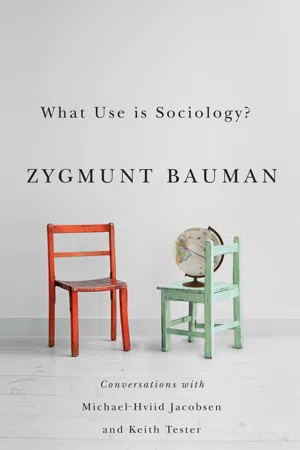
eBook - ePub
What Use is Sociology?
Conversations with Michael Hviid Jacobsen and Keith Tester
- English
- ePUB (mobile friendly)
- Available on iOS & Android
eBook - ePub
What Use is Sociology?
Conversations with Michael Hviid Jacobsen and Keith Tester
About this book
Information
1
What is sociology?
Michael Hviid Jacobsen and Keith Tester Looking back at your own sociological trajectory, your work was initially inspired by Polish sociology in the 1950s and 1960s and after that your immediate sociological environment has been British sociology. How would you – in hindsight – say that these diverse sources of inspiration – Polish and British sociology – have inspired and shaped your own thinking?
Zygmunt Bauman ‘Looking back’, as you’ve asked me to, I can hardly spot a watershed or a violent clash of ‘sources of inspiration’. Taking off from Poland, I was already set on my sociological travels and landing in Britain did not cause anything like a significant shift in my itinerary. Separated from Poland by a linguistic barrier, ‘Polish sociology’ seemed a different universe, but please remember that the barrier was one-sided: English was then the ‘official’ language in sociology’s realm and sociologists in Poland read the same books and followed the same caprices of fashion and meanders of interests as their workmates on the other side of the Iron Curtain. Besides, British sociology in the early 1970s was not exactly in the forefront of the worldwide trends, and for a newcomer from the University of Warsaw there was not much to catch onto; indeed, the discoveries made in those years in the British Isles were, in almost every respect, old and sometimes even outdated stuff around the Vistula. Most of the excitements through which my British colleagues were to go in my presence (such as the discoveries of Gramsci, the Frankfurt School, ‘culturology’, hermeneutics, the nonentity of ‘structural functionalism’ and the greatness of structuralism, etc.) I had already gone through in the company of my Polish colleagues well before landing in Britain. To cut a long story short, my first decade in Britain might have been full of sound and fury, for quite a few reasons (and indeed it was, as I confessed to Keith Tester quite a long while ago), but however, that signified pretty little for my vision of the sociological vocation.
You have always defined sociology as a ‘conversation with human experience’. This raises two questions. First of all, what do you mean by ‘human experience’?
I mean both Erfahrungen and Erlebnisse: the two different phenomena generated at the person/world interface, which Germans distinguish and set apart yet English speakers, due to the lack of distinct names, usually blend in one notion of ‘experience’. Erfahrung is what happens to me when interacting with the world; Erlebnis is ‘what I live through’ in the course of that encounter – the joint product of my perception of the happening(s) and my effort to absorb it and render it intelligible. Erfahrung can, and does, make a bid for the status of objectivity (supra – or interpersonality), whereas Erlebnis is evidently and overtly, explicitly subjective; and so, with a modicum of simplification, we may translate these concepts into English as, respectively, objective and subjective aspects of experience; or, adding a pinch of interpretation, actor-unprocessed and actor-processed experience. The first may be presented as a report from the world external to the actor; the second, coming from the actor’s ‘inside’ and concerning private thoughts, impressions and emotions, may only be available in the form of an actor’s report. In reports of the first category we hear of interpersonally testable events called ‘facts’; the contents of the second kind of reports are not testable interpersonally – beliefs as reported by the actor are, so to speak, the ultimate (and only) ‘facts of the matter’. The epistemological status of Erfahrungen and Erlebnisse therefore differ sharply; a circumstance responsible for quite a few confusions in the practice of sociological research and above all in the interpretations of its findings. The reliability and relevance of witness-supplied evidence change with the object of the witnessing – and that applies to both partners in the ongoing ‘dialogue between sociology and human experience’.
Second, in what does this conversation consist? How does sociology engage in the conversation, and what makes sociology worth engaging with? Why should non-sociologists read it?
Like all conversations, sociology engages in conversation with lay doxa – common sense or actor’s knowledge. It involves passing messages that turn into stimuli that evoke responses which become stimuli in their turn – in principle ad infinitum. The transformation of messages into effective stimuli is mediated by reception, followed by sense-making, which involves as a rule a (selective) interpretation. In its sociological variety the conversation is aimed at the confrontation between Erfahrungen and Erlebnisse, thereby ‘relativizing’ the latter while aiming at widening, rather than narrowing and limiting the conversationalists’ spectrum of choices.
In my view, the crucial objective of such ongoing conversation is in the long run the breaking of the widespread, perhaps even nearly universal habit of ‘non-sociologists’ (otherwise known as ‘ordinary folk in their ordinary life’) of evading the ‘in order to’ category of explanation when it comes to reporting their conduct and deploying instead a ‘because of’ type of argument. Behind that habit there is a tacit presumption, occasionally articulated though mostly unreflected upon and hardly ever questioned, that ‘things are as they are’ and ‘nature is nature – full stop’, and a conviction that there is little if nothing that actors – singly, severally or collectively – can change in nature’s verdicts. What results is an inert worldview, immune to argument. It entails a truly deadly mixture of two beliefs. First, there is a belief in the indomitability of the order of things, human nature or the state of human affairs. Second, there is a belief in human weakness bordering on impotence. That duo of beliefs prompts an attitude which can be only described as ‘surrender before the battle has started’. Étienne de La Boétie famously gave that attitude the name of ‘voluntary servitude’. In his Diary of a Bad Year (Penguin, 2008), J. M. Coetzee’s character C. objects: ‘La Boétie gets it wrong’. And he proceeds to spell out what was missing in that observation of four centuries ago which is nevertheless fast gaining consequentiality in our times: ‘The alternatives are not placid servitude on the one hand and revolt against servitude on the other. There is a third way, chosen by thousands and millions of people every day. It is the way of quietism, of willed obscurity, of inner emigration’ (p.12). People go through the moves, obedient to their daily routine and resigned in advance to the impossibility of changing it, and above all convinced of the irrelevance and ineffectiveness of their own actions or their refusal to act.
Alongside the questioning of the worldview that underpins such ‘quietism’, the sociological variety of conversation aimed at the expansion of individual freedom and the collective potential of humanity pursues the task of revealing and unravelling the features of the world which, however deceptive and misleading they might be, nevertheless supply some grounds for a kind of worldview that sustains and continuously galvanizes the quietist attitudes. ‘Relativization’ aims at both sides of the Erfahrungen–Erlebnisse encounter: it is the dialectics of their interaction that could be called the conversation’s ultimate objective.
Can you perhaps give an example of this?
Allow me to return for a moment to Coetzee’s alter ego; once more, he hits a bull’s eye when he points out that the popular and deeply entrenched
figure of economic activity as a race or contest is somewhat vague in its particulars, but it would appear that, as a race, it has no finishing line and therefore no natural end. The runner’s goal is to get to the front and stay there. The question of why life must be likened to a race, or of why the national economies must race against one another rather than going for a comradely jog together, for the sake of the health, is not raised. A race, a contest: that is the way things are. By nature we belong to separate nations; by nature nations are in competition with other nations. We are as nature made us. (p. 79)
He continues: but in fact ‘there is nothing ineluctable about war. If we want war we can choose war, if we want peace we can equally well choose peace. If we want competition we can choose competition; alternatively we can take the path of comradely cooperation’ (p. 81).
Just to leave no room for doubt as to the meaning of his observation, Coetzee’s C. points out that
surely God did not make the market – God or the spirit of History. And if we human beings made it, can we not unmake it and remake it in a kindlier form? Why does the world have to be a kill-or-be-killed gladiatorial amphitheatre rather than, say, a busily collaborative beehive or anthill? (p.119)
Now this is, I suggest, a clinching reason why, as you ask, ‘non-sociologists should read sociology’.
This immediately gives sociology a political edge. What is the relationship of sociology to politics?
Willy-nilly, by design or default, sociology is deeply embroiled in politics. In a conflict-ridden society like ours with its conflicts of interests and antagonistic politics, it is bound all too often to turn partisan as well. Its subject, after all, is the interaction of Erfahrungen and Erlebnisse; Erlebnisse are endemically partisan and so is the task of decomposing the deceitful ‘objectivity’ of Erfahrungen.
What renders sociology an intrinsically political activity is besides the very fact of offering a separate source and legitimation of authority, alternative to institutionalized politics. In our multivocal and multi-centred society this is not, however, the sole source of authority engaged in the competition with the political establishment – not to mention its only alternative. With state-run, state-originated and state-authorized politics chronically afflicted by the bane of ineffectiveness which is caused by a perpetual deficit of power – after a long period when it was the focus of genuine or attempted condensation and monopolization – the tendency nowadays is for a constantly widening spectrum of life pursuits to be spread all over the social body (recall Anthony Giddens’s concept of ‘life politics’ as it takes over, or is burdened with, an ever growing number of the functions once embraced and jealously guarded by institutionalized, state-centred and/or state-oriented politics).
Is sociology an ethical practice and, if so, how?
As in the case of the ‘political’, sociology cannot help being ethical (‘ethical practice’ is in my vocabulary a pleonasm; ethics is practice – of articulating, preaching, promoting and/or imposing rules of moral conduct). Morality is an issue of responsibility towards an Other; and the most powerful argument in favour of taking on that responsibility is the fact of the mutual dependency of humans, the condition which sociology explores, puts vividly on display and indefatigably hammers home. One lesson a reader of sociological treatises cannot fail to draw is the relevance of actions and inactions of others to their own condition and prospects, and the relevance of their own actions and inactions to the conditions and prospects of others; all in all, the responsibility we all bear, knowingly or not, for each other’s conditions and prospects. Yet, let’s be clear that responsibilities, whether or not they are evident and unquestionable, can be (and indeed are) as often shouldered as it may happen that they are evaded. The utmost I would risk saying is that while properly performing their professional job, sociologists are willy-nilly, by design or inadvertently, preparing the soil in which moral awareness may grow, and so the chances of moral attitudes being assumed and of responsibility for others being taken may be increased. This is, however, as far as one can go. The road leading from here to a moral world is long, twisted and full of traps – which, by the way, it is the sociologist’s task to explore and map.
How does the conversation which sociology offers differ from other kinds of conversation such as literature, art, film?
The kinds of conversations you’ve named (and one could extend their list, as I believe all three of us would agree) are complementary, supplementary to each other and reciprocally enriching. They are by no means in competition (at least, there is no predesigned and unavoidable competition) – let alone at loggerheads or cross-purposes. Knowingly or not, deliberately or matter-of-factly, they all pursue the same purpose; one could say that they ‘belong to the same business’.
It is true that alongside the proofs of consciously and willingly sharing in the same calling, one can easily find ample evidence of mutual suspicion and rivalry between them – in a form so common and so widely practised in our times of quicksand foundations, mobile signposts and fluid identifications: the form aptly called ‘one-upmanship’ (‘up’ in the league of prestige and the line-up for grants). This is a professional rivalry, however, a rivalry between craft guilds – though not between their strikingly similar craftsmanships and vocations (though all too often the clashes of interest between guilds are – falsely, as it were – represented as an incompatibility of their respective craftsmanships). As the great anthropologist Frederik Barth taught us a long time ago, boundaries are not drawn because of differences, but the other way round: differences are keenly sought, and usually found or construed as well as zealously recorded, because boundaries, once drawn, require fortification and legitimation. And to recall another of Coetzee’s many insights in the Diary, this time inspired by René Girard’s parable of the warring twins: ‘the fewer the substantive differences between the two parties, the more bitter their mutual hatred’ (p.13).
Rivalry with other guilds is indeed in the nature of guilds, being as it were the paramount reason to construct, establish and fortify them. From the point of view of the recipients and users of their products, their services are anything but antagonistic, however. They are, I repeat, complementary and enriching to each other. Signs happily abound that a rising number of the practitioners of the conversational crafts are coming to understand and appreciate that these days; ‘interdisciplinarity’ is increasingly à la mode inside the walls of an academe ever less confident in the security and market value of its institutional boundaries. Let’s hope, though, that the emergent ‘interdisciplinarians’ won’t in their turn seek shelter in a guild of their own …
Indeed you often link literature with sociology – the role of the novel with that of sociology. Moreover, you have expressed intellectual affinity if not kinship with some of the great novelists of the twentieth century. Can you explain how the novel, or literature more generally, can enrich sociology and our appreciation of it?
In his book The Curtain, Milan Kundera writes of Miguel de Cervantes: ‘A magic curtain, woven of legends, hung before the world. Cervantes sent Don Quixote journeying and tore through the curtain. The world opened itself before the knight-errant in all the comical nakedness of its prose.’ Kundera proposes that the act of tearing through the curtain of pre-judgements was the moment of the birth of modern arts. It was a destructive gesture that modern arts have since endlessly repeated. And the repetition needs to be, and cannot but be, endless, since the magic curtain promptly sews back patches, glues slits and fills the remaining holes with new stories to replace those discredited as legends. Piercing the curtain is the main and recurrent topic of Kundera’s book and the key to the interpretation of the history and the role of the novel, to which that book is dedicated. He praises Henry Fielding for aspiring to the role of ‘inventor’ in order to commit, in his own words, ‘a quick and sagacious penetration into the true essence of all the objects of our contemplation’ – that is the piercing of the curtain that bars us from looking into that essence. He also commends Jaromir John, the author of The Internal-Combustion Monster, published in Czech in 1932 (the title referred to mechanically generated noise, which John singled out as the devil running the modern hell), for ‘not just copying the truths stitched on the curtain of preinterpretation’ but displaying instead the ‘Cervantes-like courage to tear it apart’.
Not unexpectedly if you know his ‘topical relevances’, Kundera focuses on the ‘destructive gestures’ of novelists. But the image of the ‘magic curtain’ and its tearing through strikes me as eminently appropriate as the job description of practitioners of the sociological vocation. It means piercing through the ‘curtain of prejudgements’ to set in motion the endless labour of reinterpretation, opening for scrutiny the human-made and human-making world ‘in all the comical nakedness of its prose’ and so drawing new human potentialities out of the darkness into which they had been cast, and in effect stretching the realm of human freedom and retrospectively revealing all that effort as the constitutive act of free humanity. I do believe that it is by doing or failing to do such a job that sociology ought to be judged.
Writing a novel and writing sociology are not the same. Each activity has its own techniques and modes of proceeding, and its own criteria of propriety, which set them apart from each other. But I would say that literature and sociology are siblings: their relationship is a mixture of rivalry and mutual support. They share parenthood, they bear an unmistakable family resemblance, serve each other as reference points which they can’t resist comparing, and they are yardsticks by which to measure the success or failure of their own life pursuits.
It is as natural (as it is useless) for the siblings obsessively to dissect their differences – particularly if the similarities are too blatant to overlook and the affinities are too close for comfort. Both siblings are, after all, after the same goal – piercing the curtain. And so they are ‘objectively’ in competition. But the task of human emancipation is not a zero-sum game.
The last answer explains why you have said that the world of literature and fiction (more so than the sociological work of Talcott Parsons) have helped shape your own sociological imagination. You specifically mentioned the work of Honoré de Balzac, Émile Zola, Max Frisch, Samuel Beckett and others. You once said that all the books you wanted to take with you if you were to be marooned on a desert island were novels (by Robert Musil, Georges Perec and Jorge Luis Borges). There were no sociology books whatsoever. What is it that these writers and novelists are capable of doing that so enamoured and fascinated you in your formative years as a sociologist and how did their work influence the way you now think about and practise sociology?
If you are after the ‘real life’ truth, rather than ‘truth’ overloaded with the doubtful and presumptuous ‘knowled...
Table of contents
- Cover
- Half Title
- TitlePage
- Copyright
- Contents
- Preface
- Introduction
- 1 What is sociology?
- 2 Why do sociology?
- 3 How to do sociology?
- 4 What does sociology achieve?
Trusted by 375,005 students
Access to over 1.5 million titles for a fair monthly price.
Study more efficiently using our study tools.
Frequently asked questions
Yes, you can cancel anytime from the Subscription tab in your account settings on the Perlego website. Your subscription will stay active until the end of your current billing period. Learn how to cancel your subscription
No, books cannot be downloaded as external files, such as PDFs, for use outside of Perlego. However, you can download books within the Perlego app for offline reading on mobile or tablet. Learn how to download books offline
Perlego offers two plans: Essential and Complete
- Essential is ideal for learners and professionals who enjoy exploring a wide range of subjects. Access the Essential Library with 800,000+ trusted titles and best-sellers across business, personal growth, and the humanities. Includes unlimited reading time and Standard Read Aloud voice.
- Complete: Perfect for advanced learners and researchers needing full, unrestricted access. Unlock 1.5M+ books across hundreds of subjects, including academic and specialized titles. The Complete Plan also includes advanced features like Premium Read Aloud and Research Assistant.
We are an online textbook subscription service, where you can get access to an entire online library for less than the price of a single book per month. With over 1.5 million books across 990+ topics, we’ve got you covered! Learn about our mission
Look out for the read-aloud symbol on your next book to see if you can listen to it. The read-aloud tool reads text aloud for you, highlighting the text as it is being read. You can pause it, speed it up and slow it down. Learn more about Read Aloud
Yes! You can use the Perlego app on both iOS and Android devices to read anytime, anywhere — even offline. Perfect for commutes or when you’re on the go.
Please note we cannot support devices running on iOS 13 and Android 7 or earlier. Learn more about using the app
Please note we cannot support devices running on iOS 13 and Android 7 or earlier. Learn more about using the app
Yes, you can access What Use is Sociology? by Zygmunt Bauman,Michael Hviid Jacobsen,Keith Tester in PDF and/or ePUB format, as well as other popular books in Social Sciences & Sociology. We have over 1.5 million books available in our catalogue for you to explore.