![]()
Section III
Pathogenic Bacteria
![]()
Chapter 14
Staphylococcus species
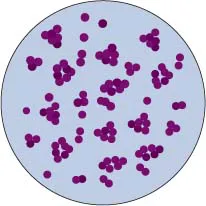
Staphylococci are Gram-positive cocci, approximately 1 μm in diameter, that tend to occur in irregular clusters resembling bunches of grapes (Fig. 14.1). The name derives from the Greek words staphyle and kokkos for a ‘bunch of grapes’ and a ‘berry’, respectively. Staphylococcus species occur as commensals on skin and mucous membranes; some may act as opportunistic pathogens causing pyogenic infections.
Most staphylococci are facultative anaerobes and catalase-positive. They are non-motile and oxidase-negative and do not form spores. Two species, S. aureus subsp. anaerobius and S. saccharolyticus, are anaerobic and catalase-negative.
A total of 43 species of Staphylococcus have been described to date, seven of which are coagulase-positive or coagulase-variable species (Table 14.1). The coagulase-positive S. aureus subsp. aureus (referred to as S. aureus), S. pseudintermedius, and the coagulase- variable S. hyicus are important pathogens of domestic animals (Table 14.1). Staphylococcus intermedius was previously thought to be the major staphylococcal pathogen of dogs and cats but it is now considered that S. intermedius strains isolated from these hosts belong to the species S. pseudintermedius (Sasaki et al., 2007; Devriese et al., 2009). Coagulase production correlates with pathogenicity. Although coagulase- negative staphylococci are usually of low virulence, some occasionally cause disease in animals and humans (Table 14.2).
Usual habitat
Staphylococcal species occur worldwide as commensals on the skin of animals and humans. They are also found on mucous membranes of the upper respiratory tract and lower urogenital tract and as transients in the digestive tract. The carriage sites of the pathogenic staphylococci are usually the mucous membranes and moist areas of the skin such as the axillae or perineal area. The nares are a major site of carriage of S. aureus in animals and humans, and approximately 20% of humans are permanent nasal carriers of this organism. Staphylococcus sciuri and S. xylosus are the most common coagulase-negative staphylococci isolated from healthy domestic animals. Staphylococci are comparatively stable in the environment, and staphylococcal strains display a selective affinity for particular animal species. Transfer of staphylococcal strains between animal species and between animals and humans is limited but of importance. Transfer of methicillin-resistant S. aureus strains from humans to animals or animals to humans is of particular significance.
Key points
- Gram-positive cocci in clusters resembling bunches of grapes
- Grow on non-enriched media
- Moderately-sized white or golden colonies
- Colonies of S. aureus and S. pseudintermedius produce double haemolysis
- Facultative anaerobes, non-motile, catalase-positive
- Commensals on mucous membranes and skin
- Coagulase production correlates with pathogenicity
- Comparatively stable in the environment
- Cause pyogenic infections
Differentiation of Staphylococcus species
In clinical specimens, Staphylococcus species must be differentiated from Streptococcus species and from Micrococcus species (Table 14.3). Staphylococci are generally catalase-positive and streptococci catalase- negative. Staphylococcus species are usually categorized by their colonial appearance, haemolytic pattern, biochemical profiles and ribosomal RNA gene restriction patterns (Thomson-Carter et al., 1989I. Some of the principal reactions of the coagulase-positive staphylococci are indicated in Table 14.4. It may be particularly important to distinguish S. aureus from S. pseudintermedius in certain clinical conditions, especially in dogs and cats.
Table 14.1 Coagulase-positive staphylococci and their clinical importance.
| Staphylococcus aureusa | Cattle | Mastitis, udder impetigo |
| | Sheep | Mastitis |
| | | Tick pyaemia (lambs) |
| | | Benign folliculitis (lambs) |
| | | Dermatitis |
| | Goats | Mastitis |
| | | Dermatitis |
| | Pigs | Botryomycosis of mammary glands |
| | | Impetigo on mammary glands |
| | Horses | Scirrhous cord (botryomycosis of the spermatic cord), mastitis |
| | Dogs, cats | Suppurative conditions similar to those caused by S. pseudintermedius |
| | Poultry | Arthritis and septicaemia in turkeys |
| | | Bumblefoot |
| | | Omphalitis in chicks |
| S. pseudintermedius | Dogs | Pyoderma, endometritis, cystitis, otitis externa, and other suppurative conditions |
| | Cats | Various pyogenic conditions |
| | Horses | Rarely isolated |
| | Cows | Rarely isolated |
| S. hyicusb | Pigs | Exudative epidermitis (greasy-pig disease) |
| | | Arthritis |
| | Cattle | Mastitis (rare) |
| S. intermedius | Horses | Isolated from nares |
| | Pigeons | Isolated from upper respiratory tract |
| S. aureus subsp. anaerobius | Sheep | Lymphadenitis |
| S. delphini | Dolphins | Suppurative skin lesions |
| | Horses | Isolated from nares |
| | Pigeons | Isolated from upper respiratory tract |
| S. lutrae | Otters | Pathogenic significance uncertain |
| S. schleiferi subsp. coagulans | Dogs | Otitis externa |
In veterinary diagnostic laboratories, specific identification of the coagulase-negative staphylococci is ordinarily reserved for those organisms that are isolated in almost pure culture, or are recovered from sites that are normally sterile such as joints or cerebrospinal fluid.
Table 14.2 Coagulase-negative staphylococci isolated from animals.
| S. arlettae | Goats/Nares |
| | Poultry/Skin |
| S. capitis | Cattle/Milk |
| S. caprae | Goats/Skin |
| S. chromogenes | Cattle/Milka |
| | Pigs, poultry/Skin |
| S. cohnii | Cattle/Milka |
| S. epidermidis | Cattle/Milka |
| | Dogs, horses/Wound infections |
| S. equorum | Horses/Skin |
| S. felisb | Cats/Otitis externa, skin infections |
| S. gallinarum | Poultry/Skin infections |
| S. haemolyticus | Cattle/Milka |
| S. hominis | Cattle/Milk |
| S. lentus | Pigs, sheep, goats/Skin infections |
| S. nepalensis | Goats/Respiratory tract |
| S. saprophyticus | Cats/Skin |
| | Cattle/Nostrils |
| S. sciuri | Cats and other animals/Skin infections |
| S. simiae | Squirrel monkeys/Gastrointestinal tract |
| S. simulans | Cattle/Milka |
| | Dogs, cats, pigs/Skin |
| S. vitulinus | Cattle, sheep, pigs/Skin |
| S. warneri | Cattle/Milka |
| S. xylosus | Cattle, sheep/Milka |
| | Cats, poultry, pigs, horses/Skin |
- Colonial characteristics: Staphylococcal colonies are usually white, opaque and up to 4 mm in diameter. The colonies of bovine and human strains of S. aureus are golden yellow. Colonies of some coagulase-negative staphylococci are also pigmented.
- Haemolysis in sheep or ox blood agar: Four staphylococcal haemolysins are recognized, alpha, beta, gamma and delta. Individual haemolysins differ antigenically, biochemically and in their effects on the red blood cells of different animal species. Strains vary in their haemolysin-producing ability, and animal strains of S. aureus and S. pseudintermedius usually produce both alpha-haemolysin and beta-haemolysin. On ruminant blood agar, the alpha-haemolysin causes a narrow zone of complete haemolysis immediately around the colony, and the beta-haemolysin produces a wider zone of partial or incomplete haemolysis. This is referred to as double haemolysis (Fig. 14.2). These haemolysins act as toxins in vivo. Coagulase-negative staphylococci exhibit variation in their ability to produce haemolysis which usually develops slowly. Isolates of S. hyicus are non-haemolytic.
- Slide and tube coagulase tests: In these tests, a suspension of staphylococci is mixed with rabbit plasma either on a slide or in a small tube. The fibrinogen in rabbit plasma i...