Concise Review of Veterinary Microbiology
eBook - ePub

Concise Review of Veterinary Microbiology

  1. English
  2. ePUB (mobile friendly)
  3. Available on iOS & Android
eBook - ePub

Concise Review of Veterinary Microbiology

About this book

Updated to reflect the latest developments in the field, Concise Review of Veterinary Microbiology, 2nd Edition, presents essential information on veterinary microbiology for students and those requiring a refresher on key topics relating to microbial diseases in animals. Morphological, cultural and other descriptive features of pathogenic microorganisms are described, together with their habitats and aetiological roles in disease production in animals and, where appropriate, in the human population.

Key features:
• There are five sections covering bacteriology, mycology, virology, biosecurity and other aspects of infectious diseases
• Provides concise, yet comprehensive information on pathogenic microorganisms of importance in veterinary medicine, the diseases which they cause, their diagnosis and control
• The 79 short chapters in this book include 13 new chapters on antibacterial resistance, structure and function of the immune system, antifungal chemotherapy, antiviral chemotherapy, principles of biosecurity and a number of topics related to the control and prevention of infectious diseases
• This latest edition uses updated nomenclature and includes detailed diagrams now in full colour, and comprehensive tables
Frequently asked questions

Yes, you can cancel anytime from the Subscription tab in your account settings on the Perlego website. Your subscription will stay active until the end of your current billing period. Learn how to cancel your subscription.
At the moment all of our mobile-responsive ePub books are available to download via the app. Most of our PDFs are also available to download and we're working on making the final remaining ones downloadable now. Learn more here.
Perlego offers two plans: Essential and Complete
  • Essential is ideal for learners and professionals who enjoy exploring a wide range of subjects. Access the Essential Library with 800,000+ trusted titles and best-sellers across business, personal growth, and the humanities. Includes unlimited reading time and Standard Read Aloud voice.
  • Complete: Perfect for advanced learners and researchers needing full, unrestricted access. Unlock 1.4M+ books across hundreds of subjects, including academic and specialized titles. The Complete Plan also includes advanced features like Premium Read Aloud and Research Assistant.
Both plans are available with monthly, semester, or annual billing cycles.
We are an online textbook subscription service, where you can get access to an entire online library for less than the price of a single book per month. With over 1 million books across 1000+ topics, we’ve got you covered! Learn more here.
Look out for the read-aloud symbol on your next book to see if you can listen to it. The read-aloud tool reads text aloud for you, highlighting the text as it is being read. You can pause it, speed it up and slow it down. Learn more here.
Yes! You can use the Perlego app on both iOS or Android devices to read anytime, anywhere — even offline. Perfect for commutes or when you’re on the go.
Please note we cannot support devices running on iOS 13 and Android 7 or earlier. Learn more about using the app.
Yes, you can access Concise Review of Veterinary Microbiology by P. J. Quinn,B. K. Markey,F. C. Leonard,E. S. Fitzpatrick,S. Fanning in PDF and/or ePUB format, as well as other popular books in Medicine & Veterinary Medicine. We have over one million books available in our catalogue for you to explore.

Information

Year
2015
Print ISBN
9781118802700
eBook ISBN
9781118802694
Edition
2

Section II
Pathogenic Bacteria

14 Staphylococcus species

images
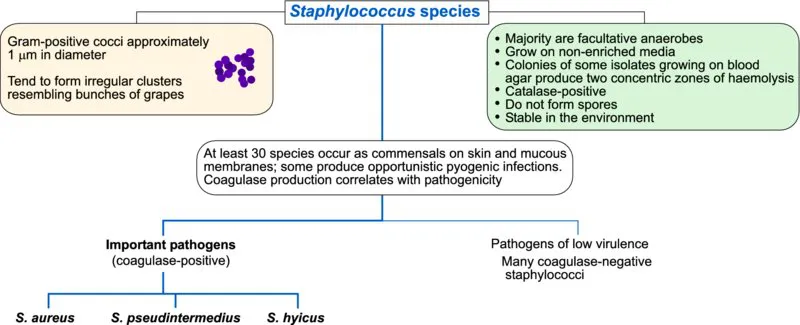
Staphylococci are Gram-positive cocci, approximately 1 μm in diameter, which form irregular clusters resembling bunches of grapes. They occur as commensals on skin and mucous membranes; some act as opportunistic pathogens causing pyogenic infections. They are comparatively stable in the environment. The coagulase-positive S. aureus subsp. aureus (referred to as S. aureus) and S. pseudintermedius and the coagulase-variable S. hyicus are important pathogens of domestic animals. Coagulase, which converts fibrinogen in plasma to fibrin, is a virulence factor of these organisms which correlates with pathogenicity. Coagulase-negative staphylococci are usually of low virulence. In clinical specimens, Staphylococcus species must be differentiated from Streptococcus species and from Micrococcus species. Staphylococci are generally catalase-positive and streptococci catalase-negative. Staphylococcus species are usually identified by the appearance of their colonies, haemolytic pattern and biochemical profiles. Molecular typing methods are increasingly being used to assign S. aureus and S. pseudintermedius to clonal complexes. Such methods include multi-locus sequence typing, analysis of patterns following enzymatic digestion and pulsed-field gel electophoresis and staphylococcal protein A typing.
Because staphylococci are pyogenic bacteria, they often cause suppurative lesions. Minor trauma or immunosuppression may predispose to the development of infection. Virulence factors of S. aureus and their pathogenic effects are indicated in Table 14.1. Although some virulence factors are plasmid-mediated, many are encoded in the staphylococcal core genome. Staphylococcal diseases of importance in domestic animals include mastitis, tick pyaemia, exudative epidermitis, botryomycosis and pyoderma (Table 14.2).
Table 14.1 Virulence factors, including toxins, of Staphylococcus aureus and their pathogenic effects.
Virulence factor Pathogenic effects
Coagulase Conversion of fibrinogen to fibrin. Fibrin deposition may shield staphylococci from phagocytic cells
Lipase, esterases, elastase, staphylokinase, deoxyribonuclease, hyaluronidase, phospholipase These factors facilitate dissemination and enhance toxicity of the organisms
Protein A Surface component which binds the Fc portion of IgG and inhibits opsonization
Leukocidin Cytolytic destruction of phagocytes of some animal species
Alpha-toxin (α-haemolysin) The major toxin in gangrenous mastitis. It causes spasm of smooth muscle and is necrotizing and potentially lethal
Beta-toxin (β-haemolysin) A sphingomyelinase which damages cell membranes
Toxic shock syndrome toxin (TSST)-1 Superantigen activity
Exfoliative toxins Responsible for desquamation in staphylococcal ‘scalded skin syndrome’ in humans
Enterotoxins Heat-stable toxins associated with staphylococcal food poisoning in humans
Table 14.2 Coagulase-positive staphylococci and their clinical importance.
Species Hosts Clinical conditions
Staphylococcus aureus Cattle Sheep Mastitis, udder impetigo Mastitis Tick pyaemia (lambs) Benign folliculitis (lambs) Dermatitis
Goats Mastitis Dermatitis
Pigs Botryomycosis of mammary glands Impetigo on mammary glands
Horses Scirrhous cord (botryomycosis of the spermatic cord), mastitis
Dogs, cats Suppurative conditions similar to those caused by S. pseudintermedius
Poultry Arthritis and septicaemia in turkeys Bumblefoot Omphalitis in chicks
S. pseudintermedius Dogs Pyoderma, endometritis, cystitis, otitis externa, and other suppurative conditions
Cats Various...

Table of contents

  1. Cover
  2. Titlepage
  3. Copyright
  4. Preface
  5. Acknowledgements
  6. Abbreviations and definitions
  7. About the companion website
  8. Section I: Introductory Bacteriology
  9. Section II: Pathogenic Bacteria
  10. Section III: Mycology
  11. Section IV: Viruses and Prions
  12. Section V: Prevention and Control of Infectious Disease
  13. Appendix: relevant websites
  14. Index
  15. EULA