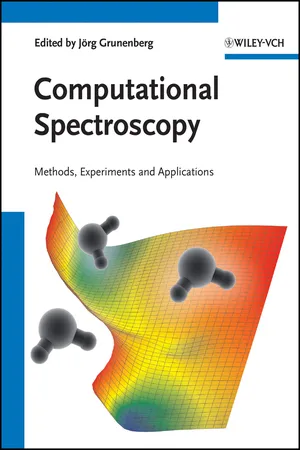
Unique in its comprehensive coverage of not only theoretical methods but also applications in computational spectroscopy, this ready reference and handbook compiles the developments made over the last few years, from single molecule studies to the simulation of clusters and the solid state, from organic molecules to complex inorganic systems and from basic research to commercial applications in the area of environment relevance.
In so doing, it covers a multitude of apparatus-driven technologies, starting with the common and traditional spectroscopic methods, more recent developments (THz), as well as rather unusual methodologies and systems, such as the prediction of parity violation, rare gas HI complexes or theoretical spectroscopy of the transition state.
With its summarized results of so many different disciplines, this timely book will be of interest to newcomers to this hot topic while equally informing experts about developments in neighboring fields.
- English
- ePUB (mobile friendly)
- Available on iOS & Android
eBook - ePub
About this book
Information
Concepts in Computational Spectrometry: the Quantum and Chemistry
1.1
Introduction
Introduction
During the nineteenth century and most of the first half of the twentieth century, after Dalton’s recognition of the atomic nature of chemical matter, which is everything tangible, that matter was regarded by most chemists as a material. Even though chemists, following Couper, Kekule, van’t Hoff, and others, drew structural formulae in terms of atoms connected by bonds represented as lines, chemical samples were generally regarded as materials or “stuff”. When, after 1955, molecular spectra, particularly of organic compounds, began to be recorded routinely in the mid-infrared region and with nuclear magnetic resonance, the outlook of chemists shifted from macroscopic properties, such as density, melting point, and refractive index, to purportedly molecular properties, such as the effect of adjacent moieties on the characteristic infrared absorption associated with a carbonyl group or on the chemical shift of a proton. The first “quantum-chemical” calculations, on H2+ by Burrau and on H2 by Heitler and London, all physicists, had as subjects chemical species remote from common laboratory experience, but Pauling’s brilliant insight and evangelical manner stimulated great qualitative interest in a theoretical interpretation of chemical properties, even though a large gap existed between the primitive calculations on methane and other prototypical molecules and molecules of substances of practical interest. This gap was bridged largely through the efforts of Pople and his collaborators during the second half of the twentieth century in developing computer programs that enabled efficient calculation of observable molecular properties; not coincidentally, Pople was also an early exponent of the application of nuclear-magnetic-resonance spectra in the publication in 1959 of an authoritative monograph [1] that was seminally influential in the general application of this spectral method [2].
Chemists concerned with quantitative analysis have always understood the distinction between spectroscopy and spectrometry: spectroscopy implies the use of a human eye as a visual detector with a dispersive optical instrument and hence necessarily qualitative and imprecise observations, whereas spectrometry pertains to an instrument with an electrical detector amenable to quantitative measurement of both frequency and intensity. For spectra throughout the entire accessible range of frequencies from 106 Hz, characteristic of nuclear quadrupole or nuclear magnetic resonance, to radiation in the X-ray region sufficiently energetic to cause ionization, a significant use of the numerical results of computations based nominally on quantum mechanics, such as of molecular electronic structure and properties, is to assist that spectral analysis. Pople’s programs were based, to an increasing extent over the years, on selected quantum-mechanical principles that arose from quantum theories. During the past century, the practice of chemistry has thus evolved much, from being a largely empirical science essentially involving operations in a laboratory and their discussion, to having – allegedly – an underpinning based on quantum theories.
During the nineteenth century, a standard paradigm for most chemical operations was that both matter and energy are continuous; following a philosophical point of view of Greek savants and concrete ideas of Bacon and Newton, Dalton’s contention that matter is particulate provided a basis to explain chemical composition, but Ostwald remained skeptical of the existence of atoms until 1909 [3]. The essence of the quantum concept is that both energy and matter ultimately comprise small packets, or chunks, not further divisible retaining the same properties. In Latin, quantum means how much?. A descriptor more enlightening than quantum is discrete, so we refer to the ultimate prospective discreteness of matter and energy. (In a mathematical context, integers take discrete values, even though they number uncountably, and have a constant unit increment, whereas real numbers 1.1, 1.11, 1.111,... vary continuously, with an increment between adjacent representatives as small as desired.) One accordingly distinguishes between the laws of discreteness, based on experiment, and various theories that have been devised to encompass or to reproduce those discrete properties. The distinctions between physical laws and theories or mathematical treatments are poorly appreciated by chemists; our objective is thus to clarify the nature of both quantum laws and quantum theories, thereby to propose an improved understanding of the purported mathematical and physical basis of chemistry and the application of computational spectrometry. After distinguishing between quantum laws and quantum theories, we apply to a prototypical problem three distinct quantum-mechanical methods that nevertheless conform to the fundamental postulate of quantum mechanics; we then consider molecular structure in relation to quantum-mechanical principles and their implications for the practice of chemistry aided by computational spectrometry.
For many chemists, the problem so called the particle in a box is the only purportedly quantum-mechanical calculation that they are ever required to undertake as a manual exercise, but its conventional solution is at least problematic. Any or all treatments of a harmonic oscillator in Section 1.3 serve as a viable alternative to that deficient model. The connection between quantum mechanics and chemistry might be based on a notion that “quantum mechanics governs the behavior of electrons and atoms in molecules,” which is merely supposition. While Dirac and Einstein had, to the ends of their lives, grave misgivings about fundamental aspects of quantum mechanics [4], and even Born was never satisfied with a separate – and thereby inconsistent – treatment of the motions of electrons and atomic nuclei that underpins common quantum-chemical calculations, almost all chemists accept, as recipes, these highly mathematical theories, in a mostly qualitative manner embodied in orbitals – “for fools rush in where angels fear to tread” (Pope). For those chemists who undertake calculations, typically with standard computer programs developed by mathematically knowledgeable specialists who have no qualms about producing more or less efficient coding but who might refrain from questioning the underlying fundamental aspects, the emphasis is placed on the credibility of the results. For the molecular structures of stable species that have been established by essentially experimental methods, although a theoretical component is invariably present, the empirical nature of the computer coding – its parameters are invariably set to reproduce, approximately, various selected properties of selected calibration species – reduces its effect to a sophisticated interpolation scheme; for the molecular structures of such fabulous species as transition states, as these are inherently impossible to verify, the results of the calculations merely reinforce preconceived notions of those undertaking such calculations. We trust that reconsideration of the current paradigm in chemistry that abides such questionable content will motivate an improved understanding of the mathematical and physical bases of chemistry and a reorientation of chemistry as an experimental and logical science ofboth molecules and materials. For this purpose, computational spectrometry has a substantial role to play in a fertile production of information about the structure and properties of molecules and materials.
1.2
Quantum Laws, or the Laws of Discreteness
Quantum Laws, or the Laws of Discreteness
The universe comprises matter and energy; as chemists, we might ignore the possibility of their interconversion. With regard to matter, we classify anything on or above an atomic scale and that displays a rest mass as either material or molecule. Molecules exist only in a gaseous state of aggregation under conditions in which intermolecular interactions are negligible, thus describable as constituting an ideal gas; an isolated atom is simply a monatomic molecule. Molecules hence exist most purely in int...
Table of contents
- Cover
- Title Page
- Copyright
- Preface
- List of Contributors
- 1: Concepts in Computational Spectrometry: the Quantum and Chemistry
- 2: Computational NMR Spectroscopy
- 3: Calculation of Magnetic Tensors and EPR Spectra for Free Radicals in Different Environments
- 4: Generalization of the Badger Rule Based on the Use of Adiabatic Vibrational Modes
- 5: The Simulation of UV-Vis Spectroscopy with Computational Methods
- 6: Nonadiabatic Calculation of Dipole Moments
- 7: The Search for Parity Violation in Chiral Molecules
- 8: Vibrational Circular Dichroism: Time-Domain Approaches
- 9: Electronic Circular Dichroism
- 10: Computational Dielectric Spectroscopy of Charged, Dipolar Systems
- 11: Computational Spectroscopy in Environmental Chemistry
- 12: Comparison of Calculated and Observed Vibrational Frequencies of New Molecules from an Experimental Perspective
- 13: Astronomical Molecular Spectroscopy
- Index
Trusted by 375,005 students
Access to over 1.5 million titles for a fair monthly price.
Study more efficiently using our study tools.
Frequently asked questions
Yes, you can cancel anytime from the Subscription tab in your account settings on the Perlego website. Your subscription will stay active until the end of your current billing period. Learn how to cancel your subscription
No, books cannot be downloaded as external files, such as PDFs, for use outside of Perlego. However, you can download books within the Perlego app for offline reading on mobile or tablet. Learn how to download books offline
Perlego offers two plans: Essential and Complete
- Essential is ideal for learners and professionals who enjoy exploring a wide range of subjects. Access the Essential Library with 800,000+ trusted titles and best-sellers across business, personal growth, and the humanities. Includes unlimited reading time and Standard Read Aloud voice.
- Complete: Perfect for advanced learners and researchers needing full, unrestricted access. Unlock 1.5M+ books across hundreds of subjects, including academic and specialized titles. The Complete Plan also includes advanced features like Premium Read Aloud and Research Assistant.
We are an online textbook subscription service, where you can get access to an entire online library for less than the price of a single book per month. With over 1.5 million books across 990+ topics, we’ve got you covered! Learn about our mission
Look out for the read-aloud symbol on your next book to see if you can listen to it. The read-aloud tool reads text aloud for you, highlighting the text as it is being read. You can pause it, speed it up and slow it down. Learn more about Read Aloud
Yes! You can use the Perlego app on both iOS and Android devices to read anytime, anywhere — even offline. Perfect for commutes or when you’re on the go.
Please note we cannot support devices running on iOS 13 and Android 7 or earlier. Learn more about using the app
Please note we cannot support devices running on iOS 13 and Android 7 or earlier. Learn more about using the app
Yes, you can access Computational Spectroscopy by Jörg Grunenberg in PDF and/or ePUB format, as well as other popular books in Physical Sciences & Physical & Theoretical Chemistry. We have over 1.5 million books available in our catalogue for you to explore.