eBook - ePub
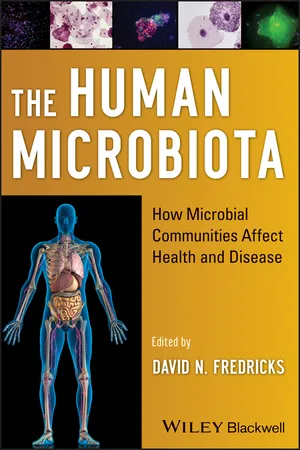
The Human Microbiota
How Microbial Communities Affect Health and Disease
- English
- ePUB (mobile friendly)
- Available on iOS & Android
eBook - ePub
About this book
The Human Microbiota offers a comprehensive review of all human-associated microbial niches in a single volume, focusing on what modern tools in molecular microbiology are revealing about human microbiota, and how specific microbial communities can be associated with either beneficial effects or diseases. An excellent resource for microbiologists, physicians, infectious disease specialists, and others in the field, the book describes the latest research findings and evaluates the most innovative research approaches and technologies. Perspectives from pioneers in human microbial ecology are provided throughout.
Information
1
The NIH Human Microbiome Project
1.1. Introduction
The human microbiome is the full complement of microbial species and their genes and genomes that inhabit the human body. The National Institutes of Health (NIH) Human Microbiome Project (HMP) is a community resource project designed to promote the study of complex microbial communities involved in human health and disease. The HMP has increased the appreciation for the features of the human microbiome that all people share as well as the features that are highly personalized. Host genetics, the environment, diet, the immune system, and many other factors all interact with the human microbiota to regulate the composition and function of the microbiome. As a scientific resource, the HMP has publically deposited to date or made available over 800 reference microbial genome sequences, hundreds of microbial isolates from the human microbiome, over 3 terabases (Tbp) of metagenomic microbial sequence, over 70 million 16S rRNA reads, close to 700 microbiome metagenome assemblies, over 5 million unique predicted genes, and a comprehensive bodywide survey of the human microbiome in hundreds of individuals from a healthy adult cohort. A number of demonstration projects are contributing a wealth of knowledge about the association of the microbiome with specific gut, skin, and urogenital diseases. Other key resources include the development of new computational tools, technologies, and scientific approaches to investigate the microbiome, and studies of the ethical, legal, and social implications of human microbiome research. This chapter captures the historical context of the HMP and other international research endeavors in the human microbiome, highlights the multiple initiatives of the HMP program and the products from this activity, and closes with some suggestions for future research needs in this emerging field.
1.2. Genesis of Human Microbiome Research and the Human Microbiome Project (HMP)
It sometimes seems that research on the human microbiome blossomed overnight. However, the conceptual and technological foundations for the study of the human microbiome began to emerge before the 1990s and can be found within many disciplines. Microbial ecologists who studied microorganisms and microbial communities in the environment recognized early on that most microorganisms in nature were not culturable and so developed alternate approaches to the study of microbial communities. An early and broadly adopted approach for investigating microorganisms in the environment, based on the three-domain system for biological classification [1], was the use of the 16S ribosomal RNA gene as a taxonomic marker for interrogating microbial diversity in nature [2]. With the growth of non-culture-based, molecular techniques in the 1980s and 1990s for study of environmental microorganisms and communities, some medical microbiologists turned these tools to the human body and found far greater microbial diversity than expected, even in well-studied sites such as the oral cavity [3–5].
In the infectious disease field, recognition was growing that many diseases could not satisfy Koch’s postulates as the pathogenesis of many of these diseases appeared to involve multiple microorganisms. The term polymicrobial diseases was coined to describe those diseases with multiple infectious agents [6]. We now recognize that many of these formerly classified polymicrobial diseases, such as abscesses, AIDS-related opportunistic infections, conjunctivitis, gastroenteritis, hepatitis, multiple sclerosis, otitis media, periodontal diseases, respiratory diseases, and genital infections, are associated with multiple microbial factors, that is, with the entire microbiome. In an essay on the history of microbiology and infectious disease, Lederberg [7], who coined the term microbiome, called for “a more ecologically informed metaphor” to understand the relationship between humans and microbes.
The field of immunology was also undergoing its own revolution with the recognition that the innate and adaptive immune systems not only evolved to eliminate specific pathogens but are also intimately involved in shaping the composition of the commensal intestinal microbiota [8–10]. Recognition was also growing in this field that the microbiota is involved in regulating gut development and function [11,12].
Another key catalyst for discussions about the inclusion of the microbiome in the study of human health and disease was the publication of the first drafts of the human genome sequence. Relman and Falkow [13] noted on this occasion that a “second human genome project” should be undertaken to produce a comprehensive inventory of microbial genes and genomes associated with the human body. Lead by Davies [14], they renewed a call for considering the role of the human-associated microorganisms in development and in health and disease. Also, by 2005 or so, as sequencing costs began to drop, sequencing technology offered the opportunity to consider extensive surveys of the microbial communities associated with the human. Early human studies focusing on the most complex of human microbiomes, the digestive tract [15,16], demonstrated the tremendous complexity as well as the functional potential of the human microbiome.
The time appeared right to undertake a comprehensive study of the human microbiome—the full complement of microbial species and their genes and genomes that inhabit the body. A meeting, organized by the French National Institute for Agricultural Research (INRA), of European, North American and Asian scientists and government agency and private-sector representatives was convened in Paris in 2005 to discuss how to approach such a comprehensive study. This 2-day meeting covered a broad range of topics, including sequencing all of the bacteria in the human microbiome, the impact of the human microbiome on the study of health, and the possible structure of a human digestive tract microbiome program. Recommendations from this first international meeting included the formation of an International Human Microbiome Consortium and an agreement to release data rapidly, share data standards, and develop reference datasets (http://www.human-microbiome.org/fileadmin/user_upload/Paris-recommendations.pdf). Around this same time, the National Academy of Sciences published a report on metagenomics [17] (http://books.nap.edu/catalog.php?record_id=11902), which highlighted this new discipline with its focus on the combination of genomics, bioinformatics, and systems biology to study microbial communities in nature; this report also informed the scientific community of the potential of this new discipline. The Paris meeting was followed by several other international meetings in 2007 and 2008.
These discussions led to the formation of the European Commission’s call for studies on human metagenomics. The NIH also invited community comment during this incubation period. A number of white papers identified specific needs for the field that included a reference microbial genome sequence catalog, animal models for microbiome studies, benchmarking studies for the analysis of 16S rRNA and microbiome metagenome sequencing, computational tools for the field, and considerations of the ethical aspects of human microbiome research. Pilot projects to develop protocols for sequencing the human microbiome were begun by the NIH National Human Genome Research Institute (NHGRI) in mid-2007. The NIH Common Fund–supported Human Microbiome Project (HMP) was formally launched in late 2007 with the intent to produce a number of major community resources: a reference catalog of microbial genome sequences, a large cohort study to survey microbiomes across the human body in healthy adults, a suite of demonstration projects to examine correlations of changes in the microbiome with disease, and the computational tools to analyzing microbiome metagenomic sequence data (http://commonfund.nih.gov/hmp/). Funding of the Metagenomics of the Human Intestinal Tract (MetaHIT) program began in 2008, which included scientific partnerships across eight European countries (http://www.metahit.eu/). Other large-scale efforts in human microbiome research emerged in close order around the world and include, among others, the NIH HIV Lung Microbiome Project, the Gambian Gut Microbiome Project, the INRA French/China program MicroObes, the Canadian Human Microbiome Initiative, the Australian Jumpstart Human Microbiome Project, and the Korean Twin Cohort Microbiome Diversity project.
1.3. Guiding Principles, Structure, and Initiatives of the HMP Program
1.3.1. HMP Guiding Principles and Creation of a Community Resource Project
The Human Microbiome Project was envisioned as a community resource program. A community resource program is defined as a research project “specifically devised and implemented to create a set of data, reagents or other material whose primary utility will be as a resource for the broad scientific community” (http://www.genome.gov/10506537). It was recognized that the metagenomic and associated metadata from human microbiome research are unique research resources. In order to establish and serve as a community resource, the guiding principles for the HMP included rapid data release into public databases. These follow the guiding principles that were created for the Human Genome Project and have been used for all large genome projects at NIH (https://commonfund.nih.gov/hmp/datareleaseguidelines.aspx).
At the same time, it was expected that users of the prepublication data would acknowledge the scientific contribution of the HMP data producers by following normal standards of scientific etiquette and fair use of unpublished data. These standards were out...
Table of contents
- Cover
- Title page
- Copyright page
- Preface
- Contributors
- 1: The NIH Human Microbiome Project
- 2: Methods for Characterizing Microbial Communities Associated with the Human Body
- 3: Phyloarrays
- 4: Mathematical Approaches for Describing Microbial Populations: Practice and Theory for Extrapolation of Rich Environments
- 5: Tension at the Border: How Host Genetics and the Enteric Microbiota Conspire to Promote Crohn’s Disease
- 6: The Human Airway Microbiome
- 7: Microbiota of the Mouth: A BLESSING OR A CURSE?
- 8: Microbiota of the Genitourinary Tract
- 9: Functional Structure of Intestinal Microbiota in Health and Disease
- 10: From Fly to Human: Understanding How Commensal Microorganisms Influence Host Immunity and Health
- 11: Insights into the Human Microbiome from Animal Models
- 12: To Grow or Not to Grow: Isolation and Cultivation Procedures in the Genomic Age
- 13: New Approaches to Cultivation of Human Microbiota
- 14: Manipulating the Indigenous Microbiota in Humans: Prebiotics, Probiotics, and Synbiotics
- Index
Trusted by 375,005 students
Access to over 1.5 million titles for a fair monthly price.
Study more efficiently using our study tools.
Frequently asked questions
Yes, you can cancel anytime from the Subscription tab in your account settings on the Perlego website. Your subscription will stay active until the end of your current billing period. Learn how to cancel your subscription
No, books cannot be downloaded as external files, such as PDFs, for use outside of Perlego. However, you can download books within the Perlego app for offline reading on mobile or tablet. Learn how to download books offline
Perlego offers two plans: Essential and Complete
- Essential is ideal for learners and professionals who enjoy exploring a wide range of subjects. Access the Essential Library with 800,000+ trusted titles and best-sellers across business, personal growth, and the humanities. Includes unlimited reading time and Standard Read Aloud voice.
- Complete: Perfect for advanced learners and researchers needing full, unrestricted access. Unlock 1.5M+ books across hundreds of subjects, including academic and specialized titles. The Complete Plan also includes advanced features like Premium Read Aloud and Research Assistant.
We are an online textbook subscription service, where you can get access to an entire online library for less than the price of a single book per month. With over 1.5 million books across 990+ topics, we’ve got you covered! Learn about our mission
Look out for the read-aloud symbol on your next book to see if you can listen to it. The read-aloud tool reads text aloud for you, highlighting the text as it is being read. You can pause it, speed it up and slow it down. Learn more about Read Aloud
Yes! You can use the Perlego app on both iOS and Android devices to read anytime, anywhere — even offline. Perfect for commutes or when you’re on the go.
Please note we cannot support devices running on iOS 13 and Android 7 or earlier. Learn more about using the app
Please note we cannot support devices running on iOS 13 and Android 7 or earlier. Learn more about using the app
Yes, you can access The Human Microbiota by David N. Fredricks in PDF and/or ePUB format, as well as other popular books in Biological Sciences & Microbiology. We have over 1.5 million books available in our catalogue for you to explore.