eBook - ePub
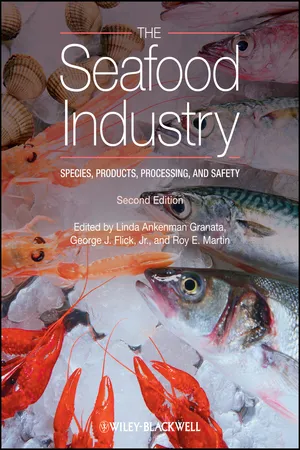
The Seafood Industry
Species, Products, Processing, and Safety
- English
- ePUB (mobile friendly)
- Available on iOS & Android
eBook - ePub
The Seafood Industry
Species, Products, Processing, and Safety
About this book
The Seafood Industry: Species, Products, Processing, and Safety, Second Edition is a completely updated and contemporary revision of Flick and Martin's classic publication, The Seafood Industry. Covering all aspects of the commercial fish and shellfish industries – from harvest through consumption – the book thoroughly describes the commercial fishery of the western hemisphere. The international audience will also find the coverage accessible because, although species and regulations may differ, the techniques described are similar worldwide,. The second edition contains a significant expansion of the material included in the first edition. Examples include: high pressure processing; inclusion of additional major crustacean species of commerce; fishery centers and development programs; handling methods on fishing vessels; and new chapters on Toxins, Allergies, and Sensitivities; Composition and Quality; and Risk Management and HACCP; and Processing Fin Fish. The Seafood Industry: Species, Products, Processing, and Safety, comprehensive in scope and current with today's issues, will prove to be a great asset to any industry professional or seafood technologist working in the field.
Information
1
A History of the Seafood Industry
Humans fished before the dawn of written history using bird's beaks for hooks and plant stalks for line. Early cave pictures show drawings of fish and fishing. Mounds of cast-off shells from prerecorded times have been found in China, Denmark, Brazil, and the United States. Although fishing was difficult because of a lack of efficient gear, it was easy to walk out at low tide and pick up shellfish, or spear fish in shallow water.
As populations grew, people tended to settle near the sea or large river systems where fish and shellfish were readily abundant as food, and sea-lanes became important for commerce, trade, communication, and transport. The need for more food and bigger fish encouraged fishermen to develop new gear design and more efficient methods of fishing and to travel even farther from shore. As a result of larger catches, the fishing enterprise expanded from a small boat, local village business to one that permitted additional onshore people to enter the business.
Fishing was often the reason, accidentally or not, for discovering new lands, finding new travel routes using trade as an excuse for expansion, and sometimes going to war. As nations organized large fishing fleets, they became sea powers.
The enormous fishing grounds of the North Atlantic lured European fishermen westward even before 1500. In fact, commercial fishing was the first industry of the New World; cod was the draw of the Grand Banks of Newfoundland. So numerous were these fish that in the early 1600s the Englishman Bartholomew Gosnold named a nearby peninsula Cape Cod. Fish were salted and packed in barrels, then shipped back to England. The state seal of Massachusetts has a codfish on its crest and shield.
The fishing industry is diverse and many segments developed independently.
vsp 22pt?enlrg -42pt? The fish curing industry
The fish curing industry of the North Atlantic coast of North America dates back to the year 1500, at least, and legends of activities go back even earlier. An extensive fish curing industry was carried on for more than 100 years before there was a permanent settlement. As early as 1580, over three hundred ships from Europe were salting cod in this area. Newfoundland was colonized because of the fish curing industry, which remains a factor in the province's economic life.
Early colonists in New England and the Maritime Provinces could not have survived without the salt cod and the smoked herring they prepared. Although fish meant food to these colonists, cured fish soon became their capital resource and their stock in trade for purchasing supplies. Cod, their most abundant fish, could be manufactured into a durable protein food product, withstand the primitive shipping and storage conditions of the day, and was comparatively low in price. Other cured fish such as smoked halibut and herring, pickled sturgeon, and salt salmon were soon being shipped abroad. Out of this grew the so-called triangular trade: salt fish to Europe; manufactured goods from Europe to the West Indies; and sugar, rum, and molasses to New England.
The trade in salt fish stimulated other industries, and capital was gradually accumulated so that the colonists could go into the shipping business. Before the end of the sixteenth century, more efficient, faster vessels were developed to meet the needs of an expanding fishery.
The fish curing industry continued to grow and prosper, dominating the economic life of the New England colonies in the late seventeenth and early eighteenth centuries. The large amount of money to be made led to disputes between the British and the French over fishing grounds and fish curing locations. Both groups wanted to secure this trade for themselves. Attempts were made to establish fishing boundaries, but they were poorly defined, and fishing rights over a wide area was the cause of frequent bickering, sometimes flaring up into undeclared warfare. The fishermen and curers of New England and Nova Scotia played an important part in England's conquest of Canada, because for them the fishing rights meant life or death.
The disputes did not end with the ousting of the French, but continued between the New England colonists and the English. The English Parliament in 1775 prohibited the New England colonies from trading directly with foreign countries and prevented New England vessels from fishing on the banks off Newfoundland, in the Gulf of St. Lawrence, and on the coasts of Labrador and Nova Scotia where they had been accustomed to fishing. This restriction meant ruin to the New England fish curing industry, and the edict was one of the causes of the Revolutionary War.
The treaty of peace negotiated in 1783 was delayed because the American delegates insisted on securing favorable fishery rights. They regarded these rights as so important that they refused to sign a general treaty of peace that left the fishing rights for later adjudication. Finally, the American delegation obtained a treaty article on fisheries that granted favorable conditions to the United States.
The New England fish curing industry generally prospered under the new republic and was able to secure salt cod markets in southern Europe and the Mediterranean. Disputes again arose with Great Britain over trade, the interpretation of fishery rights, and the conscription of American fisherman and seamen into the Royal Navy. Restrictions and embargoes were imposed by both Great Britain and the United States, resulting in a decline in the salt fish industry after 1807. The War of 1812 almost ruined the industry; the war was so unpopular among shipping, commercial, and fish curing groups that there was a move toward secession in some New England states.
At the end of the War of 1812, the British claimed that the war abrogated the treaty of 1783; the United States claimed that the treaty was still valid. The British seized some American fishing vessels, and it seemed for a time that a new war might break out. Tension was eased by the signing of a new fishery convention in 1818. However, it was followed by a whole series of disputes about interpretation, at times resulting in severe diplomatic tension for the United States with Great Britain and with Canada.
Trouble occurred less frequently during the last decades of the nineteenth century as refrigeration developed and wider markets were created in the United States for fresh fish, making salting and drying of fish on the northeastern coast less important.
Fish canning
An overview of the US fish preserving industry during the past half century shows a decline in production of cured fish but an almost continuous growth in the canning industry.
The first record of canned seafood in the United States was in 1815 when Ezra Daggert and Thomas Kensett canned salmon, lobsters, and oysters on a site near what is now Battery Park in New York City. In 1825, Kensett applied for US patents for “preserving of animal, vegetable, and other perishable foods,” but these patents were not granted until some 10 years later, presumably because patent officials doubted the idea's practicality. For years following these early canning operations, there was no significant development in seafood canning.
The production increase was gradual over a 25-year period beginning in 1844. The first large increase in demand came during the Civil War when preserved foods were needed for the troops. This increased demand also created additional consumers for canned seafood. Men who became acquainted with these products in the army demanded canned foods on their return home and introduced them to their neighbors.
Kensett was the first to break away from home kitchen methods and deserves credit for developing the first canned product, oysters, to receive wide distribution. The pioneer development of the industry in the Chesapeake Bay area, the first important canning center, is due to his efforts. Others are said to have engaged in the industry in the Baltimore area before Kensett, and it is believed that oysters were canned as early as 1819. However, the first systematic effort at large-scale development was made by Kensett in 1844 when he began packing oysters in Baltimore. Oysters were the first canned product that became popular. Large inland cities could get fresh Baltimore oysters packed in ice through the winter, but people in smaller communities seldom enjoyed such a luxury. The countryman's greatest treat when he went to town was an oyster stew. Baltimore and Boston firms canned oysters, so they would keep for months and could be bought at any country grocery store by people who had never eaten a fresh oyster.
enlrg 12pt? Tin containers for packaging processed foods were first used in the 1840s. Sardines were first canned in Maine about 1850; a turtle cannery was established in Florida in 1866; a cannery for menhaden was established on Long Island in 1872; and it is known that mackerel, clams, lobsters, and crabs were being canned by 1880. It is probable that tuna, alewives, and shad were not canned until early in the twentieth century. The production of canned products in the United States and Alaska in 1880 had an estimated value of $15 million.
Canning salmon
Salmon canning industry, one of the most important canning industries, had its beginnings during the Civil War period. Although it is claimed that the first salmon canned on the American continent was the Atlantic salmon packed in St. Johns, New Brunswick, in 1839, the salmon fishery was never of economic importance on the Atlantic Coast. The industry really began in California, where George and William Hume with A.S. Hapgood started the Pacific salmon canning industry. The Hume Brothers, who had worked as fishermen at their home in Maine, went to California as Forty-niners. They noticed that salmon were plentiful in the Sacramento River and believed that money might be made canning the fish. They went back to Maine on a visit, persuaded Hapgood, a lobster canner, to return west with them, and the first Pacific salmon pack was made in Sacramento in 1864.
Using these primitive methods, 2000 cases of salmon were canned that first year and sold at 5 dollars per dozen cans to a San Francisco merchant. Reacting to reports of extremely favorable conditions on the Columbia River, the Humes moved to Eagle Cliff, Washington, and made the first pack of Columbia River salmon in 1866.
enlrg 12pt? As a result, the rush to pack salmon was on, and within a few years hundreds of operations were set up on the Columbia River and in Alaska. Having to make cans by hand hampered operations, but because of the great demand, the pack by 1876 was 450,000 cases.
As the sale of canned salmon increased steadily, the industry sought new and profitable locations, first at New Westminster on the Fraser River in British Columbia in 1867; then at Mukilteo, on Puget Sound, Washington Territory, in 1877; and, although Alaska is today the most important salmon canning area, its first cannery was not built until 1878 at Klawak, on Prince of Wales Islands.
Today, consumers have many canned fish and seafood products available, thanks to the ingenuity of the fishery industry. Canned fishery products total more than 750 million lbs and are worth over $1.0 billion.
The shrimp fishery
The shrimp industry, as it is known today, began off the coasts of Georgia, North Carolina, and South Carolina. Around 1915, the first shrimp trawl was employed from open skiffs converted from the bluefish hook and line fishery. Gasoline engines became the major source of power during the 1920s. A small single otter trawl was manually operated from the vessel. Flat nets of a very simple design were utilized during the early days. Interestingly, this trawl proved so efficient that it is still used today.
During the 1930s, diesel engines were...
Table of contents
- Cover
- Dedication
- Title Page
- Copyright
- Preface
- Contributors
- 1: A History of the Seafood Industry
- 2: Harvesting Techniques
- 3: Groundfish
- 4: Pelagic Fish
- 5: Major Cultured Species
- 6: Shellfish—Mollusks
- 7: Shellfish—Crustaceans
- 8: Underutilized (Latent) Fishery Species
- 9: Processing Finfish
- 10: Surimi and Fish Protein Isolate
- 11: Waste (By-Product) Utilization
- 12: Processing Mollusks
- 13: Processing Crustaceans
- 14: Freshwater Fish
- 15: Nutrition and Preparation
- 16: Species Identification of Seafood
- 17: Packaging
- 18: Freezing
- 19: Handling of Fresh Fish
- 20: Shellfish—Biological Safety
- 21: Allergens, Decomposition, and Toxins
- 22: Cleaning and Sanitation
- 23: Implementing the Seafood HACCP Regulation
- 24: Aquaculture
- 25: Waste Treatment
- 26: Fish Meal and Oil
- 27: Regulations
- 28: Smoked, Cured, and Dried Fish
- 29: Transportation, Distribution, Warehousing, and Food Security
- Index
Trusted by 375,005 students
Access to over 1.5 million titles for a fair monthly price.
Study more efficiently using our study tools.
Frequently asked questions
Yes, you can cancel anytime from the Subscription tab in your account settings on the Perlego website. Your subscription will stay active until the end of your current billing period. Learn how to cancel your subscription
No, books cannot be downloaded as external files, such as PDFs, for use outside of Perlego. However, you can download books within the Perlego app for offline reading on mobile or tablet. Learn how to download books offline
Perlego offers two plans: Essential and Complete
- Essential is ideal for learners and professionals who enjoy exploring a wide range of subjects. Access the Essential Library with 800,000+ trusted titles and best-sellers across business, personal growth, and the humanities. Includes unlimited reading time and Standard Read Aloud voice.
- Complete: Perfect for advanced learners and researchers needing full, unrestricted access. Unlock 1.5M+ books across hundreds of subjects, including academic and specialized titles. The Complete Plan also includes advanced features like Premium Read Aloud and Research Assistant.
We are an online textbook subscription service, where you can get access to an entire online library for less than the price of a single book per month. With over 1.5 million books across 990+ topics, we’ve got you covered! Learn about our mission
Look out for the read-aloud symbol on your next book to see if you can listen to it. The read-aloud tool reads text aloud for you, highlighting the text as it is being read. You can pause it, speed it up and slow it down. Learn more about Read Aloud
Yes! You can use the Perlego app on both iOS and Android devices to read anytime, anywhere — even offline. Perfect for commutes or when you’re on the go.
Please note we cannot support devices running on iOS 13 and Android 7 or earlier. Learn more about using the app
Please note we cannot support devices running on iOS 13 and Android 7 or earlier. Learn more about using the app
Yes, you can access The Seafood Industry by Linda Ankenman Granata, George J. Flick, Roy E. Martin, Linda Ankenman Granata,George J. Flick, Jr.,Roy E. Martin in PDF and/or ePUB format, as well as other popular books in Technology & Engineering & Food Science. We have over 1.5 million books available in our catalogue for you to explore.