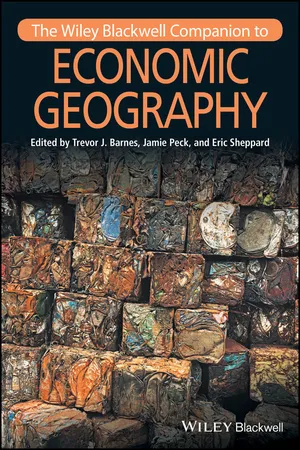
The Wiley-Blackwell Companion to Economic Geography presents students and researchers with a comprehensive overview of the field, put together by a prestigious editorial team, with contributions from an international cast of prominent scholars.
Offers a fully revised, expanded, and up-to-date overview, following the successful and highly regarded Companion to Economic Geography published by Blackwell a decade earlier, providing a comprehensive assessment of the field
Takes a prospective as well as retrospective look at the field, reviewing recent developments, recurrent challenges, and emerging agendas
Incorporates diverse perspectives (in terms of specialty, demography and geography) of up and coming scholars, going beyond a focus on Anglo-American research
Encourages authors and researchers to engage with and contextualize their situated perspectives
Explores areas of overlap, dialogues, and (potential) engagement between economic geography and cognate disciplines
15 Crisis in Space: Ruminations on the Unevenness of Financialization and its Geographical Implications
Ewald Engelen
16 The Insurmountable Diversity of Economies
Adrian Smith
17 Waste/Value
Vinay Gidwani
Editors’ Introduction: Accumulation and Value
Eric Sheppard, Jamie Peck, and Trevor J. Barnes
When economic geographers broke in the early 1970s with spatial science, in the form of neoclassical location theory, the positive motivation for this separation was an interest in classical and Marxist political economy. Among other markers of disagreement was the criticism that neoclassical economic theory, and 1960s location theory in particular, focused on places of exchange – markets – rather than those of commodity production – factory floors. Neoclassical approaches had also favored an analytical focus on the cost of factor inputs, together with the principles of optimizing behavior and price coordination, which were to be superseded by new concerns derived from political economy, including the dynamics of accumulation, profit imperatives, labor control, and class struggle. This represented more than a mere change in outlook, for the destabilization of real-world economies following the oil shocks of the 1970s and the collapse of the Bretton Woods financial order placed immediate questions of deindustrialization and regional decline on the agenda of economic geographers in the advanced industrial nations. It also began to point to new (and potentially transformative) connections between these wealthy nations of the global North and those economies of the majority world that were making their presence felt, initially in the form of “cheap imports.” Anglo-American economic geographers, who would soon be making more of these “global” connections, were preoccupied by the disruption of extant patterns of trade, employment, and production – what would later become known as “restructuring.” Equilibrium, apparently, was not what it used to be.
A concern for the geography of production, and labor relations, thus animated the reconstitution of economic geography under the rubric of political economy (Harvey 1982; Massey 1984; Scott 1988; Storper and Walker 1989; Sheppard and Barnes 1990). Geographers sought to locate commodity production in space and time, teasing out not only how space poses a challenge to capitalists – assembling inputs, picking the right location, getting the product to market – but also time. On the one hand, much can happen between the start and end of a production process; on the other, the profits made on commodity production formed the basis for accumulation and economic growth (neoclassical theory rules out profits, setting aside the question of accumulation). The essays in this section demonstrate an ongoing concern for production and accumulation. Yet, as they also show, this concern has been taken in distinctive directions: there no longer is a consensus that production should be the natural starting point or overarching concern.
All societies must come to terms with, and find a way to organize, the same basic set of economic processes: (i) deploying human labor and technology to combine biophysical processes, material objects, and energy into objects that humans need and desire in order to pursue their livelihoods (production); (ii) determining the worth of such objects (value and pricing); (iii) trading objects for one another (exchange, consumption); (iv) allocating such objects, and the value they create, among members of society (distribution); (v) creating a surplus, over and above what is socially necessary, that acts as a rainy-day fund to address emergencies and makes growth possible (savings, accumulation); (vi) returning unused, unusable, and used-up objects (however determined) to the “nature” whose “bounty” is the starting point of production (pollution, waste disposal). No matter what “kind” of economy one has in mind (capitalist, communal, socialist, subsistence), and irrespective of the more-than-economic (biophysical, cultural, political) processes that influence these, every society must find a way of combining these that will support members of that society in the long run. Otherwise, that society is unlikely to be able to reproduce itself as such.
A capitalist society integrates these six tasks through a particular logic – commodity production. This is based on the principles of private property (objects, including labor, are owned by individuals) and individual freedom (each member of society should be free to utilize his/her possessions for economic gain). Individuals with the necessary wherewithal (capitalists) can assemble technologies, resources, and other inputs, along with labor, into places of production to make an object, with the expectation of earning more money than was needed to produce it (profits): production of a commodity, for sale. Generally, the labor time of others, purchased for this purpose through the labor market, is less than fully compensated for the effort expended (creating an alternative, Marxisant optic into capitalism: labor value, surplus value, exploitation). Marx pithily describes how the supposed freedoms of the labor market do not extend inside the factory gate, to the “hidden abode” of production: “[T]he money-owner now strides in front as capitalist; the possessor of labor-power follows as his laborer. The one with an air of importance, smirking, intent on business; the other, timid and holding back, like one who is bringing his own hide to market and has nothing to expect but – a hiding” (Marx 1967 (1867): 167). Others, those “rentiers” who are the owners of such biophysical resources as land, minerals, or energy, would seek compensation for releasing their possessions into production – or for allowing them to be used as repositories for waste (rents). This implies an underlying source of potential conflict: generally speaking, increases in any one of profits, wages, or rents tendentially undermine the others as a source of income (triggering struggles over the distribution of the surplus).
The capitalist market – where goods are bought and sold for a price, each trader seeking to maximize profits or satisfaction – is advanced as the place where individual self-interest (the desire to make more profits, wages, rents) can be harnessed for general societal welfare. Adam Smith’s faith in this “invisible hand” is well known, a faith echoed by mainstream economics (which is preoccupied with how markets can achieve this), but treated with much skepticism by subsequent political economists and indeed by most economic geographers: “It is not from the benevolence of the butcher, the brewer, or the baker that we expect our dinner, but from their regard to their own interest. We address ourselves, not to their humanity but to their self-love” (Smith 1776: I.ii.2). Money made through this system of commodity production and monetary exchange then becomes the basis for further accumulation: larger and larger rounds of commodity production, together with the wealth to be derived from this.
Ever since Harvey’s (1982) foundational The Limits to Capital, economic geographers have sought to unpack the geographies produced by, but also shaping, these processes. Based in their criticisms of neoclassical theory, they focused particularly on places of production (firms, industries, and later industrial districts) and on the mutually constitutive relationship between space and such geographies of production: What kinds of places, spaces, and scales are produced as a result of commodity production and attendant struggles over labor relations and technological change? How do these produced geographies shape the spatial and economic strategies of capitalists and workers? How does “nature,” the more-than-human biophysical world, factor into such processes (Robbins 2004)? Notwithstanding this ongoing concern, detailed in several chapters of Sheppard and Barnes (2000), the past decade has seen the emergence of a variety of challenges to how production and accumulation had been studied heretofore. Many of these are described in the following chapters.
In terms of geographies of production, there has been a shift in the geographies that are being attended to. 10 years ago, the focus was very much on territorial clusters of firms, dubbed industrial districts: what were the agglomerative forces that bring these into existence, how were they changing with the rise of “post-Fordist” flexible production systems and labor markets (Scott 1988; 2001); what kinds of spatial competition were emerging between such places, following the ascendancy of local entrepreneurialism, and to what effect (Harvey 1989; Leitner 1990; Hall and Hubbard 1998; Sheppard 2000); how could such places retain their production clusters in the face of neoliberal globalization, with ever-more mobile capital and footloose firms ready to relocate for a profit (Amin and Thrift 1994; Storper 1997)? More generally, it was argued that globalizing neoliberalism was driving distinctive processes of “rescaling,” hollowing out, and “glocalization,” whereby localities and supranational institutions were becoming more influential scales of economic activity, by contrast to the national economies forwarded by the preceding era of state-led and Fordist development. During the past decade, increased attention has been paid to how production geographies stretch and leapfrog across space, often in unexpected ways. The talk has been of networks, wormholes, and sociospatial positionality (emphasizing power imbalances and difference within networks) (cf. Amin 2002; 2004; Sheppard 2002). The industrial districts literature has been criticized for over-emphasizing local, place-based determinants of success and failure, neglecting such broader-ranging connectivities as “non-local buzz” (Oinas 2002; Bathelt, Malmberg, and Maskell 2004). Complementing this, has been a growing concern with commodity chains of global reach – reconceptualized as global production networks (Dicken et al. 2001; Coe et al. 2004). Indeed, focusing on the networked nature of economic activity, of potentially global scope, has triggered a new self-styled school of economic geography – the relational turn (Bathelt and Gl
ckler 2003; Yeung 2005). Neil Coe and Martin Hess (this volume) review the emergence of such non-local approaches to the geography of production, exploring the potential of examining how networks, scales, and territories, as ways of framing geographies of production, articulate with one another. Adopting a network ontology, they propose the idea of strategic coupling as a way of conceptualizing how territorial economies and regional development strategies co-evolve with the strategic actions of translocal actors coordinating production networks.
Some economic geographers also have begun to pay more attention to the bigger picture of the uneven geographies of globalization during the past decade, examining the continued evolution of neoliberal globalization, its consequences and contestations, global governance regimes, uneven global development, imperialism, and the current global economic crisis (Harvey 2003; 2006; 2010; Peet 2003; 2007; Leitner, Peck, and Sheppard 2007; Sheppard and Leitner 2010). Reviewing the potential of such work, Jim Glassman (this volume) argues that geographers also have much to say about the global processes within which industrial districts and global production networks (GPNs) have emerged; a geographical approach can bring insight into how space, uneven development, and states remain persistent features of neoliberal globalization, albeit taking new and distinctive sociospatial forms. Complementing this has been a flourishing of research downscale, particularly around the theme of evolutionary economic geography (EEG). Whereas GPN researchers stress the space-stretching, hierarchical, cooperative, and competitive relations connecting firms (corporate structures, franchising, etc.), EEG researchers treat firms mostly as individual agents in competition with one another within specific regional contexts (seen by some as narrowing EEG’s potential: Boschma and Frenken 2009; MacKinnon et al. 2009). J
rgen Essletzbichler (this volume) sympathetically reviews the emergence of EEG, arguing that a more multiscalar approach, whereby firms, cities, regions, and nations are each conceived of as co-evolving with one another, would enable EEG researchers to contribute to regional policy-making in a fashion that would advance full employment, human dignity, and sustainability. The complementarities between his arguments and those of Coe and Hess in their chapter are worthy of further exploration.
These concerns, with networks and with evolutionary systems more generally, call attention to some of the ways in which economic geographers have been venturing far beyond those 1980s’ concerns with the “hidden abodes” of production. A notable development in recent years, for example, has been an increased engagement with the operations of various markets, which have likewise been found to be deeply structured by power relations, infused and indeed often constituted with cultural meanings, and “instituted,” governed, or regulated in various ways (Peck 2005; Berndt and Boeckler 2009). This has been accompanied by the adoption of new theoretical and methodological languages, from cognate fields like science studies, economic sociology, and convention theory.
One of the concerns here has been the question of how geographical markets are made. For example, Donald Mackenzie (2009) demonstrates how traders’ actions on the stock exchange floor perform a particular theory of markets: the efficient markets hypothesis, widely accepted by economists – until the breakdown of finance markets triggered the global crisis of 2008. Taking up these questions, and challenging economic geography’s focus on production, Marc Boeckler and Christian Berndt (this volume) propose the study of geographies of marketization – arrangements of heterogeneous elements organizing the circulation of goods as well as the property rights attached to them, through quantitative and qualitative valuations. Utilizing examples from Mexico and Ghana, they go o...
Table of contents
Cover
Wiley-Blackwell Companions to Geography
Title page
Copyright page
Dedication
Illustrations
Contributors
Acknowledgements
Editors’ Introduction: The Long Decade: Economic Geography, Unbound
Section I: Trajectories
Section II: Spatialities
Section III: Borders
Index
Trusted by 375,005 students
Access to over 1.5 million titles for a fair monthly price.
Study more efficiently using our study tools.
Frequently asked questions
Yes, you can cancel anytime from the Subscription tab in your account settings on the Perlego website. Your subscription will stay active until the end of your current billing period. Learn how to cancel your subscription
No, books cannot be downloaded as external files, such as PDFs, for use outside of Perlego. However, you can download books within the Perlego app for offline reading on mobile or tablet. Learn how to download books offline
Perlego offers two plans: Essential and Complete
Essential is ideal for learners and professionals who enjoy exploring a wide range of subjects. Access the Essential Library with 800,000+ trusted titles and best-sellers across business, personal growth, and the humanities. Includes unlimited reading time and Standard Read Aloud voice.
Complete: Perfect for advanced learners and researchers needing full, unrestricted access. Unlock 1.5M+ books across hundreds of subjects, including academic and specialized titles. The Complete Plan also includes advanced features like Premium Read Aloud and Research Assistant.
Both plans are available with monthly, semester, or annual billing cycles.
We are an online textbook subscription service, where you can get access to an entire online library for less than the price of a single book per month. With over 1.5 million books across 990+ topics, we’ve got you covered! Learn about our mission
Look out for the read-aloud symbol on your next book to see if you can listen to it. The read-aloud tool reads text aloud for you, highlighting the text as it is being read. You can pause it, speed it up and slow it down. Learn more about Read Aloud
Yes! You can use the Perlego app on both iOS and Android devices to read anytime, anywhere — even offline. Perfect for commutes or when you’re on the go. Please note we cannot support devices running on iOS 13 and Android 7 or earlier. Learn more about using the app
Yes, you can access The Wiley-Blackwell Companion to Economic Geography by Trevor J. Barnes, Jamie Peck, Eric Sheppard, Trevor J. Barnes,Jamie Peck,Eric Sheppard,Trevor J. Barnes in PDF and/or ePUB format, as well as other popular books in Physical Sciences & Geography. We have over 1.5 million books available in our catalogue for you to explore.