How women in turn-of-the-century Chicago used their consumer power to challenge male domination of public spaces and stake their own claim to downtown.
Popular culture assumes that women are born to shop and that cities welcome their trade. But for a long time America's downtowns were hardly welcoming to women. Emily Remus turns to Chicago at the turn of the twentieth century to chronicle a largely unheralded revolution in women's rights that took place not at the ballot box but in the streets and stores of the business district.
After the city's Great Fire, Chicago's downtown rose like a phoenix to become a center of urban capitalism. Moneyed women explored the newly built department stores, theaters, and restaurants that invited their patronage and encouraged them to indulge their fancies. Yet their presence and purchasing power were not universally appreciated. City officials, clergymen, and influential industrialists condemned these women's conspicuous new habits as they took their place on crowded streets in a business district once dominated by men.
A Shoppers' Paradise reveals crucial points of conflict as consuming women accessed the city center: the nature of urban commerce, the place of women, the morality of consumer pleasure. The social, economic, and legal clashes that ensued, and their outcome, reshaped the downtown environment for everyone and established women's new rights to consumption, mobility, and freedom.
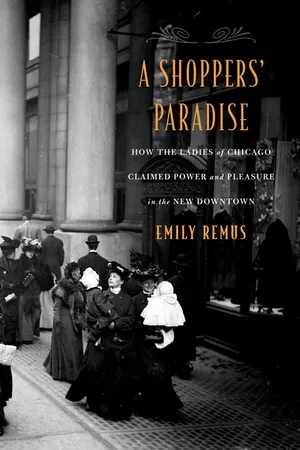
eBook - ePub
A Shoppers’ Paradise
How the Ladies of Chicago Claimed Power and Pleasure in the New Downtown
- 298 pages
- English
- ePUB (mobile friendly)
- Available on iOS & Android
eBook - ePub
A Shoppers’ Paradise
How the Ladies of Chicago Claimed Power and Pleasure in the New Downtown
About this book
Information
1
Moneyed Women and the Downtown
IN THE SUMMER OF 1891, New York writer Julian Ralph spent several weeks in Chicago to observe preparations for the World’s Columbian Exposition. His visit formed the basis of a series of essays for Harper’s New Monthly Magazine that explored Chicago’s civic and economic landscape. Ralph’s pen dwelt on the city’s singular growth in the two decades since the great fire of 1871 decimated the downtown. He spoke of the monumental achievements of Chicago capitalists, of the “energy, roar, and bustle” of the business district.1 Yet upon returning to the metropolis two years later to attend the exposition, Ralph concluded that his initial work had overlooked one of Chicago’s most distinctive features—its “gentle side,” the realm of art, literature, philanthropy, and civic betterment. In this domain, he contended, Chicago ladies took the lead. While their menfolk threw themselves into the hurly-burly of moneymaking, the city’s women devoted themselves to bringing order, culture, and beauty to the urban environment—to civilizing the capitalist city. Through their clubs and causes, they exerted a “softening influence” over public affairs, without engaging in the crass commercial life of the metropolis. They were, Ralph maintained, removed from the market, “creatures apart from the confusion—reposeful, stylish, carefully toileted, serene, and unruffled.”2
As represented in Ralph’s essay, Chicago’s commercial world rarely intersected with the gentle sphere over which ladies presided. But the city was not as neatly divided as the writer supposed. To be sure, most moneyed women devoted more time to club activities, socializing, and domestic cares than to capital accumulation. But they were nonetheless daily embedded in the relations of the market—as consumers. Invited by the operators of new consumer spaces, such as department stores, restaurants, theaters, and grand hotels, Chicago ladies were spending ever more time in the central business district. Not only errands brought them into this blossoming commercial realm. Increasingly, their entire social and cultural worlds operated there. A lady of 1890s Chicago might find herself going downtown to attend a club meeting at the Palmer House, a committee luncheon at the tearoom of Schlesinger & Mayer, a benefit concert at the Auditorium Theater, or a lecture at Central Music Hall. Indeed, the very civilizing pursuits that Ralph regarded as being isolated from the business realm were drawing ladies into commercial spaces and commercial exchanges.
Chicago’s “gentle side” thus converged with the masculine sphere of commerce via the activities of moneyed ladies. A similar fusion could be observed in other American cities during this period. But in Chicago, as Ralph noted, moneyed women had seized an unprecedented degree of involvement in public affairs. “I do not believe,” he reflected, “that in any older American city we shall find fashionable women so anxious to be considered patrons of art and of learning, or so forward in works of public improvement and governmental reform as well as of charity.” In Ralph’s view, Chicago had given birth to “a new character for the woman of fashion,” one who asserted herself in the public realm as well as in genteel society. To illustrate his claim, Ralph pointed to Chicago’s most prominent social leader, Bertha Honoré Palmer, wife of millionaire merchant and hotelier Potter Palmer. Mrs. Palmer commanded Chicago society in a way “not altogether improperly likened” to Caroline Astor’s influence over New York’s elite social set, the Four Hundred. Yet unlike Astor, Palmer exerted herself in the civic sphere.3 Most notably, she served as president of the Columbian Exposition’s Board of Lady Managers, in which capacity she oversaw construction of the fair’s Woman’s Building, represented the board before Congress, lobbied foreign governments, and supervised hundreds of volunteers.4
Ralph was far from alone in stressing the civic engagement of Chicago women; it was a theme often repeated in literature and social commentary. As Robert Herrick wrote in The Gospel of Freedom, “Chicago is the great home for intelligent woman. Here she moulds the destinies, the civilization of millions of eager human beings … She organizes immense reforms, she institutes educational benefits, she advances shoulder to shoulder with men in a common fight against the demons of want and vice.”5 Writer Emily Wheaton struck a similar chord in “The Russells in Chicago,” a Ladies’ Home Journal serial about a Boston couple who moves to the Midwest. Chicago women, Wheaton suggested, were “real thinking machines, on earth for a purpose, and that purpose was not to stay at home to be simply mothers and housekeepers.”6 Instead, they were “up to everything and doing everything.”7
Chicago’s reputation for fostering women’s participation in public life owed itself, in part, to the celebrity achieved by women such as Palmer amid the triumph of the Columbian Exposition. Also influential was the fact that the city was home to many of the nation’s most prominent female reformers—Jane Addams, founder of Hull House (a settlement house); Frances Willard, president of the Woman’s Christian Temperance Union; Florence Kelley, chief factory inspector for the state of Illinois and later head of the National Consumers League; and Ida B. Wells, journalist and anti-lynching activist.8 Yet many less famous individuals helped extend Chicago women’s reach into the public sphere. Associated with a wide range of organizations and causes, these moneyed women infused social activities with public service, mingling cultural privilege with civic consciousness.
Among these public-spirited ladies was Frances Macbeth Glessner, wife of industrialist John Jacob Glessner, a partner in one of the nation’s largest farm machinery manufacturers. Frances Glessner (1848–1932) shared with many of her contemporaries a keen interest in Chicago’s civic and cultural development. She was best known for helping to establish the city’s first permanent professional symphony, an organization she nurtured financially and socially until her death. She was an early member of two of the city’s first women’s clubs: the Fortnightly and the Chicago Woman’s Club. Glessner also served for many years as an officer of the Chicago Society of Decorative Art, later the Antiquarian Society of the Art Institute of Chicago, which provided a market for women’s handicrafts. At the behest of the first president of the new University of Chicago, she founded a reading group for faculty wives, which met at her home every Monday morning for more than thirty years.9
Glessner’s commitment to public life was typical for a woman of Chicago’s moneyed classes. She stands out because of a journal she kept between 1879 and 1915, which chronicles her daily activities, social engagements, and domestic concerns. Composed of fifty-two leather-bound volumes now preserved at the Chicago History Museum, Glessner’s journal offers a remarkable window into the experiences of moneyed women at a formative moment in Chicago’s development. With Glessner as a guide, the ladies who inhabited this bustling metropolis, as well as the built environment their activities transformed, come vividly into focus.
Like most Chicagoans of their generation, Frances Glessner and her husband, John, came from somewhere else. The couple had met in the 1860s in Springfield, Ohio, where John, then a bookkeeper in an agricultural implements firm, boarded in the home of Frances’s mother. Frances’s father, a failed merchant, had taken a job out of state, leaving his six children to help supplement the earnings he sent home. Frances was teaching school and assisting with her mother’s boarders when she “inspired the love” of her future husband. After John was made a partner in his firm in 1870, the Glessners married and moved to Chicago to establish a new headquarters for Warder, Bushnell & Glessner. With John guiding sales from Chicago, the business prospered and became a key competitor to the McCormick Harvesting Machine Company. Meanwhile, Frances oversaw the household’s domestic affairs, raised two children, and managed a handful of servants (fig. 1.1).10
Chicago was a small city of 300,000 inhabitants and seemingly endless commercial opportunity when the Glessners arrived in 1870. The couple initially rented a small frame house on the West Side, near Union Park. Four years later, with John’s success growing, they bought a stately brick home a few blocks away.11 In 1885, the Glessners affirmed their financial and social status by purchasing the last open lot on Chicago’s most exclusive residential street, Prairie Avenue. They commissioned the renowned Boston architect Henry Hobson Richardson to design the property, a fortresslike granite building that contrasted sharply with the ornate Victorian mansions then lining the avenue. Once the Glessners moved into their distinctive new home in late 1887, their nearest neighbors included the households of George Pullman, Philip Armour, Marshall Field, and other leading capitalists.12
Like their neighbors and most moneyed Chicagoans, the Glessners had humble upbringings. John Glessner grew up on an Ohio farm, where he helped his father with agricultural tasks and with editing the local newspaper, which his father owned.13 Frances, raised in a family where money was always tight, brought few financial assets to the marriage. Such backgrounds were characteristic of their peers. Unlike their counterparts back East, Chicago’s most affluent citizens had not inherited their wealth—they had made it. More than 70 percent of Chicago’s wealthiest men in 1892 had earned their own fortunes, compared to just 30 percent in New York and Boston.14 Chicago’s reputation for creating self-made men was a source of local pride, as many visitors discovered. “Nearly all of Chicago’s prominent citizens are self-made and proud of it,” observed etiquette expert Emily Post when passing through on a cross-country tour. “Millionaire after millionaire will tell you of the day when he wore ragged clothes, ran barefooted, sold papers, cleaned sidewalks, drove grocers’ wagons, and did any job he could find to get along.”15

Figure 1.1 Like most moneyed Chicago women of her era, Frances Macbeth Glessner was active in civic, philanthropic, and cultural affairs. She helped bring the first permanent symphony to Chicago and belonged to several prominent women’s clubs. Her husband, John J. Glessner, earned his fortune as a manufacturer of agricultural implements. Courtesy of Glessner House Museum, Chicago, Illinois.
In contrast to eastern cities, where most fortunes dated back two or more generations, Chicago society was less established and, in turn, less exclusive.16 It was, in the words of novelist Henry Blake Fuller, “wide enough to include the best as well as the worst.” As one of a minority of Chicago-born residents, Fuller was a close observer of the city’s social life. Society in his hometown, Fuller asserted in an 1897 article for Atlantic Monthly, was “unregulated, in the main, by anything like tradition, authority, forms, and precedents.”17 In such a young metropolis, class distinctions were flexible, even imperceptible. The designation “new money” lost much of its meaning in an environment without an established elite. Similarly, the li...
Table of contents
- Cover
- Title Page
- Copyright
- Dedication
- Contents
- Introduction
- 1. Moneyed Women and the Downtown
- 2. The Hoopskirt War of 1893
- 3. Consumer Rights and the Theater Hat Problem
- 4. Tippling Ladies and Public Pleasure
- 5. Mashers, Prostitutes, and Shopping Ladies
- 6. The Traffic of Women
- Conclusion
- Notes
- Acknowledgments
- Index
Trusted by 375,005 students
Access to over 1.5 million titles for a fair monthly price.
Study more efficiently using our study tools.
Frequently asked questions
Yes, you can cancel anytime from the Subscription tab in your account settings on the Perlego website. Your subscription will stay active until the end of your current billing period. Learn how to cancel your subscription
No, books cannot be downloaded as external files, such as PDFs, for use outside of Perlego. However, you can download books within the Perlego app for offline reading on mobile or tablet. Learn how to download books offline
Perlego offers two plans: Essential and Complete
- Essential is ideal for learners and professionals who enjoy exploring a wide range of subjects. Access the Essential Library with 800,000+ trusted titles and best-sellers across business, personal growth, and the humanities. Includes unlimited reading time and Standard Read Aloud voice.
- Complete: Perfect for advanced learners and researchers needing full, unrestricted access. Unlock 1.5M+ books across hundreds of subjects, including academic and specialized titles. The Complete Plan also includes advanced features like Premium Read Aloud and Research Assistant.
We are an online textbook subscription service, where you can get access to an entire online library for less than the price of a single book per month. With over 1.5 million books across 990+ topics, we’ve got you covered! Learn about our mission
Look out for the read-aloud symbol on your next book to see if you can listen to it. The read-aloud tool reads text aloud for you, highlighting the text as it is being read. You can pause it, speed it up and slow it down. Learn more about Read Aloud
Yes! You can use the Perlego app on both iOS and Android devices to read anytime, anywhere — even offline. Perfect for commutes or when you’re on the go.
Please note we cannot support devices running on iOS 13 and Android 7 or earlier. Learn more about using the app
Please note we cannot support devices running on iOS 13 and Android 7 or earlier. Learn more about using the app
Yes, you can access A Shoppers’ Paradise by Emily Remus in PDF and/or ePUB format, as well as other popular books in History & Consumer Behaviour. We have over 1.5 million books available in our catalogue for you to explore.