B2B marketing is functioning in an increasingly fast-paced and complex business landscape, with a wealth of new technologies, tools and channels, and where customers are more in control of the buying process than ever before. With the imperative to become 'digital', B2B marketers have become consumed by the marketing activity itself - the tactics - instead of the outcomes marketers want and need to achieve for customers and businesses. B2B Marketing Strategy provides fresh insight into the challenges marketers are facing in such an environment and offers a new framework for developing B2B marketing strategy and plans.
Written by an internationally recognised and award winning senior marketing strategist, B2B Marketing Strategy is a thought-provoking and comprehensive exploration of the state of B2B marketing. Expertly examined, this book will challenge the perspective of B2B marketers by confronting and refuting the many fallacies that currently dominate the industry. Filled with real-world case studies and practical, actionable insights, B2B Marketing Strategy takes the reader through three phases of thinking, doing and being different in order to make B2B marketing memorable in the hearts and minds of customers, creating lasting customer engagement.
eBook - ePub
B2B Marketing Strategy
Differentiate, Develop and Deliver Lasting Customer Engagement
- English
- ePUB (mobile friendly)
- Available on iOS & Android
eBook - ePub
About this book
PART ONE
Think different
FALLACY 1
Digital has forever and fundamentally changed marketing’s very foundations, so that its function and purpose are nothing like what has come before.
76 per cent of people feel that marketing has changed
more in the past 2 years than in the previous 50.
ADOBE, 2016
more in the past 2 years than in the previous 50.
ADOBE, 2016
01
Change happens
The seismic shift in our B2B marketing environment
At the end of Chapter 3, I use Apple’s iconic ‘Think Different’ campaign of 1997 as a case study for the three fundamentals of marketing: brand, strategy and customers. Whether you are a consumer or business marketer, the Apple story remains a compelling one, and serves as a potent reminder of what forms the core principles of the marketing profession.
But, wait a minute, it’s been 20 years since that campaign and a lot has changed – or has it? We are operating in a commercial landscape that has shaken B2B marketing’s foundations to its roots, but what exactly has changed? Is it marketing itself or merely the environment in which we do business?
Seismic shift
Let’s put this into perspective.
Before the vast changes in technology that led to the ubiquity of ‘digital’, marketing was all about our organizations and what we sell, pushing out our messages to a largely passive audience through what were primarily broadcast and print channels. This built awareness of our brands – which were represented by a single corporate spokesperson who was the voice of that brand – and enabled our organizations to control both the medium and the message for our brands.
Today, it is our customers who are in control. The sheer amount of information that our customers are able to access across such a wide variety of channels, combined with the rise of social media within B2B, means that our customers are not passive receivers of our messages any more, and they are certainly no longer silent.
This requires us to move away from one-way broadcast channels (and it doesn’t matter whether they are ‘digital’ or ‘traditional’) to multi-way, dynamic engagement channels in order to create impact and differentiation in the hearts and minds of our customers. And we simply can’t do this through a single ‘brand voice’ any more but need to involve the multiplicity of voices that are our entire organizations.
We know all this. But have we really embraced it? Are we thinking and doing much different from what we’ve always thought and done in B2B marketing?
Digital is now a pervasive part of our lives and we’ve got to stop worrying about where digital ends and so-called ‘traditional’ marketing begins. Digital has, in effect, become invisible, like electricity, powering our world, taken for granted.
Sure, we have a lot of new channels, and a whole host of new tools, all of which makes marketing a lot more complicated and interesting. But we’re concentrating on the wrong things. We’re concentrating on the tasks and the technology in and of themselves, instead of their relevance to marketing; in other words, how these new tools enable us to better communicate with and engage our customers.
And this is the real shift that we need to make in B2B marketing: to ‘Think Different’, bigger, more holistically, and from a true customer perspective.
The customer journey has forever and fundamentally changed
It won’t come as a surprise to anyone that there has been a fundamental change in the customer buying journey. We are living in an increasingly complex multi-channel world where B2B buying decisions are now being influenced and made long before a salesperson even makes contact.
In fact, our B2B customers tell us they don’t want to be ‘sold to’ any more. I’ve sat in customer meetings with my salespeople and been bluntly told that they’re happy to meet with us, but please, don’t try to sell anything. So, what do we have to talk to our customers about if we can’t talk about what we sell?
There are a lot of statistics that have been bandied about over the past few years, but most B2B marketers are broadly in agreement:
- nine out of ten of our customers say they will find us when they’re ready;
- up to 80 per cent are starting their buying journey with a web search;
- and more than half are already two-thirds through their decision-making process before they even talk to a salesperson.
And, in most of our B2B sectors, our customers are predominantly invisible to us until they’re ready to make a purchase.
Today’s technology is enabling our customers to access huge amounts of information in so many diverse ways, and as a result they want to engage with us and our organizations in fundamentally different ways. They’re bringing their buying behaviours from the consumer world into the business world and are now being influenced in their buying decisions through the information they find online, often engaging directly with others in the marketplace. This is giving our customers unprecedented control of the conversations we might want to have with them and is profoundly changing what we do as marketers.
Beyond the sales funnel – marketing’s role just got a whole lot more complicated
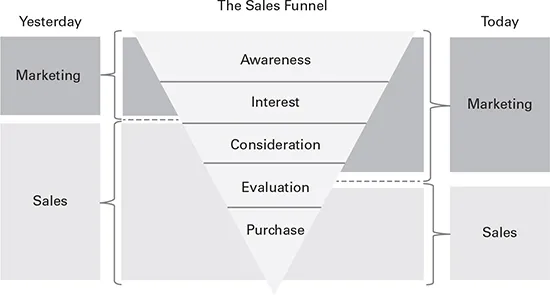
Once upon a time – a mere decade ago – the buyer journey in B2B was relatively straightforward and linear, and marketing’s job was to fill the top of the sales funnel by creating awareness of our brands and driving interest for our products and services. To do this, a B2B marketer’s toolkit consisted almost solely of PR activity, trade shows and events, and product or service collateral, with perhaps some product and industry-specific advertising added to the mix.
The traditional sales and marketing approach pushed these products or services to customers along this linear funnel and focused on lead generation and qualification, the bid or proposal, negotiation of terms and closing of the sale. Funnel metrics kept track of from where a sale would most likely come and when, enabling sales to remain on track for achieving or exceeding their targets within the specified timeframe set by the business (Figure 1.1).
Figure 1.1 The sales funnel yesterday and today
The problem is that today’s B2B customers no longer buy this way. Our customers are increasingly bringing their consumer buying behaviours into the B2B world. And sales tracking alone does not provide the business with any insight into what is driving these buying behaviours.
This dramatic shift in the buyer journey means that marketing now ‘owns’ more of the sales funnel than ever before, with sales focused on, well, closing the sale, a shift that many in our B2B organizations have not quite got to grips with. Yet, we still tend to think of the B2B customer journey in terms of this funnel. We depend upon marketing to have done their ‘brand awareness’ job so that when our salespeople come calling our customers will be interested in hearing about what we have to sell.
In many ways, the funnel is still a useful model and it remains an important tool for both sales and marketing. The funnel is the foundation for a business to understand its sales pipeline as well as for developing and delivering its marketing strategy. It creates the roadmap for the buying journey so that we as marketers can decide what outcomes we want to achieve at each stage in the journey, where to focus our marketing efforts, what tactics to use and what marketing success looks like.
Yet it’s an outdated model for looking at the customer buying cycle. First, the customer buying journey is no longer this simple or linear. But most importantly, the funnel model is overly concerned with ‘what we sell’ instead of what the customer actually wants and needs.
The engagement continuum
I now look at the customer buying journey in B2B as an engagement continuum, where there are multiple potential touchpoints for both traditional and new marketing activity. Because if our customers no longer want to be sold to, we have to completely change our perspective and think not only about where along the buying journey we need to have a presence, but how we can engage with our customers before their buying journey even begins (Figure 1.2). (I will explore this concept of engagement before customers may even be thinking about a purchase further in Part Three.)
Figure 1.2 The engagement continuum
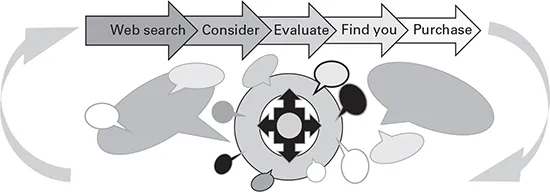
But even this doesn’t adequately explain the buying journey. Because in reality, this journey is rarely linear any more and increasingly involves more than a single decision-making authority. This is challenging for B2B sales teams, who often have long-standing relationships with those individual decision-makers. And the more complex, costly or risky a purchase, the more people will be involved in the decision-making process. Furthermore, our B2B buyers have their own influencers across their organizations – as well as influencers outside of it – who may well be drawn in to the buying journey. They continually veer off the continuum, connect with their social networks, revise their needs and perceptions, go back online, source specific information, opinions and advice, go back and discuss with their internal stakeholders – both those who will have a say in the final purchase and those who will use the product or service – at any point during the journey...
Table of contents
- Cover
- Book Halftitle
- Title Page
- Copyright
- Contents
- List of figures and tables
- About the author
- Acknowledgements
- Introduction
- PART ONE Think different
- PART TWO Do different
- PART THREE Be different
- Conclusion: being better B2B marketers
- References and further reading
- Index
- Backcover
Trusted by 375,005 students
Access to over 1.5 million titles for a fair monthly price.
Study more efficiently using our study tools.
Frequently asked questions
Yes, you can cancel anytime from the Subscription tab in your account settings on the Perlego website. Your subscription will stay active until the end of your current billing period. Learn how to cancel your subscription
No, books cannot be downloaded as external files, such as PDFs, for use outside of Perlego. However, you can download books within the Perlego app for offline reading on mobile or tablet. Learn how to download books offline
We are an online textbook subscription service, where you can get access to an entire online library for less than the price of a single book per month. With over 1.5 million books across 990+ topics, we’ve got you covered! Learn about our mission
Look out for the read-aloud symbol on your next book to see if you can listen to it. The read-aloud tool reads text aloud for you, highlighting the text as it is being read. You can pause it, speed it up and slow it down. Learn more about Read Aloud
Yes! You can use the Perlego app on both iOS and Android devices to read anytime, anywhere — even offline. Perfect for commutes or when you’re on the go.
Please note we cannot support devices running on iOS 13 and Android 7 or earlier. Learn more about using the app
Please note we cannot support devices running on iOS 13 and Android 7 or earlier. Learn more about using the app
Yes, you can access B2B Marketing Strategy by Heidi Taylor in PDF and/or ePUB format, as well as other popular books in Business & Marketing. We have over 1.5 million books available in our catalogue for you to explore.