Questionnaire Design
eBook - ePub

Questionnaire Design

How to Plan, Structure and Write Survey Material for Effective Market Research

  1. English
  2. ePUB (mobile friendly)
  3. Available on iOS & Android
eBook - ePub

Questionnaire Design

How to Plan, Structure and Write Survey Material for Effective Market Research

About this book

Market research in business is changing. Questionnaire Design, fourth edition, delivers a complete handbook for the mounting challenge of acquiring more data in less time, generating an entire rethink on how data is collected. The growth in mobile devices is limiting the readability of traditional measurement tools, new consumer channels are altering access, whilst time spent answering questions is decreasing exponentially. This book provides practical guidelines to plan, structure and compose questionnaires across all industries and purposes, ensuring valuable data insights are captured with accuracy and efficiency.

Fully updated, the fourth edition of Questionnaire Design includes a new chapter on how to navigate the multiple software options available, with guidance on how to engage and retain respondents earlier on at planning stage, using new mobile design approaches and measurement tools. Updates also cover advances in data privacy, maximizing international reach and managing the transition from face-to-face surveys towards soft launches online. Whether applying to business positioning, consumer insights, employee feedback or product analysis, the ability to gauge a market snapshot on a global scale is escalating the demand for online survey and questionnaire data, making this is an essential addition to every professional's shelf.

Frequently asked questions

Yes, you can cancel anytime from the Subscription tab in your account settings on the Perlego website. Your subscription will stay active until the end of your current billing period. Learn how to cancel your subscription.
At the moment all of our mobile-responsive ePub books are available to download via the app. Most of our PDFs are also available to download and we're working on making the final remaining ones downloadable now. Learn more here.
Perlego offers two plans: Essential and Complete
  • Essential is ideal for learners and professionals who enjoy exploring a wide range of subjects. Access the Essential Library with 800,000+ trusted titles and best-sellers across business, personal growth, and the humanities. Includes unlimited reading time and Standard Read Aloud voice.
  • Complete: Perfect for advanced learners and researchers needing full, unrestricted access. Unlock 1.4M+ books across hundreds of subjects, including academic and specialized titles. The Complete Plan also includes advanced features like Premium Read Aloud and Research Assistant.
Both plans are available with monthly, semester, or annual billing cycles.
We are an online textbook subscription service, where you can get access to an entire online library for less than the price of a single book per month. With over 1 million books across 1000+ topics, we’ve got you covered! Learn more here.
Look out for the read-aloud symbol on your next book to see if you can listen to it. The read-aloud tool reads text aloud for you, highlighting the text as it is being read. You can pause it, speed it up and slow it down. Learn more here.
Yes! You can use the Perlego app on both iOS or Android devices to read anytime, anywhere — even offline. Perfect for commutes or when you’re on the go.
Please note we cannot support devices running on iOS 13 and Android 7 or earlier. Learn more about using the app.
Yes, you can access Questionnaire Design by Ian Brace in PDF and/or ePUB format, as well as other popular books in Business & Business General. We have over one million books available in our catalogue for you to explore.

Information

Publisher
Kogan Page
Year
2018
Print ISBN
9780749481971
eBook ISBN
9780749481988
Edition
4

APPENDIX 1

Case study: whisky usage and attitude study

The questionnaire

We now have the final questionnaire. On the following pages, it will be shown as it will appear to respondents. Notes beneath each screen show the filtering or logic that that follows from each question.
image
Screen 1. The welcome screen. Here we need to tell the respondent the broad nature of the subject matter – we do not want to reveal that it is about Scotch whisky at this point. We also say how long it is likely to take. For people who do not pass the screening questions it will take a lot less, which is why we say ‘up to about 10 minutes’.
Our Data Protection responsibilities are taken care of through the link to ‘Data Protection and Privacy Policy’.
image
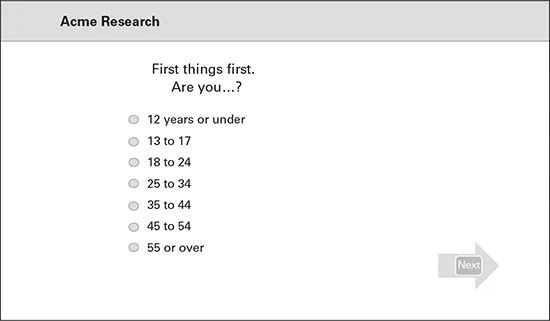
Screen 2. Because survey is about an alcoholic drink we need to screen out anyone below the legal drinking age, in this case 18 years. We disguise that this is what we are doing by having a range of age bands both above and below the 18 years. This makes it more difficult to guess that this is what we are doing and lie about their age.
Anyone under 18 is routed to Screen 33, the closure screen for those who do not qualify.
Others to QA.
image
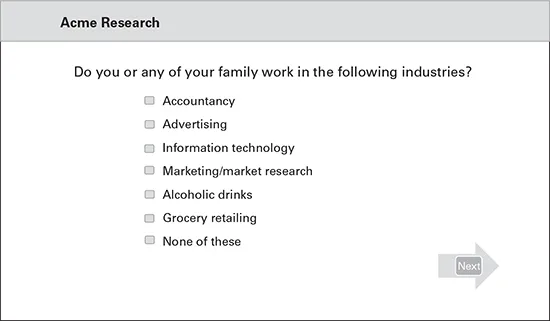
Screen 3. QA. Security screener. Here we identify people who work in, or have close relatives who work in, professions which would skew the representivity of the sample. People who work for competitors to Crianlarich could also deduce the Crianlarich strategy from some of the questions. The other answers are included as blinds, to give everyone a chance of providing an answer.
Anyone who answers Advertising, Marketing/Market Research or Alcoholic drinks goes to Screen 33.
Others to QB.
image
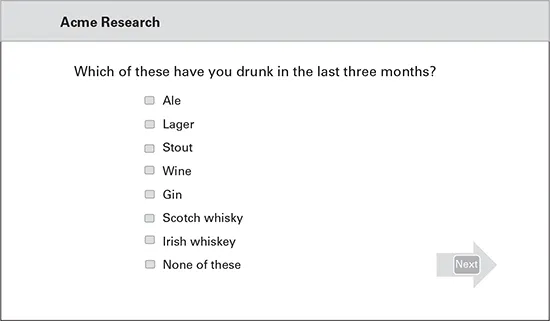
Screen 4. QB. This identifies those who drink Scotch whisky. Again, a set of blind answers are provided to allow everyone to answer something, and not be ‘helpful’ by claiming to drink Scotch which might happen if it were the only option available. This also provides valuable information about what other drinks are used by Scotch whisky drinkers.
Those who do not drink Scotch whisky, go to Screen 33.
Others to QC.
image
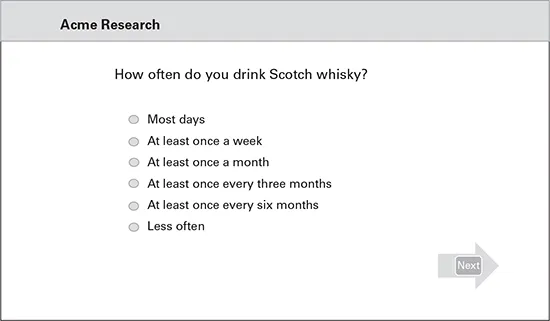
Screen 5. QC. We want to identify people who drink Scotch whisky at least once every three months. The inclusion of other answers is partly to disguise where out cut off is, but also provides valuable information about frequency of drinking amongst the sample. In a tracking study, this, taken together with the penetration of Scotch whisky drinkers from QB, can provide valuable information about whether the market as a whole is in growth or decline.
Those who drink Scotch whisky less often than every three months go to Screen 33. Everyone else constitutes the sample definition that we are looking for, and continues to Q1.
image
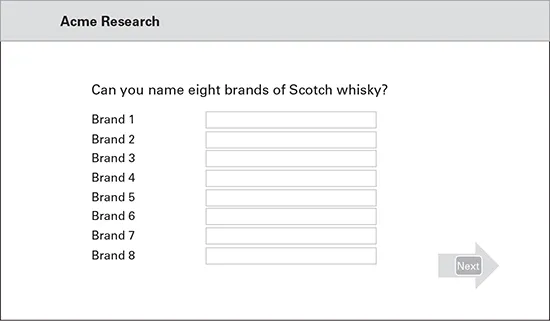
Screen 6. Q1. Spontaneous brand awareness. A key question. This is our challenge question to see if they can name eight brands. This is likely to elicit more brand names than if simply asked to name brands of Scotch of whisky. We can see from the order in which the boxes are completed whether Crianlarich moves up in people’s consciousness above other brands over time.
Continue with Q2.
image
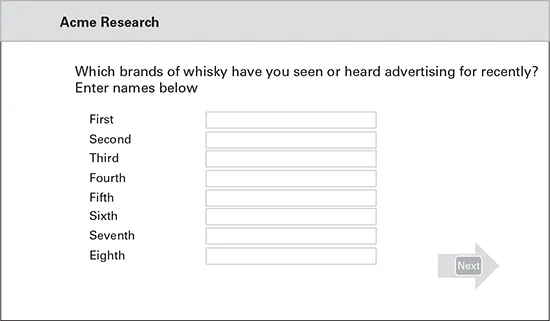
Screen 7. Q2. Spontaneous advertising awareness. A key question. No challenge here, because we want respondents to think of recent advertising, and not go back too far simply to meet the challenge.
Continue with Q3.
image
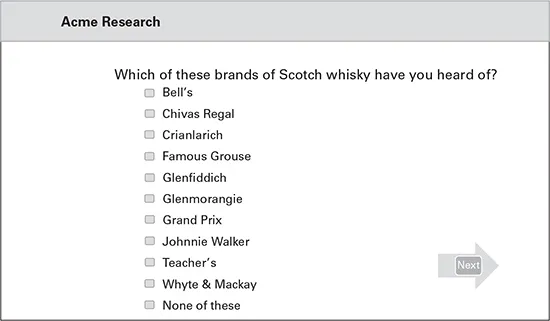
Screen 8. Q3. Prompted brand awareness. Here we have a list of the major brands and those we believe to be the closest competitors to Crianlarich. This is about brand recognition, and our concern here is mostly with the proportion of people who do not recognize the name Crianlarich. That tells us whether the job of the advertising should be primarily to raise awareness if that is very low, to reinforce brand positioning for an already well-known brand, or if there is more scope to create a brand positioning for a brand that is known but not well known.
image
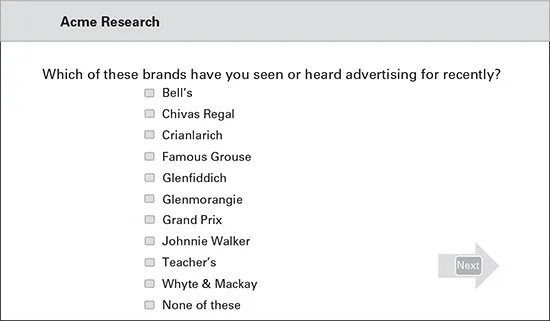
Screen 9. Q4. Prompted advertising awareness. What we are looking for here is whether the Crianlarich advertising h...
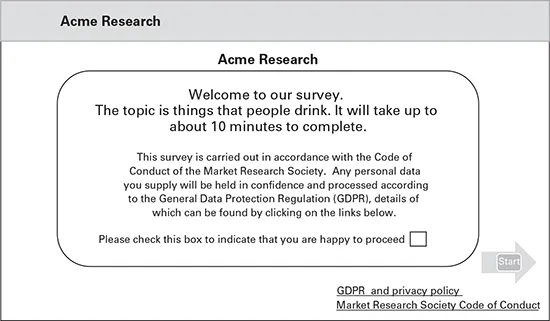
Table of contents

  1. Cover
  2. Title Page
  3. Copyright
  4. Contents
  5. List of Figures
  6. List of Tables
  7. Introduction
  8. 01 Knowing your questionnaire objectives before you begin
  9. 02 Which is the appropriate data collection media?
  10. 03 How to plan a questionnaire
  11. 04 An overview of question types
  12. 05 Understanding different data types created by questions
  13. 06 Selecting and creating appropriate rating scales
  14. 07 Asking behavioural questions for the best data
  15. 08 Measuring attitude and image: issues and solutions
  16. 09 Writing effective questions
  17. 10 Creating a questionnaire for an online survey
  18. 11 Engaging respondents in online surveys
  19. 12 Creating a questionnaire for interviewers or paper self-completion
  20. 13 Comparing questionnaire capabilities in online survey systems
  21. 14 How to pilot a questionnaire
  22. 15 Ethical issues when writing a questionnaire
  23. 16 Understanding social desirability bias in question responses
  24. 17 Building and designing questionnaires for international surveys
  25. Appendix 1
  26. Appendix 2
  27. References
  28. Index
  29. Backcover