Strengths-Based Recruitment and Development explains how and why strengths-based recruitment (SBR) is having a transformational impact on performance in top companies like Saga, Gap, Starbucks and SABMiller. By shifting the focus from what people can do (competency-based recruitment) to what they naturally enjoy doing, or SBR, these companies have reported results which include a 50% drop in staff turnover, 20% increase in productivity and a 12% increase in customer satisfaction within a matter of months. It is no wonder that organizations in many sectors are adopting this new and powerful approach to improve performance, customer satisfaction and competitive edge.
Strengths-Based Recruitment and Development includes case studies and interviews with executive board level leaders. These provide rare insight into how they implemented strengths approaches in their organizations to improve the bottom line and performance. The book shows how strengths-based talent management goes beyond simply recruiting the right people to creating a strategy and culture that has a transformational effect on organisational culture and results. Strengths-Based Recruitment and Development will be the go-to book on strengths-based talent management for HR professionals and managers. Online supporting resources include bonus frequently asked questions about strengths-based talent management.
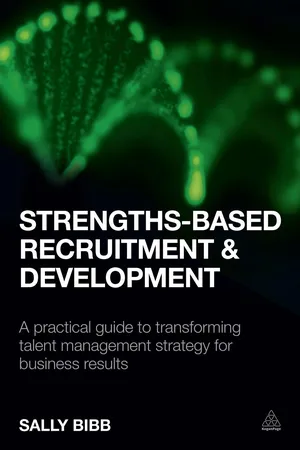
eBook - ePub
Strengths-Based Recruitment and Development
A Practical Guide to Transforming Talent Management Strategy for Business Results
- English
- ePUB (mobile friendly)
- Available on iOS & Android
eBook - ePub
Strengths-Based Recruitment and Development
A Practical Guide to Transforming Talent Management Strategy for Business Results
About this book
Information
PART ONE
A practical guide to implementing strengths-based recruitment and development
01
An introduction to strengths-based recruitment
This chapter answers these questions:
- What is strengths-based recruitment (SBR)?
- How is SBR different from other recruitment approaches?
- What are the different SBR methodologies?
The old man knew he was dying, and so did the ward sister. He had had no visitors and no friends or family to sit with him in his last days. But he had a beloved dog at home. So the ward sister arranged to have his dog brought in to the hospital. It was obviously against hospital rules, but the need to do the right thing by the old man and make a difference to him in his dying days was more important to her, so she went ahead and broke them. She didn’t put anyone else at risk in any way but she got into serious trouble for it. Nevertheless, she said she’d do it again if it were the right thing for her patient.
This true story illustrates why strengths-based recruitment is now being embraced by visionary leaders in organizations. These leaders want their organizations to be full of people who are great at, and committed to, their jobs. They want people who go the extra mile for their customers. And they realize that their people are their brand. It’s all about finding employees who are the right kind of people, and that means delving down and looking beyond the surface. It’s about understanding the strengths, values and motivations that are behind a person’s behaviour.
The ward sister who smuggled the dog into the hospital could have been seen to be risk-taking. And indeed, if that behaviour were borne of the wrong intentions, it would have been. However, there were three strengths at work in this situation that meant that this ward sister was exactly the type of person that this National Health Service (NHS) Trust’s Chief Nurse said she wanted in her team. Three of the thirteen strengths that this ward sister, and all other great ward sisters, has are ‘doing the right thing’, ‘making a difference’ and ‘having very high standards’. This story tells you how the NHS is now able to identify nurses with the potential to become great ward sisters. It’s not simply a tactical HR issue to improve recruitment processes; this is a strategic issue for the NHS. By appointing the right people in the first place and improving patient outcomes, they can fulfil their primary duty and restore public faith in the nursing profession and, by extension, the NHS.
Katherine Fenton, Chief Nurse at University College London Hospitals NHS Foundation Trust, in an article in the Health Service Journal in February 2014 said, ‘Strengths-based recruitment is about changing the selection processes of an organization, yes. But it’s about more than that. It’s a strategic intervention that transforms organizational culture, service and performance.
’This chapter defines strengths and how they are developed, explains what strengths-based recruitment is and explores its origins. It also looks briefly at the alternatives to SBR and explains how SBR is different. Finally, the different SBR methodologies are examined.
By the end of this chapter you will clearly understand SBR, how it works and how it compares to other methods of recruitment.
What is strengths-based recruitment (SBR)?
Strengths-based recruitment is attracting, selecting and promoting people with the right innate strengths and motivators for the job. It’s about finding people who are a great fit for the role, really want to do it and will thrive in it versus hiring those who just can do it. In a nutshell, it’s about finding ‘round pegs’ for ‘round holes’. Despite the huge amount of effort organizations make to attract and hire the right people there are a surprising number who are ‘square pegs’ in ‘round holes’.
As Steve Jobs, the late Chief Executive Officer (CEO) of Apple, once said, ‘Your work is going to fill a large part of your life, and the only way to be truly satisfied is to do what you believe is great work. And the only way to do great work is to love what you do.’ Steve Jobs was right when he said this. If you’ve ever been in the wrong job you will probably relate to this. It’s hard to be great if you don’t like or aren’t very good at your job. It saps your energy and enthusiasm and is a confidence killer. Identifying people who will do great work because they are a natural fit is the essence of SBR.
What is a strength?
A strength is defined as something that someone is innately good at, loves doing and is energized by. Organizations that adopt SBR do so because they want to select people whose innate strengths match the requirements of the job they want them to do.
Starbucks UK make a clear link between employees who love their jobs and customer satisfaction. They wanted to identify the strengths and motivators of their best baristas, the goal being to understand the ‘formula’ so that they could recruit more of the best. Sandra Porter, who was the HR Director of Starbucks UK and Ireland and introduced strengths-based recruitment into the company, said, ‘I felt that there was a huge opportunity to improve the effectiveness of our recruitment if we could tap into what someone is genuinely good at and has a passion for.’ If a person’s strengths don’t meet the needs of the job it is easy for them to understand why, yet still feel good about themselves. They can become great ambassadors for the company, too, because the selection process feels very positive and they walk away understanding why that job is not for them instead of feeling rejected.
Where do strengths come from?
A person’s strengths are created by synapses, or connections, in the brain. A synapse is a connection between two brain cells than enables the cells (neurons) to communicate with one another. These synapses are your threads – and behaviour depends on the formation of appropriate interconnections among neurons in the brain. Crudely, your synapses create your strengths.
On day 42 after conception your brain creates its first neuron; 120 days later you have 100 billion – or 9,500 neurons every second. Sixty days before birth your neurons start to communicate with each other and make connections (synapses). By the age of 3 years old each of the 100 billion neurons have formed 15 thousand synaptic connections with other neurons. That’s 15 thousand connections for each of your 100 billion neurons. But then things take a strange turn. Nature now prompts you to ignore a lot of your woven threads, and as these get neglected they fall into disuse and connections start to break. Between the ages of 3 and 15 you lose billions of these synaptic connections. By the age of 16 ½ the network is gone. And you can’t rebuild it. Your genetic inheritance and early childhood experiences assist you in finding some connections smoother and easier to use than others, for example the caring connections, or the strategic or relating connection. Through use or nurture some of these dwindle and some of them are used and honed so that they become very well established. By puberty these synaptic connections are formed and we don’t really change that much after that. The neuroscientist and paediatric neurologist Dr Peter Huttenlocher (2002), in his studies of neuroplasticity and neural connections, found that the typical pattern for a child’s cognitive development is that an overabundance of synaptic connections are formed early on, only later to be refined on the basis of which are used most often, that is, which are most consistently fired in response to environmental stimulus.
Our strengths are like a four-lane super-highway of the brain – the connections that are fast and efficient are those that are used often and are well trodden. The connections (or synapses) that are used less often are like a minor road that is unfamiliar, more difficult to navigate and not an enjoyable experience. Dr Harry Chugani, Professor of Paediatrics, Neurology and Radiology at Wayne State University School of Medicine put it this way, ‘Roads with the most traffic get widened. The ones that are rarely used fall into disrepair’ (Coffman and Gonzalez-Molina, 2002: 21).
This does not mean that people cannot change, but it implies that people are who they are by puberty and don’t change significantly. We may modify our behaviour, but what thrills us or drains us stays fairly constant over time. For example, if you end up with a super-highway for competitiveness, when you see numbers you can’t help but use them to compare your performance with other people’s. Or if you have no connection with strategy you understand that thinking strategically is important but you just can’t seem to think like that. It means we all filter information or respond to situations naturally in different ways.
What are the origins of SBR?
The strengths-based approach to recruitment and development has its roots in the Positive Psychology and Appreciative Inquiry (AI) movements. Positive Psychology is a branch of psychology that is primarily concerned with the positive, adaptive, creative and emotionally fulfilling aspects of human behaviour. The humanistic psychology movement, with its emphasis on the growth of the human, which has its origins in the 1950s, was the most obvious predecessor of Positive Psychology. The most notable of humanist psychologists were Carl Rogers who introduced the notion of the fully functioning human being and Abraham Maslow who was the first psychologist to use the term Positive Psychology, and whose work emphasized self-actualization. Appreciate inquiry is a term coined by David L. Cooperrider in 1986 to describe the discipline of looking for what works in a system or individual.
Martin Seligman from the University of Pennsylvania noted back in 2000 that psychologists know a lot about what is wrong with people but very little about what is right. Indeed, until the 2000s psychological research was predominantly focused on disorders, suffering and dysfunction. Seligman consequently believed that the time had come for things to change: ‘the time has arrived for a positive psychology … to remind our field that psychology is not just the study of pathology, weakness, and damage; it is also the study of strength and virtue. Treatment is not just fixing what is broken; it is nurturing what is best’ (Seligman and Cs...
Table of contents
- Cover
- Half Title
- Strengths-Based Recruitment and Development
- Contents
- About the author
- Foreword
- Acknowledgements
- Introduction
- Part one A practical guide to implementing strengths-based recruitment and development
- Part two Real-life insights and stories
- Further reading
- Index
- Copyright
Trusted by 375,005 students
Access to over 1.5 million titles for a fair monthly price.
Study more efficiently using our study tools.
Frequently asked questions
Yes, you can cancel anytime from the Subscription tab in your account settings on the Perlego website. Your subscription will stay active until the end of your current billing period. Learn how to cancel your subscription
No, books cannot be downloaded as external files, such as PDFs, for use outside of Perlego. However, you can download books within the Perlego app for offline reading on mobile or tablet. Learn how to download books offline
Perlego offers two plans: Essential and Complete
- Essential is ideal for learners and professionals who enjoy exploring a wide range of subjects. Access the Essential Library with 800,000+ trusted titles and best-sellers across business, personal growth, and the humanities. Includes unlimited reading time and Standard Read Aloud voice.
- Complete: Perfect for advanced learners and researchers needing full, unrestricted access. Unlock 1.5M+ books across hundreds of subjects, including academic and specialized titles. The Complete Plan also includes advanced features like Premium Read Aloud and Research Assistant.
We are an online textbook subscription service, where you can get access to an entire online library for less than the price of a single book per month. With over 1.5 million books across 990+ topics, we’ve got you covered! Learn about our mission
Look out for the read-aloud symbol on your next book to see if you can listen to it. The read-aloud tool reads text aloud for you, highlighting the text as it is being read. You can pause it, speed it up and slow it down. Learn more about Read Aloud
Yes! You can use the Perlego app on both iOS and Android devices to read anytime, anywhere — even offline. Perfect for commutes or when you’re on the go.
Please note we cannot support devices running on iOS 13 and Android 7 or earlier. Learn more about using the app
Please note we cannot support devices running on iOS 13 and Android 7 or earlier. Learn more about using the app
Yes, you can access Strengths-Based Recruitment and Development by Sally Bibb,Sally Bibb in PDF and/or ePUB format, as well as other popular books in Business & Human Resource Management. We have over 1.5 million books available in our catalogue for you to explore.