Trust is an invaluable commodity in any business environment. Organizations benefit from being viewed as transparent, open and human, and one of the best ways of achieving this is through authentic employee advocacy. Participation Marketing takes a detailed look at the benefits that arise when employees are fully subscribed to a brand's ethos, and how this can be used to magnify a brand's voice. After all, it's likely that every individual employee of a company now has several hundred unique social media connections, if not more. So by engaging staff and encouraging them to participate in company activity and share via their own channels, they will be broadcasting trusted brand experiences to entirely new groups of consumers.
Employee advocacy has always been worth investing in, but as the combination of constant connectedness and conversation becomes standard in our everyday lives, so too grows the importance of leveraging it. Participation Marketing will convince business leaders to think hard about employee advocacy as a channel that has many positive business outcomes. Internally, it will engage employees and make them feel part of something bigger, which will naturally result in employee satisfaction, retention and an increase in productivity. Externally, it will help brands reach new audiences with trusted and relevant stories.
eBook - ePub
Participation Marketing
Unleashing Employees to Participate and Become Brand Storytellers
- English
- ePUB (mobile friendly)
- Available on iOS & Android
eBook - ePub
Participation Marketing
Unleashing Employees to Participate and Become Brand Storytellers
About this book
PART ONE
Setting the groundwork
01
Employee advocacy
Making a believer out of you
There’s a secret I want to let you in on. And the fact that you bought, borrowed or downloaded this book means it’s a secret you probably already know. Some subconscious, intuitive space in your brain is already privy to what others will soon learn: employee advocacy is a company’s biggest opportunity for growth.
It is a concept that causes many naysayers and sceptics to roll their eyes, and that is understandable. As people who are immersed in business culture, especially that of Silicon Valley, we are absolutely spoiled on ideas. Strategies and best practices seem all too fleeting, and there is always some buzzword making the rounds, promising the world and more. Sometimes it pans out, sometimes it doesn’t. But you have to admit, there are worse things than a surplus of seemingly smart business blueprints (say that three times fast), but many of us lack the time and energy to test them.
Employee advocacy is not just another flash in the pan. The very nature of it is steadfast because, simply put, as long as there are companies, there will always be employees, and as long as there are employees, there will always be an opportunity to mobilize them to be storytellers. In other words: employee advocacy has always been an area worth investing in, but as the combination of constant connectedness and conversation becomes standard in our everyday lives, so too grows the importance of leveraging it. Marketers? This means you.
Rewind: the whole social business thing
I know what you’re thinking: more social media? Haven’t we had enough already? It has been a topic of conversation for over a decade. And it’s true – social has been a hot topic in the professional space for a number of years now, but I firmly believe we have not even come close to seeing what it is capable of, especially as companies are now embracing digital transformation.
In the recent past, marketers aiming to tap into various communities did so by participating in message boards and forums. More recently they are using popular platforms such as LinkedIn, Facebook, Twitter and even Snapchat. And while that is still a worthwhile way to connect with others, formalizing and scaling a more comprehensive process around social engagement takes that world of potential and breaks it wide open. But it requires a plan.
For starters, knowing what social business actually means is crucial. The term was coined several years ago and has taken on a load of different definitions ever since. And while the topic does not come up that much any longer, it is still important as digital transformation takes centre stage. My personal view on the topic has not changed since 2011:
Social business is the blueprint for the digital transformation of an organization – bridging external with internal, resulting in a more connected way of doing business, which creates shared value for all stakeholders – employees, customers, influencers and channel partners.
Next, understanding the framework of a social business is equally crucial. If you read my first book, Smart Business, Social Business: A playbook for social media in your organization (2011), you have likely already seen the chart shown in Figure 1.1, which categorizes work streams by platforms, processes and people. To fully embrace digital transformation and evolve your organization to be a social business, all three work streams need to work independent of each other, yet also be completely integrated into the DNA of your brand, your business and your culture.
Figure 1.1 Social business framework
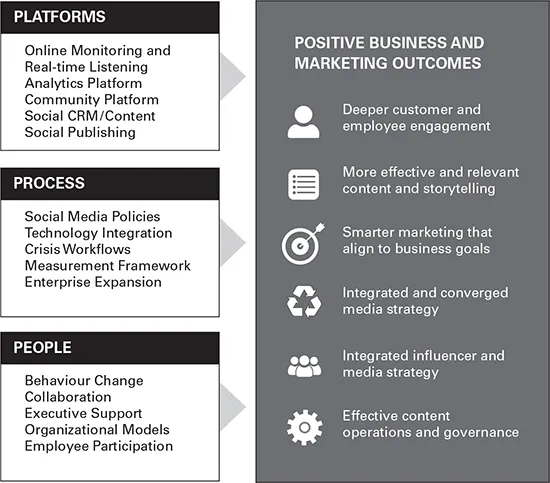
Let’s break down these three work streams one by one and review how you can get the ball rolling with each.
Platform, sometimes referred to as just technology
Social business needs proven technology to function, and I don’t mean e-mail or an outdated customer relationship management (CRM) system. The challenge is that there are so many software vendors in the space to choose from that it is hard to decide. Many of them promise the same things, but often take months to deploy and ultimately do not deliver the desired outcome.
Think strategically before making significant investments in software: consider scale, integration, support and maintenance costs – as well as the current suite of applications that you have behind the firewall. A 360-degree view of all your technical requirements up front will make your choice of technology much easier (and smarter). Another tip? You will want to get your IT group involved from the get go. The last thing you want happening is for them to shut down your project midway due to a security or privacy issue. The following are technology applications that I have used in the past and have the strongest capabilities depending on what it is you need to accomplish:
- Social Listening: monitor, dissect and learn valuable insights about online conversations (brand, competitors, general market) – Crimson Hexagon.
- Audience Analysis: analysing specific audiences to better understand what they say, share, talk about and general behaviour – Crimson Hexagon.
- Content Marketing: manage content creation, distribution and measurement – across channels, teams and global markets – NewsCred.
- Social Media Experience Management: listen, publish, engage in real time and build unique experiences for the social media community – Spredfast.
- Measurement and Reporting: social analytics and insights of content and campaigns – Simply Measured.
- Employee Advocacy: manage, scale and deploy enterprise-grade employee advocacy programmes – Dynamic Signal.
- Inbound Marketing and Sales: manage customer contacts, web analytics and the sales pipeline – Hubspot.
- Web Analytics: track and learn valuable insights about your web visitors – Google Analytics.
Before you go out and schedule a demo with any of the above vendors, be sure to document a list of your requirements first. Trust me, it’s better this way.
And finally, remember that at the end of the day, technology alone will not change your culture, even with the rise of artificial intelligence. You will still need the human touch to build relationships and drive change. There are several other factors you need to consider before you experience true digital transformation, such as process and people, as set out below.
Building simple processes
Here’s a hard truth: processes are not sexy and almost no one likes to follow them. Ask my wife and she will tell you that even I prefer to ‘cut corners’ any chance I get – and then she will tell you all the consequences I have suffered by doing so.
While good processes might be a buzz kill, they are a must-have in all business, especially those embracing digital transformation. Employees sharing sensitive material externally, social media ownership, crisis management and managing product feedback are just a few challenges that you may be dealing with today. Ensuring that you have documentation addressing these issues and evangelizing them internally will be a factor to your success.
My advice to you is this: start thinking through the solutions for all those challenges before building an employee advocacy programme. You don’t need to solve all of them, but at least have a plan that you can start working on. You need to make sure you are managing the chaos that exists behind the firewall before focusing on external activities, or you will just have double the trouble. My first book, mentioned earlier, is a good read and will help you to formulate a solid plan of action.
Start with the simple things. Give your teams easy-to-use tools for handling workflows or completing mundane tasks, and they will send fewer e-mails. Increase engagement in your meetings to uncover and address roadblocks before productivity declines, which would also naturally result in more e-mails. No one wants more e-mails. You may not win an award and you probably will not make ‘employee of the year’ by creating good processes, but I guarantee they will make your life easier in the long run – and the foundation for an employee advocacy programme much stronger.
Several processes that will be discussed later in the book will focus heavily on training initiatives, social media policies and guidelines, moderation policies and expanding your programme globally. Each of these must be documented, approved, rolled up into a larger governance model and then shared with everyone involved. This will ensure that your employees are telling consistent brand stories across multiple platforms, regions and languages, and that there is legal documentation that protects the organization, empowers employees and ensures that everyone is on the same page.
Embrace the people
I have never won a professional award. There are no ‘employee of the year’ –or month – plaques sitting on my desk or hanging on my office walls. But I have always been proud of where I work, and I am happy to spend 10+ hours a day sitting in an ...
Table of contents
- Cover
- Title Page
- Copyright
- Contents
- About the author
- Foreword by Daniel Newman
- Introduction by Russ Fradin: your people are your brand
- PART ONE Setting the groundwork
- PART TWO The business case for employee advocacy
- PART THREE Blueprint: launching your employee advocacy programme
- References
- Index
- Backcover
Trusted by 375,005 students
Access to over 1.5 million titles for a fair monthly price.
Study more efficiently using our study tools.
Frequently asked questions
Yes, you can cancel anytime from the Subscription tab in your account settings on the Perlego website. Your subscription will stay active until the end of your current billing period. Learn how to cancel your subscription
No, books cannot be downloaded as external files, such as PDFs, for use outside of Perlego. However, you can download books within the Perlego app for offline reading on mobile or tablet. Learn how to download books offline
Perlego offers two plans: Essential and Complete
- Essential is ideal for learners and professionals who enjoy exploring a wide range of subjects. Access the Essential Library with 800,000+ trusted titles and best-sellers across business, personal growth, and the humanities. Includes unlimited reading time and Standard Read Aloud voice.
- Complete: Perfect for advanced learners and researchers needing full, unrestricted access. Unlock 1.5M+ books across hundreds of subjects, including academic and specialized titles. The Complete Plan also includes advanced features like Premium Read Aloud and Research Assistant.
We are an online textbook subscription service, where you can get access to an entire online library for less than the price of a single book per month. With over 1.5 million books across 990+ topics, we’ve got you covered! Learn about our mission
Look out for the read-aloud symbol on your next book to see if you can listen to it. The read-aloud tool reads text aloud for you, highlighting the text as it is being read. You can pause it, speed it up and slow it down. Learn more about Read Aloud
Yes! You can use the Perlego app on both iOS and Android devices to read anytime, anywhere — even offline. Perfect for commutes or when you’re on the go.
Please note we cannot support devices running on iOS 13 and Android 7 or earlier. Learn more about using the app
Please note we cannot support devices running on iOS 13 and Android 7 or earlier. Learn more about using the app
Yes, you can access Participation Marketing by Michael Brito in PDF and/or ePUB format, as well as other popular books in Business & Marketing. We have over 1.5 million books available in our catalogue for you to explore.