How one man brought the Olympics to Los Angeles, fueling the city's urban transformation.
Dreamers and Schemers chronicles how Los Angeles’s pursuit and staging of the 1932 Olympic Games during the depths of the Great Depression helped fuel the city’s transformation from a seedy frontier village to a world-famous metropolis. Leading that pursuit was the “Prince of Realtors,” William May (Billy) Garland, a prominent figure in early Los Angeles. In important respects, the story of Billy Garland is the story of Los Angeles. After arriving in Southern California in 1890, he and his allies drove much of the city’s historic expansion in the first two decades of the twentieth century. Then, from 1920 to 1932, he directed the city’s bid for the 1932 Olympic Games. Garland’s quest to host the Olympics provides an unusually revealing window onto a particular time, place, and way of life. Reconstructing the narrative from Garland’s visionary notion to its consequential aftermath, Barry Siegel shows how one man’s grit and imagination made California history.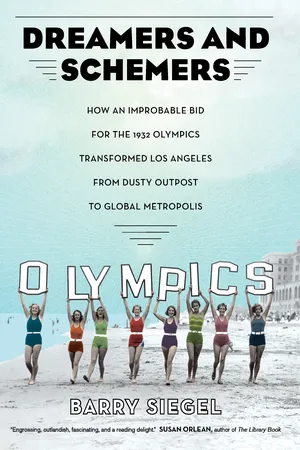
eBook - ePub
Dreamers and Schemers
How an Improbable Bid for the 1932 Olympics Transformed Los Angeles from Dusty Outpost to Global Metropolis
- 272 pages
- English
- ePUB (mobile friendly)
- Available on iOS & Android
eBook - ePub
Dreamers and Schemers
How an Improbable Bid for the 1932 Olympics Transformed Los Angeles from Dusty Outpost to Global Metropolis
About this book
Information
Publisher
University of California PressYear
2019Print ISBN
9780520379718
Edition
1eBook ISBN
9780520970649
1
BILLY’S MIGRATION
Of course he came from somewhere else, and headed west as a young man. Billy Garland was born in Maine on March 31, 1866, to the Reverend Jonathan May Garland and his wife, Becca, who had been deaf since a bout of scarlet fever at age three. Billy, a middle child, had an older brother, Rastie, and a younger sister, Rose. The family lived in Westport, an island then reachable only by ferry, where Becca’s farming family had dwelt for one hundred years. Reverend Garland, a heavily bearded circuit-riding Methodist minister, often lodged with his parishioners.
When the children came of school age, the family relocated to Waterville, Maine, where they lived in first one, then another, rented home. Life was austere in their household, but Becca encouraged her children to attend college. She prevailed with Rastie, who graduated from Colby College and Albany Law School, and with Rose, who graduated from Smith College and New York Law College. Billy followed a different path.
After three years at Waterville High School, and a short period laboring on his uncle’s farm, Billy, without graduating, moved to Boston, finding work there as a clerk in a crockery firm. Restless after one year, and troubled by a bad cough, he joined his parents in Daytona Beach, Florida, where they’d moved in 1884 to launch a stagecoach line and tend a five-acre orange grove. Billy lasted only a few months driving stagecoaches for his father’s company.
Still restless, still bothered by a bad cough, he next tried his luck in Chicago under the sponsorship of his mother’s relatives, who held leading positions in the city’s banking community. Over a span of six years, he moved up from bank messenger to clearinghouse clerk to receiving teller at the Illinois Trust and Savings Bank. His restlessness continued, though, as did his lung problems. One night in his boardinghouse room, a hemorrhage almost choked him. Find a milder, dryer climate, a doctor ordered. Billy’s eyes turned to the West. Boosters in Southern California had been extolling the great life out there: the fertile land, the burgeoning commerce, the waves of tourists, and—most important—the healthy Mediterranean-type climate. Billy boarded a Southern Pacific train and arrived in Los Angeles in the winter of 1890, with twenty-three dollars in his pocket. He moved into a boardinghouse on Olive Street, where he paid nine dollars a month for a room and breakfast. He was all of twenty-four and more than ready for his future.

FIGURE 1. Looking west on Sixth Street from Main Street, downtown Los Angeles, in 1903. Tracks cross at this intersection, where streetcars mingled with horse-drawn carriages. Security Pacific National Bank Collection / Los Angeles Public Library.
He had an inexorability about him, an air of fate. When he entered a room, often with a British “Fortunate Hits” cigarette in hand, people would gravitate toward him. What lured them was something impalpable, a certain flair. He had an infectious personality, abundant enthusiasm, unflagging energy, and a powerful handshake. On top of that, he projected composed, eye-on-the ball certitude. Those around him could see that he believed in himself and believed also in the future. Sensing he would always prevail, people wanted to follow him, wanted to climb on his bandwagon.
Billy first found work in LA as an auditor for the Pacific Cable Railway Company, earning seventy-four dollars a month. But he couldn’t stop looking out his window at this new world he inhabited. Citrus, wine grapes, and other fruits were growing everywhere. Bean fields covered what would become Beverly Hills; fig orchards covered the future Hollywood. In downtown LA, Billy could still see unpaved roads, with horses and buggies hitched in front of stores. Open water ditches—the zanjas—ran down Figueroa Street to Jefferson and along West Adams, delivering irrigation water to homes. Yet Los Angeles was evolving. The population had reached 50,000, after a sharp growth spurt in the 1880s fueled by promoters, the arrival of the transcontinental railroads, and a furious rate war between the Southern Pacific and Santa Fe lines, culminating in fares of one dollar for a journey from Chicago to LA. (It didn’t hurt that California’s oranges and lemons had taken first prize at the New Orleans International Exposition in 1884–85, suggesting Southern California as a Garden of Eden.) In just one year, 1887, the Southern Pacific brought 120,000 people to Los Angeles.
All this fueled a spectacular real estate boom between 1885 and 1887, lifting the price of an acre in Los Angeles County from one hundred dollars in 1886 to fifteen hundred dollars in 1887. It was sheer madness, a stampede, shot through with frenzied speculation. People were buying lots one day, then selling them the next day at a profit. Soon the developers stepped in, building whole new towns—more than sixty in 1887, each launched with auctions, barbecue parties, and brass bands. In that year alone, Southern California realized a dizzying one hundred million dollars in land sales, well beyond what was understood to be the region’s net value.
The boom collapsed suddenly (and inevitably) in the summer of 1888, as banks grew nervous, promoters went bust, and everyone tried to sell property simultaneously. By the time Billy arrived in 1890, real estate prices had plummeted, wiping out $14 million (nearly $355 million in 2018 dollars) of assessed valuation in one year. Millionaires had become indigents, and most of the sixty new towns had turned to grain fields. The bust shocked many residents of Los Angeles, with some fleeing, some questioning the future, and some jumping off bridges. But where others saw a debacle, Billy, as he looked around, saw only opportunity and possibility.
The boom, he reasoned, had lasting positive effects: The influx of population and capital had energized the city and generated the development of hotels, churches, schools, and new industries. The city had expanded half a mile in every direction from the central plaza, developing water service, rapid transit railroads and fifty-seven irrigation companies. Where there’d been only dirt roads, there now were eighty-seven miles of paved streets and seventy-eight miles of cement sidewalks. A number of educational institutions had also sprung up, among them the University of Southern California, Occidental College, and Pomona College. In the fall of 1888, urged on by General Harrison Gray Otis, the owner of the Los Angeles Times, the business community had formed the city’s first chamber of commerce and launched a spectacularly effective propaganda campaign, luring not fly-by-night investors but farmers and other well-off migrants from the Midwest. Given all this, Billy believed the situation to be far less discouraging than it seemed. No banks had failed. The climate and the fecund soil hadn’t gone away. Nor had the transcontinental railroads. Realty would surely rebound, he believed, . . . as it always does.
The descendent of farmers, Billy considered real estate the basis of all wealth. This represented a kind of religion to him. Since the beginning of time, he would later preach, “land has been the source of that which man calls wealth.” Real estate—the soil with its fixed improvements—“is very clearly fundamental in the makeup of the universe. It is the granite base upon which we build everything material in life.” Banks weren’t the only storehouses of wealth: “Before the time of banks, man loved the soil.”
With some of the earnings from his job, Billy bought a city lot. As his health improved he considered returning to Chicago. Then he found that his lot had increased $500 in value (the equivalent of $13,058 in 2018 dollars). He decided to stay in Los Angeles. What’s more, he decided on a new career. In 1894, after three years as an auditor at Pacific Cable, Billy at age twenty-eight quit to form his own real estate business, W. M. Garland & Co. His first important deal was the subdivision of the Wilshire Boulevard Tract, which he marketed in 1896. It was then a district of the city wholly unimproved and remote, but Billy kept urging its merits. Because he truly believed in what he was selling, so did buyers: the Wilshire tract would eventually become, for its time, the finest residential section of Los Angeles. Billy, regrettably, didn’t himself buy in the Wilshire tract (he expected LA to grow to the south). But he was on his way.
So were others, all newly arrived just as the boom went bust. Billy came to know them well. There was Harry Chandler, twenty-five in 1890, already five years into a job he’d landed in the LA Times circulation department. There was E. L. Doheny, thirty-four, a struggling frontier prospector just two years away from striking oil near the corner of Second and Glendale Boulevard—with pick and shovel, digging the first producing well in LA after finding this site by retracing the path of a wagon dripping tar. There was Henry Huntington, forty, already convinced Los Angeles would become “the most important city in this country, if not in the world,” and already planning the sprawling Pacific Electric Railway, the celebrated “Red Cars” mass transit system that, from 1901 on, connected cities throughout Southern California.
Billy soon became Chandler’s investment partner, Doheny’s neighbor and Huntington’s real estate broker, as W. M. Garland & Co. grew to dominate the field of commercial property. The future—whatever it might involve—animated Billy. Growth would shape the future, of that he was certain. Real estate values would rise along with population—the right kind of population. They just needed to promote their region, or rather, their notion of the region. Billy began to imagine a city that did not yet exist.
2
LA ON THE CUSP
It is fair enough to describe Billy Garland as a self-made man, but it’s also true that he married well. In 1897, at a party in Turnverein Hall on Spring Street, he met Blanche Hinman, one of the princesses in the Fiesta de Los Angeles that year. Her father was the wealthy cofounder of the Brooks Locomotive Works, located in Dunkirk, New York, and their family came west by private railroad car for four months every winter. “My dear Miss Hinman,” Billy wrote to Blanche that April on a sheet of W. M. Garland & Co. letterhead, “Will Mr. and Mrs. Solano, Mr. and Mrs. Hinman, yourself with any friends—occupy seats in my rooms in this building during the revelry of ‘All Fools’ night? . . . Hastily and Cordially yours, Will M. Garland. Kindly respond by bearer or tel. (Main 845).”
That evening and others like it apparently went well, for when the Hinmans returned to LA the following year, Billy and Blanche became engaged. Their wedding, at St. John’s Church in Dunkirk on October 12, 1898, was large and lavish, meriting a full-page story in the local Dunkirk Evening Observer. The church ceremony, ornamented with a lush banking of palms, ferns, and roses, was followed by a reception at the home of the bride’s parents, where electric arc lights “brilliantly illuminated the beautiful grounds” and guests’ tables were placed in the home’s bowling alley, “a fine apartment 80 feet long and 12 feet wide, with ceiling finished in natural wood.” Late that evening, Billy and Blanche departed for New York in a private car attached to the midnight train, accompanied by several friends as far as Buffalo.
Returning to Los Angeles in mid-November 1898, the young couple resided at the Van Nuys Hotel while building their house at 815 West Adams Boulevard, just west of downtown. Billy by then was already among the best known of the younger generation of LA businessmen, recognized for his prophetic signs, adorning vacant lots all over town, predicting the ever-expanding population of Los Angeles in 1900 and beyond. He was also a conspicuous figure in social circles, which made the Van Nuys Hotel just the place for him. Built by the Southern California pioneer Isaac Van Nuys on the northwest corner of Fourth and Main, the six-story hotel, even before it opened its doors in January 1897, garnered early acclaim from the Los Angeles Times as “the much needed first-class tourist hotel that was to be a credit and glory to Los Angeles.” Sunny rooms abounded, for “the peculiar situation of the lot makes it possible for the sun to shine on three sides of the house.” All bedrooms faced to the outside, all had private baths and telephones. There were richly appointed reception and lounging rooms, a grillroom and dining room, a billiard-room and barbershop, a grand staircase of iron and marble, and interior finishings of hand-polished oak, ash, and white cedar.
At the same time, despite all its fashionable elegance, the Van Nuys Hotel remained in its way very much part of the raucous frontier town it anchored, bedeviled by fatal elevator accidents, inexplicable deaths, thieving bellboys and more than a few angry fights. Interwoven with the laudatory stories hailing the new hotel were other Los Angeles Times headlines, such as “Bell Boy Killed” . . . “Charles Gamble Killed in an Elevator Shaft” . . . “Van Nuys Guests Robbed by Bell Boy” . . . “Guest of the Van Nuys Robbed of His Property While at Dinner” . . . “Hotel Waiter Accused of Larceny from Van Nuys and Beating his Wife” . . . “Wealthy Mining Man Expires Suddenly While Going to His Room in the Van Nuys” . . . and—most memorable of all—“Carved With Bread Knife; Bloody Fracas at Van Nuys Hotel; Steward Slashes Baker and Butcher” (this over an argument about a cook’s white coat).
Billy and Blanche certainly would have been happy to move into their home on West Adams when it was ready in 1900. With appreciation, Billy had been documenting its construction by taking many snapshots. They were in the newest, best, chicest area of the city, even though it still received its water from an open-ditch zanja. Billy didn’t mind. He lived now in a spacious, two-story stone-and-wood-frame gabled mansion with an expansive portico, formal dining and living rooms, and abundant grounds. This would be Billy’s home for the rest of his life.
Still, even there, he could not avoid the rowdy wide-open village around him...
Table of contents
- Subvention
- Title
- Copyright
- Dedication
- Contents
- List of Illustrations
- Author’s Note
- Prologue: Billy’s Parade
- 1 Billy’s Migration
- 2 LA on the Cusp
- 3 The Quest
- 4 A Foot in the Door
- 5 The Hand of Man
- 6 Rome, 1923
- 7 The Great Migration
- 8 Protecting the Image
- 9 A Bolt from the Blue
- 10 Planting a Seed
- 11 Then Came the Crash
- 12 Berlin, 1930
- 13 A Sacred Duty
- 14 Desperate Hours
- 15 Competing Narratives
- 16 Playing His Cards
- 17 A Lush New World
- 18 A Parallel Universe
- 19 The Games
- 20 A Footing in the World
- Epilogue
- Acknowledgments
- Notes and Sources
- Bibliography
- Index
Trusted by 375,005 students
Access to over 1.5 million titles for a fair monthly price.
Study more efficiently using our study tools.
Frequently asked questions
Yes, you can cancel anytime from the Subscription tab in your account settings on the Perlego website. Your subscription will stay active until the end of your current billing period. Learn how to cancel your subscription
No, books cannot be downloaded as external files, such as PDFs, for use outside of Perlego. However, you can download books within the Perlego app for offline reading on mobile or tablet. Learn how to download books offline
Perlego offers two plans: Essential and Complete
- Essential is ideal for learners and professionals who enjoy exploring a wide range of subjects. Access the Essential Library with 800,000+ trusted titles and best-sellers across business, personal growth, and the humanities. Includes unlimited reading time and Standard Read Aloud voice.
- Complete: Perfect for advanced learners and researchers needing full, unrestricted access. Unlock 1.5M+ books across hundreds of subjects, including academic and specialized titles. The Complete Plan also includes advanced features like Premium Read Aloud and Research Assistant.
We are an online textbook subscription service, where you can get access to an entire online library for less than the price of a single book per month. With over 1.5 million books across 990+ topics, we’ve got you covered! Learn about our mission
Look out for the read-aloud symbol on your next book to see if you can listen to it. The read-aloud tool reads text aloud for you, highlighting the text as it is being read. You can pause it, speed it up and slow it down. Learn more about Read Aloud
Yes! You can use the Perlego app on both iOS and Android devices to read anytime, anywhere — even offline. Perfect for commutes or when you’re on the go.
Please note we cannot support devices running on iOS 13 and Android 7 or earlier. Learn more about using the app
Please note we cannot support devices running on iOS 13 and Android 7 or earlier. Learn more about using the app
Yes, you can access Dreamers and Schemers by Barry Siegel in PDF and/or ePUB format, as well as other popular books in History & North American History. We have over 1.5 million books available in our catalogue for you to explore.