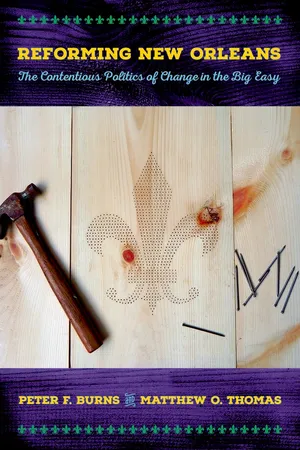
Hurricane Katrina devastated New Orleans in 2005, but in the subsequent ten years, the city has demonstrated both remarkable resilience and frustrating stagnation. In Reforming New Orleans, Peter F. Burns and Matthew O. Thomas chart the city's recovery and assess how successfully officials at the local, state, and federal levels transformed the Big Easy in the wake of disaster. Focusing on reforms in four key sectors of urban governance—economic development, education, housing, and law enforcement—both before and after Katrina, they find lessons for cities hit by sudden shocks, such as natural disasters or large-scale financial crises.One of their key insights is that post-disaster recovery tends to limit local control. State and federal officials, national foundations, and local actors excluded by pre-Katrina politics used their resources and authority to displace entrenched local interests and implement a public agenda focused on institutional and governmental change. Burns and Thomas also make clear reform in New Orleans was already underway before Katrina hit, but that it had focused largely on upper- and middle-class residents, a trend that accelerated after the storm. The market-centered nature of the reforms have ensured that they largely benefited city and regional elites while not significantly aiding the city's working-class and impoverished populations. Thus reform has come at a cost and that cost, in the long term, could undermine the political gains of the post-Katrina era.
eBook - ePub
Reforming New Orleans
The Contentious Politics of Change in the Big Easy
- 240 pages
- English
- ePUB (mobile friendly)
- Available on iOS & Android
eBook - ePub
Reforming New Orleans
The Contentious Politics of Change in the Big Easy
About this book
Information
Topic
Ciencias socialesSubtopic
Historia de Norteamérica1
Pre-Katrina New Orleans
Cities operate in a context of scarce resources; within that setting, resource providers rule. The pro-growth regime has been the most common type of political arrangement in American cities during the postwar period. In cities operated under this kind of arrangement, businesses provide human and financial capital to elected officials, who make land-use decisions favorable for business leaders. When middle-class homeowners rule, they limit growth.1
The existence of a political arrangement does not mean that governance is functional. Some arrangements operate through patronage and corruption and are characterized by mismanagement, substandard services, and poor living conditions for residents. This dysfunctional arrangement leads to a suboptimal city, especially for the poor and most racial and ethnic minorities. Dysfunction typified New Orleans even before Hurricane Katrina struck.
Prior to Katrina, New Orleans lacked a unified force in development or anything else. The business and civic elites played passive policy roles. In the 1960s, Atlanta’s corporate leaders supported desegregation of schools because they felt that tenuous race relations were bad for business. In New Orleans in the 1960s, school desegregation was characterized by violence and resistance. The elites cared more about the social order than about development. They did not endorse school desegregation but instead stood for the status quo and refused to be part of a positive political arrangement. According to one longtime member of the black political community: “When public schools integrated, white business walked away and did not come back. They relied on Catholic and private schools. This was a critical decision. New Orleans couldn’t be successful without good public schools, and without business, you have a bad educational system.”2
In 2001, Edward F. Renwick, an expert on New Orleans politics, noted that New Orleans did not have a healthy corporate sector and that the number of business leaders in the city declined each year. The city lacked big corporations with chief executive officers, senior vice presidents, and vice presidents. At the time, Entergy, the city’s energy company, was the only Fortune 500 company in New Orleans. As Renwick put it, “The business elite in New Orleans can be put into a phone booth.” In contrast to Dallas, New Orleans was a “totally political city.” The corporate elite helped solve and frame many problems in Dallas, but in New Orleans, the mayor’s office served as the epicenter of city politics. According to Renwick, “The mayor’s office rings all the time in New Orleans.”3
Several social movement–type organizations, which used protests or service provision to represent traditionally excluded groups, existed before Katrina. ACORN, which housed its national headquarters in New Orleans, was most prominent among what Rachel E. Luft calls the first generation of New Orleans’s social movement organizations. Wade Rathke, who founded ACORN in 1970, was a graduate of Ben Franklin High School in New Orleans.4
Corruption
The arrangement that governed pre-Katrina New Orleans benefited those who held elected and appointed positions. And it favored those who paid to play and had connections with elected and appointed officials. Some residents—the wealthy and middle class, business owners who secured government contracts, government employees, and relatives of those in power—supported these arrangements. These beneficiaries of the dysfunctional arrangement promoted the status quo.
How do we, as social scientists, know that pervasive corruption exists, even when it is patently obvious to just about any observer of New Orleans politics? Scholars find it difficult to quantify corruption. Most use surveys of knowledgeable informants to gauge perceptions of corruption. According to Fahim Al-Marhubi: “Ideally, measures of corruption would consist of objective evaluations that are comparable across countries and over time. Ideal measures such as these do not as yet exist. In their absence, indicators have been developed that are based on foreign businessmen and international correspondents’ perceptions of corruption.”5
New Orleans has ranked high among the most corrupt cities in the United States. In her study of corruption in fifteen large American cities over more than one hundred years, Rebecca Menes concluded that New Orleans ranked fourth among cities for corruption from 1850 to 1880; in the next thirty-year period it ranked third; and from 1931 to 1980, New Orleans was second only to Chicago as the most corrupt city in the United States.6
A team of researchers at the University of Illinois at Chicago used the number of public corruption convictions in federal courts from 1976 to 2010 to determine the most corrupt cities in the country. They ranked New Orleans fifteenth on the basis of the 545 public corruption convictions in the Eastern Federal District Court of Louisiana. A similar analysis of convictions for crimes that involved abuses of the public trust by government officials between 2002 and 2013 rated Louisiana the most corrupt state in the country. Louisiana’s Eastern Federal District Court, which includes New Orleans, had the largest number of public corruption convictions (247) in the state.7
From June 2003 until the end of 2006, the federal government indicted 190 people on corruption charges in the New Orleans metropolitan area. In that period the FBI convicted sixteen people involved in municipal corruption during the administration of Mayor Marc Morial. It also secured twenty-six convictions against employees of the New Orleans public school system for kickbacks, bribery, fraud, and theft, among other abuses. Mayor Morial’s uncle by marriage, Glenn Haydel, was convicted for stealing $550,000 from the Regional Transit Authority and spent a year in prison. Lillian Smith-Haydel, Haydel’s wife and Morial’s aunt, pleaded guilty to insurance contract bribery conspiracy charges. She received five years’ probation and four months of home confinement.8
By March 2004, the FBI had established two public corruption squads in New Orleans. At a news conference following a guilty plea on federal bribery charges by the New Orleans city council’s most senior member, the FBI’s special agent in charge of the New Orleans field office said: “It’s just brazen down here. In Louisiana, they skim the cream, steal the milk, highjack the bottle, and look for the cow.” In response to one of the convictions, U.S. Attorney Jim Letten commented: “Corruption in New Orleans is endemic. I think this simply tells us there is corruption on many levels, large scale and small scale.”9
The number of corruption cases and convictions does not include that of nine-term U.S. congressman William Jefferson, who represented New Orleans and was convicted by a federal court in Virginia for bribery, money laundering, and use of his office for racketeering. Jefferson received a thirteen-year sentence in federal prison, the longest given any member of Congress to date for acts committed while in office.
Those who benefited from corruption and patronage represented embedded interests in the New Orleans city government. The dysfunctional arrangements were headed by both black and white political leaders, who dispensed patronage to their supporters. They won; the city’s services, public policies, and residents lost. Wealthy white reformers and extra-local actors instituted piecemeal reform from time to time before Katrina but struggled to gain a foothold. Black lower- and working-class residents suffered the most from this dysfunctional political arrangement. Many went to the worst schools, lived in substandard housing in the highest-crime areas, and worked in jobs that did not pay a living wage.
The problem in New Orleans was more than the narrowness of problem-solving activity. It was an inability to defer gratification. It is the collective-action problem in an acute form. There is little history of civic cooperation. The only major cooperative projects were loaded with selective material incentives and divisible benefits that had a short-term return.
While New Orleans is on the high side with regard to political-governmental dysfunction, it is not an isolated example either in the United States or throughout the world. New Orleans resembles Naples, where client-patron relations dominate. Clientelism, as Harold Savitch and Paul Kantor call it, “overrides broader values and touches everything, from business contracts to personal relationships. Whether Christian Democrat or Socialist, the culture is geared toward exchanging jobs and favors for social support or political votes.” In Naples, government leaders choose favoritism and corruption over improving the lives of the citizens or promoting business prosperity. New Orleans has operated in much the same way. The dominant concerns for most local officials were patronage, power, and personal wealth. Other cities that have suffered from dysfunctional governance include East St. Louis, Illinois, and Camden, New Jersey.10
Machine-style patronage could be seen in New Orleans’s dozens of boards and commissions that dealt with everything from the public belt railroad to law enforcement. According to one informant, those who sat on the various boards and commissions opposed change because they were cutting deals and enjoying mega-lunches at the taxpayers’ expense. City government jobs and contracts were political in New Orleans. A person or business usually could not secure either without knowing someone in city government. As an example, a former member of the Orleans Parish School Board went to prison after she received $140,000 in kickbacks to help the brother of Congressman Jefferson secure an educational software contract.11 Relatives of elected officials often worked in city government positions and held multiple municipal contracts.
From Reconstruction onward, the machine battled reformers for control over New Orleans politics. The machine, the strongest in the South, practiced patronage, doled out political favors, and resorted when necessary to election fraud and even violence. It tended to win. The machine went by different names over time—the Regular Democratic Organization, the Choctaw Club of Louisiana, the Ring, the Old Regulars, and later the Crescent City Democratic Association—but it dominated politics.12
Mayor deLesseps “Chep” Morrison (1946–1961) led the Crescent City Democratic Association and initiated several projects and reforms, such as the Mississippi River Bridge, the New Orleans Recreation Department, and a model city home rule charter. Referring to these changes as the illusion of reform, Edward F. Haas concluded that Morrison’s machine was the last successful one to rule New Orleans. Black political organizations took off in the 1960s and 1970s and, like their white predecessors, practiced machine-style politics. Even though the golden era of the New Orleans machine may have ended with Morrison, machine-style politics, corruption, and exchange of patronage for political favors endured.13
The other political faction—the commercial-civic elite—had a conservative bent, opposed political corruption, and favored governmental reform as a way to weaken the machine. It ran candidates against the political machine but experienced limited success. Its accomplishments included the establishment of independent governing boards, which reformers thought would remove politics from government. The wealthy white Uptown elites and business interests who advocated reform in New Orleans created the Bureau of Governmental Research (BGR) in 1932, known then as the Civic Affairs League, to combat the effects of the Great Depression, Huey Long, and the Old Regulars. On its website BGR states: “Good government requires constant vigilance on the part of the governed. That’s where BGR can help.” BGR’s successes over the years include the drafting of a home rule charter (1950s), an action plan for city finances, a report on the preservation of the Vieux Carré and the rehabilitation of the Audubon Zoo (1970s), and, over the next several decades, “high-profile work on Louis Armstrong New Orleans International Airport, government contracting, and property tax exemption and assessment practices” and stoppage of the privatization of the Sewerage & Water Board.14
The election of Ray Nagin as mayor in 2002 encouraged the reform-oriented voters who put him into office. Nagin identified himself as a reform candidate who would bring business acumen to city hall. Less than four months into his first term, he authorized a raid on the city’s Taxicab Bureau and car inspection stations; police issued arrest warrants for eighty-seven people, seventy-seven of whom were taxi drivers. Among other charges, the authorities contended that city employees had accepted bribes of $200 and even $1,000 to issue permits to drivers who did not qualify for them.15
Nagin and his chief administrative officer said they wanted to show the city and the nation that the old way of doing things in New Orleans was over. The raid and these sentiments pushed Nagin’s approval ratings to more than 80 percent in public opinion polls. Seventy percent of black respondents held favorable opinions of Nagin.16
The taxicab raid did not please everyone. Most of the people arrested in the raid were blacks and Asians. Flyers distributed in black neighborhoods claimed that Nagin, himself black, employed too many whites, and that blacks had lost contracts and jobs under the new mayor’s administration. In July 2003 the Atlanta Journal-Constitution’s Drew Jubera wrote: “There’s also a suspicion among some residents in poorer African-American neighborhoods that Nagin is beholden to business interests at their expense. Elected with the overwhelming support of white voters, Nagin is now the target of anonymous fliers that brand him, in a city more than 60 percent black, ‘the white man’s mayor.’” The New Orleans Tribune, which serves the city’s black community, referred to the raid as a “witch hunt” and claimed that Nagin was a tool for those with the “specific intent of dismantling and disparaging 24 years of black political control in New Orleans.” Others claimed that the Nagin raids targeted the poor.17
The raid produced only four guilty verdicts. District Attorney Harry Connick Sr. threw out fifty-three cases for lack of evidence. Some of the city workers who were arrested got their jobs back.18
The contest between entrenched interests and those who seek to displace them is a national and international phenomenon that has played out for more than a century. In the northeastern and midwestern parts of the United States, machines blocked change; in the West and Southwest, however, reformers championed and accomplished municipal reform. In his comparative study of northern and southern Italy, Robert Putnam concludes that reform of patronage and corruption improves democracy and the economy. In the case of New Orleans, opponents of reform claimed that governmental change violated democratic principles and local control.19
Reform had not taken hold in New Orleans in part because it lacked the kind of political arrangement that existed in so many other American cities. New Orleans’s political arrangement—or any arrangement for that matter—is difficult to reform because those in positions of power and their supporters resist change. As the chapters that follow indicate, piecemeal reform took place before Katrina, but reformers had difficulty changing the arrangement as a whole. In the case of rebuilding New Or leans, businesses and the civic elite carried the reform banner into battle in the post-Katrina period. This active role was new for them. Business organizations and the civic elite concluded that reform was better for New Orleans than what had existed.
Racial, Social, and Governmental Divides
Multiple divides in pu...
Table of contents
- Acknowledgments
- Introduction
- 1. Pre-Katrina New Orleans
- 2. Reform and Economic Development
- 3. Democracy versus Reform in Pre-Katrina Education
- 4. The Most Reform-Friendly City in the Country
- 5. From Mismanagement to Reform in Housing
- 6. Public Safety or an Unsafe Public?
- Conclusion
- Notes
- Bibliography
- Index
Trusted by 375,005 students
Access to over 1.5 million titles for a fair monthly price.
Study more efficiently using our study tools.
Frequently asked questions
Yes, you can cancel anytime from the Subscription tab in your account settings on the Perlego website. Your subscription will stay active until the end of your current billing period. Learn how to cancel your subscription
No, books cannot be downloaded as external files, such as PDFs, for use outside of Perlego. However, you can download books within the Perlego app for offline reading on mobile or tablet. Learn how to download books offline
Perlego offers two plans: Essential and Complete
- Essential is ideal for learners and professionals who enjoy exploring a wide range of subjects. Access the Essential Library with 800,000+ trusted titles and best-sellers across business, personal growth, and the humanities. Includes unlimited reading time and Standard Read Aloud voice.
- Complete: Perfect for advanced learners and researchers needing full, unrestricted access. Unlock 1.5M+ books across hundreds of subjects, including academic and specialized titles. The Complete Plan also includes advanced features like Premium Read Aloud and Research Assistant.
We are an online textbook subscription service, where you can get access to an entire online library for less than the price of a single book per month. With over 1.5 million books across 990+ topics, we’ve got you covered! Learn about our mission
Look out for the read-aloud symbol on your next book to see if you can listen to it. The read-aloud tool reads text aloud for you, highlighting the text as it is being read. You can pause it, speed it up and slow it down. Learn more about Read Aloud
Yes! You can use the Perlego app on both iOS and Android devices to read anytime, anywhere — even offline. Perfect for commutes or when you’re on the go.
Please note we cannot support devices running on iOS 13 and Android 7 or earlier. Learn more about using the app
Please note we cannot support devices running on iOS 13 and Android 7 or earlier. Learn more about using the app
Yes, you can access Reforming New Orleans by Peter F. Burns,Matthew O. Thomas in PDF and/or ePUB format, as well as other popular books in Ciencias sociales & Historia de Norteamérica. We have over 1.5 million books available in our catalogue for you to explore.