On August 29, 2005, Hurricane Katrina made landfall near New Orleans leaving death and destruction across the Louisiana, Mississippi, and Alabama Gulf Coast counties. The lethargic and inept emergency response that followed exposed institutional flaws, poor planning, and false assumptions that are built into the emergency response and homeland security plans and programs. Questions linger: What went wrong? Can it happen again? Is our government equipped to plan for, mitigate, respond to, and recover from natural and manmade disasters? Can the public trust government response to be fair? Does race matter? Racial disparities exist in disaster response, cleanup, rebuilding, reconstruction, and recovery. Race plays out in natural disaster survivors' ability to rebuild, replace infrastructure, obtain loans, and locate temporary and permanent housing. Generally, low-income and people of color disaster victims spend more time in temporary housing, shelters, trailers, mobile homes, and hotels - and are more vulnerable to permanent displacement. Some 'temporary' homes have not proved to be that temporary. In exploring the geography of vulnerability, this book asks why some communities get left behind economically, spatially, and physically before and after disasters strike.
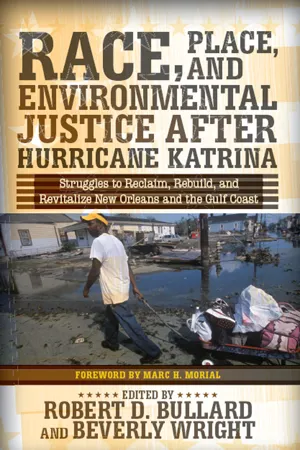
eBook - ePub
Race, Place, and Environmental Justice After Hurricane Katrina
Struggles to Reclaim, Rebuild, and Revitalize New Orleans and the Gulf Coast
- 312 pages
- English
- ePUB (mobile friendly)
- Available on iOS & Android
eBook - ePub
Race, Place, and Environmental Justice After Hurricane Katrina
Struggles to Reclaim, Rebuild, and Revitalize New Orleans and the Gulf Coast
About this book
Information
PART I

CHALLENGES OF RACIALIZED PLACE
CHAPTER 1

RACE, PLACE, AND THEScientists Scrutinize ToxicScientists Scrutinize Toxic ENVIRONMENT IN POST-KATRINA NEW ORLEANS
The year 2005 saw the worst Atlantic hurricane season since record keeping began in 1851 (Cuevas 2005). An average season produces ten named storms, of which about six become hurricanes and two or three become major hurricanes. But 2005 saw the most named storms ever, 27, topping the previous record of 21 in 1933—and 13 hurricanes—breaking the old record of 12 in 1969 (Tanneeru 2005). And on August 29, 2005, of course, Hurricane Katrina laid waste to New Orleans. Katrina’s death toll of 1,836 and counting made it the third most deadly hurricane in U.S. history, after the 1928 Okeechobee hurricane in Florida, which killed 2,500, and the 1900 Galveston hurricane, which killed 8,000 (Ho 2005, A1). The disaster in New Orleans after Katrina was unnatural and man-made. Flooding in the New Orleans metropolitan area largely resulted from breached levees and flood walls (Gabe, Falk, McCarthy, and Mason 2005). A May 2006 report from the Russell Sage Foundation, In the Wake of the Storm: Environment, Disaster, and Race After Katrina, found these same groups often experience a “second disaster” after the initial storm (Pastor et al. 2006).
Hurricane Katrina demonstrated that negative effects of climate change fall heaviest on the poor and people of color (Brinkley 2006; Dyson 2006; Horn 2006; Pastor et al. 2006). Eighty percent of New Orleans was flooded. Low-income and people-of-color neighborhoods were hardest hit. Pre-storm vulnerabilities limit participation of thousands of Gulf Coast low-income communities of color in the after-storm reconstruction, rebuilding, and recovery. In these communities, days of hurt and loss are likely to become years of grief, dislocation, and displacement.
Hurricane Katrina left debris across a 90,000-square-mile disaster area in Louisiana, Mississippi, and Alabama, compared to a 16-acre tract in New York on September 11, 2001 (Luther 2006). According to the Congressional Research Service, debris from Katrina could well top 100 million cubic yards, compared to the 8.8 million cubic yards of disaster debris generated after the 9/11 terrorist attacks on New York City.
New Orleans, like most major urban centers, was in peril before Katrina flood waters devastated the city (Pastor, Bullard, Boyce, Fothergill, Morello-Frosch, and Wright 2006). Katrina was complete in its devastation of homes, neighborhoods, institutions, and communities. The city’s coastal wetlands, which normally serve as a natural buffer against storm surge, had been destroyed by offshore drilling, Mississippi River levees, canals for navigation, pipelines, highway projects, agricultural and urban development.
Over the past century, more than 2,000 of the original 7,000 square miles of coastal marsh and swamp forests that formed the coastal delta of the Mississippi River have vanished. An average of 34 square miles of south Louisiana land, mostly marsh, has disappeared each year for the past five decades. More than 80 percent of the nation’s coastal wetland loss in this time occurred in Louisiana. From 1932 to 2000, the state lost 1,900 square miles of land to the Gulf of Mexico (Tibbetts 2006). Hurricane Katrina pushed New Orleans closer to the coast because of extensive erosion at the coastal edge. This is a national problem. A range of groups, including researchers, policy makers, and environmentalists, for decades have called for restoration of wetlands and barrier islands to help protect New Orleans the next time a hurricane strikes.
BLACK NEW ORLEANS BEFORE HURRICANE KATRINA
The history of New Orleans is intrinsically tied to the Vieux Carré, the French Quarter. In 1718, Jean-Baptiste Le Moyne de Bienville, a French Canadian and governor of the state of Louisiana, and a small group of men, left Mobile, Alabama, to establish a city on the banks of the Mississippi (Regional Planning Commission of Orleans, Jefferson, and St. Bernard Parishes 1969, 13; Baumbach and Borah 1981, 5). Located 90 miles from the Gulf of Mexico, it was named in honor of the Duke of Orleans. La Nouvelle Orléans was initially established as a military outpost, a trading post, and an administrative center for French holdings in Louisiana.
As a result of the official launching of the American slave trade in 1619, blacks began to appear in large numbers in New Orleans. The 1726 census recorded only 300 slaves living in the city, but by 1732, there were nearly a thousand (Wright 1991). New Orleans was unique not only because of its European inhabitants, uncommon in most southern cities, but also because of its significant number of “free colored people.” The first free blacks were recorded living in New Orleans in the 1720s; and by 1803, there were 1,335.
After the Civil War, New Orleans’ black population swelled, with many ex-slaves unable to find work or housing. Consequently, the poorest blacks lived where they could. They lived along the battures, or backswamps. Because New Orleans was built facing the Mississippi River, its shape followed the great crescent bend of the river, hence its nickname, the Crescent City. The batture was “the area on the riverside of the artificial levee without flood protection and without private ownership.” The poorest blacks built shacks in the batture away from the dock area. These houses were, however, temporary because the river would periodically overflow and wash away the shacks.
Because New Orleans is a seaport city at the mouth of the Mississippi that largely is below sea level, with flooding its main problem, it is not surprising that whites occupied the highest and best land, protected by natural levees. Poor blacks lived in the backswamps on the inland margin of the natural levee, where drainage was bad, foundation material precarious, streets atrociously unmaintained, mosquitoes endemic, and flooding a recurrent hazard. It is along this margin that a continuous belt of black population developed. Free blacks in New Orleans, many of whom were economically well off, originally lived and owned property in the French Quarter. After the Civil War and the onset of Jim Crow laws, however, they were pushed out of that section.
Many of the blacks moved their families to the Treme, or Sixth Ward, an area adjacent to the French Quarter. As the Sixth Ward became crowded, many moved to the old Seventh Ward, next to the Sixth Ward, making for a natural extension of the black community. These early black residential patterns developed over the years into long-standing, traditionally black neighborhoods, although early New Orleans’ residential patterns were peculiarly integrated.
Several inventions influenced the racial geography of New Orleans in the twentieth century. These included the invention of a screw pump and the expansion of the city’s public transportation system through use of the streetcar. The Wood Screw Pump is a drainage pump designed by A. Baldwin Wood in 1913. In 1915 the first four of these pumps were installed in New Orleans to help alleviate drainage problems in the city. Thanks to the pumps, the city was able to eliminate some of its flooding problems, allowing residents to settle in areas previously flooded. World War I brought with it a virtual halt in the construction of housing. Until the war, black residents of New Orleans had lived in housing comparable to their white working-class counterparts, but they were now relegated to the less desirable homes in the back-swamp area. There was also a large in-migration of rural blacks and whites, attracted by defense jobs in the city.
It became clear in the early 1920s that additional housing units were needed in the city, but there were many early barriers to their construction. There was an apparent drive to improve housing conditions when the 1920 census showed that New Orleans had dropped from twelfth to sixteenth place in population. The loss of population was blamed on the local authorities’ inability to solve the housing problems of the city, resulting in many of the townspeople moving out beyond the city’s boundaries.
The expansion of the city’s streetcar system also affected its racial geography. As public transportation expanded, old black neighborhoods established in the nineteenth-century backswamp areas expanded into the newly drained margins of that area. The expanded transportation system made it possible for blacks to live in areas away from their jobs. The Wood Screw Pump made it possible for whites to move to the suburbs and for blacks, with the aid of the expanded streetcar system, to move closer into the city. The black and white populations, it seems, were moving in opposite directions.
For three decades, beginning in 1978, with the election of Ernest “Dutch” Morial, New Orleans has had an uninterrupted succession of black mayors. In 2002, Orleans Parish (a parish is comparable to a county) had the highest percentage of black residents of any older county in the United States. Roughly 68 percent of New Orleans–area residents were black. “White flight” from New Orleans to the suburbs and continuing racial segregation, poverty, unemployment, crime, and low levels of educational achievements stand in marked contrast to the city’s growing black middle class, which has elected to settle in all-black affluent areas to the east of New Orleans, an area known as New Orleans East (Wright 1997).
New Orleans, like most major urban centers, was a city in peril long before Hurricane Katrina’s floodwaters devastated the city (Pastor et al. 2006; Dyson 2006). New Orleans (Orleans Parish) had a population of 484,674 in 2000. Of this total, 325,947 (68 percent) were African Americans, 135,956 (28 percent) were non-Hispanic whites, and 22,871 (4 percent) were of other ethnic groups. Like many great cities, New Orleans also had its share of problems. The economic structure of the city made it difficult to provide jobs with wages high enough to support a family. New Orleans’ economy was built around low-wage service jobs in the tourism sector.
In the 1970s, New Orleans East was the fastest-growing section of the city. Spurred by the prosperity of the oil industry, construction in the east was at an all-time high. Newly constructed moderate-to-expensive homes and comparable luxury apartments dotted the landscape of New Orleans’ newest residential area. Between 1979 and 1980, the oil boom turned to bust, and the city fell into decline. Banks that held the mortgages on large luxury apartment complexes built by contractors who overestimated the housing needs of the city and the ability of the population to pay were losing money. At the same time, the city was facing a housing shortage. The inner-city housing stock was increasingly dilapidated. Public housing was in ruin and in short supply. The city was in deep trouble, and the City Council was desperate for answers.
Population patterns in the 1980s changed the race and class composition of New Orleans East. White residents very quickly began to migrate to St. Tammany Parish, a bedroom community across Lake Pontchartrain. Middle-class African Americans began buying more homes in the eastern suburb, and more and more luxury apartments were becoming filled with poorer African-American New Orleanians on rent subsidies. Interstate 10, designated in 1955 as part of the Interstate Highway System, made it possible for middle-class black New Orleanians to move to the eastern suburbs and for white New Orleanians to move to St. Tammany Parish and drive into the central business district every day for work, taking the city’s tax dollars with them. The result of this new migration pattern devastated the city’s economy. Suburban New Orleans East, just like its inner city, became increasingly black and with pockets of poverty.
AGRICULTURE STREET LANDFILL COMMUNITY—A BLACK LOVE CANAL
Dozens of toxic “time bombs” along Louisiana’s Mississippi River Industrial Corridor, dubbed Cancer Alley, the 85-mile stretch from Baton Rouge to New Orleans, made the region a major environmental justice battleground in the 1990s and early 2000s. For decades, black communities there have been fighting against environmental racism and demanding relocation from polluting facilities (Bullard 2005).
Two mostly black New Orleans subdivisions, Gordon Plaza and Press Park, have special significance to environmental justice and emergency response. Both subdivisions were built on a portion of land that had been a municipal landfill for decades. The Agriculture Street Landfill, covering approximately 190 acres in the Ninth Ward, was used as a city dump as early as 1910. After 1950, the landfill was mostly used to discard large solid objects, including trees and lumber. The landfill was a major source for dumping debris from the very destructive Hurricane Betsy that struck New Orleans in 1965. It is important to note that the landfill was classified as a solid waste site and not a hazardous waste site.
In 1969, the federal government created a home ownership program to encourage lower-income families to purchase their first home. Press Park was the first subsidized housing project on this program in New Orleans. The federal program allowed tenants to apply 30 percent of their monthly rental payments toward the purchase of a family home. In 1987, some 17 years later, the first sale was completed. In 1977, construction began on a second subdivision, Gordon Plaza. This development was planned, controlled, and constructed by the U.S. Department of Housing and Urban Development (HUD) and the Housing Authority of New Orleans (HANO). Gordon Plaza consists of 67 single-family homes.
In 1983, the Orleans Parish School Board purchased part of the Agriculture Street Landfill site for a school. That this site had previously been used as a municipal dump prompted concerns about its suitability for a school. The board contracted engineering firms to survey the site and assess it for contamination of hazardous materials. Heavy metals and organics were detected.
In May 1986, the U.S. Environmental Protection Agency (EPA) performed a site inspection (SI) in the Agriculture Street Landfill community. Although lead, zinc, mercury, cadmium, and arsenic were found, based on the Hazard Ranking System (HRS) model used at that time, the score of 3 was not high enough to place the site on the EPA’s National Priorities List (NPL) of hazardous substances, pollutants, and contaminants. Despite warnings, Moton Elementary School, an $8 million state-of-the-art public school, opened with 421 students in 1989 (Lyttle 2000).
On December 14, 1990, the EPA published a revised HRS model in response to the Superfund Amendment and Reauthorization Act (SARA) of 1986. Upon the request of community leaders, in September 1993, an Expanded Site Inspection (ESI) was conducted. On December 16, 1994, the Agriculture Street Landfill community was placed on the NPL with a new score of 50.
The Agriculture Street Landfill community is home to approximately 900 African-American residents. The average family income is $25,000, and the educational level is high school graduate and above. The community pushed for a buy-out of their property and to be relocated. However, this was not the resolution of choice by EPA. A clean-up was ordered at a cost of $20 million, even though the community buyout would have cost only $14 million. The actual clean-up began in 1998 and was completed in 2001 (Lyttle 2000).
Disagreeing with the EPA’s clean-up plans, the Concerned Citizens of Agriculture Street Landfill filed a class-action lawsuit against the city of New Orleans for damages and cost of relocation. The case was still pending when Hurricane Katrina struck. It is ironic that the environmental damage wrought by Katrina may force both the clean-up and the relocation of the Agriculture Street Landfill community from the dumpsite, but then again it may not, given t...
Table of contents
- Cover
- Half Title
- Title Page
- Copyright Page
- Table of Contents
- Tables and Figures
- Acronyms and Abbreviations
- Acknowledgments
- Foreword
- Preface
- Introduction
- PART I CHALLENGES OF RACIALIZED PLACE
- PART II HEALTH AND ENVIRONMENT POST-KATRINA
- PART III EQUITABLE REBUILDING AND RECOVERY
- PART IV POLICY CHOICES FOR SOCIAL CHANGE
- Afterword: Looking Back to Move Forward
- About the Authors
- Index
Trusted by 375,005 students
Access to over 1.5 million titles for a fair monthly price.
Study more efficiently using our study tools.
Frequently asked questions
Yes, you can cancel anytime from the Subscription tab in your account settings on the Perlego website. Your subscription will stay active until the end of your current billing period. Learn how to cancel your subscription
No, books cannot be downloaded as external files, such as PDFs, for use outside of Perlego. However, you can download books within the Perlego app for offline reading on mobile or tablet. Learn how to download books offline
Perlego offers two plans: Essential and Complete
- Essential is ideal for learners and professionals who enjoy exploring a wide range of subjects. Access the Essential Library with 800,000+ trusted titles and best-sellers across business, personal growth, and the humanities. Includes unlimited reading time and Standard Read Aloud voice.
- Complete: Perfect for advanced learners and researchers needing full, unrestricted access. Unlock 1.5M+ books across hundreds of subjects, including academic and specialized titles. The Complete Plan also includes advanced features like Premium Read Aloud and Research Assistant.
We are an online textbook subscription service, where you can get access to an entire online library for less than the price of a single book per month. With over 1.5 million books across 990+ topics, we’ve got you covered! Learn about our mission
Look out for the read-aloud symbol on your next book to see if you can listen to it. The read-aloud tool reads text aloud for you, highlighting the text as it is being read. You can pause it, speed it up and slow it down. Learn more about Read Aloud
Yes! You can use the Perlego app on both iOS and Android devices to read anytime, anywhere — even offline. Perfect for commutes or when you’re on the go.
Please note we cannot support devices running on iOS 13 and Android 7 or earlier. Learn more about using the app
Please note we cannot support devices running on iOS 13 and Android 7 or earlier. Learn more about using the app
Yes, you can access Race, Place, and Environmental Justice After Hurricane Katrina by Robert D. Bullard,Beverly Wright in PDF and/or ePUB format, as well as other popular books in Social Sciences & Global Development Studies. We have over 1.5 million books available in our catalogue for you to explore.